

Calling all engineers and tank builders

Nate Chalk

10K Club member
View Badges
Joined
Nov 15, 2018
Messages
10,548
Reaction score
30,479
Location
no
Rating - 0%
0   0   0
Looking to upgrade my current system which I built myself out of 1/2in glass and silicone the system has been running for roughly 4-5 years.
PXL_20260226_001802230.jpg


Here's the general direction of dimensions I'm looking for. The catch I can't have someone build it because it won't fit through doorframes to the basement. Soooo we build. Looking for insight on glass vs acrylic. Thickness recommendations.

I've built a sump from acrylic as well so I can do it, just need some other brain power.
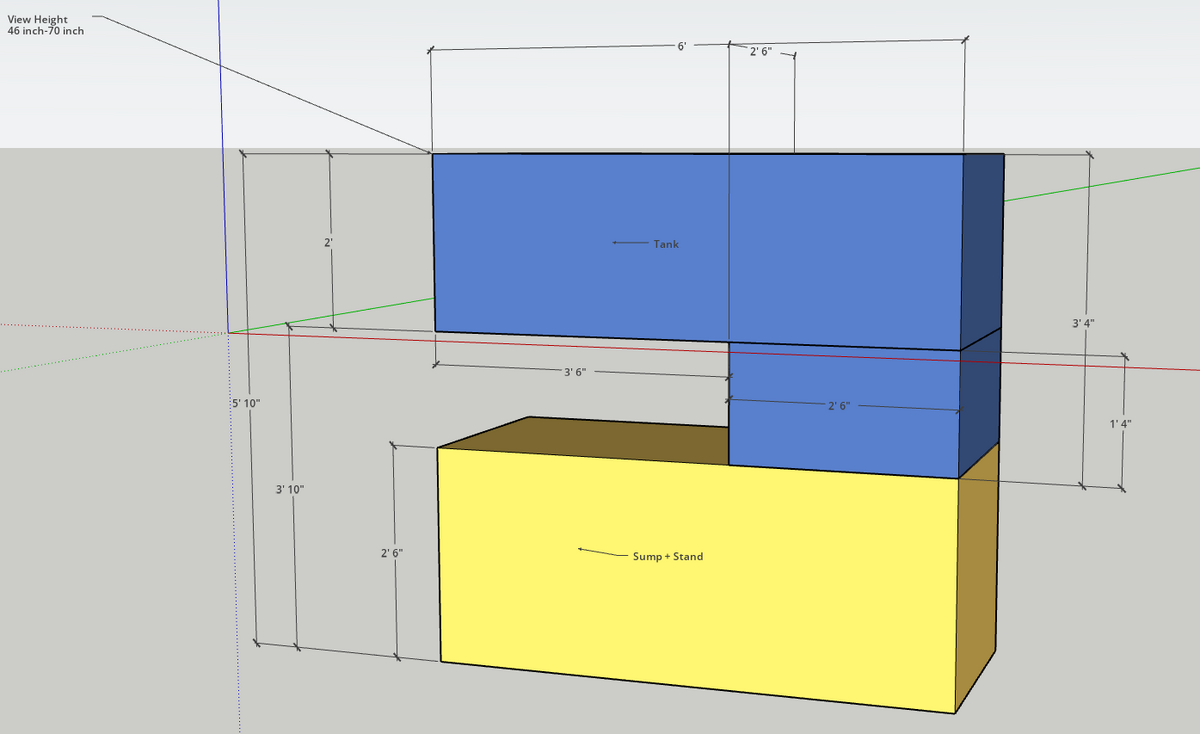
image-18.png


Questions and ideas are definitely welcome!

 

lapin

10K Club member
View Badges
Joined
Dec 16, 2017
Messages
11,672
Reaction score
18,286
Location
Austin
Rating - 0%
0   0   0
Ideas
 
OP
OP
Nate Chalk

Nate Chalk

10K Club member
View Badges
Joined
Nov 15, 2018
Messages
10,548
Reaction score
30,479
Location
no
Rating - 0%
0   0   0
Ideas
Thanks

:)
 

Slocke

I’m pedantic, ignore me
View Badges
Joined
Feb 3, 2022
Messages
13,678
Reaction score
53,520
Location
Atlanta
Rating - 0%
0   0   0
1774738592691.png

I am not a structural engineer nor have I built a tank. Just re-sealed, I am technically an engineer though...

Actual question, are you making a tank with uneven dimensions? As in, is that blue box below the main tank meant to be full of water?
 

UncommonSense

2500 Club Member
View Badges
Joined
May 4, 2025
Messages
4,263
Reaction score
4,991
Location
Monterey Bay area, California
Rating - 0%
0   0   0
Looking for insight on glass vs acrylic. Thickness recommendations.
I’m more of a hobbyist glass fabricator with only a handful of smaller scratch-built tanks under my belt (aside from tank/sump modification work), but I’ll give it the ol’ college try!

For this one? Probably glass… the only commercially manufactured drop off tank I know of anywhere near this size is glass!


This said, your current dimensions might be a bit optimistic, unless you’re prepared to get into some seriously thick (and heavy!) materials!

Here’s a preliminary calculation for glass thickness, assuming it’s just a 30”x30”x40” rimless glass box: no plastic frames, eurobracing, center bracing, stacked bottom glass, etc…

IMG_0909.png


So, you could theoretically get away with 16mm glass for the vertical 30”x40” end pane, especially if eurobrace and bottom seam glass stacking are used…

The bottom 30”x30” pane is the challenging one… ~ 3.25ft of potential water above it… ~.454PSI per-vertical foot of water column… that sets the bottom 30”2 pane at roughly 1.475PSI of force against it… 28.75”x28.75” (accounting for 5/8” vertical pane thickness X2) = 826.5in2…. Times that by 1.475, and you land at ~1,219LBS of total hydrostatic force pressing down on that deep bottom pane when the tank is full…


All this said, I think the best place to start would be with your desired design choices!

— monolithic vertical panes? Or stepped in thickness and seamed to save some cash and tank weight for the shallower segment?

— eurobrace? Rimmed? Rimless?

— open to dimensional adjustments?

— do you have access to tempered glass?

— how will you set up your overflow and return/any other plumbing? (IE, internal/external/island overflow, and possible closed loop plumbing?)
 
OP
OP
Nate Chalk

Nate Chalk

10K Club member
View Badges
Joined
Nov 15, 2018
Messages
10,548
Reaction score
30,479
Location
no
Rating - 0%
0   0   0
I’m more of a hobbyist glass fabricator with only a handful of smaller scratch-built tanks under my belt (aside from tank/sump modification work), but I’ll give it the ol’ college try!

For this one? Probably glass… the only commercially manufactured drop off tank I know of anywhere near this size is glass!


This said, your current dimensions might be a bit optimistic, unless you’re prepared to get into some seriously thick (and heavy!) materials!

Here’s a preliminary calculation for glass thickness, assuming it’s just a 30”x30”x40” rimless glass box: no plastic frames, eurobracing, center bracing, stacked bottom glass, etc…

IMG_0909.png


So, you could theoretically get away with 16mm glass for the vertical 30”x40” end pane, especially if eurobrace and bottom seam glass stacking are used…

The bottom 30”x30” pane is the challenging one… ~ 3.25ft of potential water above it… ~.454PSI per-vertical foot of water column… that sets the bottom 30”2 pane at roughly 1.475PSI of force against it… 28.75”x28.75” (accounting for 5/8” vertical pane thickness X2) = 826.5in2…. Times that by 1.475, and you land at ~1,219LBS of total hydrostatic force pressing down on that deep bottom pane when the tank is full…


All this said, I think the best place to start would be with your desired design choices!

— monolithic vertical panes? Or stepped in thickness and seamed to save some cash and tank weight for the shallower segment?

— eurobrace? Rimmed? Rimless?

— open to dimensional adjustments?

— do you have access to tempered glass?

— how will you set up your overflow and return/any other plumbing? (IE, internal/external/island overflow, and possible closed loop plumbing?)

This is so helpful!! Thanks for replying. Definitely crazy and willing to try anything. Built my first build on a whim and it worked out. Always over plan and overbuild before doing.

I've not done stepped or seamed panels vision was for a single panel .

Rimless would be the goal so I could re use my current lid but that may not be possible.

Could probably get tempered glass, there's many local shops

I've considered either reusing my external overflow or building one into the tank on the end.
 

UncommonSense

2500 Club Member
View Badges
Joined
May 4, 2025
Messages
4,263
Reaction score
4,991
Location
Monterey Bay area, California
Rating - 0%
0   0   0
Rimless would be the goal so I could re use my current lid but that may not be possible.
Hmm… no bottom rim mean best practice is putting the bottom pane inside the vertical panes… this means bottom pane thickness is the primary dictator of bottom seam thickness! (Basically, that ~28.5-28.75in2 bottom pane for the deep section will be the single thickest piece of glass… probably at least 1”-1.25” thick, possibly with 3/8-1/2” thick glass stacked on top of the bottom seams…)

let’s now calculate full tank span vs. just the deep section (at 2ft tall, not 3.33ft):

IMG_0913.png


The number we’re interested in here is side glass thickness: ~12.8mm minimum at 2ft tall!

The lower section calls for ~5/8”(16mm) minimum side glass… so, you can use 16mm minimum thickness for all your vertical panes! — adding a eurobrace would absolutely help from a structural perspective, too… as would 2x glass top center braces stacked under the euro (to increase total in2 silicone bonding area)!

The bottom pane in the upper section could probably be 16mm tempered, or just step up to 19mm for that!

As far as overflows go, you could do a coast to coast external peninsula overflow, a bit like the above Fiji drop off tank… or, you could do an internal overflow box and plan that into your shallow segment’s bottom pane fabrication plan (bulkhead holes)!
 
OP
OP
Nate Chalk

Nate Chalk

10K Club member
View Badges
Joined
Nov 15, 2018
Messages
10,548
Reaction score
30,479
Location
no
Rating - 0%
0   0   0
Hmm… no bottom rim mean best practice is putting the bottom pane inside the vertical panes… this means bottom pane thickness is the primary dictator of bottom seam thickness! (Basically, that ~28.5-28.75in2 bottom pane for the deep section will be the single thickest piece of glass… probably at least 1”-1.25” thick, possibly with 3/8-1/2” thick glass stacked on top of the bottom seams…)

let’s now calculate full tank span vs. just the deep section (at 2ft tall, not 3.33ft):

IMG_0913.png


The number we’re interested in here is side glass thickness: ~12.8mm minimum at 2ft tall!

The lower section calls for ~5/8”(16mm) minimum side glass… so, you can use 16mm minimum thickness for all your vertical panes! — adding a eurobrace would absolutely help from a structural perspective, too… as would 2x glass top center braces stacked under the euro (to increase total in2 silicone bonding area)!

The bottom pane in the upper section could probably be 16mm tempered, or just step up to 19mm for that!

As far as overflows go, you could do a coast to coast external peninsula overflow, a bit like the above Fiji drop off tank… or, you could do an internal overflow box and plan that into your shallow segment’s bottom pane fabrication plan (bulkhead holes)!
I think I'm with you on construction....

All vertical 16mm
Upper bottom 19mm
Bottom deep is 1.25 inches and another piece on top of it inside that's 0.5 inches

Rimless

Could do a 1-2 inch brace inside the bottom of upper for additional safety factor

Glass: annealed

I'll likely use the external overflow and a single return in the shallow end. Similar to what I have now.
 

Michael Hughes

Active Member
View Badges
Joined
Oct 27, 2024
Messages
240
Reaction score
271
Location
Florida
Rating - 0%
0   0   0
If you're still interested in the dropoff look, I have a suggestion that may be easier to build. This is not my idea - it's actually something I saw on a YouTube video tour of the Panta Rhei aquarium store in Germany.

Instead of making the dropoff by building the tank like an L-shaped cube, the store owner used an ordinary rectangular tank. He built an internal perforated box on the right side of the tank (I don't recall the exact material, but it was probably egg crate light diffuser or something similar). The vertical panel was the reef dropoff and the horizontal panel of the box served as the base for the lagoon zone on top with sand and live rock. He left a strip at the far right where it was just the perforated material. With access ports from one panel, he had two sets of pumps hidden under this box. Two pumps would push water right to left, out through the wall into the tank, and then up and over the lagoon. Six hours later, those pumps would shut off and the other two pumps would push water left to right, drawing water in through the wall and pushing it back out that narrow strip on the right, up and over the lagoon in the opposite direction, and back down to the deeper part of the tank.

So not only did he achieve the dropoff look, but he also plumbed it in such a way that he changed the prevailing "tide" direction across the reef every six hours. If I were ever to do a peninsula tank, I think I would probably aim for something similar.
 

UncommonSense

2500 Club Member
View Badges
Joined
May 4, 2025
Messages
4,263
Reaction score
4,991
Location
Monterey Bay area, California
Rating - 0%
0   0   0
Bottom deep is 1.25 inches and another piece on top of it inside that's 0.5 inches
To clarify, the .5” thick glass would be just thin bars, probably no more than 2” wide, laid log cabin style; no mitered joints!

— standard single-part silicone cures via exposure to atmospheric humidity, so very thick seams like your bottom pane seams, in addition to wide glass laminations like the bottom stacked glass will cure incredibly slowly, likely taking 20-30 days minimum to fully solidify in the centers of the seams/laminations!

I'll likely use the external overflow and a single return in the shallow end. Similar to what I have now.
This tank promises to be roughly 250g at operating volume, so just plumb accordingly if using a single return is a necessary design requirement!
 
OP
OP
Nate Chalk

Nate Chalk

10K Club member
View Badges
Joined
Nov 15, 2018
Messages
10,548
Reaction score
30,479
Location
no
Rating - 0%
0   0   0
To clarify, the .5” thick glass would be just thin bars, probably no more than 2” wide, laid log cabin style; no mitered joints!

— standard single-part silicone cures via exposure to atmospheric humidity, so very thick seams like your bottom pane seams, in addition to wide glass laminations like the bottom stacked glass will cure incredibly slowly, likely taking 20-30 days minimum to fully solidify in the centers of the seams/laminations!


This tank promises to be roughly 250g at operating volume, so just plumb accordingly if using a single return is a necessary design requirement!
Right I'm currently using a varios 8 on my 180

I'm so visual log cabin I would need a drawing to know what you mean.
 

UncommonSense

2500 Club Member
View Badges
Joined
May 4, 2025
Messages
4,263
Reaction score
4,991
Location
Monterey Bay area, California
Rating - 0%
0   0   0
Right I'm currently using a varios 8 on my 180

I'm so visual log cabin I would need a drawing to know what you mean.
Make your glass reinforcement join in each corner like so:

image.jpg


As opposed to cutting the end of each rod at a 45 degree angle, so they seam in a direct line with the tank’s vertical seam!

Basically, you want the structural load path to change directions after the primary tank’s seams, preventing both tank seam and seam between euro or bottom stacked glass segments from unzipping all at once!
 

UncommonSense

2500 Club Member
View Badges
Joined
May 4, 2025
Messages
4,263
Reaction score
4,991
Location
Monterey Bay area, California
Rating - 0%
0   0   0
Right I'm currently using a varios 8 on my 180
So, this should be good for around 1,900gph at 4.5ft head height… — if you don’t already have plans as such, it could be worth bumping return plumbing up to 1.25” diameter pipe, or 1.5” diameter hose to achieve the flow rates this pump is capable of!
 

Slocke

I’m pedantic, ignore me
View Badges
Joined
Feb 3, 2022
Messages
13,678
Reaction score
53,520
Location
Atlanta
Rating - 0%
0   0   0
A unique issue with this design worries me. That is torsional force along the z axis (green). Silicon is weakest to torsional force and can tear so make sure you have enough support on the two points I circled to prevent any torsion. Or in other words, don’t do a Red Sea and have a floating front or back pane.
IMG_7875.jpeg
 
OP
OP
Nate Chalk

Nate Chalk

10K Club member
View Badges
Joined
Nov 15, 2018
Messages
10,548
Reaction score
30,479
Location
no
Rating - 0%
0   0   0
You would be better off letting the dropoff go to almost floor level and on a frame than hanging it over a sump. Polo Reef has a drop off similar to what you are thinking but without the sump directly underneath.
That's the exact tank I want, but for a 6 ft version vs his 8


reason for not going to the floor for me is re using my existing sump.
 
OP
OP
Nate Chalk

Nate Chalk

10K Club member
View Badges
Joined
Nov 15, 2018
Messages
10,548
Reaction score
30,479
Location
no
Rating - 0%
0   0   0
A unique issue with this design worries me. That is torsional force along the z axis (green). Silicon is weakest to torsional force and can tear so make sure you have enough support on the two points I circled to prevent any torsion. Or in other words, don’t do a Red Sea and have a floating front or back pane.
IMG_7875.jpeg
Yes the overhang would be fully supported with an 80/20 aluminum stand similar to what I have now. 100% contact
 

jsmkmavity

Valuable Member
View Badges
Joined
Apr 21, 2023
Messages
2,477
Reaction score
3,909
Location
Sandpoint
Rating - 0%
0   0   0
I see a total volume of about 280 gallons. Shouldnt that be in your first set of calculations on the build sheet @UncommonSense ?
is the left side of the tank completely unsupported? If so the leverage effect of that cantilever will direct incredible forces on the corner joint of the drop-off.
The front and back panes of the upper tank will need to be thick enough to hold the forces of that cantilever and that left panel underneath the upper tank will need to be very thick since it is carrying essentially the weight of the whole tank plus the shear forces of the cantilever. I am not an engineer and dont know how to calculate the actual forces applied to these areas. I have years of practical structural experience and just pointing out some areas of concern. @BeanAnimal might have knowledge of the correct formulas or know who does.
 

TOP 10 Trending Threads

WHAT AMOUNT OF LIVE ROCK AND SAND SHOULD BE PRIORITIZED FOR OPTIMAL BIODIVERSITY/FILTRATION?

  • 100% live rock + bagged sand

    Votes: 34 28.3%
  • 100% dry rock + 100% live sand

    Votes: 41 34.2%
  • 50/50 live/dry rock, 50/50 live/bagged sand

    Votes: 27 22.5%
  • 75% live rock, 25% live sand

    Votes: 10 8.3%
  • 25% live rock, 75% live sand

    Votes: 8 6.7%
Back
Top






