



Cause for "red coralline" ?

ellisbart

New Member
View Badges
Joined
Feb 14, 2021
Messages
14
Reaction score
33
Location
uk
Rating - 0%
0   0   0
Does anyone have any theories as to what causes the proliferation of "red coralline"? I believe the species isn't actually a part of the coralline family but rather a red thalloid algae from the genus Peyssonnelia sp. or maybe Hildenbrandia rubra.

Some systems appear to have none, whilst others can have varying amounts to blanket coverage, much like I have experienced on some areas of rock.

It is documented that algae can grow on precipitation sites until the precipitated elements are exhausted. Could it be the precipitation of trace metals (Fe, Mn, etc), phosphorous, and or halogens like iodine leading to deposits that algae, including (H. rubra?) take advantage of? @Hans-Werner

Could there be a link with the salt products we use, which contain anti-caking agents, iron (ferrocyanide) and manganese? It is often said that these elements have no biological effect and rapidly precipitate after a water change. However, can those Fe and Mn precipitates not fuel algal recruitment and growth?
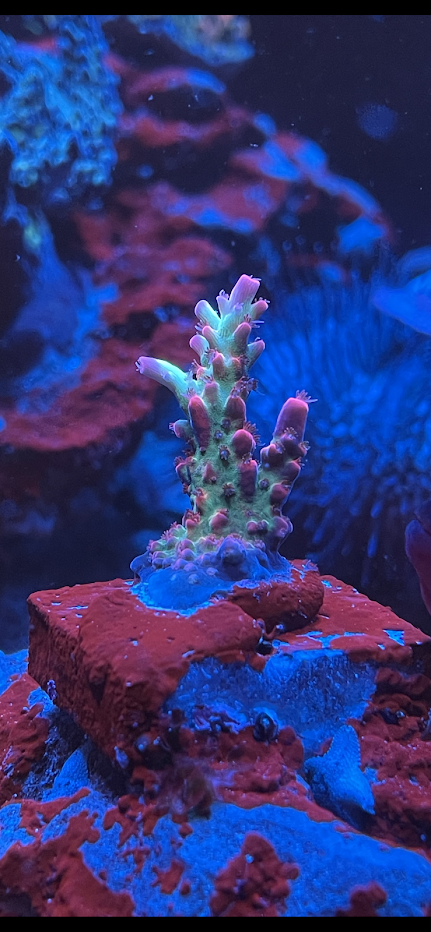
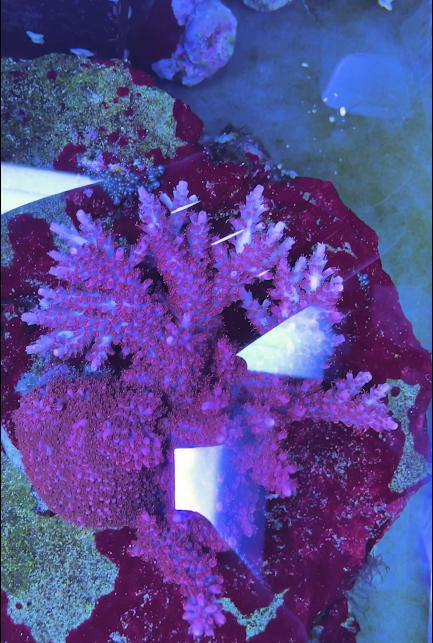
1750513889882.png
1750514348786.png
 

exnisstech

Grumpy old man
View Badges
Joined
Feb 11, 2019
Messages
18,921
Reaction score
30,375
Location
Ashland Ohio
Rating - 0%
0   0   0
Im not much of a science guy so I don't have any theory but I do find it interesting that I have multiple tanks but only have that type in one tank. I only see it in the rocks and have the more typical light purple type on the back glass.

PXL_20250208_220255915~5.jpg


PXL_20240411_000026937.jpg


I have much less now that I added a pincushion urchin.

EDIT. The tank pictured uses the same salt (IO purple) that my other tanks run and gets nothing dosed except AFR so in my case I have no idea why it only appears in ine tank.
The only difference i can think of between my tanks is that this one gets much more intense lighting for the acros. I get about 500 par at the top but nothing close to that in my other tanks.
 
Last edited:

rlman41299

Valuable Member
View Badges
Joined
Mar 11, 2012
Messages
1,171
Reaction score
594
Location
san jose
Rating - 0%
0   0   0
I am having the same issue with this plating red purple coraline algae. It is taking over my tank and suffocating corals even encrusting over and killing them. Any way to control it?
IMG_4941.jpeg
IMG_4941.jpeg
 

Hans-Werner

Valuable Member
View Badges
Joined
Aug 24, 2016
Messages
1,994
Reaction score
3,042
Rating - 0%
0   0   0
It is documented that algae can grow on precipitation sites until the precipitated elements are exhausted. Could it be the precipitation of trace metals (Fe, Mn, etc), phosphorous, and or halogens like iodine leading to deposits that algae, including (H. rubra?) take advantage of? @Hans-Werner
Coralline algae need, like many other marine macro algae, bacterial partners for growth. Bacteria on their side may benefit from phosphate and metals in precipitates and may make the precipitated elements and compounds bioavailable to the coralline algae. I think in cyanobacterial growth a similar mechanism is involved.

I am quite sure calcification of coralline algae, like calcification of corals, needs and consumes some phosphate.
 

exnisstech

Grumpy old man
View Badges
Joined
Feb 11, 2019
Messages
18,921
Reaction score
30,375
Location
Ashland Ohio
Rating - 0%
0   0   0
I am having the same issue with this plating red purple coraline algae. It is taking over my tank and suffocating corals even encrusting over and killing them. Any way to control it?
IMG_4941.jpeg
IMG_4941.jpeg

The type I have does not seem to hinder my coral growth.

Same coral month apart.
PXL_20240604_233913235.jpg


PXL_20250324_023655472.jpg
 

Sophie"s mom

2500 Club Member
View Badges
Joined
Oct 25, 2023
Messages
3,526
Reaction score
4,443
Location
Va.
Rating - 0%
0   0   0
I have a couple miscellaneous pieces of the red in my tank, but mostly the purple. My red, does not really seem to grow much.
 

TOP 10 Trending Threads

WHAT AMOUNT OF LIVE ROCK AND SAND SHOULD BE PRIORITIZED FOR OPTIMAL BIODIVERSITY/FILTRATION?

  • 100% live rock + bagged sand

    Votes: 34 27.0%
  • 100% dry rock + 100% live sand

    Votes: 45 35.7%
  • 50/50 live/dry rock, 50/50 live/bagged sand

    Votes: 27 21.4%
  • 75% live rock, 25% live sand

    Votes: 11 8.7%
  • 25% live rock, 75% live sand

    Votes: 9 7.1%
Back
Top







