Cycling Help

leith.l

New Member
View Badges
Joined
Mar 6, 2025
Messages
19
Reaction score
15
Location
Ohio
Rating - 0%
0   0   0
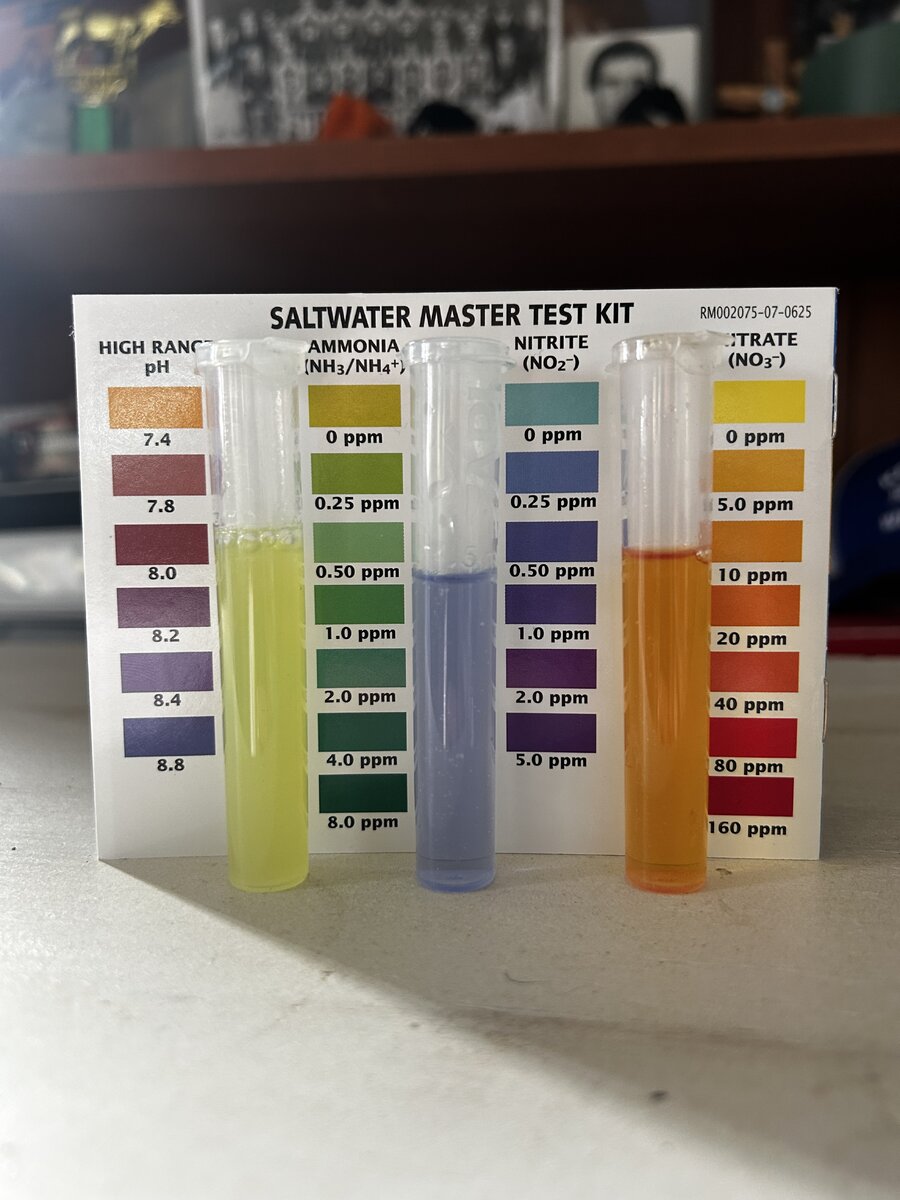
Hello everyone. I have had my deskmate 4.8 up and running for about 3 weeks now. I added bottled bacteria may 21 along with some ammonia. I’m just now struggling to determine where I am in the cycle. Here are the results today.
IMG_6726.jpeg
 
OP
OP
L

leith.l

New Member
View Badges
Joined
Mar 6, 2025
Messages
19
Reaction score
15
Location
Ohio
Rating - 0%
0   0   0
Here were the results later in the day, May 21, after adding bacteria/ammonia.
IMG_6711.jpeg
IMG_6712.jpeg
 

Evil1

Valuable Member
View Badges
Joined
Mar 28, 2023
Messages
2,029
Reaction score
10,730
Location
Staten Island
Rating - 0%
0   0   0
It looks like you are
To me this tank is cycled
100% agree. I would test ph, and alkalinity with a good test kit prior to adding any livestock. Calcium and magnesium when you plan to add corals. Start slowly with livestock. Good luck!
 

BeanAnimal

7500 Club Member
View Badges
Joined
Jul 16, 2009
Messages
9,265
Reaction score
15,537
Rating - 0%
0   0   0
Thought process with what? Testing ph and alk? Before adding fish?
Yes

Is it necessary to do a water change before adding any fish?
No, it is advice passed on for the sake of passing it on. There is no compelling reason to do a water change in a new tank, just to add fish. I personally wouldn't waste the salt or time even on a nano.
 

Evil1

Valuable Member
View Badges
Joined
Mar 28, 2023
Messages
2,029
Reaction score
10,730
Location
Staten Island
Rating - 0%
0   0   0
Yes


No, it is advice passed on for the sake of passing it on. There is no compelling reason to do a water change in a new tank, just to add fish. I personally wouldn't waste the salt or time even on a nano.
To answer your question kh or alkalinity acts as a buffer to stabilize ph.
 

BeanAnimal

7500 Club Member
View Badges
Joined
Jul 16, 2009
Messages
9,265
Reaction score
15,537
Rating - 0%
0   0   0
To answer your question kh or alkalinity acts as a buffer to stabilize ph.
That was not my question.

I was trying to understand your reasoning before explaining why I don’t think it is important for a new aquarist to test pH, or worry about alkalinity before adding fish.

My take:
Barring edge cases where something has gone catastrophically wrong, marine aquarium pH is usually in an acceptable range for general stocking of fish.

We test and manage alkalinity almost exclusively for the sake of keeping calcifying corals. The parameter is not relevant to stocking a new tank with its first fish.

With that in mind, I don't see the need for him (or any new aquarist) to test for those parameters before adding fish. Doing so adds cost and confusion at the start of a journey.

But I asked, because I was hoping to get your thoughts instead of just contradicting your advice.
 
Last edited:

Evil1

Valuable Member
View Badges
Joined
Mar 28, 2023
Messages
2,029
Reaction score
10,730
Location
Staten Island
Rating - 0%
0   0   0
So my point is how do you know where your ph and alk is especially in a fresh tank if you don’t test? Are you saying not to test ph and alk due to cost and confusion is a legitimate excuse for not testing? What’s the cost? The OP already has API master saltwater test kit. Ph test is in it. 2cents to test (and I’m being liberal) alk test if the OP buys a salifert test kit for KH what another 15 bucks and it will last quite some time and will definitely need if they plan to add corals in the future. In my opinion ph and salinity are key at this point in their journey and to keep ph stable kh is a big factor especially in a new tank. Just my 2 cents (and I’m not being liberal) lol! Aquariums of any kind are not a Ron Popiel “set it and forget it” product it does take some work to keep it healthy and periodic testing is key as far as I am concerned to begin successful.
 
Last edited:

BeanAnimal

7500 Club Member
View Badges
Joined
Jul 16, 2009
Messages
9,265
Reaction score
15,537
Rating - 0%
0   0   0
So my point is how do you know where your ph and alk is especially in a fresh tank if you don’t test?
I am saying there is no compelling reason to know for a newly cycled tank, especially as a prerequisite to adding a fish.

I am saying that a new aquarist adding a fish doesn't yet need to dive into pH testing, let alone Alkalinity and then further being told to adjust them somehow, just to add a fish. The advice, and follow on advice add unnecessary complication.

Outside of some insane circumstance a new aquarium's water is not going to be unsafe for fish, or coral for that matter.

ph stable kh is a big factor especially in a new tank.
Why do you think it is a big factor? It is not for adding a fish and getting started on the reefing journey.

add corals in the future.
That is a great time to take the next step and learn about things like alkalinity, calcium and magnesium testing. I would still argue that most still don't ever need to touch a pH test.
 
Last edited:

BeanAnimal

7500 Club Member
View Badges
Joined
Jul 16, 2009
Messages
9,265
Reaction score
15,537
Rating - 0%
0   0   0
Aquariums of any kind are not a Ron Popiel “set it and forget it” product it does take some work to keep it healthy and periodic testing is key as far as I am concerned to begin successful.
I am going to address this in its own post, as I don't think it is relevant to the discussion of pH or the OPs new tank.

I think I am successful. My tank has been running for over 25 years and for many of those has been as close to "set it and forget it" as it can be.

It went well over 5 years quite literally “set and forget.” No dosing, no water changes, no skimmer, no added salt to make up for creep, basically no food, and certainly not a single test done for anything other than salinity a few times over that period. No cleaning the glass. Just ATO and electricity, and the ATO water was from long-expired membrane, filters, and resin.

A fat and happy tang, a Coral Beauty, and several LPS and soft corals lived over that time and are both still alive, each at least 15, if not closing in on 20 or more years old. Pods, algae, and all kinds of microfauna fed the fish.

That same system, now 6 or so years later, still has not had a water change, and my interaction is, at most, 15-30 minutes a month.

I fill the auto feeder once every month or so.

I clean the skimmer cup once every 3–6 weeks, often just draining it and not cleaning the crud.

I scrape the front glass when I can’t see in after a month or so.

I fill the auto dosing containers once every few months.

Testing? Just the KH Director. I look at that maybe once a month, and if things have drifted, I adjust the dose. Same with salinity. I check once or twice a month at most and adjust the makeup water feed slightly to drift it higher or lower if needed.

pH - The last time I looked at it was maybe 2 years ago when I was out of town and noticed it drastically jumped, enough to show Randy an image because the spike was so large. It was not actionable, just stunning. The probe has not been calibrated in 5 or more years. If the controller didn't have a pH probe, I wouldn't ever test pH.

 

Privateye

Well-Known Member
View Badges
Joined
Jan 17, 2020
Messages
501
Reaction score
454
Rating - 0%
0   0   0
I've used these kits a lot (perhaps thousands of times) and I am comfortable saying you are ALMOST cycled.

For Ammonia, that's a typical zero when using this test kit in salt water.

The nitrite is still elevated. When it's truly cycled it'll look close to the turquoise color when you first add the drops.

You're getting nitrate though, so you've established enough bacteria to convert ammonia to nitrite. You have some bacteria that convert nitrite to nitrate, but their population is still growing to meet the demand. I'd expect you to be cycled in about a week or two.

Here's the thing: nitrite isn't that bad in a saltwater tank. It's way worse in freshwater. Your fish would probably be fine, but you'd want to watch for difficulty breathing. nitrite causes the hemoglobin in their blood to contort, making it unable to carry oxygen. This is known as "brown blood disease".

However, the chloride ion from the salt is preferentially taken-up by the fish's gills, excluding the nitrite from entering the bloodstream. So the typical fix for freshwater fish with nitrite poisoning is actually to add a little salt, or other source of chloride. The amount needed depends on the nitrite concentration, but it's very little. Around 0.1% of the salt we have in our reef tanks.
 

BeanAnimal

7500 Club Member
View Badges
Joined
Jul 16, 2009
Messages
9,265
Reaction score
15,537
Rating - 0%
0   0   0
I've used these kits a lot (perhaps thousands of times) and I am comfortable saying you are ALMOST cycled.
For the OPs purpose the only distinction that matters is that the system is able to process ammonia predictably.

The efficiency of the follow on bacteria that process Nitrite are not a concern. They will catch in time.

The reason that they don't matter is because nitrite and nitrate are not toxic to marine fish at any meaningful level achievable in a normal marine aquarium.

You are correct, In a freshwater system the presence if nitrite is not acceptable.
 

Privateye

Well-Known Member
View Badges
Joined
Jan 17, 2020
Messages
501
Reaction score
454
Rating - 0%
0   0   0
For the OPs purpose the only distinction that matters is that the system is able to process ammonia predictably.

The efficiency of the follow on bacteria that process Nitrite are not a concern. They will catch in time.

The reason that they don't matter is because nitrite and nitrate are not toxic to marine fish at any meaningful level achievable in a normal marine aquarium.

You are correct, In a freshwater system the presence if nitrite is not acceptable.

Yeah, that's exactly what I was saying with the fish - not a real concern. However, I'm not certain about all marine organisms so I didn't want to overreach and say it would be safe for all animals.

While nitrate isn't really toxic, it is an endocrine disruptor. Not really an issue at the levels we maintain in reef tanks, but it can be in FOWLR tanks if they're neglected. It would be tough to attribute any issues we'd see to it since we aren't doing much that could be affected (e.g. breeding).
 

Evil1

Valuable Member
View Badges
Joined
Mar 28, 2023
Messages
2,029
Reaction score
10,730
Location
Staten Island
Rating - 0%
0   0   0

I am going to address this in its own post, as I don't think it is relevant to the discussion of pH or the OPs new tank.

I think I am successful. My tank has been running for over 25 years and for many of those has been as close to "set it and forget it" as it can be.

It went well over 5 years quite literally “set and forget.” No dosing, no water changes, no skimmer, no added salt to make up for creep, basically no food, and certainly not a single test done for anything other than salinity a few times over that period. No cleaning the glass. Just ATO and electricity, and the ATO water was from long-expired membrane, filters, and resin.

A fat and happy tang, a Coral Beauty, and several LPS and soft corals lived over that time and are both still alive, each at least 15, if not closing in on 20 or more years old. Pods, algae, and all kinds of microfauna fed the fish.

That same system, now 6 or so years later, still has not had a water change, and my interaction is, at most, 15-30 minutes a month.

I fill the auto feeder once every month or so.

I clean the skimmer cup once every 3–6 weeks, often just draining it and not cleaning the crud.

I scrape the front glass when I can’t see in after a month or so.

I fill the auto dosing containers once every few months.

Testing? Just the KH Director. I look at that maybe once a month, and if things have drifted, I adjust the dose. Same with salinity. I check once or twice a month at most and adjust the makeup water feed slightly to drift it higher or lower if needed.

pH - The last time I looked at it was maybe 2 years ago when I was out of town and noticed it drastically jumped, enough to show Randy an image because the spike was so large. It was not actionable, just stunning. The probe has not been calibrated in 5 or more years. If the controller didn't have a pH probe, I wouldn't ever test pH.

So 25 years ago when you initially set your tank up you didn’t check your PH? You filled it, put in salt monitored the cycle ( key 3 parameters) and when cycle was complete you added livestock? I’m not asking about after the tank settles in. In many ways we are alike. I have been in this hobby for over 40 years. In that time I have had all types of freshwater and marine systems. Was around when both canister filters and UV sterilizers became publicly available and marine test kits had dry chemical pilllows (as they called them) that you had to clip open with the supplied nail clippers and dump into vial of tank water so I’m no novice to the hobby. That said, in many ways we approach the hobby similarly. I to do limited WC and rarely test unless I notice my livestock is not acting normally or something is off. I dose AFR daily, along with NP bacto balance for nutrient control. I do use a ATO and Auto Doser. My point is I believe to get to the point of set and basically forget you need to start somewhere within the safe zones. Yes ph fluctuations are normal even within an established tank but generally within the safe zones. Th OP’er did not state or show what the current PH was at. My concern was if it was above (highly unlikely) or more important below acceptable ranges. That it. Simple question to the OP’er and in my opinion not out of line. Thanks for a brief description of your journey quite interesting.

 

BeanAnimal

7500 Club Member
View Badges
Joined
Jul 16, 2009
Messages
9,265
Reaction score
15,537
Rating - 0%
0   0   0
Maybe I can hep ease your mind on the subject 😀

It i important to remember that most toxicity numbers express nitrate concentrations as NO3-N, but our test kits read NO3. That means our test kits read 4.43 times higher.

For example, if a specific shrimp has an acute toxicity threshold listed as 113 ppm NO3-N, our test kit reading for that same threshold would be about 500 ppm NO3.

I don’t think you are going to find a reef aquarium or FOWLR at 250 ppm NO3, let alone 500 ppm NO3.
 

TOP 10 Trending Threads

WHAT AMOUNT OF LIVE ROCK AND SAND SHOULD BE PRIORITIZED FOR OPTIMAL BIODIVERSITY/FILTRATION?

  • 100% live rock + bagged sand

    Votes: 34 27.6%
  • 100% dry rock + 100% live sand

    Votes: 43 35.0%
  • 50/50 live/dry rock, 50/50 live/bagged sand

    Votes: 27 22.0%
  • 75% live rock, 25% live sand

    Votes: 11 8.9%
  • 25% live rock, 75% live sand

    Votes: 8 6.5%
Back
Top