


First Time Plumbing Advice

Shrooms

Community Member
View Badges
Joined
Feb 4, 2021
Messages
47
Reaction score
20
Location
California
Rating - 0%
0   0   0
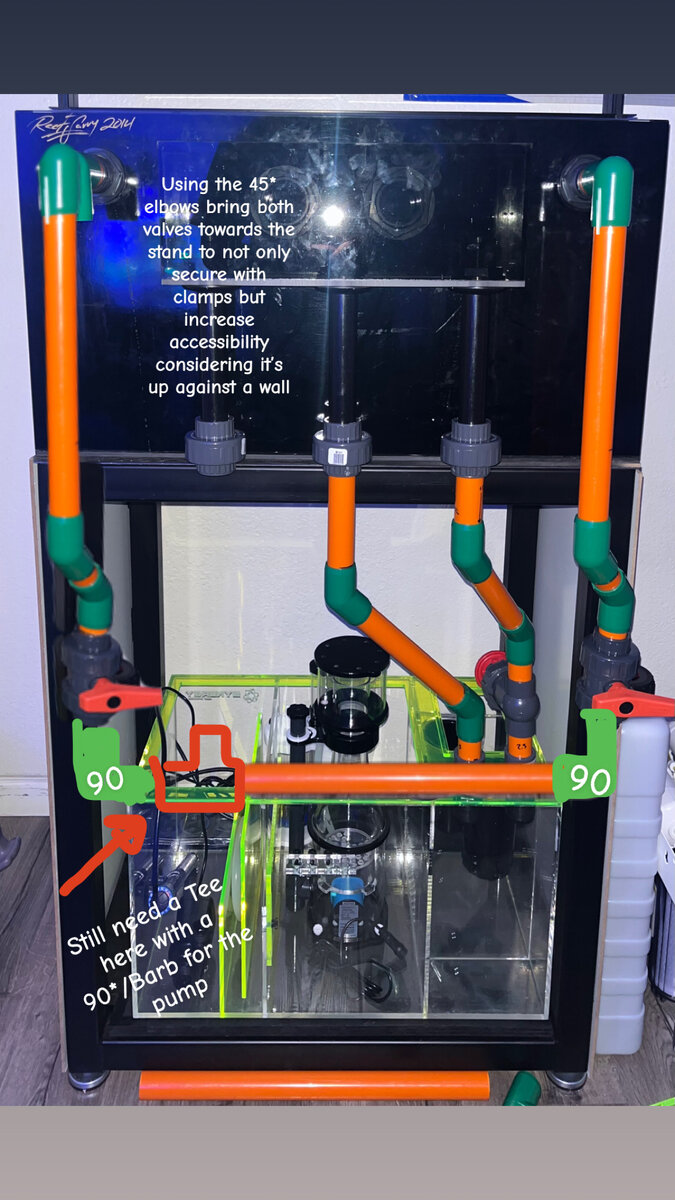
First time plumbing a tank, would like some advice and criticism on my plan. This is a rough mock using extra PVC so it’ll be redone no matter what. My biggest concern as of now is using too many fittings. I have a Sicce 3.0 SDC for my return and it’s looking like it’ll be a bit undersized.

All the PVC/Bulkheads are 1 inch. I have five 90 degree elbows and eight 45 degree elbows. One Tee fitting above the pump.

Clamps will be along the stand just under the unions for the overflow and just above the gate valves on both return drains.

I’ve got two Cepex 1 inch ball valves on the return drains to stop flow if I ever have to remove anything connected to them.

One Spears 1 inch gate valve just above the primary bulkhead in the sump.

I have extra unions I can plumb in, just don’t know where and if even needed.

So any advice and tips will be greatly appreciated, build thread will hopefully be up soon!

IMG_0389.jpeg
 
I have a Sicce 3.0 SDC for my return and it’s looking like it’ll be a bit undersized.
This depends on tank size!

The 3.0 looses about 50% of its flow rate in an unrestricted pipe at 3.2ft of head height… that means you’ll get <=400gph observed at the display…

The next step up is the 6.0, which looks to flow a hair over 1,000gph at 3.2ft head height, which is right on the upper end of what 1” sch.40 PVC will flow via our hobby style pumps! (That is to say, it’s ideal if the tank is over 120-ish gallons!)

I’ve got two Cepex 1 inch ball valves on the return drains to stop flow if I ever have to remove anything connected to them.
These may be somewhat redundant, as the return plumbing will void itself of water back into the sump once the return pump is turned off, assuming the return plumbing/nozzles in-display are set up correctly to break any return plumbing back-flow (siphoning from display to sump) during return pump shutdown!


I have extra unions I can plumb in, just don’t know where and if even needed.
I’d add unions to the return lines at the same height as the drain unions, so the tank can be physically decoupled from the stand/sump if needed!


— the last thing I can think of would be using 1.25” silicone hose vs. 1” for your vibration mitigation ( if you opt for the SDC 6.0), because barbed fittings are more restrictive in inside diameter than equivalent rigid pipe!
 
This depends on tank size!

The 3.0 looses about 50% of its flow rate in an unrestricted pipe at 3.2ft of head height… that means you’ll get <=400gph observed at the display…

The next step up is the 6.0, which looks to flow a hair over 1,000gph at 3.2ft head height, which is right on the upper end of what 1” sch.40 PVC will flow via our hobby style pumps! (That is to say, it’s ideal if the tank is over 120-ish gallons!)


These may be somewhat redundant, as the return plumbing will void itself of water back into the sump once the return pump is turned off, assuming the return plumbing/nozzles in-display are set up correctly to break any return plumbing back-flow (siphoning from display to sump) during return pump shutdown!


I’d add unions to the return lines at the same height as the drain unions, so the tank can be physically decoupled from the stand/sump if needed!


— the last thing I can think of would be using 1.25” silicone hose vs. 1” for your vibration mitigation ( if you opt for the SDC 6.0), because barbed fittings are more restrictive in inside diameter than equivalent rigid pipe!
So my display is 40 gallons and has about about a 20 gallon sump.

Flow in the display isn’t much of an issue since I have two Nero 3’s. It’s more of running the pump at its highest setting to circulate enough water is what I’m worried about.

The two ball valves are dual use I guess not only as a union but to close off water and be able to remove the entire return setup like you mentioned.

I will be utilizing soft plumbing on the return pump for exactly that reason.

Lastly, thank you very much!!!
 
Back again, with another question. Finishing the internal plumbing and wanted to know if this was correct or not. Not fully inserted into bulkheads just a mock.

Far Right - Primary Drain 2.0”
Middle - Secondary Drain 3.5”
Far Left - Emergency Drain 5.0” (maybe 4.5”)

All pipes will be cut down to size as they are far too long atm. This is a reef savvy overflow but identical to the ghost overflow from synergy so I followed their directions on ultra low flow systems under 1000gph apparently I don’t need the u-pipe setup?


IMG_0906.jpeg
IMG_0902.jpeg
IMG_0907.jpeg
 
Also, Plumbing is complete besides overflow!
Will be putting two pipes in the bulkhead drains going to sump, so they’ll be submerged and not splashing.


IMG_0912.jpeg
 
Thumbs up for choosing true union ball valves! You won't regret it. The ability to stop flow and disconnect from either side of the valve can be very useful when you're replacing or upgrading things.
 
IMG_0921.jpeg

Ok I’ve cut the pipes down, anything wrong with this setup? Seems fine to me but I also don’t have water in it lol. Opted to not use u-pipes since my secondary is in the middle. Pipes won’t fit in that spot with the brace.

Primary is 3.5” from top of box
Secondary is 2 1/4” from top of box
Emergency is 1” from top of box
 
IMG_0921.jpeg

Ok I’ve cut the pipes down, anything wrong with this setup? Seems fine to me but I also don’t have water in it lol. Opted to not use u-pipes since my secondary is in the middle. Pipes won’t fit in that spot with the brace.

Primary is 3.5” from top of box
Secondary is 2 1/4” from top of box
Emergency is 1” from top of box
This should work out nicely!

In fact, after running it for a while, you might end up choosing to omit the standpipe on the primary completely, instead using your gate valve to tune final overflow box water height!

(These short external overflows typically leave very little room for error in primary drain siphon tuning, so every inch of height difference between primary and secondary drain in the overflow box does matter!)
 
This should work out nicely!

In fact, after running it for a while, you might end up choosing to omit the standpipe on the primary completely, instead using your gate valve to tune final overflow box water height!

(These short external overflows typically leave very little room for error in primary drain siphon tuning, so every inch of height difference between primary and secondary drain in the overflow box does matter!)
Thank you! The primary stand pipe is slightly less than a half an inch above the bulkhead lip. I trimmed it slightly down. Literally in there just to have a smooth drain instead of the big bulkhead hole.
 
Thank you! The primary stand pipe is slightly less than a half an inch above the bulkhead lip. I trimmed it slightly down. Literally in there just to have a smooth drain instead of the big bulkhead hole.
I normally see these bulkheads installed opposite of yours, though either orientation does work! (Just note that you can flip the primary drain bulkhead 180 degrees to get a lower primary drain intake height if so-desired!)

that said, the primary drain does appear to be at a decent height, holding sufficient water in the overflow box at all times to prevent water entering the box from making a waterfall, thus appreciable noise!
 
I normally see these bulkheads installed opposite of yours, though either orientation does work! (Just note that you can flip the primary drain bulkhead 180 degrees to get a lower primary drain intake height if so-desired!)

that said, the primary drain does appear to be at a decent height, holding sufficient water in the overflow box at all times to prevent water entering the box from making a waterfall, thus appreciable noise!
Oh my dear lord I did install them upside down. I guess if they work that way I’m leaving em.
 
Should I use the gasket on the flat side on the outside of the box because they’re upside down? Right now I have them under the nut on the inside.
 
Oh my dear lord I did install them upside down. I guess if they work that way I’m leaving em.
It honestly really doesn’t matter from a sealing perspective, as long as the rubber gasket is on the flange side of the bulkhead!

— all up to personal preference, or design constraints! (In fact, I’ve built a handful of things where backwards bulkheads were a necessity!)

Should I use the gasket on the flat side on the outside of the box because they’re upside down? Right now I have them under the nut on the inside.
Oh! The gasket ALWAYS goes on the flat flange side, regardless of bulkhead orientation!

If a gasket is on the nut side of a bulkhead, water seeps down the threads between bulkhead body and nut, past the gasket!
 
It honestly really doesn’t matter from a sealing perspective, as long as the rubber gasket is on the flange side of the bulkhead!

— all up to personal preference, or design constraints! (In fact, I’ve built a handful of things where backwards bulkheads were a necessity!)


Oh! The gasket ALWAYS goes on the flat flange side, regardless of bulkhead orientation!

If a gasket is on the nut side of a bulkhead, water seeps down the threads between bulkhead body and nut, past the gasket!
Will change them, thank you for all your help. I’ll get the tank moved into its final spot and fill it up soon!
 

TOP 10 Trending Threads

ARE YOU READY TO CONFESS TO CRAZIEST, DUMBEST, FUNNIEST THING YOU’VE EVER DONE IN REEFING?

  • Yeah, I'll confess! (Share your story in the comments!)

    Votes: 61 55.5%
  • Nah, I'll keep mine a secret...(Don't be like that, share with the class!)

    Votes: 49 44.5%
Back
Top
Home
Post thread…
Market
What's new









