Help with Dino ID

Jamie9

Active Member
View Badges
Joined
Oct 4, 2025
Messages
428
Reaction score
388
Location
Mid Atlantic
Rating - 0%
0   0   0
Apologies that I can't get a really clear shot under the microscope, but I'll show you what I've got here. I used a Tomlov 602D which claims to have magnification up to 2000x, and I was dialed in as close as I could possibly get, so either these are quite small...or user error (quite possible). I've got a link below to a video as well as the best photo I could manage.

My first guess is maybe small cell amphidinium? Just a guess though, I'd be grateful for any experienced input.

It is primarily presenting high in the tank on dry rock...and also on plastic nozzles (which is where these samples came from). The strands are short though, like 1/2" or less. Not much mucus. They do produce bubbles under tank light. Not seeing any at the tank bottom, which is sand (although I've got a bit of GHA or something down there but not too much).

Tank is young (2 months cycled). These do not appear to go away overnight and reappear with the light...they are just there 24-7, but not out of control as long as I keep up with tooth brush scrubbing. UV has appeared to slow things down.
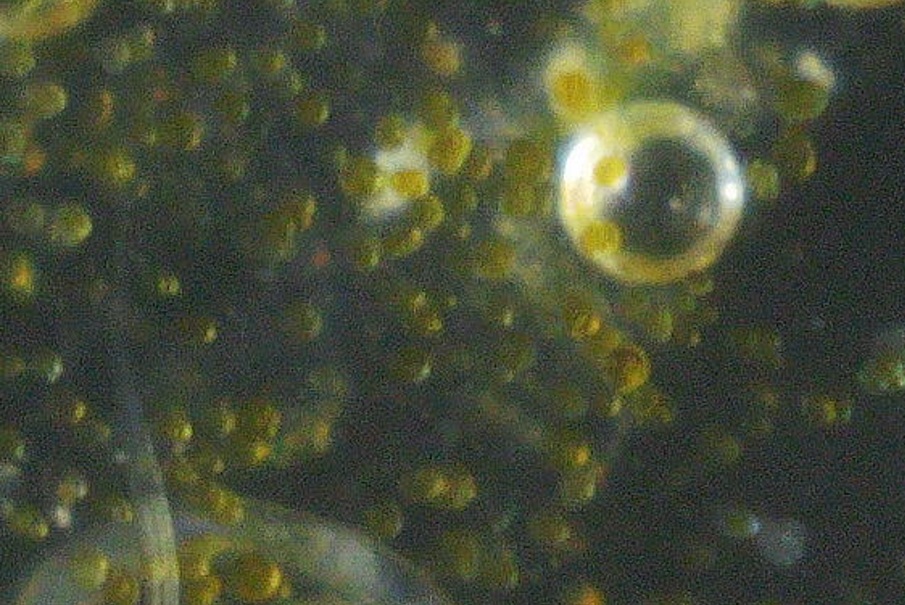


slide1.jpg


Here is where I pulled the sample off:
IMG_7547.JPG
 
OP
OP
Jamie9

Jamie9

Active Member
View Badges
Joined
Oct 4, 2025
Messages
428
Reaction score
388
Location
Mid Atlantic
Rating - 0%
0   0   0
Oh and I'm sure it will come up. Nutrients have not bottomed out. I tend to be around 8-12ppm nitrate and 0.07-0.1 phosphate. So far I've done the following:
- daily scrub with a toothbrush and then change out filter floss (nozzles got cleaned with citric acid)
- UV running 24/7 for about a week but I just changed it to 12 hours over night
- keeping an eye on nitrate/phosphate to make sure they don't drop (and that they don't sky rocket)
- Last night I started up a refugium with chaeto and put two jars of pods in...one into the fuge and one into the display.
 
OP
OP
Jamie9

Jamie9

Active Member
View Badges
Joined
Oct 4, 2025
Messages
428
Reaction score
388
Location
Mid Atlantic
Rating - 0%
0   0   0
Well, the dinos moved down to the sand bed today, and the strings there are longer, > 1" as opposed to short strings on the rocks. I did what I could to blow them off the sand and filter some out. I've also swapped my UV back to 24-7, perhaps that was helping more than I realized. Feeding 10 mL phyto per day now after adding 2 jars of copepods, and I'm going to reduce my lighting period by an hour per day, maybe more every couple days as long as the corals are looking ok. Nutrients today still look ok at 8ppm nitrates and .07 phosphate.
 

MeganV

Community Member
View Badges
Joined
Dec 10, 2022
Messages
51
Reaction score
50
Location
Findlay, OH
Rating - 0%
0   0   0
Can you get us a better image? It would be nice to confirm what you are dealing with. Likely a couple of things if I had to guess.

The stringyness makes me think you probably have ostreopsis, which UV will help significantly, but only if the dwell time in the UV is long enough to kill the dinos. Also, for some reason people report it works much better if its plumbed directly into the display and not to the sump. I have read that the flow rate should be on the order of 2-3x display vol in gal/hr. Similarly, they tend to work better oversized compared to general UV recommendations, on the order of a watt per 2-3 gallons. I used a 36W on my 70ish gallon display and it did the trick after a couple of weeks.

Another thing I read is that scrubbing/turkey bastung can disrupt other benthic organisms that are trying to colonize surfaces, and can be counterproductive. The idea is that long term you need to out-compete the dinos.

Just a couple thoughts. Mack's Reef group on Facebook is a good resource. They are going to want better images though to give meaningful help.
 
OP
OP
Jamie9

Jamie9

Active Member
View Badges
Joined
Oct 4, 2025
Messages
428
Reaction score
388
Location
Mid Atlantic
Rating - 0%
0   0   0
Thanks, I'm going to see if I can backlight the scope somehow to get better focus...but the things are quite tiny, needing the 1000-2000x lens. Interesting point about disturbing the organisms that are colonizing the surfaces, I better look into that. I'm really hoping the addition of pods two days ago will start to help.
 

TOP 10 Trending Threads

WHAT AMOUNT OF LIVE ROCK AND SAND SHOULD BE PRIORITIZED FOR OPTIMAL BIODIVERSITY/FILTRATION?

  • 100% live rock + bagged sand

    Votes: 34 27.0%
  • 100% dry rock + 100% live sand

    Votes: 45 35.7%
  • 50/50 live/dry rock, 50/50 live/bagged sand

    Votes: 27 21.4%
  • 75% live rock, 25% live sand

    Votes: 11 8.7%
  • 25% live rock, 75% live sand

    Votes: 9 7.1%
Back
Top