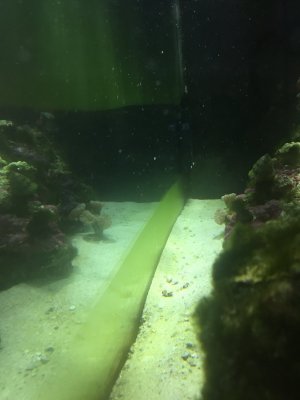
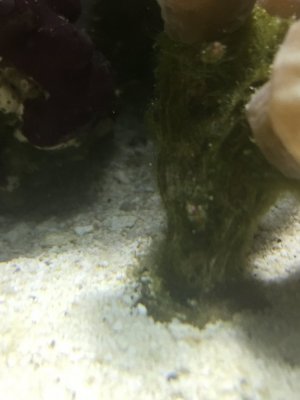
help with my algae issue

Barnabie Mejia

Well-Known Member
View Badges
Joined
Jun 10, 2019
Messages
573
Reaction score
1,018
Location
El Paso, Texas/ Chamberino, New Mexico
Rating - 0%
0   0   0
hello, i'm new to the forum!
A little background, we in herited this 25 gallon tank from our neighbor and we began learning the basics (and by that I mean water changes and filtering the water...) about a month into having the tank we were doing 10 gallon water changes everyweek and keeping the salinity at 1.025 - 1.026. we added some coral that my brother in law gave to my sons. added an AI Prime HD and Tunze 6040 powerhead.
then one day I walked in and noticed some furry stuff on my candy cane, when I turned the white light on the Prime BAM! I saw algae everywhere!
I was given a suggestion to put some chemi pure elite and purigen in the HOB filters and get a small clean up crew. I bought 5 blue leg crabs, 3 snails and a lawnmower. this picture is a week into having the crew and chemi pure & purigen in the filters.
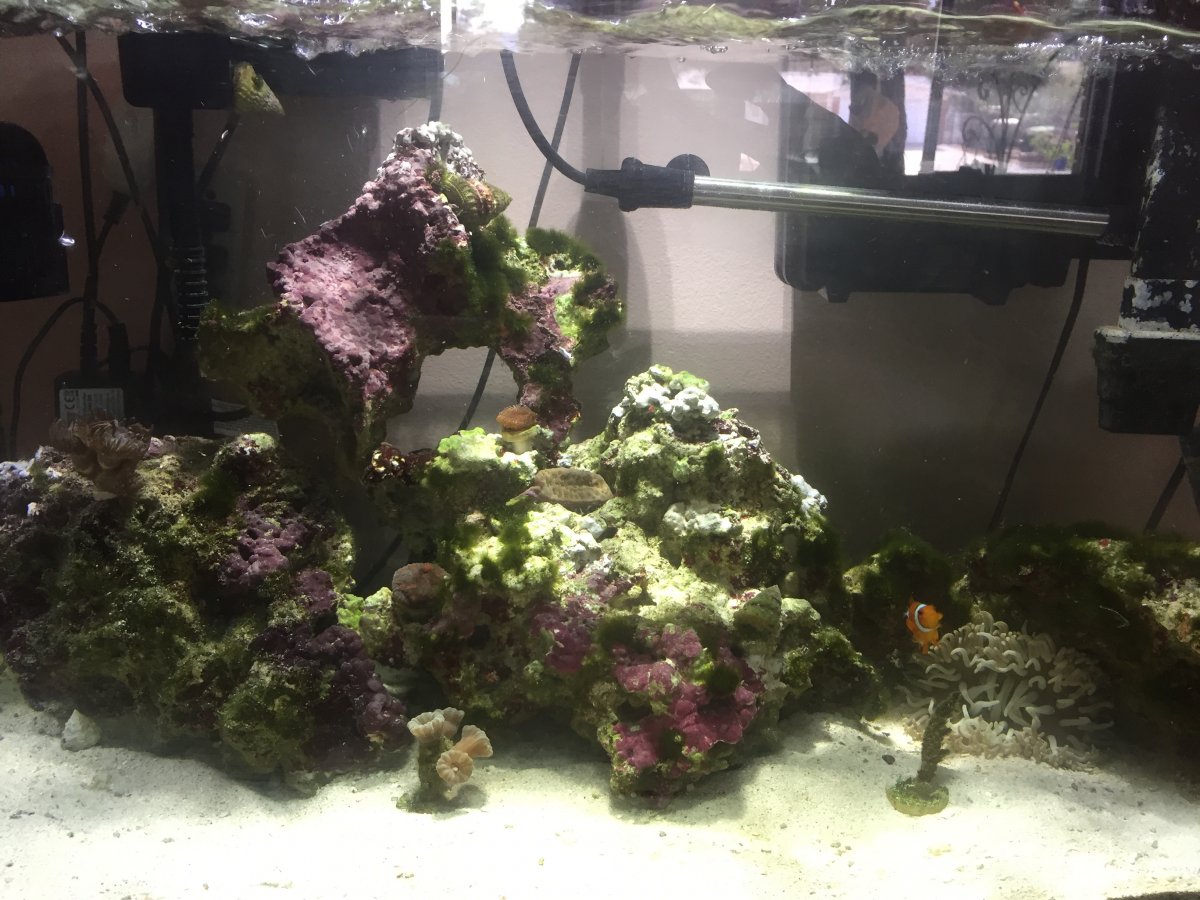
file7-3.jpeg


it looks a lot better when the blue lights are on lol
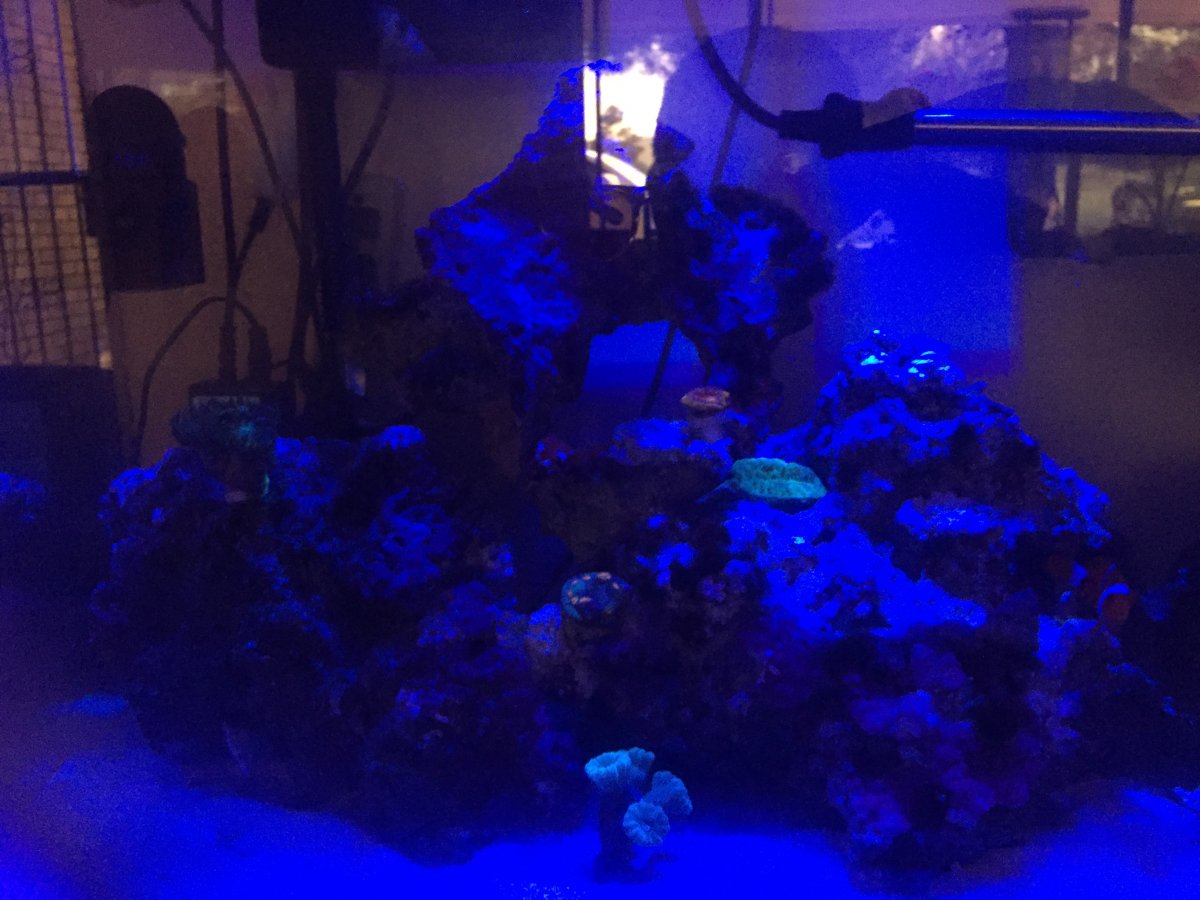
file1-10.jpeg


Help! I want to know how to fix this before we get our new 75 gallon going.... ( for that I am planning to start adding stuff into about 4 months after the start up for proper cycle and precautions are taken.)

 

P-Dub

The ocean is open to all, merciful to none.
View Badges
Joined
Sep 30, 2017
Messages
5,627
Reaction score
23,667
Location
West Pacific
Rating - 0%
0   0   0
What is your source water?
How long has the tank been running?
How old is the live rock?
How long did you cycle your tank and was the rock cured?
What are your parameters?
What was the process that you followed, step-by-step in setting up this tank?
Do you have a protein skimmer?
Sump?
Where did you get your sand?
I have more questions but this is a start.
 
OP
OP
Barnabie Mejia

Barnabie Mejia

Well-Known Member
View Badges
Joined
Jun 10, 2019
Messages
573
Reaction score
1,018
Location
El Paso, Texas/ Chamberino, New Mexico
Rating - 0%
0   0   0
1. What is your source water?
2. How long has the tank been running?
3. How old is the live rock?
4. How long did you cycle your tank and was the rock cured?
5. What are your parameters?
6. What was the process that you followed, step-by-step in setting up this tank?
7. Do you have a protein skimmer?
8. Sump?
9. Where did you get your sand?
10. I have more questions but this is a start.


1. RO/DI mixed with Reef Crystals from my brother in law (just received a 6 stage from BRS Friday)
2. the tank has been running for 10 years (that's what I was told from the lady I got it from)
3. I'm assuming about 5-10 years
4. I didn't cycle it because it was already in the tank and running when I got it.
5. I don't know the parameters, what would I have to buy to check this? (I'm only 2-3 months old in the reefing game)
6. We pumped water out in to a 32 gallon drum leaving enough water in there for the fish upon transport (1 mile at most). pumped water back in. did a 3 gallon water change the next day. did a 5 gallon two days later. 7 gallons 2 days after that. then have been on 10 gallon water changes since then.
7. No protein skimmer (although she gave me one with it, its a berlin triple pass, brand new and was never used. also a CPR siphon overflow with aqualift. after the research, I figured she never used these because there was going to be a need for a sump.
8. No sump as of yet. I was advised that I would not need a sump because the tank is so small (25gallon) and I have a good water change schedule.
9. Sand was in the tank when I got it. and during the water changes, I try and vacuum as much as possible during the 10 gallon change.

I answered them in order.... I don't want anyone to think i'm coming off as a jerk, clear answers are always best! im excited to learn from who ever I can!
 

P-Dub

The ocean is open to all, merciful to none.
View Badges
Joined
Sep 30, 2017
Messages
5,627
Reaction score
23,667
Location
West Pacific
Rating - 0%
0   0   0
Those are large water changes for sure and likely necessary at this point. You need to test for Nitrates, Phosphates, Calcium, Alkalinity, and to a lesser degree Magnesium. You need to export nutrients, i.e. nitrates and phosphates. This is what is feeding your GHA. You could test for them and they might even seem low but that is due to the fact that they are being absorbed by the GHA. You need to control for nutrients via source water and test that for nitrates and phosphates before introducing to the DT and determine where else nutrients are getting into the system. You are somehow getting high enough nutrients to allow for the algae to grow. A good skimmer is a great way to help with nutrient export but not necessarily necessary. It looks like GHA but it may be Bryopsis. Can you take a close up, in focus, white lights photo for better determination?
 

Mastiffsrule

Where ever you go, there you are, so be nice 2 you
View Badges
Joined
Feb 10, 2019
Messages
8,447
Reaction score
28,811
Location
Charlotte
Rating - 0%
0   0   0
Sorry you are having problems. I still have turf algae in my tank 10 years in. I think if we didn’t have something to fight like algae we would be bored with our tanks. :)

Anyway, follow p-dub advise, you get good info and help.

The only question I had was you mentioned pumping water into a 32 gallon container. Was it a new clean can or was it used for something prior?
 

lapin

10K Club member
View Badges
Joined
Dec 16, 2017
Messages
11,672
Reaction score
18,286
Location
Austin
Rating - 0%
0   0   0
Yes I can, as soon as I get home!
Also my brother said it was maybe from the tank not having any light for a long period of time then getting light all of a sudden.... could I buy a test kit at my LFS?
You can buy test kits at the LFS. What you need is for salt water . Nitrate and Phosphate test kits for sure.
Your brother is one smart cookie. Algae needs light and nutrients to grow. The nutrients were there all along. Add light and presto - algae. Now your clean-up crew has something to eat. Thats good. You can help them work by scrubbing some of it off the rocks, cutting it back and sucking it out of the tank. It will go away with good husbandry over time. It is nothing to panic about. I have some after 1 1/2 years and I feel it adds a natural look to the tank. Plus my lawnmower would starve without it.
 
OP
OP
Barnabie Mejia

Barnabie Mejia

Well-Known Member
View Badges
Joined
Jun 10, 2019
Messages
573
Reaction score
1,018
Location
El Paso, Texas/ Chamberino, New Mexico
Rating - 0%
0   0   0
The 32 gallon container that we used, is the container that he uses to make his RO/DI water. He cleans that thing religiously, he was in the Marine Corps for a while and those kind of habits carried over into a salt water tank. So I highly doubt that we got any contaminants from his container! LOL

How would I go about scrubbing off some of the algae to help out the cleaning crew? Just with a small brush?
 
OP
OP
Barnabie Mejia

Barnabie Mejia

Well-Known Member
View Badges
Joined
Jun 10, 2019
Messages
573
Reaction score
1,018
Location
El Paso, Texas/ Chamberino, New Mexico
Rating - 0%
0   0   0
Some people that use a python type vacuum on the sand bed just tape a tooth brush to it. The algae gets sucked out while brushing.
https://www.amazon.com/25-Foot-Pyth...=2025&creative=165953&creativeASIN=B000255NXC

I use one that is just a siphon, no sink connection and I never thought to tape a toothbrush to it! gonna give it a try on the next water change! thanks! also going to get a test kit today and start gathering numbers. I already made a spreadsheet to track the numbers.

my next question is, what are optimal numbers for:
Nitrates
Phoshates
Calcium
Alkalinity
Magnesium

Thanks guys!!!
 
OP
OP
Barnabie Mejia

Barnabie Mejia

Well-Known Member
View Badges
Joined
Jun 10, 2019
Messages
573
Reaction score
1,018
Location
El Paso, Texas/ Chamberino, New Mexico
Rating - 0%
0   0   0
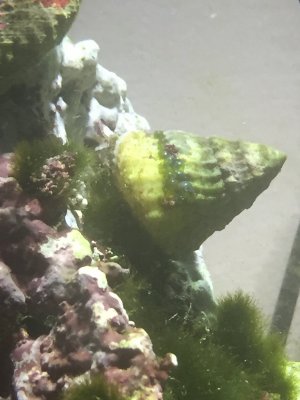
I noticed today that one of the snails has bubble algae growing on him, and I was going to post a picture but I already had and didn't even notice the bubble algae.

what should I do? should I pull him and clean him off?
Here is the picture again for reference
file-12.jpeg
 
OP
OP
Barnabie Mejia

Barnabie Mejia

Well-Known Member
View Badges
Joined
Jun 10, 2019
Messages
573
Reaction score
1,018
Location
El Paso, Texas/ Chamberino, New Mexico
Rating - 0%
0   0   0
So going off the pictures, do you guys think its just algae or bryposis? im really hoping that its not bryposis cause I have heard horror stories about dealing with it.

on another note, the algae doesn't seem to be getting worse, I have been manually pulling it out as much as I can when I get home and I think I might have to increase the CUC population to help. it seems that my blue leg hermits aren't eating too much. I don't know how they work, if they typically eat more at night when I'm sleeping or during the day when i'm at work... im open to more advice!!!!

I also just picked up a GFO and Carbon reactor and that will fire up tomorrow evening, and I will be doing another water change tonight when I get home.... I will also have some water parameters tonight for you guys to look at....
 
OP
OP
Barnabie Mejia

Barnabie Mejia

Well-Known Member
View Badges
Joined
Jun 10, 2019
Messages
573
Reaction score
1,018
Location
El Paso, Texas/ Chamberino, New Mexico
Rating - 0%
0   0   0
ok guys its been a little while but I don't think I have made any headway on the algae....
did some testing last night and this is what I have going on right now:
Salinity - 1.025
Temperature - 78*
Phosphate - .046
Ammonia - 0
Calcium - 450
Alkalinity - 7

didn't get to test Nitrate, Nitrite, or Magnesium, but I will do that today (had to tuck little guys to sleep).
I have been doing 10Gallon Water changes per week and recently fired up a GFO and Carbon Reactor to help out. and I have seen a Phosphate drop from last week. I manually pull the GHA out and even got a sea hare to help out (hes been going to town for a week and the tank still looks the same) I am kinda lost.... feeding is just what the clown can eat in 1 min.

I feed the Anemone a small chunk of mysis shrimp, coral get spot fed either Reef roids or reef chili about 2 hours before a water change to help keep the water "cleaner"

I also noticed that there is green algae build up on the frag plugs on my coral (some sit at a slight angle and the upper surface has the algae, but not the bottom, if that makes sense)

I want to know how to combat this in my 25 gal tank now while I am still setting up my sons 75 gallon with him.

thanks guys!
 

ScottB

7500 Club Member
View Badges
Joined
Mar 5, 2018
Messages
7,895
Reaction score
11,509
Location
Fairfield County, CT
Rating - 0%
0   0   0
Good on you for taking the steps suggested. Given your very light coral load and heavy water change regimen, No need to test/worry about Calcium, magnesium, and alkalinity (which I would've thought would be much higher, but little matter). Nor nitrite.

Here is what is/has happened in your tank:
Over the years of relatively slack husbandry, that rock and sand has stored a lot of Nitrate and Phosphate. Not a problem. Be glad you have old rock; old rock is good. It is just loaded with PO4 and NO3. It is leaching PO4 and NO3 (nutrient) into your water as you continue to replace dirty water with clean. Eventually (slowly) your continued WCs would strip the nutrient down to a constant level that would make the algae totally manageable. In fact, .046 in the water is ideal, but there is actually MUCH more in your system, it is just bound up in the rock and algae (which I believe to be GHA, not bryopsis). And yes, get those bubble algae out of the system asap.

It is also possible that there was some die-off during the move (in the rock/sand) but hopefully not. This would mean more nutrient and a bit less of the good bacteria potentially. If you had some kind of flow going and reasonable temps and timing in the move you should be good.

Using GFO to speed up that process is fine but it will be very important that you continue to test PO4 with a REAL test kit (Hanna ULR Phosphate Checker). Just before you do a water change. If your PO4 goes up over a measurement or two, probably means the GFO is exhausted and needs to be replaced. (Or you waited longer between WCs, maybe.) Anyway, the important thing I want to convey is this: you do NOT want to get to 0 PO4 at all. Your corals will hate it, and you will hate it when you join us over in the dinoflagellate thread (now over 7,000 posts). OK?

Next, GFO only removes PO4 and not NO3 (Nitrate). Nitrate is less tricky to measure; most tests will suffice but I prefer Red Sea. Getting to something in the 5-15 range WITHOUT all the GHA would be fine. As with PO4, zero nitrate is a very bad number and for the same reason. The GHA is binding a lot of nitrate -- so it is present in there now. But as GHA gets eliminated it will be important not to hit zero NO3.

Good luck with both tanks!
 
OP
OP
Barnabie Mejia

Barnabie Mejia

Well-Known Member
View Badges
Joined
Jun 10, 2019
Messages
573
Reaction score
1,018
Location
El Paso, Texas/ Chamberino, New Mexico
Rating - 0%
0   0   0
Good on you for taking the steps suggested. Given your very light coral load and heavy water change regimen, No need to test/worry about Calcium, magnesium, and alkalinity (which I would've thought would be much higher, but little matter). Nor nitrite.

Here is what is/has happened in your tank:
Over the years of relatively slack husbandry, that rock and sand has stored a lot of Nitrate and Phosphate. Not a problem. Be glad you have old rock; old rock is good. It is just loaded with PO4 and NO3. It is leaching PO4 and NO3 (nutrient) into your water as you continue to replace dirty water with clean. Eventually (slowly) your continued WCs would strip the nutrient down to a constant level that would make the algae totally manageable. In fact, .046 in the water is ideal, but there is actually MUCH more in your system, it is just bound up in the rock and algae (which I believe to be GHA, not bryopsis). And yes, get those bubble algae out of the system asap.

It is also possible that there was some die-off during the move (in the rock/sand) but hopefully not. This would mean more nutrient and a bit less of the good bacteria potentially. If you had some kind of flow going and reasonable temps and timing in the move you should be good.

Using GFO to speed up that process is fine but it will be very important that you continue to test PO4 with a REAL test kit (Hanna ULR Phosphate Checker). Just before you do a water change. If your PO4 goes up over a measurement or two, probably means the GFO is exhausted and needs to be replaced. (Or you waited longer between WCs, maybe.) Anyway, the important thing I want to convey is this: you do NOT want to get to 0 PO4 at all. Your corals will hate it, and you will hate it when you join us over in the dinoflagellate thread (now over 7,000 posts). OK?

Next, GFO only removes PO4 and not NO3 (Nitrate). Nitrate is less tricky to measure; most tests will suffice but I prefer Red Sea. Getting to something in the 5-15 range WITHOUT all the GHA would be fine. As with PO4, zero nitrate is a very bad number and for the same reason. The GHA is binding a lot of nitrate -- so it is present in there now. But as GHA gets eliminated it will be important not to hit zero NO3.

Good luck with both tanks!

the PO4 Reading is from a Hannah ULR Phosphate Checker, and I will be sure to be checking it before the water changes! I will look into the Red Sea testing kit for NO3. does the carbon in the reactor do anything for the nitrates? the reactor that I have is a dual reactor so they have independent of each other, not sure if that's better or not.... what could I do to keep the NO3 in check when that time comes Cause I don't want to be in the other thread! haha
 

brandon429

what, exactly, are you doing in your avatar
View Badges
Joined
Dec 9, 2014
Messages
31,035
Reaction score
23,923
Location
tejas
Rating - 0%
0   0   0
take a test rock, work our rasping action on it + the algae kill step and put it back in the tank. in two or three days it still looks awesome, and algae free, compared to the rest of the tank.

at that time do all the rocks, clean out the sandbed and change all the water if you want it fixed the right way. none of this requires testing, purely action itself for the pristine reef skip cycle outcome. The whole sand rinse thread is 23 pages of this already being done / handy for predictions on outcome likely.

you have all kinds of options ranging from adding things to the water with low work, to dosing medications specific to algae (which remove no waste from the system) all the way up to and including the ideal: the skip cycle take-apart rip clean. You are blasting out all the detritus where it hides: in the rock and in the sand

and putting back a perfectly clean, algae killed setup no need to wait for compliance unless you just would like to. any test rock you run using this exact step will model near perfect compliance for a long time, that live rock is perfect its what you want. the minor algae growth means nothing, check out the coralline part

see how few algae bits if any attach there? coralline is the bioexcluder

we farm more of it, by hand guiding (killing) algae and making way for coralline to grow. simply starving out algae over 6 mos isn't the only way, we have a by-Wed this week option. I will also venture to say this method is the best there is because no other method that leaves full detritus in place prepares for the next cyclic invader (cyano) like we do here. This is literally the best thing you can do for that tank, though only 3% of reefers would agree to that statement. taking a nano down for a rip cleaning/instant re setup like when you moved it over/ is the key to making a nano reef have an infinite life span. Leaving them hands off, to run as things present, is how to get a finite lifespan or total invasion scenario.

The cause of aging and age-related invasions in reefing is detritus cloud related, so, the corrective condition to any aging tank is to make it where no amount of sandbed disturbance causes a cloud, and every once in a while clean out your live rocks using saltwater, externally, such that when you lift them mid tank and twist them, no cloud results.

right now= able to get cloud out of sandbed most likely, and for sure from the rocks. Anywhere algae grows is detritus retentive; they'll cast off clouding from the actual algae tufts which is why directly killing them robs their feed.

**only large tankers have to put up with months and months of testing, waiting hoping for an algae cure. Any nano keeper has secret access, easy tank size, allowing insta fix.
 
Last edited:

TOP 10 Trending Threads

WHAT AMOUNT OF LIVE ROCK AND SAND SHOULD BE PRIORITIZED FOR OPTIMAL BIODIVERSITY/FILTRATION?

  • 100% live rock + bagged sand

    Votes: 34 27.6%
  • 100% dry rock + 100% live sand

    Votes: 43 35.0%
  • 50/50 live/dry rock, 50/50 live/bagged sand

    Votes: 27 22.0%
  • 75% live rock, 25% live sand

    Votes: 11 8.9%
  • 25% live rock, 75% live sand

    Votes: 8 6.5%
Back
Top