How bright is too bright

Nate G

Community Member
View Badges
Joined
Jul 25, 2015
Messages
80
Reaction score
7
Rating - 0%
0   0   0
This may be the wrong spot for this, and if it is forgive me. I am currently running a Current Orbit Marine Ramp Timer Pro and I am concerned about the quality of light my inhabitants are receiving. Currently, the timer is set for 12-hours. It does about 8-hours of full light (100% white light and 100% blue light) with a 4-hour moonlight. The light has a maximum output of 120W. It seems when I turn the white light down, I get more color out of my corals.

I guess my question here is, what amount of light is good for coral and when does it become a hindrance? Also, is blue light better than white light?

I know the aim is to mimic a natural habitat as much as possible, so it would seem that less white should be appropriate, but I am not sure. Any advice is greatly appreciated.
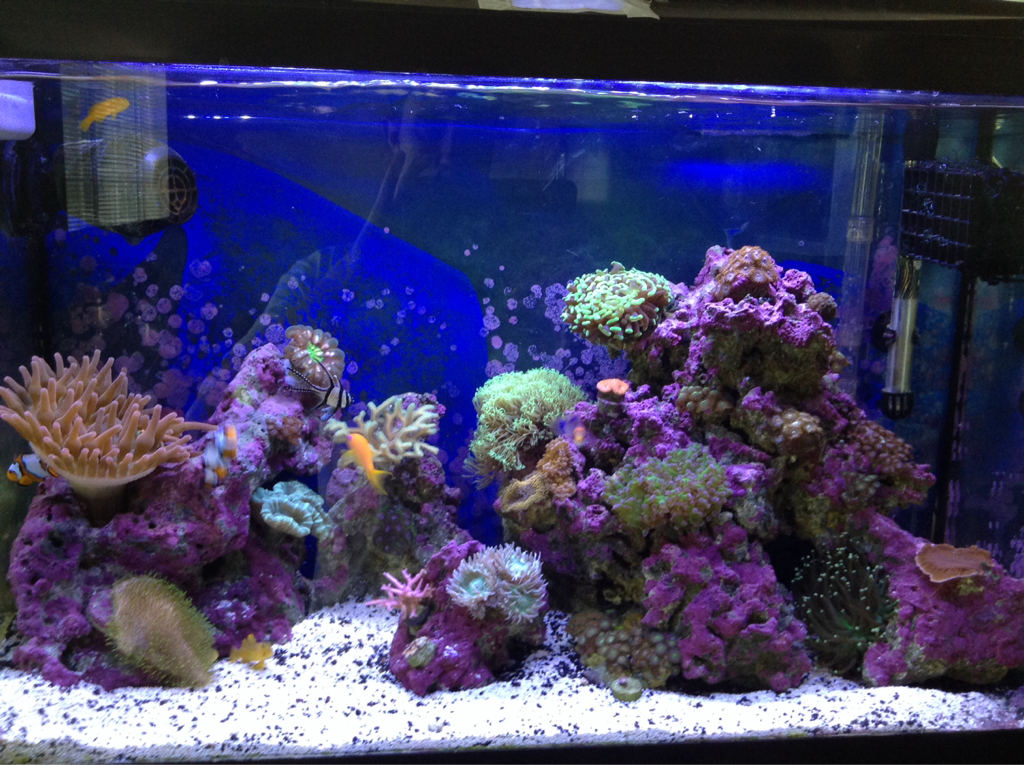
ImageUploadedByREEF2REEF1453922140.561189.jpg
 

mcarroll

10K Club member
View Badges
Joined
Jan 8, 2012
Messages
15,217
Reaction score
8,978
Location
Virginia
Rating - 0%
0   0   0
Just as a start, you might consider which reef environment you're emulating. Corals grow all the way from 100,000 lux at the surface down to only 1% of that...so you'll have to pick.

You could also consider the corals you plan to keep. Most of the colorful ones are from deeper water environments, but that is far from universal. Corals from costal or lagoon environments each have fairly distinct lighting emvironments.

While you are considering those things, equip yourself:

  • Get a free lux meter app to start with.
  • A $15 handheld meter is a solid upgrade though.
You will find having one of these around to be useful and interesting. I don't make a lighting change or setup without using something!

$0.02
 

TheEngineer

Formerly icecool2
View Badges
Joined
Nov 26, 2011
Messages
7,296
Reaction score
6,387
Location
PA
Rating - 0%
0   0   0
For photosynthesis, you really only need up to around 500nm. That's still rather blue. White light is more for our preference than anything. I run my whites at around 10% so it isn't just solid blue staring back at me.
 

saltyfilmfolks

Lights! Camera! Reef!
View Badges
Joined
Feb 25, 2014
Messages
28,739
Reaction score
40,625
Location
California
Rating - 0%
0   0   0
gah. so hotly debated. Corals up to 3 feet below the water get a fuller spectrum of those deeper. there are those deeper water corals that prefer bluer lighting and less intense light.


im familiar with you light. It wont give out more than the corals will take. so your on track there. adjust the blue to what you like to see.

when I turn the white light down, I get more color out of my corals.
is that by eye when you do it or long term growth.
by eye its a trick of light.

nay Sayers of the inclusion of red 660nm for deeper corals sometimes forget its a longer wavelength and travels farther and a reason many are including it current leds. blue is much more on the planet(sky) however and more so underwater.

a lux meter does give you the intensity value "how much" and for most corals its a lot.
 
OP
OP
N

Nate G

Community Member
View Badges
Joined
Jul 25, 2015
Messages
80
Reaction score
7
Rating - 0%
0   0   0
Is there a place out there that tells you where in depth and lighting spectrum you'll find different types of coral? Typically, I find the moderate light middle to high placement, type stuff. If my current arrangement is all over the place it will be difficult to set the correct lighting.
 

mcarroll

10K Club member
View Badges
Joined
Jan 8, 2012
Messages
15,217
Reaction score
8,978
Location
Virginia
Rating - 0%
0   0   0
Is there a place out there that tells you where in depth and lighting spectrum you'll find different types of coral? Typically, I find the moderate light middle to high placement, type stuff. If my current arrangement is all over the place it will be difficult to set the correct lighting.

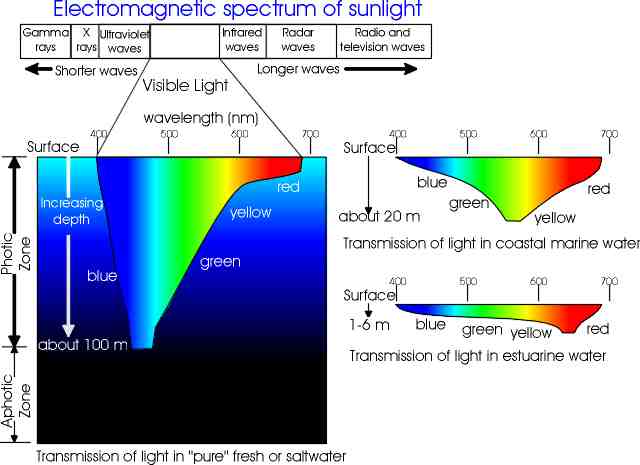
Well, it's not that any particular coral is that particular....quite the opposite. Corals are generally very adaptable. There aren't enough exceptions to worry about.

If you use a lux meter and have any modern reef light, 40,000-50,000 lux will work for pretty much every coral you could bring home from the store.

If you want to get more into it....you look to the groups of corals that come from (e.g.) coastal environments, those that come from lagoon environments and those from the deeper ocean.
electrospectruminwater.jpg


These environments all obviously begin with 100,000 lux at the surface, but they attenuate the light very differently and for reasons more complicated than just depth.

As if the math to compute all that wasn't enough, it gets even more complicated because few of us know where our corals come from and there is quite a bit of overlap as far as what corals will show up in which environments.

So, this is why I tell everyone to keep it simple.

Shoot for low-to-moderate lighting and you'll keep about every coral happy with much less worry.

20,000-40,000 lux is a great starting place. :)

40,000-50,000 should be a happy medium.

If you have a coral you specifically want to target with higher light, 80,000 lux should be adequate.

Figure from here:
http://www.marinebiology.org/oceanography.htm
 

saltyfilmfolks

Lights! Camera! Reef!
View Badges
Joined
Feb 25, 2014
Messages
28,739
Reaction score
40,625
Location
California
Rating - 0%
0   0   0
that has actually been driving me nuts for years. so no. :D
Many corals of the same species live in many different places AND depths. but many or most prefer ,youll hate this, a general higher and lower amount of that kind of light.
think in 3 meter increments. zoas will ive researche grow in a tide pool and 24 meters. the color of the same species is different, but it grows and reproduces.
Plus corals are quite highly adaptable to lighting conditions. most people are growing corals in lighting conditions well outside that of what you would find on a natural reef.
the deeper you get in the ocean the light changes(an easy google) so i like to remember deeper is bluer.

its a very detailed subject. My guru Is Dana Riddle. People interpret his work differently. but thats people.

heres a small list. also flow nutrition etc.
 

saltyfilmfolks

Lights! Camera! Reef!
View Badges
Joined
Feb 25, 2014
Messages
28,739
Reaction score
40,625
Location
California
Rating - 0%
0   0   0
Well, it's not that any particular coral is that particular....quite the opposite. Corals are generally very adaptable. There aren't enough exceptions to worry about.

If you use a lux meter and have any modern reef light, 40,000-50,000 lux will work for pretty much every coral you could bring home from the store.

If you want to get more into it....you look to the groups of corals that come from (e.g.) coastal environments, those that come from lagoon environments and those from the deeper ocean.
electrospectruminwater.jpg


These environments all obviously begin with 100,000 lux at the surface, but they attenuate the light very differently and for reasons more complicated than just depth.

As if the math to compute all that wasn't enough, it gets even more complicated because few of us know where our corals come from and there is quite a bit of overlap as far as what corals will show up in which environments.

So, this is why I tell everyone to keep it simple.

Shoot for low-to-moderate lighting and you'll keep about every coral happy with much less worry.

20,000-40,000 lux is a great starting place. :)

If you have a coral you specifically want to target with higher light, 80,000 lux should be adequate.

Figure from here:
http://www.marinebiology.org/oceanography.htm
and thanks mcarrol I couldn't find mine.
 
OP
OP
N

Nate G

Community Member
View Badges
Joined
Jul 25, 2015
Messages
80
Reaction score
7
Rating - 0%
0   0   0
I have cut the white down to 10%. Here's to what happens
 

hart24601

5000 Club Member
View Badges
Joined
Mar 18, 2014
Messages
6,720
Reaction score
6,599
Location
Iowa
Rating - 0%
0   0   0
Something people don't often talk about with light intensity is flow. We use light reading from reefs as a yardstick for our systems, but not matching the flow. The reason it's important is excess light intensity is dissipated as heat, and the flow rate is important. The lower the flow in the tank the less light most coral can take before they have bleaching issues. It just adds another layer of complexity to lighting. Just as an FYI.


Just an example I was running 5 hydra 26s at 80% blues, uv, and 45% whites over a 120. That is a lot of light!! But I also ran a gyre 150 and 2 mp40s at 100%!
 

DO YOU THINK TECHNOLOGICAL ADVANCEMENTS ARE MORE HELPFUL OR HURTFUL TO REEFING?

  • More helpful.

    Votes: 59 42.4%
  • More hurtful.

    Votes: 5 3.6%
  • I think it depends mostly on the technology.

    Votes: 53 38.1%
  • I think it dependsmostly on the reefer behind the technology.

    Votes: 41 29.5%
Back
Top
Home
Post thread…
Market
What's new