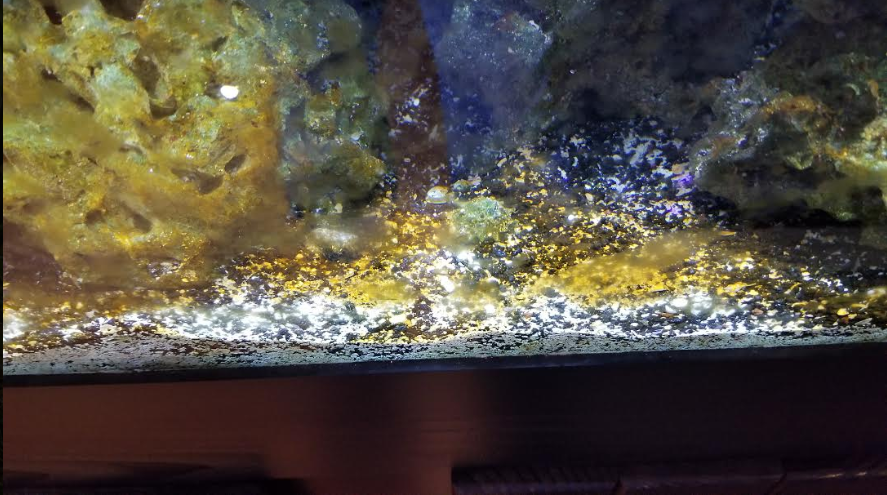
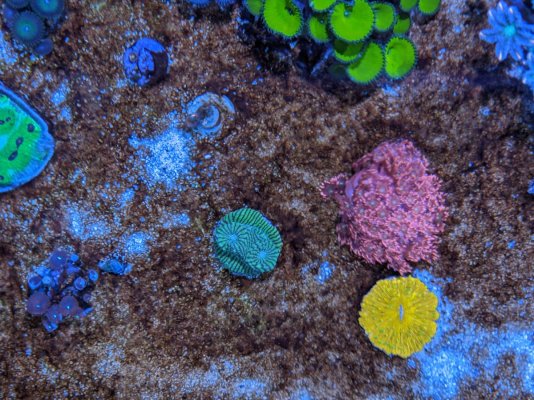
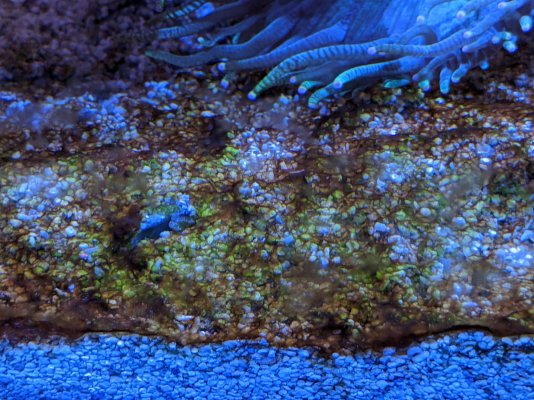
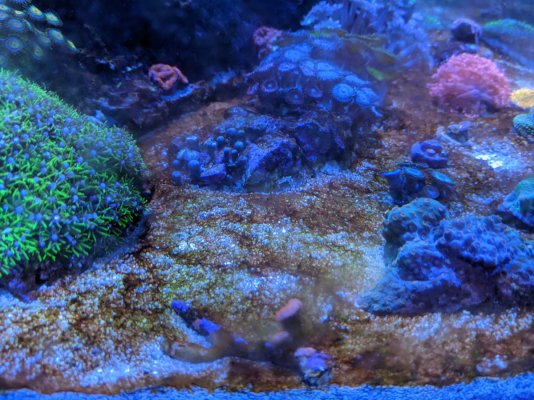
Hey all, I have been battling what is either diatoms or dinos. I got my icp test back and it says I have 1.2 silicates in my water. Is this enough for diatoms to grow. If so then how do I remove it? Here are some pictures
Recently dealing with chrysophytes, I followed the instructions in the chrysophytes thread. Manual removal and use of GFO, also working on getting nutrients in line, I have 0 po4 and high nitrates. I have also increased CUC
GFO removes silicates, the trick is to only use the recommended dose for your tank and only allow it to run for 24 hours. Apparently the first 24 hours is when it does the silicate removal and does not remove po4 so much.
I never tested the silicate level in my tank to give you a number that is good or bad. The chrysophytes need it to grow though so I knew I needed to address it.
2 things: How old is your tank and do you have sand? (Lots of sand?)
Are you using RODI? If only tap, it probably contains silica.
If I had to guess though, I’d say it looks more like dinos than diatoms. But I’ve never had dinos so I can’t be sure.
Do you have access to a microscope? I used a friends one. I think it was at 400x and I found diatoms in my water during cycling. You can research what they look like but they look like clear cylindrical worms with holes at both ends and they had a bit of coloring on them. They swam in and carried around some brown gunk.
Hey all, I have been battling what is either diatoms or dinos. I got my icp test back and it says I have 1.2 silicates in my water. Is this enough for diatoms to grow. If so then how do I remove it? Here are some pictures
With one exception (discussed below) all diatoms require silica for growth, and low silica levels cause significant changes in the cell cycle.7 Silicon is a major limiting nutrient for diatom growth in certain parts of the oceans,8 although iron,9 nitrogen, and phosphorus can also be limiting. There have been many studies on the uptake of silica by diatoms. Most diatoms take up silica in the form of silicic acid, although one has been shown to take up the silicate form.10 If absorbing silica is a limiting factor, then it makes sense to transport silicic acid since it is present at much higher concentrations than is silicate, and hence is potentially easier to transport.
Different diatom species have different abilities to absorb silica from the water. That is, as the silica concentration drops, some diatoms can continue to pull silica from the water while others cannot. Most diatoms have half maximal rates of silica absorption of 0.7-10 mM (0.04 – 0.6 ppm SiO2),2 but some are substantially higher, up to about 60 mM (2.6 ppm SiO2).2 The in-situ average for biogenic silica uptake in the surface layer of the equatorial pacific showed half maximal uptake at a silica concentration of 1.6 mM at 3°S and 2.4 mm at the equator, which was close to the silica concentrations present.3
There apparently are genes for many different silica transporters in each of the diatom species that has been investigated.8 Diatoms also somehow maintain internal silicic acid concentrations at levels higher than its solubility, but the mechanism for accomplishing this is unclear. Nevertheless, it is obvious that this facilitates the deposition process, and inhibits dissolution of the existing frustule. Diatoms apparently use proteins to guide the deposition process, where soluble silica is converted into the intricate solid frustule, but exactly how this role is accomplished is not known.8
In a reef tank like mine with silica concentrations below 0.8 mM (0.05 ppm SiO2, the practical limit of the Hach silica kit), some diatoms will have a hard time absorbing silica. Many reef tanks may, in fact, be selecting for diatoms that are able to get enough silica at the low concentrations typically available. Are diatoms silica-limited in reef tanks? That question is addressed experimentally below.
In the oceans, diatoms are silica limited in some natural settings (like the polar regions and the Sargasso Sea, where the ambient silica concentration is less than 1 mM (0.06 ppm SiO2).11 There have also been many cases where eutrophication of natural waters has raised nitrogen and phosphorus levels to the point where silica has become limiting,12 even when it was not limiting in pristine waters. In reef tanks, where nitrogen and phosphorus are often not in short supply, it makes sense that silica could be limiting. In case you were thinking that silica limitation to diatom growth is necessarily a good thing, there are drawbacks. The limitation of silica, inhibiting the growth of diatoms that would otherwise take up the limiting nutrients nitrogen and phosphorus, has even been implicated in blooms of cyanobacteria.
With one exception (discussed below) all diatoms require silica for growth, and low silica levels cause significant changes in the cell cycle.7 Silicon is a major limiting nutrient for diatom growth in certain parts of the oceans,8 although iron,9 nitrogen, and phosphorus can also be limiting. There have been many studies on the uptake of silica by diatoms. Most diatoms take up silica in the form of silicic acid, although one has been shown to take up the silicate form.10 If absorbing silica is a limiting factor, then it makes sense to transport silicic acid since it is present at much higher concentrations than is silicate, and hence is potentially easier to transport.
Different diatom species have different abilities to absorb silica from the water. That is, as the silica concentration drops, some diatoms can continue to pull silica from the water while others cannot. Most diatoms have half maximal rates of silica absorption of 0.7-10 mM (0.04 – 0.6 ppm SiO2),2 but some are substantially higher, up to about 60 mM (2.6 ppm SiO2).2 The in-situ average for biogenic silica uptake in the surface layer of the equatorial pacific showed half maximal uptake at a silica concentration of 1.6 mM at 3°S and 2.4 mm at the equator, which was close to the silica concentrations present.3
There apparently are genes for many different silica transporters in each of the diatom species that has been investigated.8 Diatoms also somehow maintain internal silicic acid concentrations at levels higher than its solubility, but the mechanism for accomplishing this is unclear. Nevertheless, it is obvious that this facilitates the deposition process, and inhibits dissolution of the existing frustule. Diatoms apparently use proteins to guide the deposition process, where soluble silica is converted into the intricate solid frustule, but exactly how this role is accomplished is not known.8
In a reef tank like mine with silica concentrations below 0.8 mM (0.05 ppm SiO2, the practical limit of the Hach silica kit), some diatoms will have a hard time absorbing silica. Many reef tanks may, in fact, be selecting for diatoms that are able to get enough silica at the low concentrations typically available. Are diatoms silica-limited in reef tanks? That question is addressed experimentally below.
In the oceans, diatoms are silica limited in some natural settings (like the polar regions and the Sargasso Sea, where the ambient silica concentration is less than 1 mM (0.06 ppm SiO2).11 There have also been many cases where eutrophication of natural waters has raised nitrogen and phosphorus levels to the point where silica has become limiting,12 even when it was not limiting in pristine waters. In reef tanks, where nitrogen and phosphorus are often not in short supply, it makes sense that silica could be limiting. In case you were thinking that silica limitation to diatom growth is necessarily a good thing, there are drawbacks. The limitation of silica, inhibiting the growth of diatoms that would otherwise take up the limiting nutrients nitrogen and phosphorus, has even been implicated in blooms of cyanobacteria.
2 things: How old is your tank and do you have sand? (Lots of sand?)
Are you using RODI? If only tap, it probably contains silica.
If I had to guess though, I’d say it looks more like dinos than diatoms. But I’ve never had dinos so I can’t be sure.
Do you have access to a microscope? I used a friends one. I think it was at 400x and I found diatoms in my water during cycling. You can research what they look like but they look like clear cylindrical worms with holes at both ends and they had a bit of coloring on them. They swam in and carried around some brown gunk.
I'll tell you with my tank and testing that 100+ µg/l is when I see diatoms on my sand. I recently had them, made changes to my rodi to get them down and I am at 60 µg/l in my latest ATI ICP test and have had zero issues with them for a couple of months now.
1.2 ppm Si (if the form of silicon that you have is silicate) is certainly plenty for diatoms. I regularly dosed silicate (~1.8 ppm) to encourage certain organisms (sponges, for example) and each time I did, I switched from green algae on the glass to diatoms for a short period of time.
What do you believe to be the cause of this? as your silicates eventually go away but mine has been here for months. May something be leaching or am I putting it back in via Water change?
For me my problem was RODI. A benefit to ATI's ICP test is they test your RODI which mine was clean except silicates. Silica is removed by the DI resin. I had a DI mixed bed resin plus a silica buster previously and to me the color change NEVER happened to show it was spent. So basically my top off water was continuously adding silicates back to the tank which fueled the diatoms. Because of that I've now gone to a new DI configuration with 3 cartridges, first single bed of cation resin, second single bed of anion resin, third mixed bed for a final polish. I feel much better about it and have a very clear color change now as it starts to deplete in the single beds. Once I did that it took about 2 weeks to clear up in the tank as silica is used up pretty quickly and the diatoms went away.
1.2 ppm Si (if the form of silicon that you have is silicate) is certainly plenty for diatoms. I regularly dosed silicate (~1.8 ppm) to encourage certain organisms (sponges, for example) and each time I did, I switched from green algae on the glass to diatoms for a short period of time.
Hello Randy,I believe I'm having a severe diatom bloom as well as the pictures provided by PBar look identical to what I'm experiencing. What are your thoughts on my results from a recent ICP test? Please see attached. Thanks in advance.
Hello Randy,I believe I'm having a severe diatom bloom as well as the pictures provided by PBar look identical to what I'm experiencing. What are your thoughts on my results from a recent ICP test? Please see attached. Thanks in advance.
When I was dosing, my tank had about 0.06 ppm. Here’s a previous comment on it:
Silicon (Si). I dose silicate (as sodium silicate solution) to my aquarium. I boost the concentration to about 200 µg/L of silicon equivalent once a week or so. This water sample was drawn one week after the last dose of silicate. I know from previous studies that silicate is rapidly depleted in my tank, presumably by sponges (the reason I dose it), by diatoms, and possibly by the GFO that I use to bind phosphate.
I fought diatoms for months before figuring out that my 30 gallon, blue plastic barrels were leaching. The water out of the RO was .2 tested with a Com-100 TDS meter but out of the barrel it was 463. I replaced the barrels with Brute food grade containers and the reading out of those is .4. I purchased the original barrels from a local container company that cleans and refurbishes but they did not know what they originally held.
When I was dosing, my tank had about 0.06 ppm. Here’s a previous comment on it:
Silicon (Si). I dose silicate (as sodium silicate solution) to my aquarium. I boost the concentration to about 200 µg/L of silicon equivalent once a week or so. This water sample was drawn one week after the last dose of silicate. I know from previous studies that silicate is rapidly depleted in my tank, presumably by sponges (the reason I dose it), by diatoms, and possibly by the GFO that I use to bind phosphate.
Thanks for the reply.. since this post the bloom of whatever it is looks more like brown cyano perhaps? I don't recall cyano just blowing away off the rocks with a good turkey baste but the stuff in the sand is matty and is now looking more like cyano, although brown in color. If you would please, take a look at let me know your thoughts. Also, in small patches some areas look to be turning green.. I'm hoping this is a sign of it breaking down. Thanks again!
Thanks for the reply.. since this post the bloom of whatever it is looks more like brown cyano perhaps? I don't recall cyano just blowing away off the rocks with a good turkey baste but the stuff in the sand is matty and is now looking more like cyano, although brown in color. If you would please, take a look at let me know your thoughts. Also, in small patches some areas look to be turning green.. I'm hoping this is a sign of it breaking down. Thanks again!
Thought I'd add that I recently began to dose nitrates as they were reading zero while my phosphates are elevated so I wanted to get this balanced back out. My corals are loving it, but unfortunately so is what ever the hell is growing in my sand bed. My nitrates are around .08 ppm and phosphate is around .12 ppm. I've fought the urge to do a water change as I wasn't sure if this was diatoms or not. Anyways, I'm hoping the slight color change to green in some areas is a positive sign. Thanks again.
Hey randy, if you see this, my goal is to grow diatoms to outcompete dinos in my tank. What PPM should I shoot for to start growing diatoms? I was told between 0.01 and 0.05. I was hoping I can get your weight-in here
Hey randy, if you see this, my goal is to grow diatoms to outcompete dinos in my tank. What PPM should I shoot for to start growing diatoms? I was told between 0.01 and 0.05. I was hoping I can get your weight-in here
I got diatoms to grow when I boosted silicate to 1-2 ppm SiO2. Would less have also caused a burst of diatoms? Probably, but the diatom growth on the glass and silicate in the water faded away between doses.
Why would I recommend dosing silica? Largely because creatures in our tanks use it, the concentrations in our tanks (at least in mine) are below natural levels, and the sponges, mollusks, and diatoms may not be getting enough to thrive.
I got diatoms to grow when I boosted silicate to 1-2 ppm SiO2. Would less have also caused a burst of diatoms? Probably, but the diatom growth on the glass and silicate in the water faded away between doses.
Why would I recommend dosing silica? Largely because creatures in our tanks use it, the concentrations in our tanks (at least in mine) are below natural levels, and the sponges, mollusks, and diatoms may not be getting enough to thrive.