Ich? Velvet? or something else

drread1459

New Member
View Badges
Joined
Jun 17, 2025
Messages
6
Reaction score
0
Location
Austin
Rating - 0%
0   0   0
I had a 270-gallon saltwater FOWLR tank recently set up (about 8 weeks ago) at my office. There are two puffers (porcupine and spiny box), several rabbit fish, 2 Klein butterflies, a pin fish (long story), and a snowflake eel. All of
the fish in the new tank were in 5 different "grow out" tanks at my office for at least 6 (the puffers I had for closer to 9 months). There were no outbreaks or fish loss in the grow out tanks over that 9-month period. After the new tank was set up, I slowly (over 4 weeks) moved fish to it along with live rock from their tanks. There is a lot of rock in the tank (tt is all CaribSea LifeRock or something like that)

Last Wednesday when the maintenance company was "cleaning" the new tank, he noted that my porcupine puffer had small dots on it. He thought it looked like ich. I asked the Owner of a LFS store (located 1/2 mile away) if he would stop by and look at the porcupine puffer (he sold me the puffer around a year ago). He said it looked like ich to him but could not rule out velvet. We have since noticed similar dots on the spiny box puffer and one of the Kleins "flicking" against rocks. Both recommended hyposalinity to treat the ich. I slowly lowered the salinity over 5 days to get it to 1.009. It has been at this salinity for close to 48 hours now. Since reaching hyposalinity, ammonia has been going up slowly. This morning Ammonia was at 1 ppm (determined with hanna checker and lamotte), nitrites were 0.2 (determined with spin touch), and nitrates were 15 (determined with spin touch). I began dosing with Prime and Seed two days ago.

With the exception of the spiny box, all the fish are acting normal and eating. The spiny box is hiding a lot and didn't eat last night.

There are no corals or inverts in the tank.

Can someone help me identify if this is ich, velvet, or something else and help me prepare a treatment plan? I still have a few of the 40 gallon grow out tanks but have gotten rid of a couple.

Thank you in advance for your help.

Dean
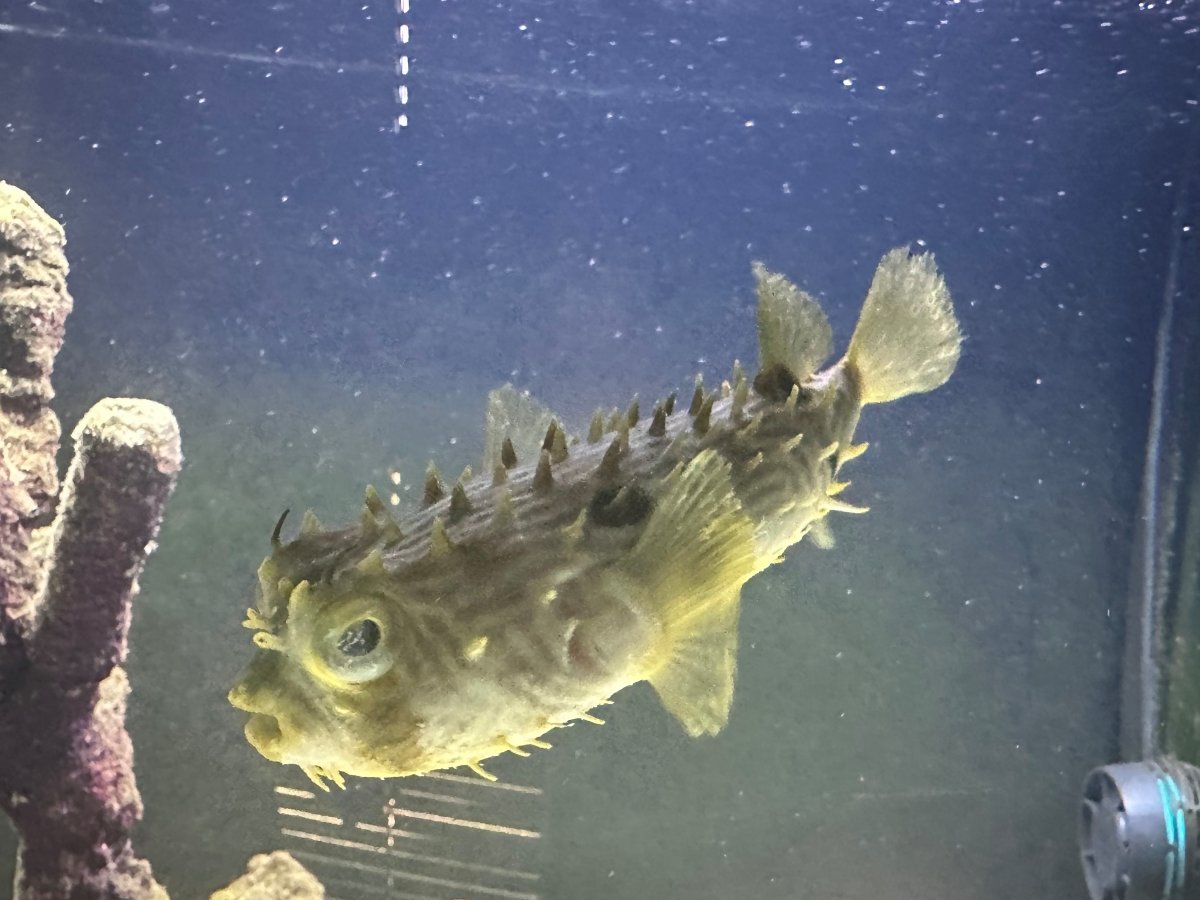


Spiny Box.jpg
 

vetteguy53081

Well known Member and monster tank lover
View Badges
Joined
Aug 11, 2013
Messages
108,089
Reaction score
242,648
Location
Wisconsin -
Rating - 100%
17   0   0
I had a 270-gallon saltwater FOWLR tank recently set up (about 8 weeks ago) at my office. There are two puffers (porcupine and spiny box), several rabbit fish, 2 Klein butterflies, a pin fish (long story), and a snowflake eel. All of
the fish in the new tank were in 5 different "grow out" tanks at my office for at least 6 (the puffers I had for closer to 9 months). There were no outbreaks or fish loss in the grow out tanks over that 9-month period. After the new tank was set up, I slowly (over 4 weeks) moved fish to it along with live rock from their tanks. There is a lot of rock in the tank (tt is all CaribSea LifeRock or something like that)

Last Wednesday when the maintenance company was "cleaning" the new tank, he noted that my porcupine puffer had small dots on it. He thought it looked like ich. I asked the Owner of a LFS store (located 1/2 mile away) if he would stop by and look at the porcupine puffer (he sold me the puffer around a year ago). He said it looked like ich to him but could not rule out velvet. We have since noticed similar dots on the spiny box puffer and one of the Kleins "flicking" against rocks. Both recommended hyposalinity to treat the ich. I slowly lowered the salinity over 5 days to get it to 1.009. It has been at this salinity for close to 48 hours now. Since reaching hyposalinity, ammonia has been going up slowly. This morning Ammonia was at 1 ppm (determined with hanna checker and lamotte), nitrites were 0.2 (determined with spin touch), and nitrates were 15 (determined with spin touch). I began dosing with Prime and Seed two days ago.

With the exception of the spiny box, all the fish are acting normal and eating. The spiny box is hiding a lot and didn't eat last night.

There are no corals or inverts in the tank.

Can someone help me identify if this is ich, velvet, or something else and help me prepare a treatment plan? I still have a few of the 40 gallon grow out tanks but have gotten rid of a couple.

Thank you in advance for your help.

Dean



Spiny Box.jpg
Video does not play ( please post you tube version under bright white lighting). These fish are prone to ich and need to confirm
 
OP
OP
D

drread1459

New Member
View Badges
Joined
Jun 17, 2025
Messages
6
Reaction score
0
Location
Austin
Rating - 0%
0   0   0
Video does not play ( please post you tube version under bright white lighting). These fish are prone to ich and need to confirm
Sorry. Hopefully I did YouTube correctly.

Porcupine Puffer -
Spiny Box Puffer -

Thank you in advance.

Dean
 

Jay Hemdal

10K Club member
View Badges
Joined
Jul 31, 2020
Messages
37,573
Reaction score
37,370
Location
Dundee, MI
Rating - 0%
0   0   0
I had a 270-gallon saltwater FOWLR tank recently set up (about 8 weeks ago) at my office. There are two puffers (porcupine and spiny box), several rabbit fish, 2 Klein butterflies, a pin fish (long story), and a snowflake eel. All of
the fish in the new tank were in 5 different "grow out" tanks at my office for at least 6 (the puffers I had for closer to 9 months). There were no outbreaks or fish loss in the grow out tanks over that 9-month period. After the new tank was set up, I slowly (over 4 weeks) moved fish to it along with live rock from their tanks. There is a lot of rock in the tank (tt is all CaribSea LifeRock or something like that)

Last Wednesday when the maintenance company was "cleaning" the new tank, he noted that my porcupine puffer had small dots on it. He thought it looked like ich. I asked the Owner of a LFS store (located 1/2 mile away) if he would stop by and look at the porcupine puffer (he sold me the puffer around a year ago). He said it looked like ich to him but could not rule out velvet. We have since noticed similar dots on the spiny box puffer and one of the Kleins "flicking" against rocks. Both recommended hyposalinity to treat the ich. I slowly lowered the salinity over 5 days to get it to 1.009. It has been at this salinity for close to 48 hours now. Since reaching hyposalinity, ammonia has been going up slowly. This morning Ammonia was at 1 ppm (determined with hanna checker and lamotte), nitrites were 0.2 (determined with spin touch), and nitrates were 15 (determined with spin touch). I began dosing with Prime and Seed two days ago.

With the exception of the spiny box, all the fish are acting normal and eating. The spiny box is hiding a lot and didn't eat last night.

There are no corals or inverts in the tank.

Can someone help me identify if this is ich, velvet, or something else and help me prepare a treatment plan? I still have a few of the 40 gallon grow out tanks but have gotten rid of a couple.

Thank you in advance for your help.

Dean


Spiny Box.jpg

Welcome to Reef2Reef!

I was able to get the videos to play - that is late stage marine ich. Velvet would cause rapid breathing.

The 1 ppm ammonia during hyposalinity is a huge issue though - that must have something to do with the recent age of the tank, it didn't have a mature micro-biome.

I wouldn't rely on Prime to manage the ammonia toxicity: https://www.reef2reef.com/threads/does-prime-actually-detoxify-free-ammonia-nh3.849985/

What is the pH of the tank?
 
OP
OP
D

drread1459

New Member
View Badges
Joined
Jun 17, 2025
Messages
6
Reaction score
0
Location
Austin
Rating - 0%
0   0   0
This morning it was 7.9 (determined with spin touch) I picked up a pH Hanna Checker today. Will check with that shortly.
 
OP
OP
D

drread1459

New Member
View Badges
Joined
Jun 17, 2025
Messages
6
Reaction score
0
Location
Austin
Rating - 0%
0   0   0
Thank you very much for the response.

What does “late stage” mean? Puffer is about to die? Or the ich on it is about to fall off?

Thanks again.

Dean
 

vetteguy53081

Well known Member and monster tank lover
View Badges
Joined
Aug 11, 2013
Messages
108,089
Reaction score
242,648
Location
Wisconsin -
Rating - 100%
17   0   0
Me
Thank you very much for the response.

What does “late stage” mean? Puffer is about to die? Or the ich on it is about to fall off?

Thanks again.

Dean
Meaning that the fish has become infested and ich is well established
 

Jay Hemdal

10K Club member
View Badges
Joined
Jul 31, 2020
Messages
37,573
Reaction score
37,370
Location
Dundee, MI
Rating - 0%
0   0   0
This morning it was 7.9 (determined with spin touch) I picked up a pH Hanna Checker today. Will check with that shortly.

Good, a pH less than 8 helps with ammonia toxicity.
 
OP
OP
D

drread1459

New Member
View Badges
Joined
Jun 17, 2025
Messages
6
Reaction score
0
Location
Austin
Rating - 0%
0   0   0
Maybe I am not being patient, but after 8 days of hyposalinity things seem to be getting worse. I figured if it was ich, the small white dots would be going away after 8 days of hyposalinity and not spreading and getting worse. I may be wrong.

Videos of the puffers taken a few minutes ago can be viewed at the following links:
- Porcupine puffer
- Spiny Box Puffer.

I have been dosing with a "bacteria in a bottle" product for the last 5 days. This morning the ammonia was at 0.0 ppm (determined with a hanna checker and lamotte spin disk), nitrites were at 0.8 (determined with spin touch), and nitrates were at 84 (determined with spin touch). The pH was 7.6 (determined with spin touch).

I forgot to mention that there is a mean as hell sunshine chromis in the new tank also. He now has white spots as does the pin fish.

Also, the spiny box puffer was offered to me about 9 months ago by a local fish store. He had some sort of fungus on one of his eyes and the LFS said the puffer would lose his eye. Since I have a 14-year-old "blind" MBU puffer in another 200-gallon tank, I took the puffer to see if I could treat him. A one-eyed puffer isn't a deal breaker for me (he was named "one-eyed willie" by my kids and is still called that even though he still has both eyes). I treated him with some sort of medicine (I don't remember what) and the fungus went away. At the tail end of the fungus treatment, willie got ich. I treated with Copper Power and willie successfully made it through the copper treatment. After the copper treatment, willie was kept in a grow out tank with a real small (started at about 1 inch) dog face puffer and a bi-color angel for at least 6 months before moving to the new large tank. While I planned to move the dog face to the new tank, he is very timid and still only about 2.5 inches so I have left him in the 40-gallon grow out tank. The dog face and a bi-color angel are still doing fine with no outbreaks in the grow out tank.

With the exception of the Kleins, all the fish in the new large tank are currently eating. The spiny box quit eating for a couple of days at the beginning of the hyposalinity treatment but has started eating again. The Kleins ate yesterday but have not eaten today. All the fish are active with the exception of the Kleins (they were active yesterday but have been hiding in caves all day today). No one seems to be breathing heavy.

I have at least one 40-gallon tank and two 75-gallon tanks at another building I could possibly move the fish to. It wouldn't be easy but could possibly be done. All the tanks are empty right now. All the fish, except the eel and the Kleins, should be easy to catch. I am not sure I can catch the eel to make the display tank fallow. He doesn't stick his head out of the rocks more than 2 inches to grab food.

My time to address this is limited due to work commitments. Since I never plan to have inverts or corals in the display tank, would it be stupid to treat the display tank with Copper Power? I have the means to test the copper power levels daily and re-dose as necessary. Should I try to get chloroquine phosphate and treat the display tank (I found a source that can get it to me in 4 days)? Should I be patient and continue with just hyposalinity? While all the fish are important, the puffers and eel (and one of the rabbitfish) are the most important.

I am at a loss as to what to do. Any further thoughts as to what it is (ich, velvet, something else) and advice on how to treat would be greatly appreciated?

Thanks,

Dean

Good, a pH less than 8 helps with ammonia toxicity.
 

Jay Hemdal

10K Club member
View Badges
Joined
Jul 31, 2020
Messages
37,573
Reaction score
37,370
Location
Dundee, MI
Rating - 0%
0   0   0
Maybe I am not being patient, but after 8 days of hyposalinity things seem to be getting worse. I figured if it was ich, the small white dots would be going away after 8 days of hyposalinity and not spreading and getting worse. I may be wrong.

Videos of the puffers taken a few minutes ago can be viewed at the following links:
- Porcupine puffer
- Spiny Box Puffer.

I have been dosing with a "bacteria in a bottle" product for the last 5 days. This morning the ammonia was at 0.0 ppm (determined with a hanna checker and lamotte spin disk), nitrites were at 0.8 (determined with spin touch), and nitrates were at 84 (determined with spin touch). The pH was 7.6 (determined with spin touch).

I forgot to mention that there is a mean as hell sunshine chromis in the new tank also. He now has white spots as does the pin fish.

Also, the spiny box puffer was offered to me about 9 months ago by a local fish store. He had some sort of fungus on one of his eyes and the LFS said the puffer would lose his eye. Since I have a 14-year-old "blind" MBU puffer in another 200-gallon tank, I took the puffer to see if I could treat him. A one-eyed puffer isn't a deal breaker for me (he was named "one-eyed willie" by my kids and is still called that even though he still has both eyes). I treated him with some sort of medicine (I don't remember what) and the fungus went away. At the tail end of the fungus treatment, willie got ich. I treated with Copper Power and willie successfully made it through the copper treatment. After the copper treatment, willie was kept in a grow out tank with a real small (started at about 1 inch) dog face puffer and a bi-color angel for at least 6 months before moving to the new large tank. While I planned to move the dog face to the new tank, he is very timid and still only about 2.5 inches so I have left him in the 40-gallon grow out tank. The dog face and a bi-color angel are still doing fine with no outbreaks in the grow out tank.

With the exception of the Kleins, all the fish in the new large tank are currently eating. The spiny box quit eating for a couple of days at the beginning of the hyposalinity treatment but has started eating again. The Kleins ate yesterday but have not eaten today. All the fish are active with the exception of the Kleins (they were active yesterday but have been hiding in caves all day today). No one seems to be breathing heavy.

I have at least one 40-gallon tank and two 75-gallon tanks at another building I could possibly move the fish to. It wouldn't be easy but could possibly be done. All the tanks are empty right now. All the fish, except the eel and the Kleins, should be easy to catch. I am not sure I can catch the eel to make the display tank fallow. He doesn't stick his head out of the rocks more than 2 inches to grab food.

My time to address this is limited due to work commitments. Since I never plan to have inverts or corals in the display tank, would it be stupid to treat the display tank with Copper Power? I have the means to test the copper power levels daily and re-dose as necessary. Should I try to get chloroquine phosphate and treat the display tank (I found a source that can get it to me in 4 days)? Should I be patient and continue with just hyposalinity? While all the fish are important, the puffers and eel (and one of the rabbitfish) are the most important.

I am at a loss as to what to do. Any further thoughts as to what it is (ich, velvet, something else) and advice on how to treat would be greatly appreciated?

Thanks,

Dean


To start with -
What is the current salinity/specific gravity?
What are you measuring it with?
Have you confirmed the reading with a second device?
 
OP
OP
D

drread1459

New Member
View Badges
Joined
Jun 17, 2025
Messages
6
Reaction score
0
Location
Austin
Rating - 0%
0   0   0
To start with -
What is the current salinity/specific gravity?
What are you measuring it with?
Have you confirmed the reading with a second device?
The salinity / specific gravity is 1.009 and is being measured twice daily with two different recently calibrated ATC portable refractometers. A local fish store has also tested it with their Milwaukee MA997 refractometer and got 12.0 PPT (which I understand is equivalent to a specific gravity of about 1.009). I have a Milwaukee MA997 refractometer on order and it should be here on Wednesday.

I understand that refractometers may not be the most accurate method for testing salinity. If there is a better device to use, please let me know what. Assuming it is not horribly expensive and is generally available I will be glad to get it.

I just tested the hypo water in the new tank again tonight and got the following parameters:
With Lamotte Spin Touch:
Alkalinity: 126 ppm / 7.1 dKH
pH: 7.8
Phosphate: 1.3 ppm
Ammonia: 0.0 ppm
Nitrite: 0.0 ppm
Nitrate: 86 ppm

ATC portable refractometer #1: Salinity 1.009
ATC portable refractometer #2: Salinity between 1.009 and 1.010

I understand using the saltwater disks for hyposalinity with the Spin Touch can give less accurate results. Per Lamotte, brackish tablets for hypo water should be used for the most accurate results. I have tested the hypo water several times with Hanna Checkers (alkalinity, ammonia, nitrite, nitrate, and pH) and get similar results to the Lamotte with saltwater disks and no brackish tablets (maybe the hanna checkers have the same accuracy issues with hypo water). I am trying to order some of the brackish tablets but Lamotte isn't making it easy.

Thank you very much for you past and future assistance.

Dean
 

Jay Hemdal

10K Club member
View Badges
Joined
Jul 31, 2020
Messages
37,573
Reaction score
37,370
Location
Dundee, MI
Rating - 0%
0   0   0
The salinity / specific gravity is 1.009 and is being measured twice daily with two different recently calibrated ATC portable refractometers. A local fish store has also tested it with their Milwaukee MA997 refractometer and got 12.0 PPT (which I understand is equivalent to a specific gravity of about 1.009). I have a Milwaukee MA997 refractometer on order and it should be here on Wednesday.

I understand that refractometers may not be the most accurate method for testing salinity. If there is a better device to use, please let me know what. Assuming it is not horribly expensive and is generally available I will be glad to get it.

I just tested the hypo water in the new tank again tonight and got the following parameters:
With Lamotte Spin Touch:
Alkalinity: 126 ppm / 7.1 dKH
pH: 7.8
Phosphate: 1.3 ppm
Ammonia: 0.0 ppm
Nitrite: 0.0 ppm
Nitrate: 86 ppm

ATC portable refractometer #1: Salinity 1.009
ATC portable refractometer #2: Salinity between 1.009 and 1.010

I understand using the saltwater disks for hyposalinity with the Spin Touch can give less accurate results. Per Lamotte, brackish tablets for hypo water should be used for the most accurate results. I have tested the hypo water several times with Hanna Checkers (alkalinity, ammonia, nitrite, nitrate, and pH) and get similar results to the Lamotte with saltwater disks and no brackish tablets (maybe the hanna checkers have the same accuracy issues with hypo water). I am trying to order some of the brackish tablets but Lamotte isn't making it easy.

Thank you very much for you past and future assistance.

Dean

O.K., sounds like you have a good handle on that (it's just that sometimes people don't run hypo correctly).

I think your two options are to stick with hypo and see if it eventually clears the infection. Hypo is slow to work, but the Klein's not acting normal is concerning. The second option would be to run coppersafe during hypo. I can't say if you can do that with copper power or not though, you'd have to read to level to see if it can be used in FW like coppersafe can.
 

TOP 10 Trending Threads

WHAT AMOUNT OF LIVE ROCK AND SAND SHOULD BE PRIORITIZED FOR OPTIMAL BIODIVERSITY/FILTRATION?

  • 100% live rock + bagged sand

    Votes: 34 27.4%
  • 100% dry rock + 100% live sand

    Votes: 44 35.5%
  • 50/50 live/dry rock, 50/50 live/bagged sand

    Votes: 27 21.8%
  • 75% live rock, 25% live sand

    Votes: 11 8.9%
  • 25% live rock, 75% live sand

    Votes: 8 6.5%
Back
Top