



Is it Cyano or ?

Reef Johnson

New Member
View Badges
Joined
Mar 16, 2026
Messages
16
Reaction score
7
Location
North Carolina
Rating - 0%
0   0   0
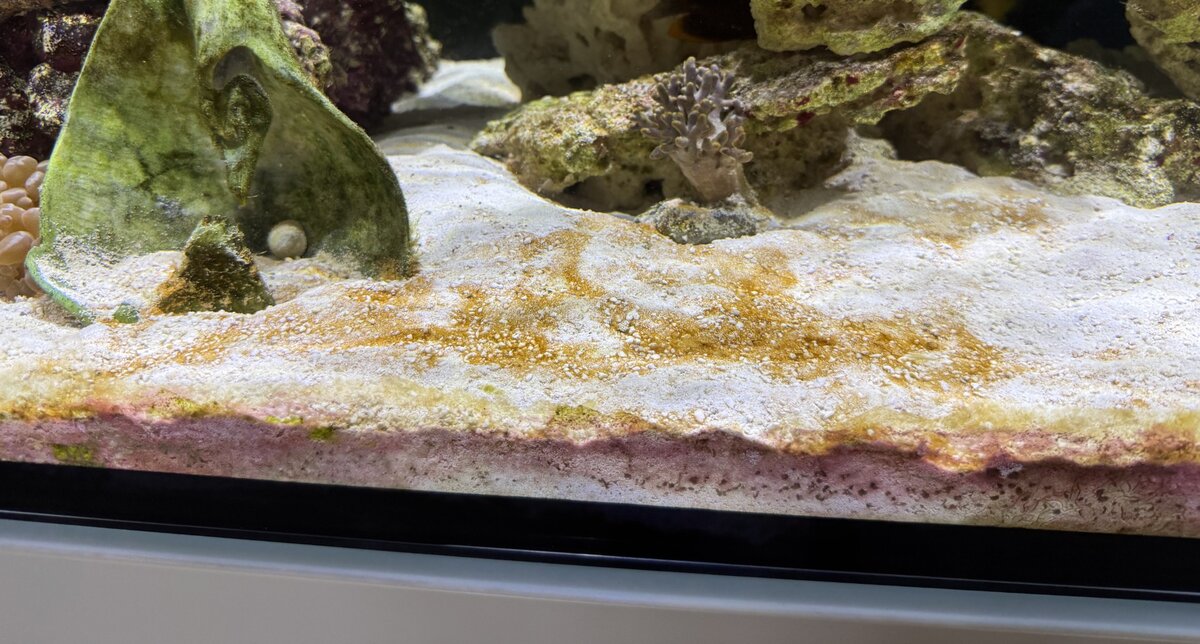
Hi there. A first timer, I'm 8 months into this new 90 g. tank. This algae or bacteria grows rapidly after vacuuming, as I'm not sure what it is. I don't have a microscope. Have 2 Reefwave devices providing what seems like good circulation and a UV clarifier that seems to be helping with nuisance algae. Except for slightly low PH and slightly elevated calcium, parameters are consistent and OK. I'm thinking of adding a small powerhead, but not sure if that's a solution.
cyano or.jpeg
 

JTP424

2500 Club Member
View Badges
Joined
Jan 10, 2022
Messages
2,762
Reaction score
3,195
Location
US
Rating - 0%
0   0   0
What do you have in terms of CUC that can stir the sand?
 

malacoda

Valuable Member
View Badges
Joined
Nov 22, 2015
Messages
1,172
Reaction score
1,348
Location
Western North Carolina
Rating - 0%
0   0   0
It's normal. A combination of film algae and/or diatoms.

I assume you use RODI water? If so, has your DI resin been exhausted?

I tend to always see a little of it on my sand, but there usually tends to be a more when my DI resin is close to being exhausted ... allowing a bit of silica to creep past into my RODI tank. More silica = more diatoms.
 

bmheath

Community Member
View Badges
Joined
Feb 27, 2026
Messages
53
Reaction score
81
Location
Taylor Ridge
Rating - 0%
0   0   0
I would suggest a conch snail and or some sandsifting gobies. I have a yellow head that keeps my sand completely clean. When I get my tank upgrade I plan to add a conch snail and a yellow watchman and pistol shrimp. I’m always for having your animals in your tank do the work for you! Plus it’s more fun to watch
 

bmheath

Community Member
View Badges
Joined
Feb 27, 2026
Messages
53
Reaction score
81
Location
Taylor Ridge
Rating - 0%
0   0   0

Euphyllia97

FOWLR and reef member
View Badges
Joined
Oct 22, 2019
Messages
1,026
Reaction score
1,493
Location
Belgium
Rating - 0%
0   0   0
Might be amphidinium dinoflagellates. Only way to confirm is a microscope. If you blow it with a turkey baster, does it look to be dusty or slimy? Does it have the tendency to try and stivk together?
 
OP
OP
R

Reef Johnson

New Member
View Badges
Joined
Mar 16, 2026
Messages
16
Reaction score
7
Location
North Carolina
Rating - 0%
0   0   0
I would suggest a conch snail and or some sandsifting gobies. I have a yellow head that keeps my sand completely clean. When I get my tank upgrade I plan to add a conch snail and a yellow watchman and pistol shrimp. I’m always for having your animals in your tank do the work for you! Plus it’s more fun to watch
good stuff. Have one sandsifting goby but I'll look at another one as they are cool to watch, and I'll check into a conch snail too.......
 
OP
OP
R

Reef Johnson

New Member
View Badges
Joined
Mar 16, 2026
Messages
16
Reaction score
7
Location
North Carolina
Rating - 0%
0   0   0
It's normal. A combination of film algae and/or diatoms.

I assume you use RODI water? If so, has your DI resin been exhausted?

I tend to always see a little of it on my sand, but there usually tends to be a more when my DI resin is close to being exhausted ... allowing a bit of silica to creep past into my RODI tank. More silica = more diatoms.
I think I have too much for normal but I get it as I didn't capture all in the photo. My RODI should be good, as I've got a 5-stage filter system that's only a couple of months old. Others have suggested more CUC - I'll try that and maybe a microscope just for fun.
 
OP
OP
R

Reef Johnson

New Member
View Badges
Joined
Mar 16, 2026
Messages
16
Reaction score
7
Location
North Carolina
Rating - 0%
0   0   0
Might be amphidinium dinoflagellates. Only way to confirm is a microscope. If you blow it with a turkey baster, does it look to be dusty or slimy? Does it have the tendency to try and stivk together?
Did the turkey baster test- its a very thin layer but it sticks together. ??
 

Euphyllia97

FOWLR and reef member
View Badges
Joined
Oct 22, 2019
Messages
1,026
Reaction score
1,493
Location
Belgium
Rating - 0%
0   0   0
Did the turkey baster test- its a very thin layer but it sticks together. ??
I would say that chances are high you are dealing with dinoflagellates. You will have to aim to keep nutrients readable, both phosphates and nitrates. Increase microbiome by dosing some groups of bacteria and preferably copepods.

Best way to completely get rid of them is to manual remove and dose silicates to cause a diatom bloom which will outcompete the dino’s.

Best thing is to grab a sample, buy or find someone with a microscope and confirm/identify the dino’s . I would guess Amphidinium but needs confirmation. Good thing is that these are not really toxic to your livestock, bad thing is that it is more difficult to get rid of as this type doesn’t migrate to the water column by night and therefore UV is not effective

 
OP
OP
R

Reef Johnson

New Member
View Badges
Joined
Mar 16, 2026
Messages
16
Reaction score
7
Location
North Carolina
Rating - 0%
0   0   0
I would say that chances are high you are dealing with dinoflagellates. You will have to aim to keep nutrients readable, both phosphates and nitrates. Increase microbiome by dosing some groups of bacteria and preferably copepods.

Best way to completely get rid of them is to manual remove and dose silicates to cause a diatom bloom which will outcompete the dino’s.

Best thing is to grab a sample, buy or find someone with a microscope and confirm/identify the dino’s . I would guess Amphidinium but needs confirmation. Good thing is that these are not really toxic to your livestock, bad thing is that it is more difficult to get rid of as this type doesn’t migrate to the water column by night and therefore UV is not effective

Great insight, and thanks for the tips.
 

TOP 10 Trending Threads

WHAT AMOUNT OF LIVE ROCK AND SAND SHOULD BE PRIORITIZED FOR OPTIMAL BIODIVERSITY/FILTRATION?

  • 100% live rock + bagged sand

    Votes: 34 28.1%
  • 100% dry rock + 100% live sand

    Votes: 41 33.9%
  • 50/50 live/dry rock, 50/50 live/bagged sand

    Votes: 27 22.3%
  • 75% live rock, 25% live sand

    Votes: 11 9.1%
  • 25% live rock, 75% live sand

    Votes: 8 6.6%
Back
Top







