Just for Fun - The Perfect Spectrum

OP
OP
Dana Riddle

Dana Riddle

2500 Club Member
View Badges
Joined
Sep 10, 2011
Messages
3,162
Reaction score
7,455
Location
Dallas, Georgia
Rating - 0%
0   0   0
Thought I'd lost this file. Here's the spectrum that produced the highest growth in the stony coral Porites lobata. Running statistics on this and several other spectra revealed growths were not significantly different. But growths (as judged by weight) under this LED was highest. Again, just for fun.
upload_2018-3-28_13-41-40.png
 
OP
OP
Dana Riddle

Dana Riddle

2500 Club Member
View Badges
Joined
Sep 10, 2011
Messages
3,162
Reaction score
7,455
Location
Dallas, Georgia
Rating - 0%
0   0   0
Thanks for posting that it was a good read. I think the penetration numbers make sense for Red and far red. Still not sure how far IR will penetrate in nature other than Orphek stating they measured it down to 60cm with their fixture which only has two 850nm led's in it so I would think it's definitely more in nature but 8-10m is probably not the case for IR
I really wish I could have overcome the obstacles collecting data at deeper depths presented. Launching a floating spectrometer to gather data is difficult. Protection of the electronics in salt spray is a priority, the ocean must be relatively calm, the day must be sunny throughout (uncommon, as cloud cover is like clockwork around the Hualalai volcano near Kona), shadows of the float/boat must be avoided, I must have the time to do it... getting the planets to align so good data could be obtained at depth just never happened. Did the best I could. As for IR, the attenuation coefficients I have from Jerlov don't go far enough, so some lab work is needed.
 
U

User1

Guest
View Badges
Thought I'd lost this file. Here's the spectrum that produced the highest growth in the stony coral Porites lobata. Running statistics on this and several other spectra revealed growths were not significantly different. But growths (as judged by weight) under this LED was highest. Again, just for fun.

upload_2018-3-28_13-41-40.png

Wonder how this data compares to what the EcoTech / CoralLab recommends.
 

oreo54

5000 Club Member
View Badges
Joined
Sep 18, 2017
Messages
6,877
Reaction score
4,083
Rating - 0%
0   0   0
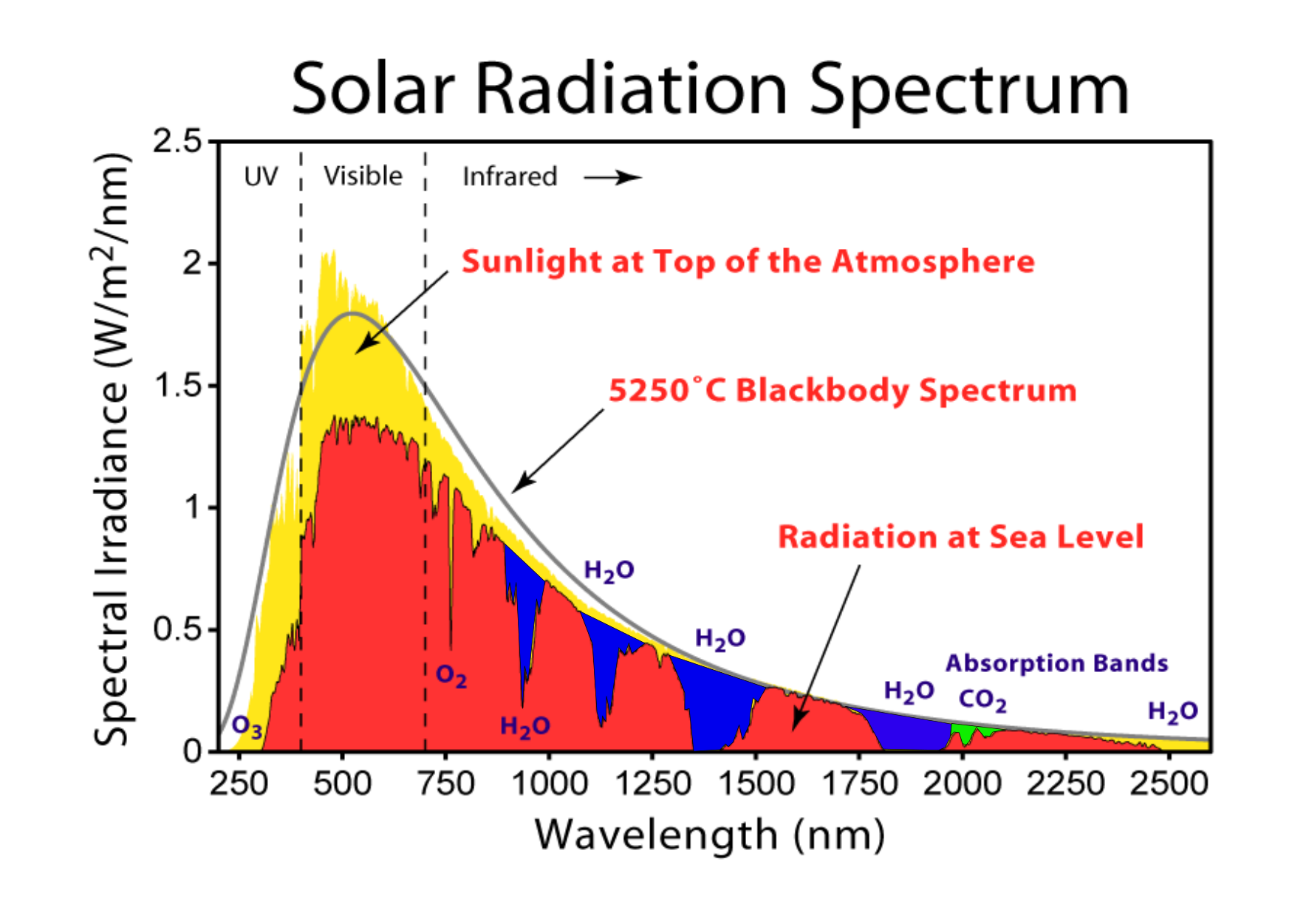
Remebered this about the IR part:
Much is being pulled out by atmospheric water in some select bands.
Obviously a lot of a lot.. can still be a lot.. ;)
drawing.png
 

Tony Thompson

Well-Known Member
View Badges
Joined
Jul 17, 2016
Messages
586
Reaction score
1,125
Location
North East England
Rating - 0%
0   0   0
Has a resonance ever been observed between frequencies and their double or half frequencies?
I mean in physics/sound a system that has a resonance frequency of 500hz can be made to wiggle by waves of the octave below (250hz) or the octave above (1000hz).
So have we ever seen the mechanisms that absorb, say 425nm light become excited by 850nm, or the mechanisms that absorb at 700nm excited by 350nm?

just spitballing here... If the absorption happens by method of vibrations in the bonds of the protein complex, then yes - it may also vibrate in response to the light an "octave" above or below.
If however, the absorption mechanism is by electrons kicked up to higher energy levels, then it probably wouldn't have any similar response to wavelengths/ frequencies double or half the ideal.

Very interesting idea, as an Electronics Engineer with experience particularly within the field Telecommunications. I recall harmonics and resonant frequencies playing an important role in frequency allocation. Due to the very nature of Radio Waves and Light waves. I will be following with great interest.
 
OP
OP
Dana Riddle

Dana Riddle

2500 Club Member
View Badges
Joined
Sep 10, 2011
Messages
3,162
Reaction score
7,455
Location
Dallas, Georgia
Rating - 0%
0   0   0
You say this is just for fun, but lots of us take this very seriously.

Interesting, but perfect can mean different things. It seems this is an attempt to optimize for efficiency - this is the spectrum that is best absorbed. But "perfect" could be whatever spectrum gives the best coral colors, shows off the coral colors best, or is the most natural. And I'd expect all of these to be different for corals at different depths.
My intent was to demonstrate absorption based on photopigments' abs. Again, what is good for a brown coral may not be the best for a coral possessing fluorescent proteins. A word to the wise is sufficient, as the saying goes...
 

Biologic

Active Member
View Badges
Joined
Aug 25, 2014
Messages
369
Reaction score
270
Location
USA
Rating - 0%
0   0   0
Thought I'd lost this file. Here's the spectrum that produced the highest growth in the stony coral Porites lobata. Running statistics on this and several other spectra revealed growths were not significantly different. But growths (as judged by weight) under this LED was highest. Again, just for fun.

upload_2018-3-28_13-41-40.png

I've always thought our LED's are far too violet and blue heavy and not enough green. I really like my Reefi UNO's lime channel, and 100% blue and violet channels, 400 nm scaled back. Get's really nice muted crisp white caustic lines like a Kessil, with great color in the evenings. I am about to do a write up on it.

In general, LED's need more cyan, green, and lime.. or maybe more neutral white LED's, which would satisfy the Ushio 6500K fans out there.
 

A. grandis

2500 Club Member
View Badges
Joined
Feb 15, 2012
Messages
4,824
Reaction score
3,483
Rating - 0%
0   0   0
I've always thought our LED's are far too violet and blue heavy and not enough green. I really like my Reefi UNO's lime channel, and 100% blue and violet channels, 400 nm scaled back. Get's really nice muted crisp white caustic lines like a Kessil, with great color in the evenings. I am about to do a write up on it.

In general, LED's need more cyan, green, and lime.. or maybe more neutral white LED's, which would satisfy the Ushio 6500K fans out there.
Can't satisfy the Ushio 6500K fans out there, if LEDs will never offer exactly the same intensity, spectrum, delivery and distribution emitted by those halides, ever. They are different types of lights and will never be able to produce the same results. They can try to "mimic" what they see, not physically what is produced by any MHs.
 

oreo54

5000 Club Member
View Badges
Joined
Sep 18, 2017
Messages
6,877
Reaction score
4,083
Rating - 0%
0   0   0
Can't satisfy the Ushio 6500K fans out there, if LEDs will never offer exactly the same intensity, spectrum, delivery and distribution emitted by those halides, ever. They are different types of lights and will never be able to produce the same results. They can try to "mimic" what they see, not physically what is produced by any MHs.
You do realize the opposite is true too..
MH's can never be like LED's either.

Just saying.

Any high CRI 6500k white led array with enough intensity w/ some supplementation in the blue/violet/UV range and a bit in the IR will be closer to MH than any mh would be to match an led array spectrum.
The major green mercury narrow spike and green leds being err the sloppiest spread of an led make matching impossible to some degree.

Since, pretty much from the beginning, and regardless of pr, LEDs were never designed to match MH spectrums..
Matching the crazy spikey Iwasaki isn't easy either.

Nor with the "refusal" to add more 490 greenblue diodes which is THE relative highest output nm of an Iwasaki.
:)

Iwaskis is just photons, not magic..
6500k 95 cri white cobs and 410nm viosys diodes.
Needs some work.. ;)

iwaff.jpg
 

A. grandis

2500 Club Member
View Badges
Joined
Feb 15, 2012
Messages
4,824
Reaction score
3,483
Rating - 0%
0   0   0
You do realize the opposite is true too..
MH's can never be like LED's either.

Just saying.

Any high CRI 6500k white led array with enough intensity w/ some supplementation in the blue/violet/UV range and a bit in the IR will be closer to MH than any mh would be to match an led array spectrum.
The major green mercury narrow spike and green leds being err the sloppiest spread of an led make matching impossible to some degree.

Since, pretty much from the beginning, and regardless of pr, LEDs were never designed to match MH spectrums..
Matching the crazy spikey Iwasaki isn't easy either.

Nor with the "refusal" to add more 490 greenblue diodes which is THE relative highest output nm of an Iwasaki.
:)

Iwaskis is just photons, not magic..
6500k 95 cri white cobs and 410nm viosys diodes.
Needs some work.. ;)

iwaff.jpg
Metal halide can't be like any LED either, yes. 100% correct. They are different!
That is the main reason why I choose metal halides.
I personally don't appreciate the results under LEDs: growth, pigment production, and colony formation under LEDs. My personal choice.
Iwasaki 65K was a very unique bulb providing spectrum and intensity like no other up to this date IMO. Hard core LED users like Jake Adams have also said that about the 65K Iwasaki! Coral growers like Adam from Battle Corals have published how sad he was when they discontinued the bulb. A matter of preference. Just personal preference!
 

oreo54

5000 Club Member
View Badges
Joined
Sep 18, 2017
Messages
6,877
Reaction score
4,083
Rating - 0%
0   0   0
Metal halide can't be like any LED either, yes. 100% correct. They are different!
That is the main reason why I choose metal halides.
I personally don't appreciate the results under LEDs: growth, pigment production, and colony formation under LEDs. My personal choice.
Iwasaki 65K was a very unique bulb providing spectrum and intensity like no other up to this date IMO. Hard core LED users like Jake Adams have also said that about the 65K Iwasaki! Coral growers like Adam from Battle Corals have published how sad he was when they discontinued the bulb. A matter of preference. Just personal preference!
Yes personal preference..
Soo why keep telling people they are "missing" something based on your "personal preference"?

Over the years I assumed that the agreement on 6500k Iwas was valid.
Thing is mostly for growth and "suntanning" corals.. not for "enjoying" them.

Face it you have the "pop" crowd. the "semi-natural" crowd and the hardcore daylight crowd.
Personal preference.
Each tech can add something to each other..

You talk the talk of personal preference but often walk the walk of err something else
Just saying.

Oh and one thing about me and my box of LED crayons, I have no predisposed opinion on what it "should be"
only speculation based on data I found.


Like this:
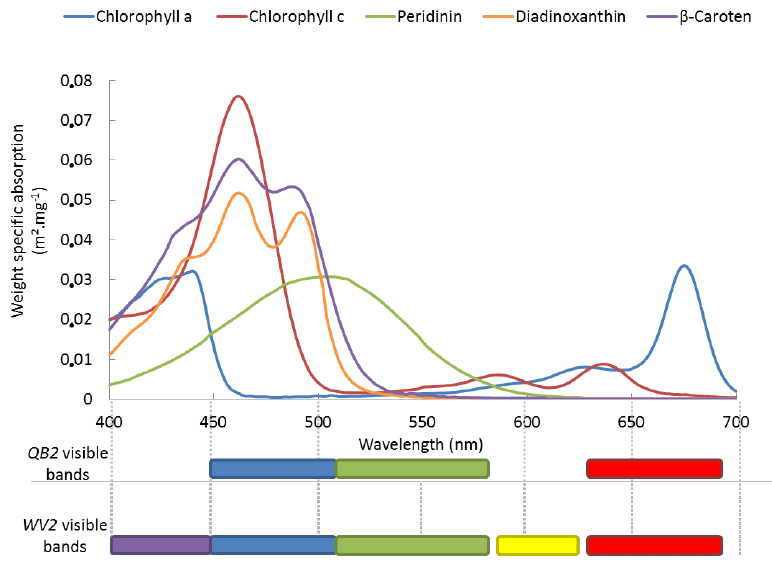
Major component of zoo's photosynthesis reaction center and it's absorption characteristics.
Transfer from peridinin to chl a is quite efficient, so they say.

Blue line is an ati blue plus.
An Iwasaki w/ heavy 490 will "fit" even better.

pcpcomplexb.JPG

Like so.. Look at all that energy being absorbed by peridinin.
Chl a and it does overlap though..
peridiwa.JPG


Coincidence? Not meaningful?
The "magic"???
Don't know

Pigment analysis showed a peridinin-to-Chl a ratio of 4. The peridinin-to-Chl a Qy energy transfer efficiency is 95% in this complex.

Reference:
Absorption-spectra-of-the-five-zooxanthellae-pigments-in-respect-to-both-spectral.png


Oddly, considering REAL ocean spectrums it is not really surprising.
 
Last edited:

Biologic

Active Member
View Badges
Joined
Aug 25, 2014
Messages
369
Reaction score
270
Location
USA
Rating - 0%
0   0   0
You do realize the opposite is true too..
MH's can never be like LED's either.

Just saying.

Any high CRI 6500k white led array with enough intensity w/ some supplementation in the blue/violet/UV range and a bit in the IR will be closer to MH than any mh would be to match an led array spectrum.
The major green mercury narrow spike and green leds being err the sloppiest spread of an led make matching impossible to some degree.

Since, pretty much from the beginning, and regardless of pr, LEDs were never designed to match MH spectrums..
Matching the crazy spikey Iwasaki isn't easy either.

Nor with the "refusal" to add more 490 greenblue diodes which is THE relative highest output nm of an Iwasaki.
:)

Iwaskis is just photons, not magic..
6500k 95 cri white cobs and 410nm viosys diodes.
Needs some work.. ;)

iwaff.jpg

completely agree, it’s not fair to compare the two together. The spikiness is pointless when you have the smooth emission curve of white LED’s. I love playing on spectra. I play around trying to add the least amount of diodes to create the ultimate spectrum at depth. If i had time and cash I’d build these.

It’s fun to think about how theoretically the proper mixture of LED exists of “5 to 10 meters below the surface” and I think we are so close to getting there commercially. That MH will look like an incandescent light bulb in comparison. A true LED replacement is coming soon. Practically speaking LED’s already are.
 

oreo54

5000 Club Member
View Badges
Joined
Sep 18, 2017
Messages
6,877
Reaction score
4,083
Rating - 0%
0   0   0
completely agree, it’s not fair to compare the two together. The spikiness is pointless when you have the smooth emission curve of white LED’s. I love playing on spectra. I play around trying to add the least amount of diodes to create the ultimate spectrum at depth. If i had time and cash I’d build these.

It’s fun to think about how theoretically the proper mixture of LED exists of “5 to 10 meters below the surface” and I think we are so close to getting there commercially. That MH will look like an incandescent light bulb in comparison. A true LED replacement is coming soon. Practically speaking LED’s already are.
Violet based emitter, phosphor pack based on depth.


Nonya

Valuable Member
View Badges
Joined
Mar 18, 2019
Messages
1,704
Reaction score
693
Location
Grand Rapids
Rating - 0%
0   0   0
It seems that the right combination and number of LEDs can closely match the spectra in #1 and #41 above, but the large difference in UVA, violet and blue for each diagram would be the big puzzle. Which would be better? Has anyone tested growth for the first one?
 

oreo54

5000 Club Member
View Badges
Joined
Sep 18, 2017
Messages
6,877
Reaction score
4,083
Rating - 0%
0   0   0

Biologic

Active Member
View Badges
Joined
Aug 25, 2014
Messages
369
Reaction score
270
Location
USA
Rating - 0%
0   0   0
Reference..
1651548347793.jpeg


Proof in the pudding. Why is there anymore debate? Why do we sit on these great articles from 2015?
 

outhouse

Valuable Member
View Badges
Joined
May 25, 2021
Messages
1,322
Reaction score
957
Location
Auburn ca
Rating - 0%
0   0   0
I hope others will chime in here
after a long time of burning coral with leds, I turned down my ocean revive black boxes to 8% blue and 1% white and growth exploded, not near MH/VHO combination, but more growth then ive seen with leds.

210g tank, and I added 2 x 5' UV bars reefbreeders new UV bars. Love the blacklight pop in morning and dawn effect.

But growth seems to have increased, over mainly blue and white with a hint of other colors.

Im probably matching your chart now pretty close, and I think its a great balance for my LPS
 

TOP 10 Trending Threads

WHAT AMOUNT OF LIVE ROCK AND SAND SHOULD BE PRIORITIZED FOR OPTIMAL BIODIVERSITY/FILTRATION?

  • 100% live rock + bagged sand

    Votes: 38 27.0%
  • 100% dry rock + 100% live sand

    Votes: 47 33.3%
  • 50/50 live/dry rock, 50/50 live/bagged sand

    Votes: 32 22.7%
  • 75% live rock, 25% live sand

    Votes: 14 9.9%
  • 25% live rock, 75% live sand

    Votes: 10 7.1%
Back
Top