Lawnmower Blenny Not Eating/Lethargic

Arruna

Active Member
View Badges
Joined
Dec 9, 2020
Messages
113
Reaction score
77
Location
usa
Rating - 0%
0   0   0
My lawnmower blenny, got him in December of 2020 has always been very active, and happy eater. He eats nori sheets and frozen meats and veggie. Also pics at rocks in a 150 gal.

Yesterday I noticed he didnt come out to eat, he just chilled in the rocks. Acting normal except not coming to eat. Which is very unlike him. Today he seems very lethargic, laying in the sand bed. Still very alert, but still not eating. Hes always breathing kinda fast, but this seems even quicker then normal. His belly looks very fat, but I don't think bloated, do you? Im confident I can catch him and treat, but I dont know what for.

All other fish are fine. (trigger, angel, clowns, wrasses, leopard wrasse, goby, tang)

Just did a water check:
Am: 0
Nitrate: 2
Salt: 1.025
Temp: 78.3-78.9
DKH: 8
Cal: 470 20210901_131255.jpg
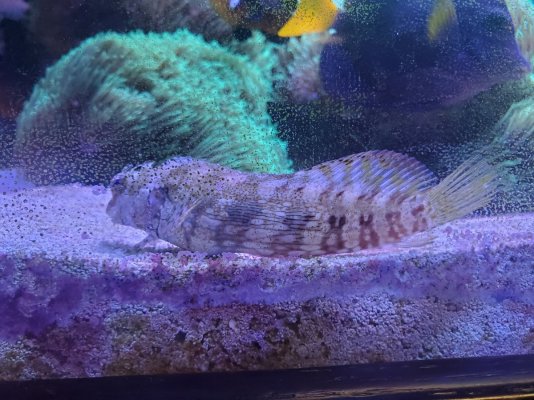

 

Attachments

  • 20210901_131259.mp4
    19.3 MB

vetteguy53081

Well known Member and monster tank lover
View Badges
Joined
Aug 11, 2013
Messages
108,108
Reaction score
242,675
Location
Wisconsin -
Rating - 100%
17   0   0
These blennies pound the substrate with their flexible jaws and comb-like teeth. While they do eat some algae (the amount varies from one species to the next), recent studies have shown their primary source of food is detritus in the form of detrital aggregates. Because detritus is often overlooked in food-habit studies, its importance as Salarias food has long been overlooked.
These blennies scrape this material off hard surfaces (e.g., coral rock, dead coral skeletons), along with some algae. They will also incidentally ingest tiny invertebrates. For example, the diet of The lawnmower has been reported to include filamentous algae, diatoms, foraminiferans (shelled protozoa), tiny crustaceans, detritus, and sand.
On occasion, this species will also consume fish eggs, sponges, and small snails. They ingest a significant amount of calcium carbonate as they feed, which is not uncommon for herbivores with less selective feeding tactics. While many of the Lawnmowers eat some algae, some steer away from the filamentous forms that can overgrow our aquariums
 
OP
OP
Arruna

Arruna

Active Member
View Badges
Joined
Dec 9, 2020
Messages
113
Reaction score
77
Location
usa
Rating - 0%
0   0   0
These blennies pound the substrate with their flexible jaws and comb-like teeth. While they do eat some algae (the amount varies from one species to the next), recent studies have shown their primary source of food is detritus in the form of detrital aggregates. Because detritus is often overlooked in food-habit studies, its importance as Salarias food has long been overlooked.
These blennies scrape this material off hard surfaces (e.g., coral rock, dead coral skeletons), along with some algae. They will also incidentally ingest tiny invertebrates. For example, the diet of The lawnmower has been reported to include filamentous algae, diatoms, foraminiferans (shelled protozoa), tiny crustaceans, detritus, and sand.
On occasion, this species will also consume fish eggs, sponges, and small snails. They ingest a significant amount of calcium carbonate as they feed, which is not uncommon for herbivores with less selective feeding tactics. While many of the Lawnmowers eat some algae, some steer away from the filamentous forms that can overgrow our aquariums

That's good information, but really isnt prevalent to the topic at hand...
 

rhostam

Well-Known Member
View Badges
Joined
Oct 12, 2020
Messages
810
Reaction score
1,009
Location
Aurora
Rating - 0%
0   0   0
Mine does this occasionally. I'd be curious what others say as I'd like to know also. When mine does do this (sporadically) he eventually moves from where he is perched (bottom/rocks) and starts swimming up and down (straight up and down) the water column usually in a corner near flow. He poops while doing so. I assumed he was constipated since he always resumes his busy body feeding after going through this. HE IS ALWAYS SCRAPING SOMETHING. Following along.
 
OP
OP
Arruna

Arruna

Active Member
View Badges
Joined
Dec 9, 2020
Messages
113
Reaction score
77
Location
usa
Rating - 0%
0   0   0
Mine does this occasionally. I'd be curious what others say as I'd like to know also. When mine does do this (sporadically) he eventually moves from where he is perched (bottom/rocks) and starts swimming up and down (straight up and down) the water column usually in a corner near flow. He poops while doing so. I assumed he was constipated since he always resumes his busy body feeding after going through this. HE IS ALWAYS SCRAPING SOMETHING. Following along.
That makes me feel better. I hope this is the case. His belly is very full so that would make alot of since. No fish bothers him. But he's fine swimming when needs too. Very alert. Fingers crossed this is the case!!
 

vetteguy53081

Well known Member and monster tank lover
View Badges
Joined
Aug 11, 2013
Messages
108,108
Reaction score
242,675
Location
Wisconsin -
Rating - 100%
17   0   0
That's good information, but really isnt prevalent to the topic at hand...
If you haven’t gathered, they fill their faces constantly and do require an occasional break. In stirring detritus, it can have an adverse affect with water quality, so assure no rise in ammonia and nitrate levels
 

Fish Think Pink

5000 Club Member
View Badges
Joined
Mar 6, 2021
Messages
5,808
Reaction score
26,113
Location
DFW Texas
Rating - 0%
0   0   0
That makes me feel better. I hope this is the case. His belly is very full so that would make alot of since. No fish bothers him. But he's fine swimming when needs too. Very alert. Fingers crossed this is the case!!
@Arruna How did this turn out for you and your fish?
 

zuri

Well-Known Member
View Badges
Joined
Aug 11, 2017
Messages
673
Reaction score
388
Rating - 0%
0   0   0
the problem is a pinched belly should be fat if you look closely you can see
3b7d60fc_004.jpg
you're mistaking that first hump for his stomach which its not this fat lil guy is fed
 

TOP 10 Trending Threads

WHAT AMOUNT OF LIVE ROCK AND SAND SHOULD BE PRIORITIZED FOR OPTIMAL BIODIVERSITY/FILTRATION?

  • 100% live rock + bagged sand

    Votes: 38 26.6%
  • 100% dry rock + 100% live sand

    Votes: 48 33.6%
  • 50/50 live/dry rock, 50/50 live/bagged sand

    Votes: 32 22.4%
  • 75% live rock, 25% live sand

    Votes: 15 10.5%
  • 25% live rock, 75% live sand

    Votes: 10 7.0%
Back
Top