Let Me ID Your Wrasse!

  • Thread starter Thread starter evolved
  • Start date Start date
  • Tagged users Tagged users None
Status
Not open for further replies.
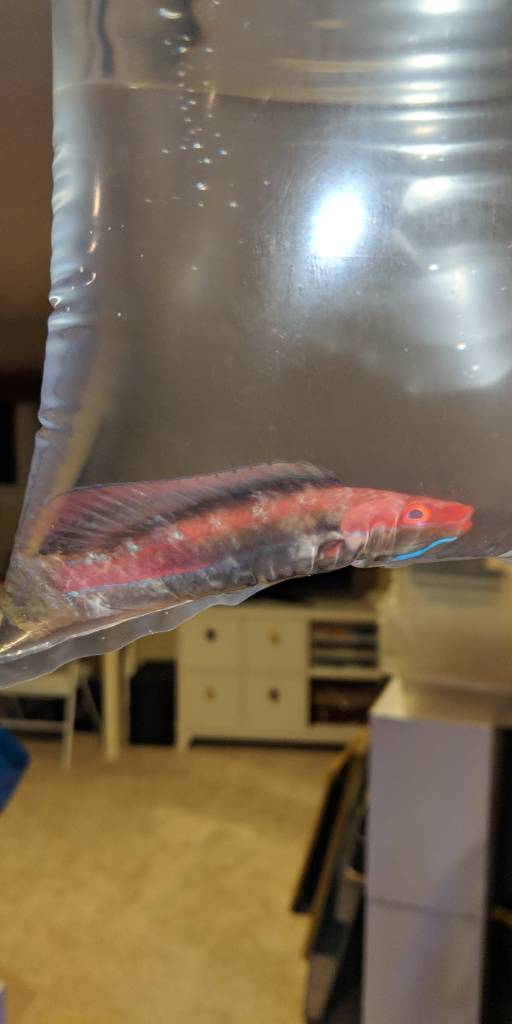
Right, it should continue to progress and eventually reach terminal male, and look something similar to Liveaquaria's photo: https://www.liveaquaria.com/product/1153/bluehead-fairy-wrasse?pcatid=1153&c=15+1378+1153

Some examples of terminal males in this article, there are some color variations but all develop the namesake green/blue "hood":
https://reefbuilders.com/2015/06/22/fairy-wrasses-cyanopleura-group/

Wow, thanks for the information. Some of the variations are really cool. Honestly, they're all beautiful. Can't wait to see what mine transitions to! I also saw what the females look like, does the presence of a female affect this transition at all?

 
does the presence of a female affect this transition at all?
It can speed it up, but in captivity it'd also be likely to result in both fish transitioning, and then problems tend to arise.
 
Yeah, I'm afraid that may have happened with my clowns (to female). They've been together for years, but now the supposed "male" has grown to be bigger than the supposed "female". I'm not really sure what to make of it, but I know that this is not the place for clownfish discussion.
 
One of my earlier mistakes was thinking I could try to create a harem of flame wrasses by purchasing three females. All three were male or well on their way within a few months, and I had to re-home two.
 
Unidentified fairy wrasse at a local shop that I just picked up.
19bc1c9aac740be3b330eb21e5599c15.jpg
 
The first one seems to be a female exquisitus for What I have seen on the web.
 
I’m awful at ID’ing females, but for sure can tell you the last one is a red spotted dottyback, not a wrasse. They are semi-aggressive.
 
Hi
Can you help me ID these beauties


Thanks

First one could be a female of the lubbocki complex; could also be a female pylei or maybe even rubripinnis. Would require good pictures over a video.
Same situaiton with #2. It's a transitional male Paracheilinus of either mccoskeri, carpenteri, or flavianalis - would need to see the dorsal and anal fins in a picture to determine.
And the last one:
I’m awful at ID’ing females, but for sure can tell you the last one is a red spotted dottyback, not a wrasse. They are semi-aggressive.
Yeah, that.
 
Is it just me or do the linespot and blue flasher wrasse look the exact same? I got a linespot flasher from LA but after they put a hippo tang in the bag that was labeled for a yellowfin flasher wrasse, I am not confident at all.

Any specific ways to tell the difference? I will try to get some pictures and a video later of it. I would love to get a blue flasher wrasse too along with my linespot if possible in my 180 gallon DT, I just want to make sure I actually have a linespot and not a blue flasher.
 
Status
Not open for further replies.

TOP 10 Trending Threads

WHEN PLANNING CORAL PLACEMENT, WHAT USUALLY WINS? THE FUTURE COLONY, OR THE NEXT FRAG?

  • I leave plenty of open space for large future colonies

    Votes: 3 21.4%
  • I plan for growth...but occasionally squeeze coral into tight spaces

    Votes: 5 35.7%
  • I try to balance future growth with variety now

    Votes: 4 28.6%
  • I fit in as many frags as I reasonably can

    Votes: 3 21.4%
  • One more frag always wins! Future me can solve the problem...

    Votes: 0 0.0%
  • It depends on the coral and how quickly it grows

    Votes: 1 7.1%
  • I squeeze 'em in! Survival of the fittest, baby!!

    Votes: 0 0.0%
  • I’m already out of room, so apparently we know my answer...

    Votes: 1 7.1%
Back
Top
Home
Post thread…
Market
What's new