


Reef-pi build with DIY dosing pumps

babrooks

New Member
View Badges
Joined
Feb 28, 2020
Messages
22
Reaction score
41
Rating - 0%
0   0   0
Here are some photos of my LPS tank build. I have been slowly putting it together over the last ten months or so. The post is a tribute to @Ranjib and the rest of the reef-pi dev team. You guys are fantastic! Thanks for enabling such a fun and educational project.

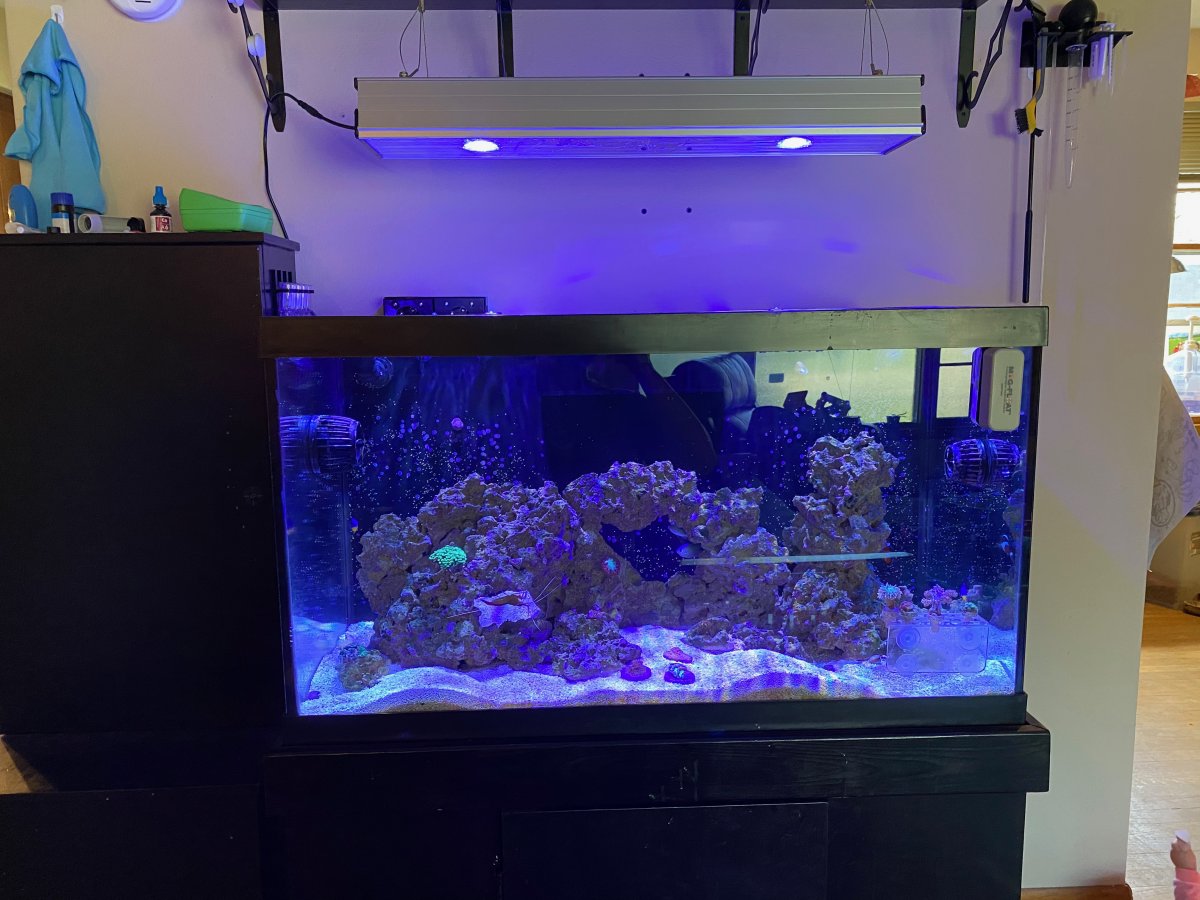
The display tank is a 53 gallon Marineland. I cut return and overflow holes in the back. The overflow is a beauty I got from from Modular Marine.
IMG_1222.jpeg

The tank seems to have finally stabilized and most of the coral are growing quite nicely. The duncan seemed especially happy today. Pink and purple coralline growing all over the rocks and back glass.

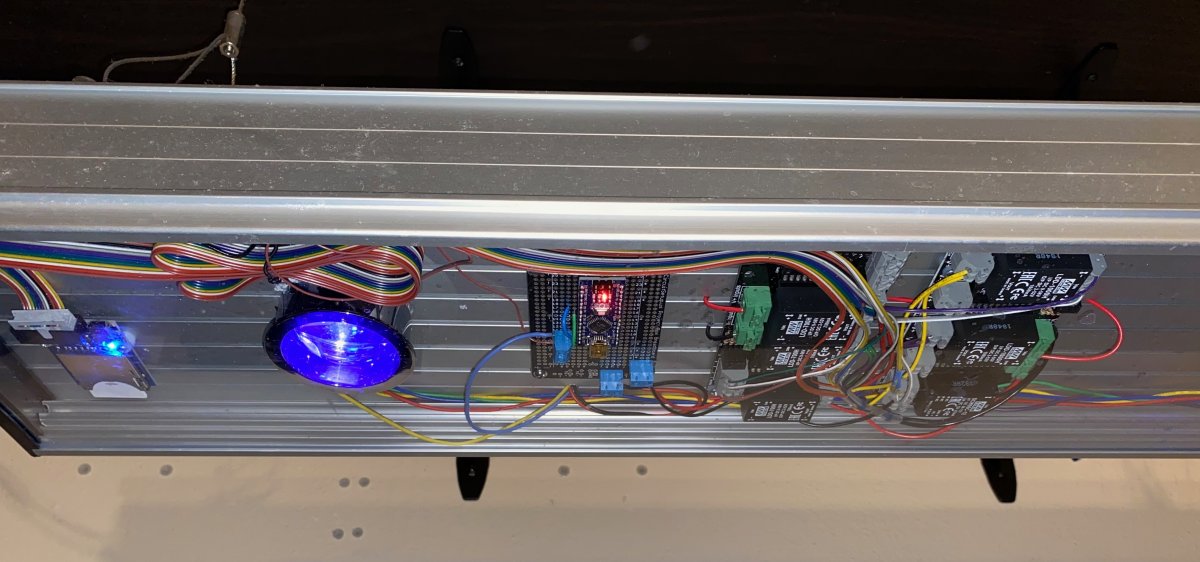
The DIY light is 2x lumia pucks from ledgroupbuy, meanwell drivers, a bluefish controller, and an Arduino nano changing the frequency of the PWM for the cooling fans (on top of the MakersLED heatsink). The boards for the drivers are from rapidled. I'm planing to switch the control over to the reef-pi eventually. Here is a closeup:
IMG_1237 (1).jpeg


Here is the sump in the cabinet underneath the tank, made from a 20 gal high. Lots of 3d-printed brackets for the ATO, ph probe, water level sensors, dosing lines, etc. Designed in OpenSCAD and printed in PETG on a modified Ender 3. My DIY upflow algae scrubber is on the right (still not quite working as intended). There are lights in the cabinet controlled with a reed switch on the door, to a relay in the electronics cabinet.
IMG_1221.jpeg


Here is the electronics cabinet I made at a local woodshop, with the ATO reservoir on the bottom. I have the reservoir fed from a line that goes straight to the RODI, under the kitchen sink.
IMG_1220 (1).jpeg


Here is a closeup of the upper cabinet.
IMG_1219 (1).jpeg

There's the MP10 driver (MP40 driver is mounted outside for easy access); battery backup for the vortechs; reef-octopus skimmer and return pump; MeanWell PSUs (48v and 24v) running everything but the skimmer and return; exhaust fans; driver for the dosing pumps; the reef-pi and relay box. The relay box is the first thing I built; it's slated for replacement with a new 3d printed enclosure that should be safer and easier to maintain. Will post pictures when that's done. Here is a closeup of the reef-pi:
IMG_1223 (1).jpeg

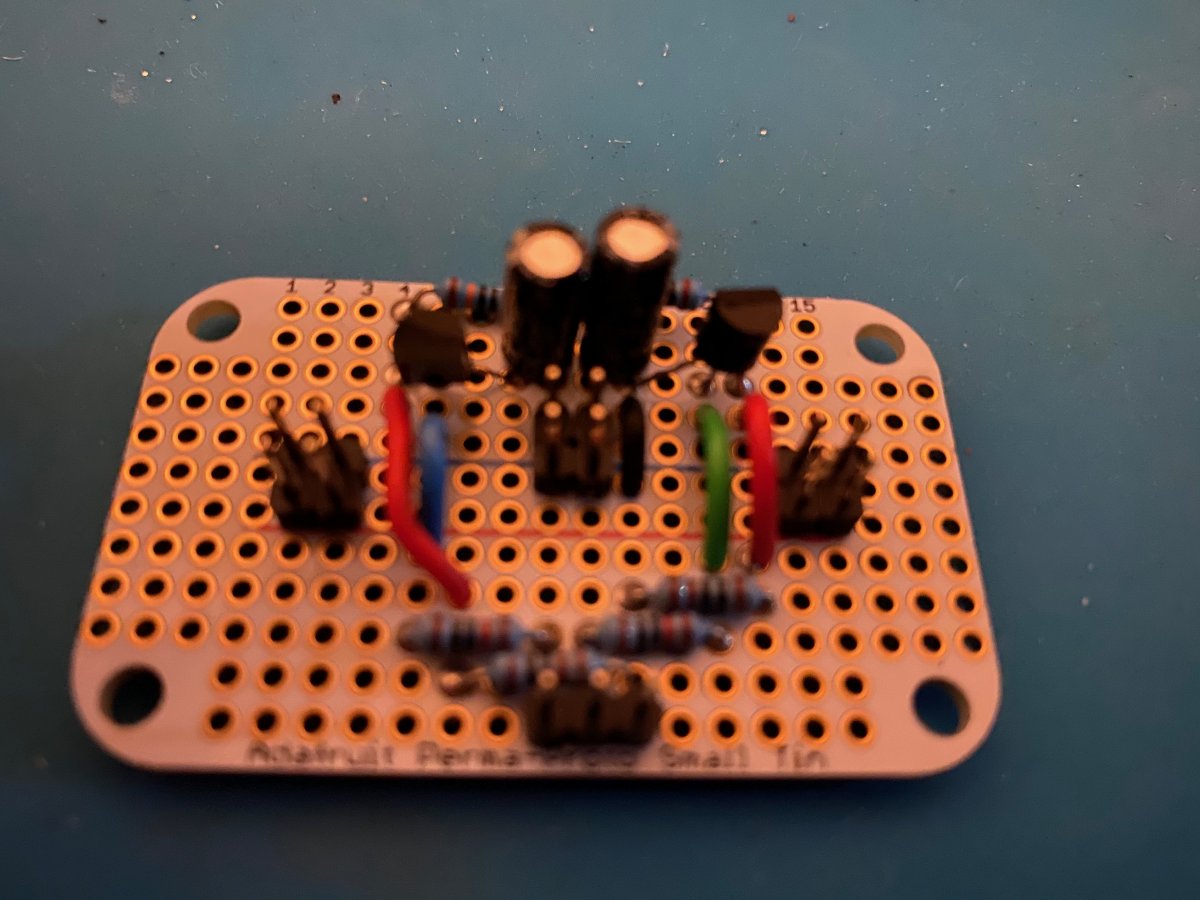
The rj45 connectors are on little breakout boards I designed in Eagle and had printed by OSH Park. Only one is currently in use, for the dosing pumps, but eventually they'll also go to the lights and new relay box. The layout of the pi box has gone through several iterations. Right now the pca9685 is just running the pumps. Eventually it will also run the lights. It used to run this little RC filter, sending 10v analog signals to the skimmer and return pump:
IMG_1238.jpeg

I was going to use the lighting module to change the speed of the return pump to hold water in the return line during feeding, but I couldn't figure out a way to do this with macros, so I took the part out to make room. Might add it back in when macros can control light profiles, or when I figure out how to do it with the current software.

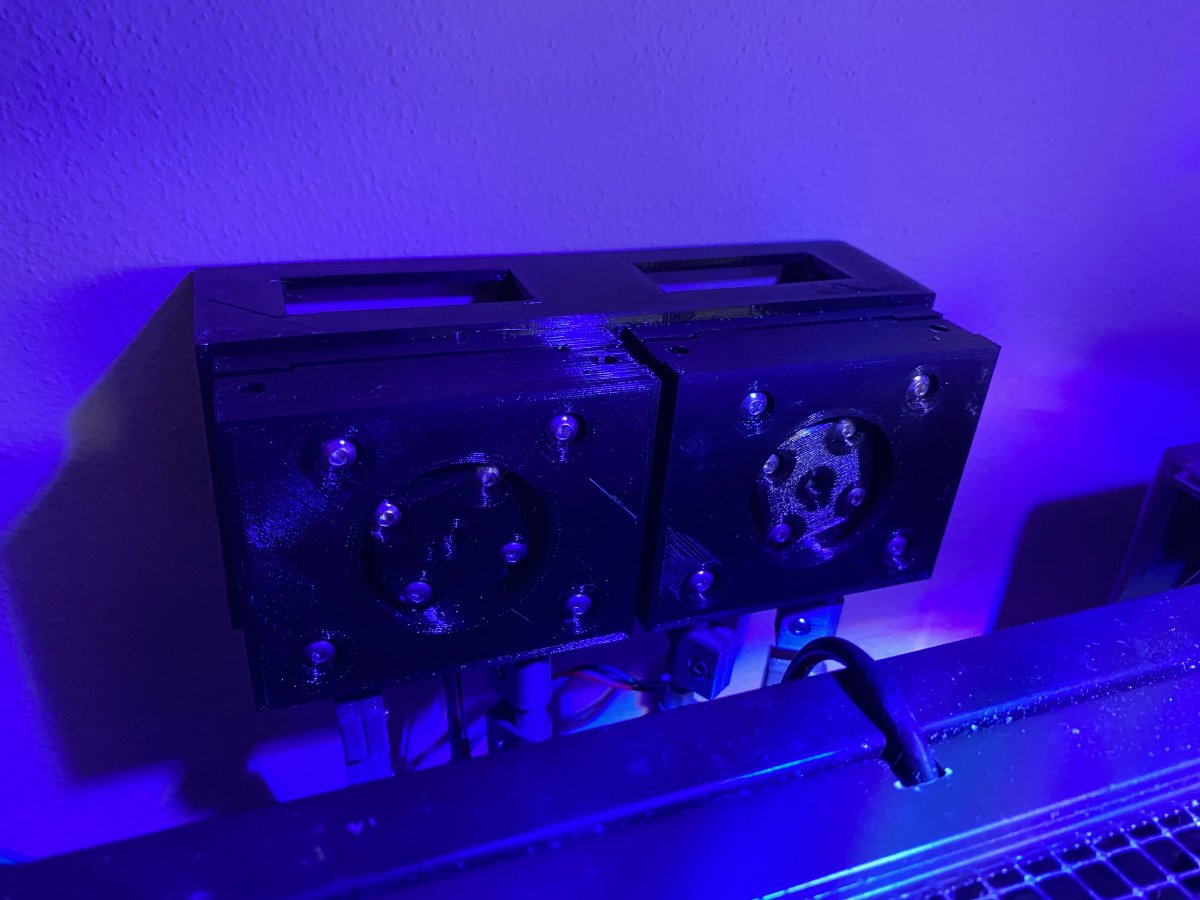
Here are the dosing pumps:
IMG_1218.jpeg

They are based on a beautiful design on thingiverse for a NEMA17 compatible peristaltic pump head. But I redesigned it from scratch in OpenSCAD so that it has an adjustable pressure plate for the hose, 4 rollers instead of 3, and a stronger roller carriage. Right now they're just dosing BRS two part. They've been running for a few days and I'm very pleased with the result, much easier to control than kalkwasser in the ATO. I'm planning to print more pumps for magnesium and auto water changes.

Here is the pump driver setup:
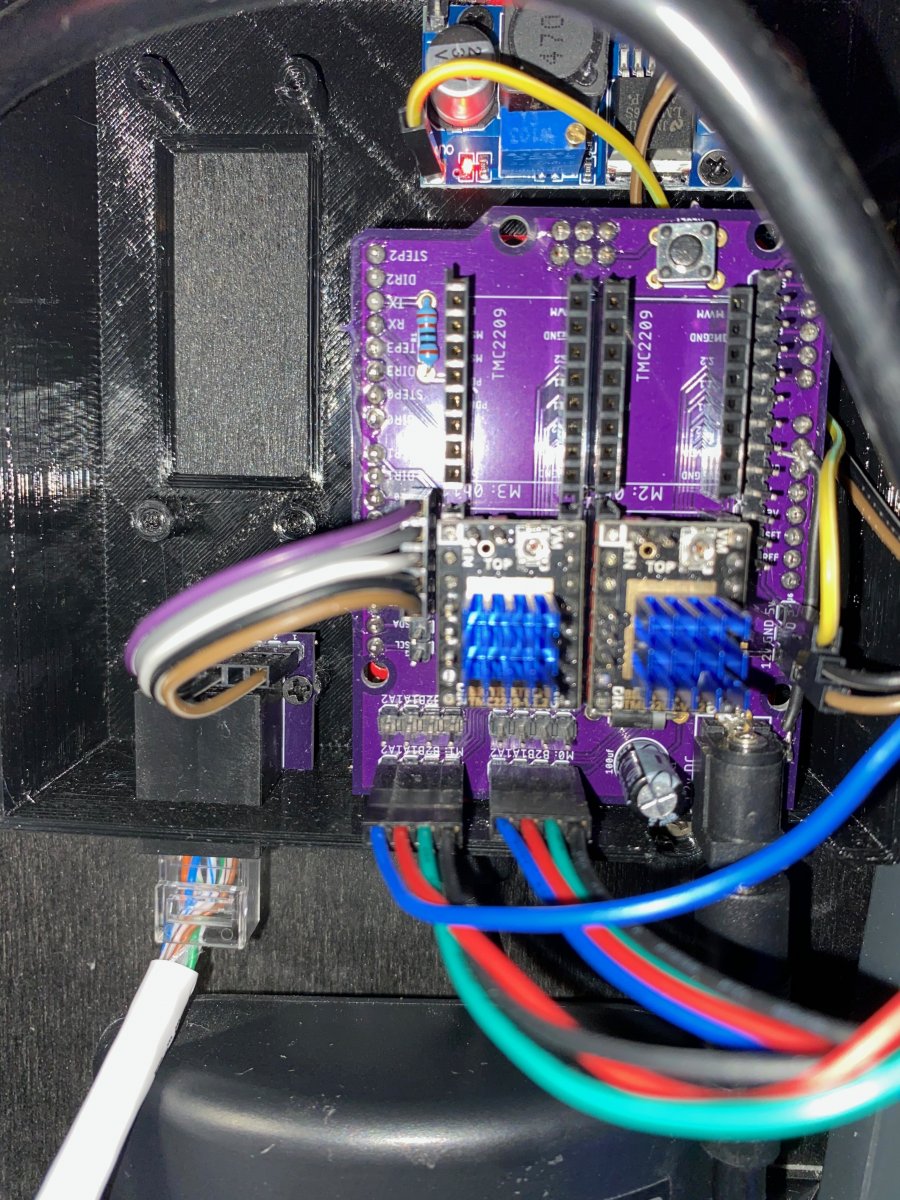
IMG_1225.jpeg

On top is an Arduino UNO hat I designed in Eagle and had printed by OSH Park. Underneath is a Sparkfun Redboard. The whole setup runs on 24v from the MeanWell PSU, with the LM2596 powering the Arduino. It can control 4 TMC2209's over UART, but only two are in use right now. I programmed the Arduino to just read the PWM signal from the pi (coming over the cat6 cable) every 1/10 second and adjusts the speed of the pumps accordingly. It would be great to eventually add drivers in reef-pi to directly control Arduino over i2c so that people can easily create Arduino-based peripherals like pumps and auto feeders. I read through the driver code that the devs have already wrote and may even try implement it myself, if I can find some time to learn Go :)

Thanks again for making reef-pi! It helped me to learn to develop so many fun and interesting skills. Keep up the great work!
 
Last edited:

Michael Lane

Well-Known Member
View Badges
Joined
Aug 11, 2018
Messages
677
Reaction score
1,121
Rating - 0%
0   0   0
Wow! That's a tremendous set up with plenty to study and little bit of everything going on!

reef-pi drivers are much easier to add now. Reach out if you have any questions getting things set up or reef-pi code in general.
 
OP
OP
B

babrooks

New Member
View Badges
Joined
Feb 28, 2020
Messages
22
Reaction score
41
Rating - 0%
0   0   0
Thanks! The forum and various build guides are so comprehensive, I've basically been able to answer every question with only a tiny bit of digging. I did set up the reef-pi development environment on a test pi zero and started reading the examples for the tp-link. I do a fair bit of coding in C++, so Go syntax is not that hard to parse. For my immediate application, reading the PWM signal from the doser seems to work just fine, but I think it would be a great to implement a general purpose driver for Arduino (or the TMC stepper drivers for that matter).

I would love to know if there is a way to control lighting intensity/profiles with macros. It seems like that would open up some nice possibilities, e.g., switching to a photo mode for lights, or changing a pump speed during feeding. If not, I might do some digging to see how hard it is to implement that feature as well.
 

Michael Lane

Well-Known Member
View Badges
Joined
Aug 11, 2018
Messages
677
Reaction score
1,121
Rating - 0%
0   0   0
Thanks! The forum and various build guides are so comprehensive, I've basically been able to answer every question with only a tiny bit of digging. I did set up the reef-pi development environment on a test pi zero and started reading the examples for the tp-link. I do a fair bit of coding in C++, so Go syntax is not that hard to parse. For my immediate application, reading the PWM signal from the doser seems to work just fine, but I think it would be a great to implement a general purpose driver for Arduino (or the TMC stepper drivers for that matter).

I would love to know if there is a way to control lighting intensity/profiles with macros. It seems like that would open up some nice possibilities, e.g., switching to a photo mode for lights, or changing a pump speed during feeding. If not, I might do some digging to see how hard it is to implement that feature as well.
I'm not aware of any way for macros to change the lighting intensities. I think that would be a great feature on the lights themselves. At this time, they basically only support a single profile and manual mode. You can switch between the two, but you would have to tweak the manual values every time.

Adding multiple profiles would be a significant change since it would hit the UI, API, and DB. I think it would be a good improvement though. It might also be a good way to move toward automating seasonal lighting patterns too.
 
OP
OP
B

babrooks

New Member
View Badges
Joined
Feb 28, 2020
Messages
22
Reaction score
41
Rating - 0%
0   0   0
My tank has a lot of DIY, but your DIY automation puts mine to shame. I like how you have one long distance shot of the display tank and 3 pages of equipment photos. :)

What batteries are you using for the backup and how does it switch over?
I do love the aesthetic beauty of the tank, but it's also true that a lot of the enjoyment from the project has been learning about physics and biology and chemistry and engineering :)

They are just 12v 18ah lead acid batteries in parallel, hooked up to a float charger. I followed someone else's guide for a simple setup to replicate Ecotech's own battery backup solution, at a quarter of the cost. The Vortechs have internal circuitry to switch over to battery power if the mains go out. I thought about adding a 24v battery backup for the return pump and skimmer (and maybe even the reef-pi), with two of these batteries in series. Could also be done with a boost converter (or a buck converter to step down for the Vortechs, which need 12v). I'd have to rig up a circuit to switch over the power. I was thinking of just using a mechanical relay with a signal produced by a PSU that's on mains power, with mains power on the NO side and the battery on NC. It would cause the power to drop out for a fraction of a second (which might cause the pi to reboot) but I don't think that would be a major issue. I haven't done it mainly because the cabinet is full and the powerheads should be sufficient to keep the coral and fish from suffocating until the mains come back on. I have only ever lost power for less than a day, and these batteries would keep the powerheads going for two or three.
 
Last edited:

theatrus

Valuable Member
View Badges
Joined
Mar 26, 2016
Messages
2,253
Reaction score
3,603
Location
Sacramento, CA area
Rating - 0%
0   0   0
Here are some photos of my LPS tank build. I have been slowly putting it together over the last ten months or so. The post is a tribute to @Ranjib and the rest of the reef-pi dev team. You guys are fantastic! Thanks for enabling such a fun and educational project.

The display tank is a 53 gallon Marineland. I cut return and overflow holes in the back. The overflow is a beauty I got from from Modular Marine.
IMG_1222.jpeg

The tank seems to have finally stabilized and most of the coral are growing quite nicely. The duncan seemed especially happy today. Pink and purple coralline growing all over the rocks and back glass.

The DIY light is 2x lumia pucks from ledgroupbuy, meanwell drivers, a bluefish controller, and an Arduino nano changing the frequency of the PWM for the cooling fans (on top of the MakersLED heatsink). The boards for the drivers are from rapidled. I'm planing to switch the control over to the reef-pi eventually. Here is a closeup:
IMG_1237 (1).jpeg


Here is the sump in the cabinet underneath the tank, made from a 20 gal high. Lots of 3d-printed brackets for the ATO, ph probe, water level sensors, dosing lines, etc. Designed in OpenSCAD and printed in PETG on a modified Ender 3. My DIY upflow algae scrubber is on the right (still not quite working as intended). There are lights in the cabinet controlled with a reed switch on the door, to a relay in the electronics cabinet.
IMG_1221.jpeg


Here is the electronics cabinet I made at a local woodshop, with the ATO reservoir on the bottom. I have the reservoir fed from a line that goes straight to the RODI, under the kitchen sink.
IMG_1220 (1).jpeg


Here is a closeup of the upper cabinet.
IMG_1219 (1).jpeg

There's the MP10 driver (MP40 driver is mounted outside for easy access); battery backup for the vortechs; reef-octopus skimmer and return pump; MeanWell PSUs (48v and 24v) running everything but the skimmer and return; exhaust fans; driver for the dosing pumps; the reef-pi and relay box. The relay box is the first thing I built; it's slated for replacement with a new 3d printed enclosure that should be safer and easier to maintain. Will post pictures when that's done. Here is a closeup of the reef-pi:
IMG_1223 (1).jpeg

The rj45 connectors are on little breakout boards I designed in Eagle and had printed by OSH Park. Only one is currently in use, for the dosing pumps, but eventually they'll also go to the lights and new relay box. The layout of the pi box has gone through several iterations. Right now the pca9685 is just running the pumps. Eventually it will also run the lights. It used to run this little RC filter, sending 10v analog signals to the skimmer and return pump:
IMG_1238.jpeg

I was going to use the lighting module to change the speed of the return pump to hold water in the return line during feeding, but I couldn't figure out a way to do this with macros, so I took the part out to make room. Might add it back in when macros can control light profiles, or when I figure out how to do it with the current software.

Here are the dosing pumps:
IMG_1218.jpeg

They are based on a beautiful design on thingiverse for a NEMA17 compatible peristaltic pump head. But I redesigned it from scratch in OpenSCAD so that it has an adjustable pressure plate for the hose, 4 rollers instead of 3, and a stronger roller carriage. Right now they're just dosing BRS two part. They've been running for a few days and I'm very pleased with the result, much easier to control than kalkwasser in the ATO. I'm planning to print more pumps for magnesium and auto water changes.

Here is the pump driver setup:
IMG_1225.jpeg

On top is an Arduino UNO hat I designed in Eagle and had printed by OSH Park. Underneath is a Sparkfun Redboard. The whole setup runs on 24v from the MeanWell PSU, with the LM2596 powering the Arduino. It can control 4 TMC2209's over UART, but only two are in use right now. I programmed the Arduino to just read the PWM signal from the pi (coming over the cat6 cable) every 1/10 second and adjusts the speed of the pumps accordingly. It would be great to eventually add drivers in reef-pi to directly control Arduino over i2c so that people can easily create Arduino-based peripherals like pumps and auto feeders. I read through the driver code that the devs have already wrote and may even try implement it myself, if I can find some time to learn Go :)

Thanks again for making reef-pi! It helped me to learn to develop so many fun and interesting skills. Keep up the great work!

Very nice pump setup. Always happy to try to help with writing a driver from scratch to avoid the need to read a PWM :)
 

Ranjib

7500 Club Member
View Badges
Joined
Apr 16, 2016
Messages
9,876
Reaction score
16,680
Location
Pleasant Hill, Concord
Rating - 0%
0   0   0
Here are some photos of my LPS tank build. I have been slowly putting it together over the last ten months or so. The post is a tribute to @Ranjib and the rest of the reef-pi dev team. You guys are fantastic! Thanks for enabling such a fun and educational project.

The display tank is a 53 gallon Marineland. I cut return and overflow holes in the back. The overflow is a beauty I got from from Modular Marine.
IMG_1222.jpeg

The tank seems to have finally stabilized and most of the coral are growing quite nicely. The duncan seemed especially happy today. Pink and purple coralline growing all over the rocks and back glass.

The DIY light is 2x lumia pucks from ledgroupbuy, meanwell drivers, a bluefish controller, and an Arduino nano changing the frequency of the PWM for the cooling fans (on top of the MakersLED heatsink). The boards for the drivers are from rapidled. I'm planing to switch the control over to the reef-pi eventually. Here is a closeup:
IMG_1237 (1).jpeg


Here is the sump in the cabinet underneath the tank, made from a 20 gal high. Lots of 3d-printed brackets for the ATO, ph probe, water level sensors, dosing lines, etc. Designed in OpenSCAD and printed in PETG on a modified Ender 3. My DIY upflow algae scrubber is on the right (still not quite working as intended). There are lights in the cabinet controlled with a reed switch on the door, to a relay in the electronics cabinet.
IMG_1221.jpeg


Here is the electronics cabinet I made at a local woodshop, with the ATO reservoir on the bottom. I have the reservoir fed from a line that goes straight to the RODI, under the kitchen sink.
IMG_1220 (1).jpeg


Here is a closeup of the upper cabinet.
IMG_1219 (1).jpeg

There's the MP10 driver (MP40 driver is mounted outside for easy access); battery backup for the vortechs; reef-octopus skimmer and return pump; MeanWell PSUs (48v and 24v) running everything but the skimmer and return; exhaust fans; driver for the dosing pumps; the reef-pi and relay box. The relay box is the first thing I built; it's slated for replacement with a new 3d printed enclosure that should be safer and easier to maintain. Will post pictures when that's done. Here is a closeup of the reef-pi:
IMG_1223 (1).jpeg

The rj45 connectors are on little breakout boards I designed in Eagle and had printed by OSH Park. Only one is currently in use, for the dosing pumps, but eventually they'll also go to the lights and new relay box. The layout of the pi box has gone through several iterations. Right now the pca9685 is just running the pumps. Eventually it will also run the lights. It used to run this little RC filter, sending 10v analog signals to the skimmer and return pump:
IMG_1238.jpeg

I was going to use the lighting module to change the speed of the return pump to hold water in the return line during feeding, but I couldn't figure out a way to do this with macros, so I took the part out to make room. Might add it back in when macros can control light profiles, or when I figure out how to do it with the current software.

Here are the dosing pumps:
IMG_1218.jpeg

They are based on a beautiful design on thingiverse for a NEMA17 compatible peristaltic pump head. But I redesigned it from scratch in OpenSCAD so that it has an adjustable pressure plate for the hose, 4 rollers instead of 3, and a stronger roller carriage. Right now they're just dosing BRS two part. They've been running for a few days and I'm very pleased with the result, much easier to control than kalkwasser in the ATO. I'm planning to print more pumps for magnesium and auto water changes.

Here is the pump driver setup:
IMG_1225.jpeg

On top is an Arduino UNO hat I designed in Eagle and had printed by OSH Park. Underneath is a Sparkfun Redboard. The whole setup runs on 24v from the MeanWell PSU, with the LM2596 powering the Arduino. It can control 4 TMC2209's over UART, but only two are in use right now. I programmed the Arduino to just read the PWM signal from the pi (coming over the cat6 cable) every 1/10 second and adjusts the speed of the pumps accordingly. It would be great to eventually add drivers in reef-pi to directly control Arduino over i2c so that people can easily create Arduino-based peripherals like pumps and auto feeders. I read through the driver code that the devs have already wrote and may even try implement it myself, if I can find some time to learn Go :)

Thanks again for making reef-pi! It helped me to learn to develop so many fun and interesting skills. Keep up the great work!
Wow... this is mind blowing., Thank you so much for the kind words.
 

92Miata

Valuable Member
View Badges
Joined
Feb 26, 2020
Messages
1,523
Reaction score
2,358
Location
Richmond, VA
Rating - 0%
0   0   0
They are based on a beautiful design on thingiverse for a NEMA17 compatible peristaltic pump head. But I redesigned it from scratch in OpenSCAD so that it has an adjustable pressure plate for the hose, 4 rollers instead of 3, and a stronger roller carriage. Right now they're just dosing BRS two part. They've been running for a few days and I'm very pleased with the result, much easier to control than kalkwasser in the ATO. I'm planning to print more pumps for magnesium and auto water changes.

On top is an Arduino UNO hat I designed in Eagle and had printed by OSH Park. Underneath is a Sparkfun Redboard. The whole setup runs on 24v from the MeanWell PSU, with the LM2596 powering the Arduino. It can control 4 TMC2209's over UART, but only two are in use right now. I programmed the Arduino to just read the PWM signal from the pi (coming over the cat6 cable) every 1/10 second and adjusts the speed of the pumps accordingly. It would be great to eventually add drivers in reef-pi to directly control Arduino over i2c so that people can easily create Arduino-based peripherals like pumps and auto feeders. I read through the driver code that the devs have already wrote and may even try implement it myself, if I can find some time to learn Go :)

Thanks again for making reef-pi! It helped me to learn to develop so many fun and interesting skills. Keep up the great work!
Just ran across this (looking at DIY dosing pump designs as my 3d Printer should arrive today!) - definitely cool.


Would it make more sense to swap the Arduino out for something like an ESP8266 (mostly compatible) and just talk via HTTP/REST?
 
OP
OP
B

babrooks

New Member
View Badges
Joined
Feb 28, 2020
Messages
22
Reaction score
41
Rating - 0%
0   0   0
Just ran across this (looking at DIY dosing pump designs as my 3d Printer should arrive today!) - definitely cool.


Would it make more sense to swap the Arduino out for something like an ESP8266 (mostly compatible) and just talk via HTTP/REST?

Good for you! 3d printing is a great hobby, lots to learn. And as I've discovered, there is huge complementarity with reefing :)

The ESP8266 is an interesting suggestion. The Uno is definitely overkill and a smaller microcontroller would suffice. I have been designing a smaller TMC2209 breakout board that doesn't have the Uno form factor and could be used with lots of microcontrollers. UART is needed to control the TMC2209's, and with the current analog interface with the Pi, I need one digital input pin per doser that is controlled. The long term goal was to write a driver for reef-pi to communicate with Arduino over i2c, so that only four pins would be needed, but I still haven't had time to work on the i2c driver...

I don't know very much about the ESP8266, but evidently it supports UART? I kind of like the idea of a wired connection to the reef-pi for reliability, but perhaps this concern is overblown. Would be very happy to collaborate on improvements to the reef-pi/doser interface!
 
OP
OP
B

babrooks

New Member
View Badges
Joined
Feb 28, 2020
Messages
22
Reaction score
41
Rating - 0%
0   0   0
The pumps have been running for three months now. Initially there was a lot of air in the line but I fixed that with some collars I printed to help the silicone tubing seal around the barb unions. Since then, no issues with bubbles, and it's been keeping my alk rock steady at 8.5. I printed more pumps to set up auto water change (and I have been further refining the pump design), but will probably only implement that after I move the tank to a new home in a month and a half.

The new relay box has also been up and running for a couple of months:
99772D39-CE54-4333-8653-7E9C61583410_1_105_c.jpeg


250CC717-2EA7-4F60-9F4D-9F0F386A5663_1_105_c.jpeg

8E5CC7E6-ADB6-4DB3-A455-F5776670E6F5_1_105_c.jpeg

All the pumps and powerheads are now running on a single 24v meanwell PSU, and controlled via relays from the pi. I think this will be much easier to maintain if a relay goes. Long term, I should probably set up a solid-state relay for the heater, since that puts the most wear on the relays.

Tank inhabitants seem very happy. I rearranged the rock work a bit to spread things out:
1CCA4995-6C76-4B92-8D11-6B5F42AA4A74_1_105_c.jpeg

New sand sifting goby is keeping the sandbed pristine but has his own ideas about landscaping :)

A few of the corals were hit hard with a kalkwasser "incident" several months ago, in which the entire ATO container got dumped into the tank. (This was part of the impetus for switching to two part and finishing the dosers.) They seem to be recovering slowly but surely:
98FB1F30-311E-4B17-AE34-36FC309E7E74_1_105_c.jpeg

0602EA99-75E8-49C3-80D2-6CCD5B73FCDF_1_105_c.jpeg

A8B8CEAE-A71A-4364-A46E-672965E7BD84_1_105_c.jpeg

C95CECF0-56D0-4F95-B101-DCDFFE9A28BB_1_105_c.jpeg

One clown hosts in the hammer, the other in the duncan.

Next items on the agenda are to switch the light over to reef-pi control, and build a higher stand so I don't break my back looking at this thing!
 
Last edited:

Ranjib

7500 Club Member
View Badges
Joined
Apr 16, 2016
Messages
9,876
Reaction score
16,680
Location
Pleasant Hill, Concord
Rating - 0%
0   0   0
Just ran across this (looking at DIY dosing pump designs as my 3d Printer should arrive today!) - definitely cool.


Would it make more sense to swap the Arduino out for something like an ESP8266 (mostly compatible) and just talk via HTTP/REST?
Yes, i think so. You are at the mercy of home wifi connectivity, thats the only risk. Otherwise its awesome
 

92Miata

Valuable Member
View Badges
Joined
Feb 26, 2020
Messages
1,523
Reaction score
2,358
Location
Richmond, VA
Rating - 0%
0   0   0
Yes, i think so. You are at the mercy of home wifi connectivity, thats the only risk. Otherwise its awesome

I think you'd want to offload a lot of the processing/scheduling to the processor on the dosing pump and have the controller just sending the schedule and feeding time/etc adjustments/pauses, and poll for status data. I don't think you'd want the controller in charge of all the on/off toggling.

And yeah, if the dosing pump had to listen for an on/off, you'd have all sorts of inconsistentsies
 

92Miata

Valuable Member
View Badges
Joined
Feb 26, 2020
Messages
1,523
Reaction score
2,358
Location
Richmond, VA
Rating - 0%
0   0   0
Here are some photos of my LPS tank build. I have been slowly putting it together over the last ten months or so. The post is a tribute to @Ranjib and the rest of the reef-pi dev team. You guys are fantastic! Thanks for enabling such a fun and educational project.

The display tank is a 53 gallon Marineland. I cut return and overflow holes in the back. The overflow is a beauty I got from from Modular Marine.
IMG_1222.jpeg

The tank seems to have finally stabilized and most of the coral are growing quite nicely. The duncan seemed especially happy today. Pink and purple coralline growing all over the rocks and back glass.

The DIY light is 2x lumia pucks from ledgroupbuy, meanwell drivers, a bluefish controller, and an Arduino nano changing the frequency of the PWM for the cooling fans (on top of the MakersLED heatsink). The boards for the drivers are from rapidled. I'm planing to switch the control over to the reef-pi eventually. Here is a closeup:

IMG_1237 (1).jpeg


Here is the sump in the cabinet underneath the tank, made from a 20 gal high. Lots of 3d-printed brackets for the ATO, ph probe, water level sensors, dosing lines, etc. Designed in OpenSCAD and printed in PETG on a modified Ender 3. My DIY upflow algae scrubber is on the right (still not quite working as intended). There are lights in the cabinet controlled with a reed switch on the door, to a relay in the electronics cabinet.
IMG_1221.jpeg


Here is the electronics cabinet I made at a local woodshop, with the ATO reservoir on the bottom. I have the reservoir fed from a line that goes straight to the RODI, under the kitchen sink.
IMG_1220 (1).jpeg


Here is a closeup of the upper cabinet.
IMG_1219 (1).jpeg

There's the MP10 driver (MP40 driver is mounted outside for easy access); battery backup for the vortechs; reef-octopus skimmer and return pump; MeanWell PSUs (48v and 24v) running everything but the skimmer and return; exhaust fans; driver for the dosing pumps; the reef-pi and relay box. The relay box is the first thing I built; it's slated for replacement with a new 3d printed enclosure that should be safer and easier to maintain. Will post pictures when that's done. Here is a closeup of the reef-pi:
IMG_1223 (1).jpeg

The rj45 connectors are on little breakout boards I designed in Eagle and had printed by OSH Park. Only one is currently in use, for the dosing pumps, but eventually they'll also go to the lights and new relay box. The layout of the pi box has gone through several iterations. Right now the pca9685 is just running the pumps. Eventually it will also run the lights. It used to run this little RC filter, sending 10v analog signals to the skimmer and return pump:
IMG_1238.jpeg

I was going to use the lighting module to change the speed of the return pump to hold water in the return line during feeding, but I couldn't figure out a way to do this with macros, so I took the part out to make room. Might add it back in when macros can control light profiles, or when I figure out how to do it with the current software.

Here are the dosing pumps:
IMG_1218.jpeg

They are based on a beautiful design on thingiverse for a NEMA17 compatible peristaltic pump head. But I redesigned it from scratch in OpenSCAD so that it has an adjustable pressure plate for the hose, 4 rollers instead of 3, and a stronger roller carriage. Right now they're just dosing BRS two part. They've been running for a few days and I'm very pleased with the result, much easier to control than kalkwasser in the ATO. I'm planning to print more pumps for magnesium and auto water changes.

Here is the pump driver setup:
IMG_1225.jpeg

On top is an Arduino UNO hat I designed in Eagle and had printed by OSH Park. Underneath is a Sparkfun Redboard. The whole setup runs on 24v from the MeanWell PSU, with the LM2596 powering the Arduino. It can control 4 TMC2209's over UART, but only two are in use right now. I programmed the Arduino to just read the PWM signal from the pi (coming over the cat6 cable) every 1/10 second and adjusts the speed of the pumps accordingly. It would be great to eventually add drivers in reef-pi to directly control Arduino over i2c so that people can easily create Arduino-based peripherals like pumps and auto feeders. I read through the driver code that the devs have already wrote and may even try implement it myself, if I can find some time to learn Go :)

Thanks again for making reef-pi! It helped me to learn to develop so many fun and interesting skills. Keep up the great work!
Did you ever get the dosing pump design to a place that you were comfortable with sharing?

I'm about to sit down and redesign the same thingiverse one - either my motor shafts are too short, or the design is poor. I need to stack 2 bearings to get it to fully compress the tubing - but that leaves me with minimal mating surface with the top plate - so the shaft chews up the top plate and then starts wobbling and stop dosing.
 
OP
OP
B

babrooks

New Member
View Badges
Joined
Feb 28, 2020
Messages
22
Reaction score
41
Rating - 0%
0   0   0
Did you ever get the dosing pump design to a place that you were comfortable with sharing?

I'm about to sit down and redesign the same thingiverse one - either my motor shafts are too short, or the design is poor. I need to stack 2 bearings to get it to fully compress the tubing - but that leaves me with minimal mating surface with the top plate - so the shaft chews up the top plate and then starts wobbling and stop dosing.
I am happy to share! It's the least I can do to give back to a community from which I have benefited so much. I tried to post the design on thingiverse but apparently I have to wait 24 hrs after registering to publish a design.

I also encountered the issue with the motor shaft being too short for the existing design, which was one of the reasons that I redesigned the roller housing to be more solid and also have set screws to hold it onto the shaft.

I further refined the design since my initial version; the roller housing is now more solid and does a better job of staying centered on the shaft. I also improved the mechanism for tensioning the hose plate. The dosers have been in service for 8 months and I have had another pair doing daily auto water changes for almost four months, without any issue. Here is a picture of them in my new stand.
C3865E19-2C19-41ED-8C5A-853FC24E8692_1_105_c.jpeg

I will post here when it is up on thingiverse. I'll also upload the openscad code in case you want to refine it further. It was a lot of work to redesign the pump, since I wrote the code from scratch (inspired by Ralf and silisand's designs). I think a lot of the parts can be scaled down to save time and filament, and I started to revise it in that direction but never finished.
 
OP
OP
B

babrooks

New Member
View Badges
Joined
Feb 28, 2020
Messages
22
Reaction score
41
Rating - 0%
0   0   0
Here are the STLs and scad files for the pumps: https://www.thingiverse.com/thing:4692199. I also posted some other designs which may be useful to reefers, namely some brackets for holding sensors in a rimmed tank sump, and a Mean Well power supply cover.

I moved the tank to a new home about four months ago. Here it is in its new location:
0C323471-5DF7-4863-B3D1-557FA221620A_1_105_c.jpeg

Here are some closeups up of the pets:
9B72A775-B785-4EFF-A2B1-9F15094E5F52_1_105_c.jpeg

The sole acropora hasn't done much since we got them about two months ago, but they're hanging on! We got a sand sifting goby that drives me nuts with their landscaping. This micromussa was on the verge of death but seems to be bouncing back:
F488252B-0F1C-4CCF-8E7E-E092B84D82FB_1_105_c.jpeg

This green micromussa took a hit in the great kalkwasser disaster, but has largely grown back.
8132054A-22E6-450E-8240-C97177BC1458_1_105_c.jpeg

The coralline receded when we moved but it has now rebounded, and is once again covering the glass and fittings.

I took the opportunity with the move to replace the stand with a new one that's about 11 inches taller. It also has much larger doors for easier maintenance. Here is a look inside:
6130AE86-9761-4875-BDD9-0F0B65097AF5_1_105_c.jpeg

The stand is made out of 2x4's and skinned with 1/4" plywood, and 1/2" plywood for the doors. I finished the inside with Kilz original primer and Rustoleum appliance enamel paint, and the outside with Rustoleum latex paint. It's hard to imagine how I survived with the previous stand for so long.

The relay box has been performing nicely. Only issue was that a fuse blew on the Mean Well DC power supply, but that was easy enough to diagnose and repair. And the repair was much easier than it would have been on the previous relay box (or a commercial solution for that matter!)

We also set up auto water change when we moved, which has been awesome.
 

92Miata

Valuable Member
View Badges
Joined
Feb 26, 2020
Messages
1,523
Reaction score
2,358
Location
Richmond, VA
Rating - 0%
0   0   0
Here are the STLs and scad files for the pumps: https://www.thingiverse.com/thing:4692199. I also posted some other designs which may be useful to reefers, namely some brackets for holding sensors in a rimmed tank sump, and a Mean Well power supply cover.

I moved the tank to a new home about four months ago. Here it is in its new location:
0C323471-5DF7-4863-B3D1-557FA221620A_1_105_c.jpeg

Here are some closeups up of the pets:
9B72A775-B785-4EFF-A2B1-9F15094E5F52_1_105_c.jpeg

The sole acropora hasn't done much since we got them about two months ago, but they're hanging on! We got a sand sifting goby that drives me nuts with their landscaping. This micromussa was on the verge of death but seems to be bouncing back:
F488252B-0F1C-4CCF-8E7E-E092B84D82FB_1_105_c.jpeg

This green micromussa took a hit in the great kalkwasser disaster, but has largely grown back.
8132054A-22E6-450E-8240-C97177BC1458_1_105_c.jpeg

The coralline receded when we moved but it has now rebounded, and is once again covering the glass and fittings.

I took the opportunity with the move to replace the stand with a new one that's about 11 inches taller. It also has much larger doors for easier maintenance. Here is a look inside:
6130AE86-9761-4875-BDD9-0F0B65097AF5_1_105_c.jpeg

The stand is made out of 2x4's and skinned with 1/4" plywood, and 1/2" plywood for the doors. I finished the inside with Kilz original primer and Rustoleum appliance enamel paint, and the outside with Rustoleum latex paint. It's hard to imagine how I survived with the previous stand for so long.

The relay box has been performing nicely. Only issue was that a fuse blew on the Mean Well DC power supply, but that was easy enough to diagnose and repair. And the repair was much easier than it would have been on the previous relay box (or a commercial solution for that matter!)

We also set up auto water change when we moved, which has been awesome.
Awesome - thanks. I'll get a set printed out and play around with them. Are those little square blocks on the line just hose clamps?

I'm spending way too much time babysitting the original Ralf/Silisand design. Just off enough to cause problems.


I've got everything running off meanwell power supplies too - just need to sit down and spend some time fabricating a controllable switch box.
 
OP
OP
B

babrooks

New Member
View Badges
Joined
Feb 28, 2020
Messages
22
Reaction score
41
Rating - 0%
0   0   0
Awesome - thanks. I'll get a set printed out and play around with them. Are those little square blocks on the line just hose clamps?

I'm spending way too much time babysitting the original Ralf/Silisand design. Just off enough to cause problems.


I've got everything running off meanwell power supplies too - just need to sit down and spend some time fabricating a controllable switch box.
Looking forward to hearing how they work for you! Let me know if you encounter issues.

Yes they are just hose clamps. I had issues with air in the line initially. I am not sure the clamps are really necessary but they don’t do any harm. I also put some food grade gasket lubricant on the hose barbs.

It sounds like you already have a solution for driving the steppers, but I’m happy to share my eagle cad files for the tmc2209 uno shield and the arduino code if you want to control them with the pwm signal from reef pi.
 

iLMaRiO

Well-Known Member
View Badges
Joined
Jun 24, 2020
Messages
601
Reaction score
129
Rating - 0%
0   0   0
Here are the dosing pumps:
IMG_1218.jpeg

They are based on a beautiful design on thingiverse for a NEMA17 compatible peristaltic pump head. But I redesigned it from scratch in OpenSCAD so that it has an adjustable pressure plate for the hose, 4 rollers instead of 3, and a stronger roller carriage. Right now they're just dosing BRS two part. They've been running for a few days and I'm very pleased with the result, much easier to control than kalkwasser in the ATO. I'm planning to print more pumps for magnesium and auto water changes.

I'm trying to find a working NEMA17dosing pump to print.
Could you please share the openscad file ? I would like to try 6 rollers and tubing of 0.8ID
 

TOP 10 Trending Threads

WHAT AMOUNT OF LIVE ROCK AND SAND SHOULD BE PRIORITIZED FOR OPTIMAL BIODIVERSITY/FILTRATION?

  • 100% live rock + bagged sand

    Votes: 37 27.4%
  • 100% dry rock + 100% live sand

    Votes: 46 34.1%
  • 50/50 live/dry rock, 50/50 live/bagged sand

    Votes: 30 22.2%
  • 75% live rock, 25% live sand

    Votes: 12 8.9%
  • 25% live rock, 75% live sand

    Votes: 10 7.4%
Back
Top









