Resealing 75 gallon long

Saltwater_Reefing

Active Member
View Badges
Joined
Jan 2, 2023
Messages
192
Reaction score
57
Location
United States
Rating - 0%
0   0   0
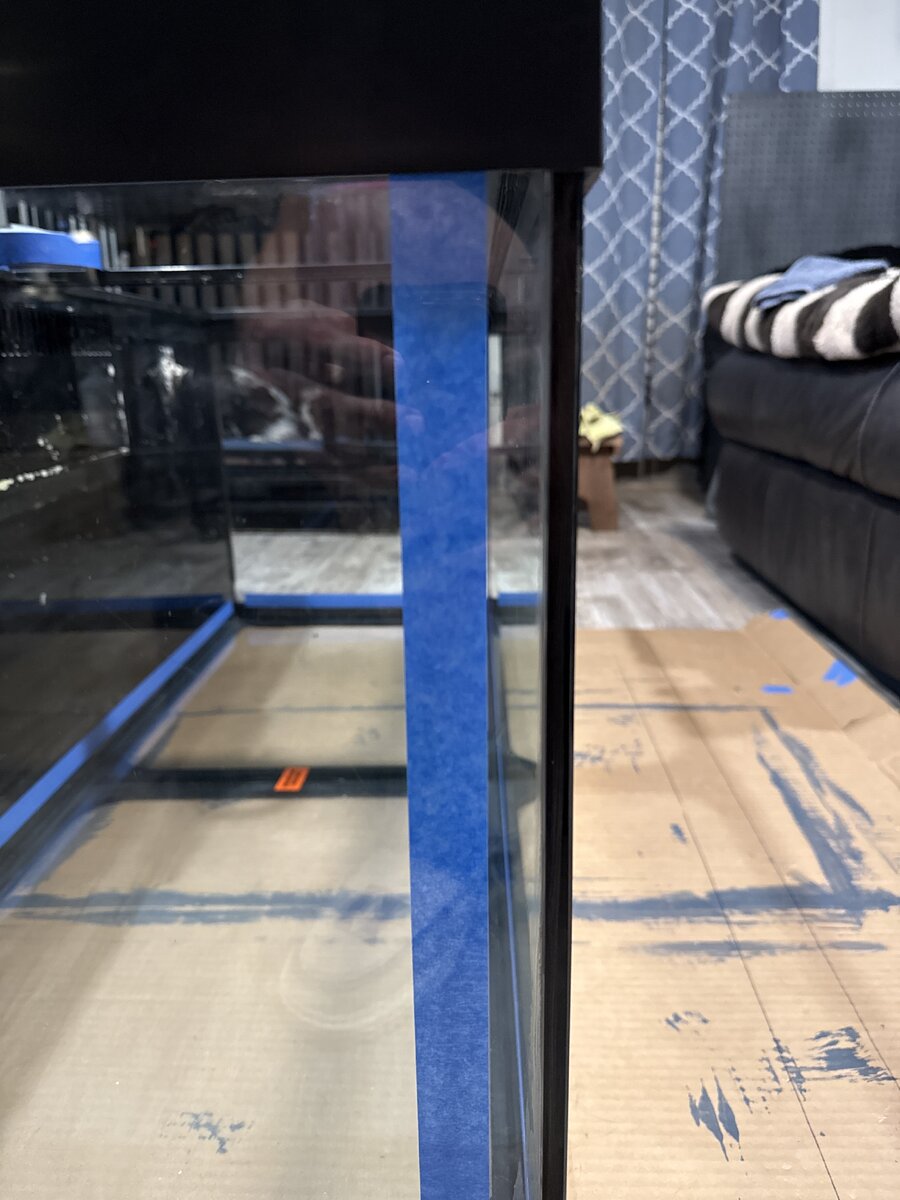
I have 75 gallon tank that I’m resealing from facebook marketplace. I have done all the scraping and Ive done a previous tank successfully. I just want to make sure this isn’t too thick of a silicone beed.
IMG_1698.jpeg
 
Looks too thick to me, I'd aim for about 3/8-1/2" on that tank.

That said, I have something of a standard reply for anytime anyone wants to reseal a tank, and that's:

I for YEARS resealed tanks like you're planning on doing - scrapping out the old silicon, cleaning the area well with isopropyl alcohol, and then resealing. Using the painter's tape is a great way to make really good looking seams. Use a grout tool or dip your fingers in water to help smooth out the silicon. I've done this to dozens of tanks, even tanks I don't own. The largest tank I resealed in this way was a 125 gallon that's still holding water 7 years after doing the reseal. I know that I was told like 40 years ago by a pet store manager that you should reseal a tank about every ten years out of an abundance of caution, so that's what I did for many years.

All that said, fast-forward to today where those "in the know" here on R2R have said that it's not a good idea to reseal a tank in this way. The experts say that to properly reseal a tank, the glass panels must be completely separated, cleaned, and the tank basically completely rebuilt, which can be very difficult if you're not in the business of building aquariums.

For me, based on quite a bit of real experience, I think resealing tanks is fine, but please know that many here on R2R would tell you not to do this.

@UncommonSense is very good with these kinds of questions 🙂

I hope this helps!
 
was this tank sold as holding water? If so, the reseal will probably keep it going for a while longer…

These rimmed tanks have the advantage of being somewhat held together by the rims, which helps people get away with just a bead of silicone around the interior of each seam!

— it’s the rimless ranks where this is a definite no-no, and I have seen some scary stuff… for example: the structural seam fully split, glass panes being spread, just a thin membrane of interior silicone holding the water in…

— if you want to go one step further than just a reseal, you could enquire at a local glass shop about getting some strips of 1/4” -3/8” (6mm-10mm) thick glass cut (1/2”-1” wide strips would suffice)… then, lay those strips in each silicone bead you lay over each of the eight seams; effectively moving the structural seam inboard!
 
These rimmed tanks have the advantage of being somewhat held together by the rims, which helps people get away with just a bead of silicone around the interior of each seam!
I've been thinking about this lately, and perhaps I should edit my "standard reply" posted above to say that I've only resealed standard, rimmed tanks. And yes, I believe the rim is both a huge challenge to try to remove in the first place, and it adds a lot of strength that allows simply resealing the inside of the tank to be successful.

Again, right or wrong I've done this to dozens of tanks over the years and I don't think I've ever had a problem, but your milage may certainly vary 🤪
 

TOP 10 Trending Threads

ARE YOU READY TO CONFESS TO CRAZIEST, DUMBEST, FUNNIEST THING YOU’VE EVER DONE IN REEFING?

  • Yeah, I'll confess! (Share your story in the comments!)

    Votes: 27 54.0%
  • Nah, I'll keep mine a secret...(Don't be like that, share with the class!)

    Votes: 23 46.0%
Back
Top
Home
Post thread…
Market
What's new