




- Joined
- Mar 13, 2016
- Messages
- 1,553
- Reaction score
- 1,025
- Location
- Canton Ohio
- What state or country do you live in
- Ohio
- Seller Rating
- 5 ★
- Rating Count
I've been going down the path of trying to decrease the costs of this hobby lately. One of a reefer's biggest expenses is Salt Mix. So down the rabbit hole I go, trying to figure out the most cost-effective use of my salt that fits my style of reefing.
This analysis models a 100-gallon reef aquarium that begins at 20 ppm nitrate and produces 5 ppm of nitrate each week through normal feeding and livestock waste. The simulation assumes the replacement saltwater contains 0 ppm nitrate and runs continuously over a full year. Without any water changes, nitrate would steadily climb to approximately 280 ppm by the end of the year, demonstrating how important regular maintenance is for long-term nutrient control. The cost breakdown of $80.00 per 165-gallon box of salt mix was used.
One thing people need to know is that nitrate does not remain at a constant value between water changes. Instead, it gradually rises each day as waste accumulates and then drops immediately when a water change is performed. This creates the familiar "sawtooth" pattern seen in the updated graphs. The size of the water change determines how far nitrate drops, while the amount of feeding determines how quickly it climbs back up. For this purpose, I assumed a moderate feeding that raises nitrates by 5ppm each week.
Weekly Water Changes-
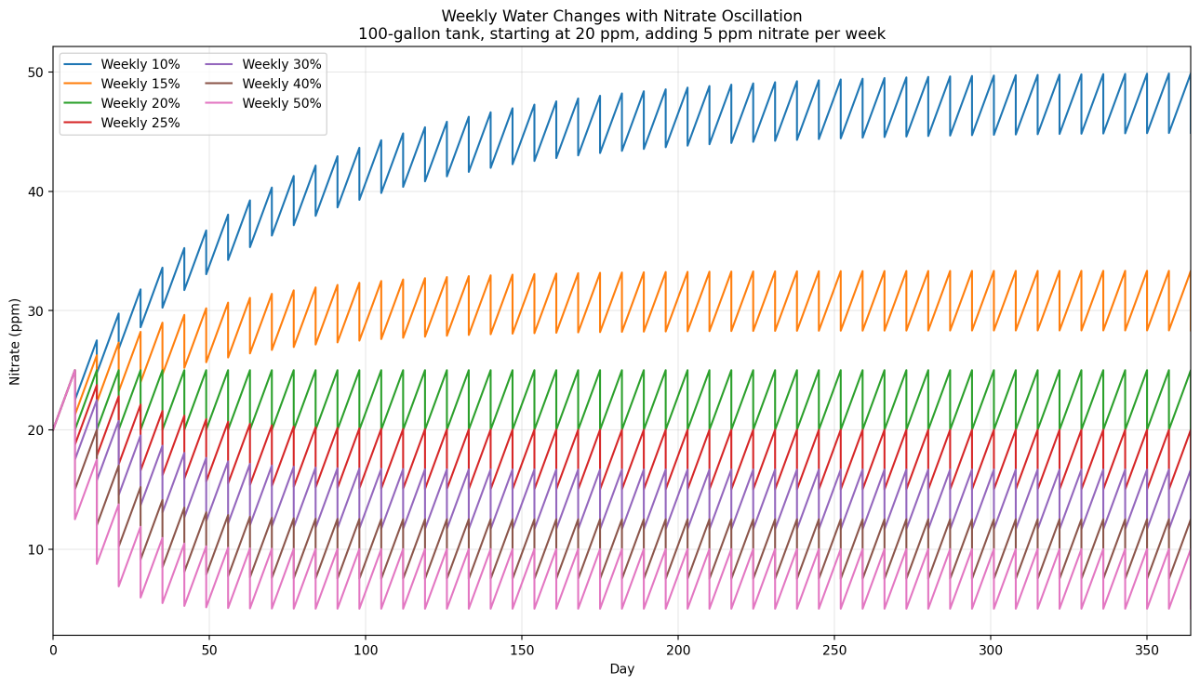
Starting off with smaller, WEEKLY water changes provides consistent nutrient control but allows nitrate to stabilize at higher levels. A 10% weekly water change eventually oscillates between approximately 45 and 50 ppm, while a 15% weekly change settles between roughly 28 and 33 ppm. Both are still a gradual climb of nitrates. A 20% weekly water change maintains nitrate between approximately 20 and 25 ppm, roughly keeping nitrate stable at 20ppm. Although these schedules prevent nitrate from becoming excessive, they may not achieve the lower nutrient levels.
Increasing the weekly water change to 25% or 30% produces a much larger improvement. A 25% weekly schedule stabilizes between approximately 15 and 20 ppm, while a 30% weekly schedule settles between approximately 11.7 and 16.7 ppm. These schedules represent a noticeable reduction in nitrate while remaining within the range of water changes that many experienced reef hobbyists already perform. Both these options hold nitrate steady or reduce nitrate levels over the year.
Daily Water Changes-

Daily water changes are often promoted because they provide excellent stability, but this simulation shows that they are not always the most efficient solution for nitrate reduction alone. Changing one gallon per day (or 1%) uses 365 gallons of saltwater each year, but still allows nitrate to climb to nearly 70 ppm. Increasing to two gallons (2%) per day improves nitrate substantially, but the annual salt consumption also doubles. Even a five-gallon (5%) daily water change requires nearly 1,825 gallons of new saltwater each year while only reducing nitrate to approximately 13.6 ppm.
Bi-Weekly Water Changes-

The bi-weekly water change schedules demonstrate an interesting balance between water usage and nitrate reduction. Because water is changed every two weeks instead of every week, nitrate is allowed to accumulate for a longer period before a larger percentage is removed. As a result, the tank experiences larger swings in nitrate concentration than the weekly schedules. Smaller bi-weekly changes, such as 10% and 20%, are inexpensive but do relatively little to reduce long-term nitrate levels. Increasing the water change to 30% produces a noticeable improvement while still using less salt than many weekly schedules. The 40% bi-weekly schedule provides one of the most significant reductions in nitrate without requiring the high annual water volume associated with large weekly water changes.
From a cost-to-performance standpoint, the 40% bi-weekly schedule stands out as one of the strongest values in the entire analysis. It uses approximately 1,040 gallons of new saltwater per year and costs about $504 annually in salt, yet lowers nitrate to approximately 15 ppm immediately after each water change. This is the same annual water volume and salt cost as a 20% weekly schedule, but the larger bi-weekly change removes a greater percentage of accumulated nitrate during each maintenance event. The tradeoff is that nitrate rises higher between water changes, creating larger fluctuations than a weekly schedule. For reef aquariums where moderate nutrient swings are acceptable, a 40% bi-weekly water change offers an excellent compromise between operating cost and nitrate reduction.
MONTHLY WATER CHANGES
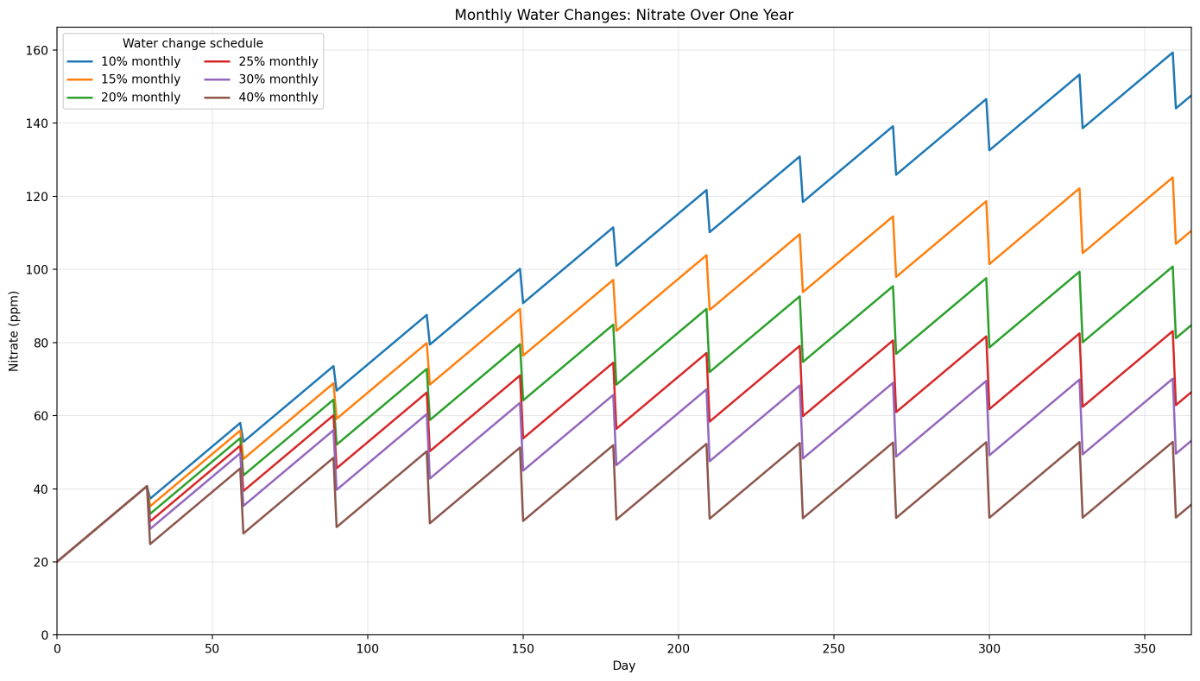
The monthly water change schedules were the most economical options in the analysis because they require the least amount of new saltwater over the course of a year. Annual salt costs ranged from approximately $63 for a 10% monthly water change to about $252 for a 40% monthly water change. However, because an entire month passes between water changes, nitrate has much more time to accumulate before any is removed. This results in the largest nitrate fluctuations of any schedule tested, with nitrate steadily increasing throughout the month before dropping sharply on water-change day. Smaller monthly water changes, such as 10% and 20%, had little effect on long-term nitrate control, while 30% and 40% monthly changes provided noticeably better reductions but still allowed significantly higher nitrate levels between maintenance intervals than the weekly or bi-weekly schedules.
Monthly water changes are best viewed as a supplemental maintenance strategy rather than a primary method of nutrient export for most reef aquariums. While they offer the lowest operating costs and require the least amount of maintenance time, they are less effective at maintaining consistently low nitrate levels. For reef systems that already rely on refugiums, algae scrubbers, carbon dosing, sulfur denitrators, or other biological filtration methods, monthly water changes can be an economical way to replenish trace elements and maintain overall water quality. However, for aquariums that depend primarily on water changes for nitrate control, the results of this analysis suggest that more frequent water changes provide significantly better nutrient stability and lower long-term nitrate concentrations.
COSTS-
Salt cost becomes a significant factor over time. At $80 for enough salt to make 165 gallons of seawater, each gallon costs approximately $0.485 to produce. This means that your water-change strategy has a direct impact on yearly expenses. Depending on the schedule selected, annual salt costs in this analysis ranged from about $63 to well over $1,200. This does not take into consideration the cost to produce clean water itself for the salt mix.

When both nitrate reduction and operating cost are considered together, several schedules stand out as providing exceptional value. A monthly 50% water change is inexpensive but introduces large swings in water chemistry and nutrient levels, making it less representative of how most successful reef aquariums are maintained. For that reason, it should be viewed primarily as a mathematical comparison rather than a practical recommendation.
Among schedules commonly used by reef hobbyists, a bi-weekly 40% water change provides one of the best balances between cost and nitrate reduction. It uses approximately 1,040 gallons of saltwater per year, costs about $504 annually in salt, and maintains nitrate levels around 15 ppm after each water change. It also uses the same total amount of water as a 20% weekly schedule while producing lower post-change nitrate levels in this model.
For hobbyists who prefer smaller, more frequent maintenance, a 25–30% weekly water change is an excellent compromise. A 25% weekly schedule costs approximately $630 per year in salt and maintains nitrate between roughly 15 and 20 ppm. Increasing to 30% weekly raises annual salt costs to about $756, but lowers nitrate further into the 12–17 ppm range. These schedules are widely used in successful reef aquariums because they provide good nutrient control while also replenishing trace elements and maintaining overall system stability.
Overall, the simulation demonstrates that simply changing more water is not always the most economical approach. The best balance of performance and cost comes from selecting a schedule that achieves the desired nitrate level without using significantly more salt than necessary. For most reef aquariums, 25–30% weekly or 40% every two weeks represents the strongest overall value, providing excellent nitrate control, reasonable costs, and maintenance schedules that are practical and commonly followed within the reef-keeping community.
One thing we can agree on here is that the SIZE OF YOUR WATERCHANGE DOES MATTER!
This analysis models a 100-gallon reef aquarium that begins at 20 ppm nitrate and produces 5 ppm of nitrate each week through normal feeding and livestock waste. The simulation assumes the replacement saltwater contains 0 ppm nitrate and runs continuously over a full year. Without any water changes, nitrate would steadily climb to approximately 280 ppm by the end of the year, demonstrating how important regular maintenance is for long-term nutrient control. The cost breakdown of $80.00 per 165-gallon box of salt mix was used.
One thing people need to know is that nitrate does not remain at a constant value between water changes. Instead, it gradually rises each day as waste accumulates and then drops immediately when a water change is performed. This creates the familiar "sawtooth" pattern seen in the updated graphs. The size of the water change determines how far nitrate drops, while the amount of feeding determines how quickly it climbs back up. For this purpose, I assumed a moderate feeding that raises nitrates by 5ppm each week.
Weekly Water Changes-
Starting off with smaller, WEEKLY water changes provides consistent nutrient control but allows nitrate to stabilize at higher levels. A 10% weekly water change eventually oscillates between approximately 45 and 50 ppm, while a 15% weekly change settles between roughly 28 and 33 ppm. Both are still a gradual climb of nitrates. A 20% weekly water change maintains nitrate between approximately 20 and 25 ppm, roughly keeping nitrate stable at 20ppm. Although these schedules prevent nitrate from becoming excessive, they may not achieve the lower nutrient levels.
Increasing the weekly water change to 25% or 30% produces a much larger improvement. A 25% weekly schedule stabilizes between approximately 15 and 20 ppm, while a 30% weekly schedule settles between approximately 11.7 and 16.7 ppm. These schedules represent a noticeable reduction in nitrate while remaining within the range of water changes that many experienced reef hobbyists already perform. Both these options hold nitrate steady or reduce nitrate levels over the year.
Daily Water Changes-
Daily water changes are often promoted because they provide excellent stability, but this simulation shows that they are not always the most efficient solution for nitrate reduction alone. Changing one gallon per day (or 1%) uses 365 gallons of saltwater each year, but still allows nitrate to climb to nearly 70 ppm. Increasing to two gallons (2%) per day improves nitrate substantially, but the annual salt consumption also doubles. Even a five-gallon (5%) daily water change requires nearly 1,825 gallons of new saltwater each year while only reducing nitrate to approximately 13.6 ppm.
Bi-Weekly Water Changes-
The bi-weekly water change schedules demonstrate an interesting balance between water usage and nitrate reduction. Because water is changed every two weeks instead of every week, nitrate is allowed to accumulate for a longer period before a larger percentage is removed. As a result, the tank experiences larger swings in nitrate concentration than the weekly schedules. Smaller bi-weekly changes, such as 10% and 20%, are inexpensive but do relatively little to reduce long-term nitrate levels. Increasing the water change to 30% produces a noticeable improvement while still using less salt than many weekly schedules. The 40% bi-weekly schedule provides one of the most significant reductions in nitrate without requiring the high annual water volume associated with large weekly water changes.
From a cost-to-performance standpoint, the 40% bi-weekly schedule stands out as one of the strongest values in the entire analysis. It uses approximately 1,040 gallons of new saltwater per year and costs about $504 annually in salt, yet lowers nitrate to approximately 15 ppm immediately after each water change. This is the same annual water volume and salt cost as a 20% weekly schedule, but the larger bi-weekly change removes a greater percentage of accumulated nitrate during each maintenance event. The tradeoff is that nitrate rises higher between water changes, creating larger fluctuations than a weekly schedule. For reef aquariums where moderate nutrient swings are acceptable, a 40% bi-weekly water change offers an excellent compromise between operating cost and nitrate reduction.
MONTHLY WATER CHANGES
The monthly water change schedules were the most economical options in the analysis because they require the least amount of new saltwater over the course of a year. Annual salt costs ranged from approximately $63 for a 10% monthly water change to about $252 for a 40% monthly water change. However, because an entire month passes between water changes, nitrate has much more time to accumulate before any is removed. This results in the largest nitrate fluctuations of any schedule tested, with nitrate steadily increasing throughout the month before dropping sharply on water-change day. Smaller monthly water changes, such as 10% and 20%, had little effect on long-term nitrate control, while 30% and 40% monthly changes provided noticeably better reductions but still allowed significantly higher nitrate levels between maintenance intervals than the weekly or bi-weekly schedules.
Monthly water changes are best viewed as a supplemental maintenance strategy rather than a primary method of nutrient export for most reef aquariums. While they offer the lowest operating costs and require the least amount of maintenance time, they are less effective at maintaining consistently low nitrate levels. For reef systems that already rely on refugiums, algae scrubbers, carbon dosing, sulfur denitrators, or other biological filtration methods, monthly water changes can be an economical way to replenish trace elements and maintain overall water quality. However, for aquariums that depend primarily on water changes for nitrate control, the results of this analysis suggest that more frequent water changes provide significantly better nutrient stability and lower long-term nitrate concentrations.
COSTS-
Salt cost becomes a significant factor over time. At $80 for enough salt to make 165 gallons of seawater, each gallon costs approximately $0.485 to produce. This means that your water-change strategy has a direct impact on yearly expenses. Depending on the schedule selected, annual salt costs in this analysis ranged from about $63 to well over $1,200. This does not take into consideration the cost to produce clean water itself for the salt mix.
When both nitrate reduction and operating cost are considered together, several schedules stand out as providing exceptional value. A monthly 50% water change is inexpensive but introduces large swings in water chemistry and nutrient levels, making it less representative of how most successful reef aquariums are maintained. For that reason, it should be viewed primarily as a mathematical comparison rather than a practical recommendation.
Among schedules commonly used by reef hobbyists, a bi-weekly 40% water change provides one of the best balances between cost and nitrate reduction. It uses approximately 1,040 gallons of saltwater per year, costs about $504 annually in salt, and maintains nitrate levels around 15 ppm after each water change. It also uses the same total amount of water as a 20% weekly schedule while producing lower post-change nitrate levels in this model.
For hobbyists who prefer smaller, more frequent maintenance, a 25–30% weekly water change is an excellent compromise. A 25% weekly schedule costs approximately $630 per year in salt and maintains nitrate between roughly 15 and 20 ppm. Increasing to 30% weekly raises annual salt costs to about $756, but lowers nitrate further into the 12–17 ppm range. These schedules are widely used in successful reef aquariums because they provide good nutrient control while also replenishing trace elements and maintaining overall system stability.
Overall, the simulation demonstrates that simply changing more water is not always the most economical approach. The best balance of performance and cost comes from selecting a schedule that achieves the desired nitrate level without using significantly more salt than necessary. For most reef aquariums, 25–30% weekly or 40% every two weeks represents the strongest overall value, providing excellent nitrate control, reasonable costs, and maintenance schedules that are practical and commonly followed within the reef-keeping community.
One thing we can agree on here is that the SIZE OF YOUR WATERCHANGE DOES MATTER!
Last edited:















