The Wrasse Lover's Thread!

"She" is well on the way to full male, already as a transitional male. ;)

What makes you say that? Could you educate me on why you think its transitioning? It very well could be,im not an expert, but the retailer I bought her from specified gender, she has a black point by her head and a very short dorsal fin(so short i thought something munched it) From my research the only real difference from the males and females is the black dot. Which in person i visibly see. So it is hard to tell since not much is different between them. I do have a female melanurus wrasse as well which could trigger it in the future, but they were bought roughly around the same time(few days apart), but my ornate has been in the sand pretty much for 4 days straight now and is shy/timid(only comes out for two hours or so at a time, as its getting used to the light schedule.) Nothing like a male at all IMO from what ive read, but as stated above, im willing to be educated or see things from your point of view. The melanurus is the more dominant fish by far though.

 
What makes you say that? Could you educate me on why you think its transitioning? It very well could be,im not an expert, but the retailer I bought her from specified gender, she has a black point by her head and a very short dorsal fin(so short i thought something munched it) From my research the only real difference from the males and females is the black dot. Which in person i visibly see. So it is hard to tell since not much is different between them. I do have a female melanurus wrasse as well which could trigger it in the future, but they were bought roughly around the same time(few days apart), but my ornate has been in the sand pretty much for 4 days straight now and is shy/timid(only comes out for two hours or so at a time, as its getting used to the light schedule.) Nothing like a male at all IMO from what ive read, but as stated above, im willing to be educated or see things from your point of view. The melanurus is the more dominant fish by far though.
It is a tricky species to sex, but the tail pattern on yours is a dead give away as male.
 
It is a tricky species to sex, but the tail pattern on yours is a dead give away as male.

Im pretty sure they have the same tails, but thanks for the response will see what happens, im not shooting it down, especially in the future since i have another female in the tank, could definitely happen.

Screenshot (13).png


Pretty much looked exactly like my other female that passed.
dead2.jpg
 
Last edited:
hi guy is it normal for a blue star leopard wrasse to stay out when first added to the tank because i was expecting the wrasse to go under the sand for a few days
 
Im pretty sure they have the same tails, but thanks for the response will see what happens, im not shooting it down, especially in the future since i have another female in the tank, could definitely happen.

Screenshot (13).png


Pretty much looked exactly like my other female that passed.
dead2.jpg
That graphic isn't a good example, and that deceased fish looks male again to me.
hi guy is it normal for a blue star leopard wrasse to stay out when first added to the tank because i was expecting the wrasse to go under the sand for a few days
It can be.
 
hi guy is it normal for a blue star leopard wrasse to stay out when first added to the tank because i was expecting the wrasse to go under the sand for a few days
I’ve had both happen. Most of the time it’s a few day buried and a few times they just hung out with the gang and cruise the tank
 
Im pretty sure they have the same tails, but thanks for the response will see what happens, im not shooting it down, especially in the future since i have another female in the tank, could definitely happen.

Screenshot (13).png


Pretty much looked exactly like my other female that passed.
dead2.jpg


Trust me, if Hunter says it's a male...it's a male. :D He is one of the leading wrasse experts anywhere and a frequent lecturer at MACNA.
 
Trust me, if Hunter says it's a male...it's a male. :D He is one of the leading wrasse experts anywhere and a frequent lecturer at MACNA.
Sorry, based on what I see I just can't, thanks though, not trying to turn this into a debate.
 
No debate, no uncertainty here, but for the sake of better explanation:

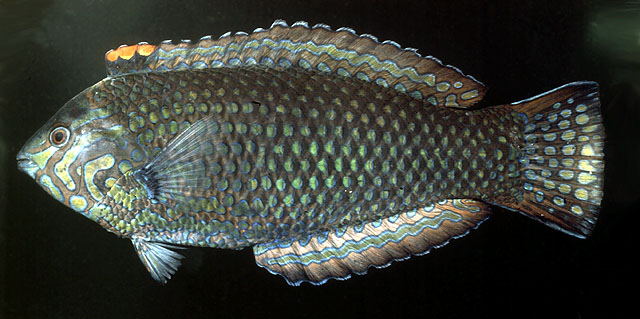
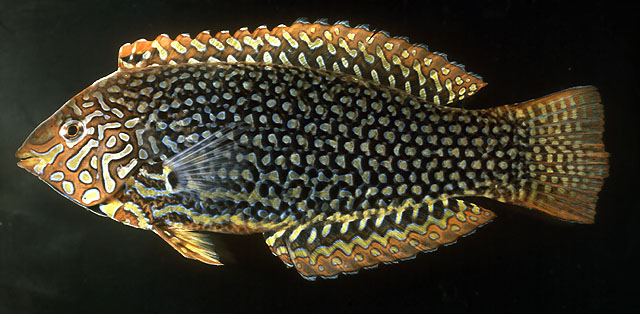
These are holotype pictures (dead fish), so don't get too hung up on the coloration, but I'll draw attention to the patterns/features of both.

Male M. ornatus:
Maorn_m0.jpg


Female M. ornatus:
Maorn_f1.jpg


First, look at the patterns around the eyes and also on the gill plates (cheeks, if you'd rather). You'll note that the male has nice bold, solid lines, whereas the female has much more of a broken, spotted pattern. Next, look at the pattern on the sides of the body. The male has much more uniform, orderly circles than the female. And lastly, I'll draw your attention to the caudal (tail). Two big things here. First, the male much bigger spots, nicely arranged in a "fan array" style. The female has much smaller, less orderly spots. And then, there's the bold margins with the distinct iridescent edge on the male's caudal v. the female. It's this latter feature that makes both of your specimens male.

Your current fish; note those bold boarders and iridescent edges on the side of the tail:
ornate leopard wrasse 2.png


And you can even sort of see the same on your dead fish. And if there's any uncertainty in the photo, you can just look at the markings on the gill plates as well as the orderly fashion and size of the spots along the sides of the body:
dead2.jpg


(and hopefully now, you can see why I softly stated that the male/female graphic you showed is essentially wrong. The "male" in that graphic might be a transitional male, but I'd still say both are females)

Now, with all that said, this is still a very tricky species to discern where the line between female ends and sub-male begins.
 
Trust me, if Hunter says it's a male...it's a male. :D He is one of the leading wrasse experts anywhere and a frequent lecturer at MACNA.
Thanks for the vote of confidence, but I'm wrong sometimes too. I try to make it clear when I'm not 100% certain, though. :)
 
Are there captive bred wrasses available? I found some websites from 2015 discussing Bali Aquarich breeding melanurus but can't find much else...
 
Are there captive bred wrasses available? I found some websites from 2015 discussing Bali Aquarich breeding melanurus but can't find much else...
Very few. Bali did it by accident, originally. Rising tide has done some work here, as have a few others.
 
Excited to say I'll be joining the wrasse lovers club. Just placed an order for my first wrasse other than a 6-line.
Starting with these 3.
C. Jordani
C. Isosceles
P. Carpenteri

I'm irrationally excited about it. Hopefully this isn't a bad starting point for someone new to these little guys.
nice choices!
 
No debate, no uncertainty here, but for the sake of better explanation:

These are holotype pictures (dead fish), so don't get too hung up on the coloration, but I'll draw attention to the patterns/features of both.

Male M. ornatus:
Maorn_m0.jpg


Female M. ornatus:
Maorn_f1.jpg


First, look at the patterns around the eyes and also on the gill plates (cheeks, if you'd rather). You'll note that the male has nice bold, solid lines, whereas the female has much more of a broken, spotted pattern. Next, look at the pattern on the sides of the body. The male has much more uniform, orderly circles than the female. And lastly, I'll draw your attention to the caudal (tail). Two big things here. First, the male much bigger spots, nicely arranged in a "fan array" style. The female has much smaller, less orderly spots. And then, there's the bold margins with the distinct iridescent edge on the male's caudal v. the female. It's this latter feature that makes both of your specimens male.

Your current fish; note those bold boarders and iridescent edges on the side of the tail:
ornate leopard wrasse 2.png


And you can even sort of see the same on your dead fish. And if there's any uncertainty in the photo, you can just look at the markings on the gill plates as well as the orderly fashion and size of the spots along the sides of the body:
dead2.jpg


(and hopefully now, you can see why I softly stated that the male/female graphic you showed is essentially wrong. The "male" in that graphic might be a transitional male, but I'd still say both are females)

Now, with all that said, this is still a very tricky species to discern where the line between female ends and sub-male begins.

Hunter,

Would the same logic apply to Potters Leopards? I can find good visuals of male vs female, where in the other (melagris and bipartisus) have very defined changes.
 
Hunter,

Would the same logic apply to Potters Leopards? I can find good visuals of male vs female, where in the other (melagris and bipartisus) have very defined changes.
Yes - the lines v. dots on the gill plates is the easiest way to sex geoffroy.

More here:
 
9 months into stocking my ”mainly” wrasse tank... just one left to get now to finish my collection (unless I find a Chaoti) my LFS is holding a Jordani for me

386F5ADC-B934-4693-A54B-6A859ED69131.jpeg
Wow! That's amazing!
 
@evolved Where is this chart.. I have not been able to locate it... And as a rising.. ummm... Excited.. ummmmm learning about wrasses guy, I would love to see this..


Here's Evolved's chart for fairy wrasses.


TOP 10 Trending Threads

ARE YOU READY TO CONFESS TO CRAZIEST, DUMBEST, FUNNIEST THING YOU’VE EVER DONE IN REEFING?

  • Yeah, I'll confess! (Share your story in the comments!)

    Votes: 26 55.3%
  • Nah, I'll keep mine a secret...(Don't be like that, share with the class!)

    Votes: 21 44.7%
Back
Top
Home
Post thread…
Market
What's new