If its not your alk fluxing or kalk dosing, looks to be c02 related, i just went through this last week from the hot weather that approached. Usually i keep my windows open, but had to shut them to run my ac so i finally got the air line from outside to my skimmer.
If its not your alk fluxing or kalk dosing, looks to be c02 related, i just went through this last week from the hot weather that approached. Usually i keep my windows open, but had to shut them to run my ac so i finally got the air line from outside to my skimmer.
I acually went to go screen shot my apex dashboard and the graph only goes to a little before the 28th, but around the middle of the month my max was around 8.14 and lowest around 7.9
I added my outside air line on the 1st
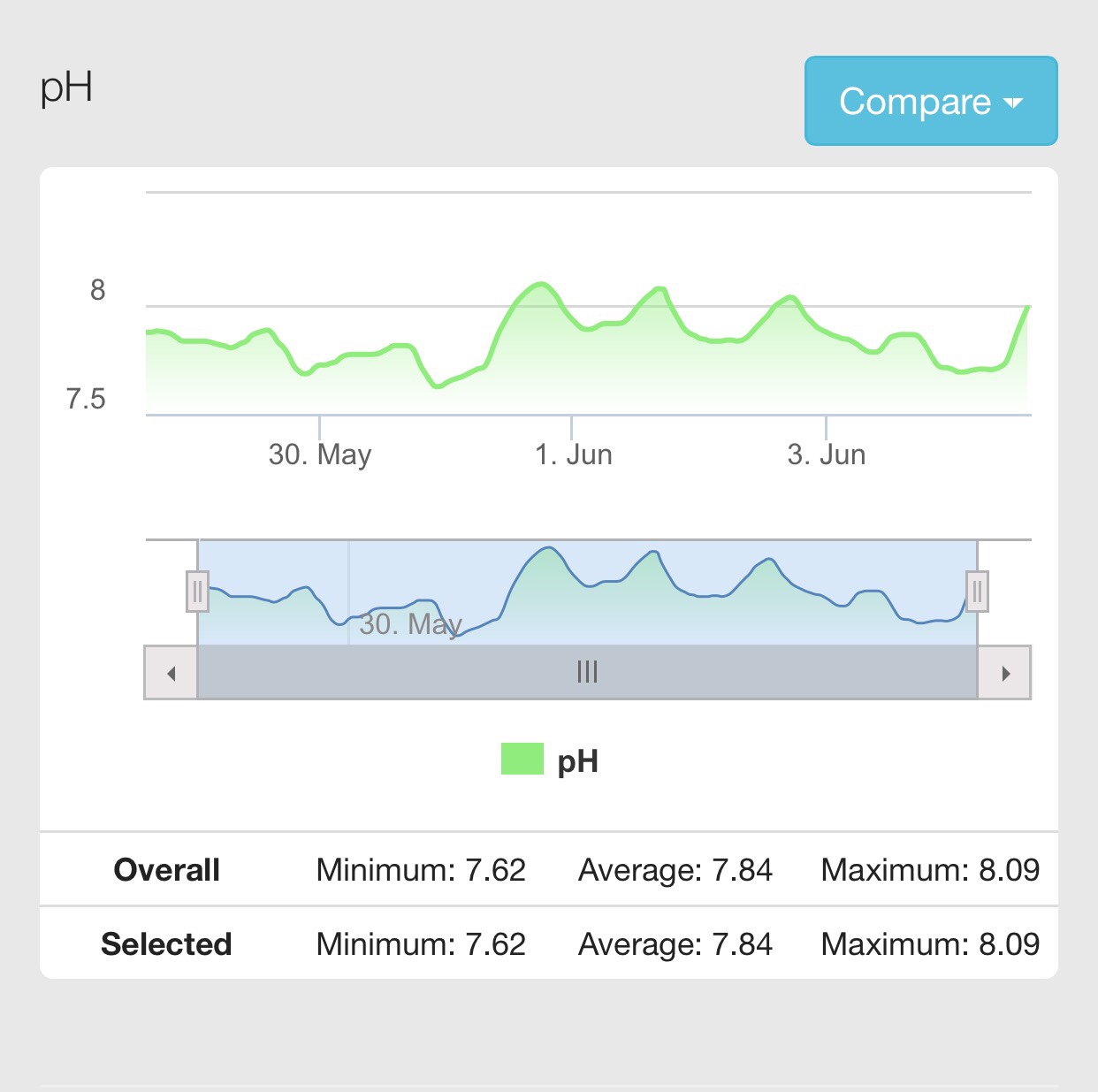
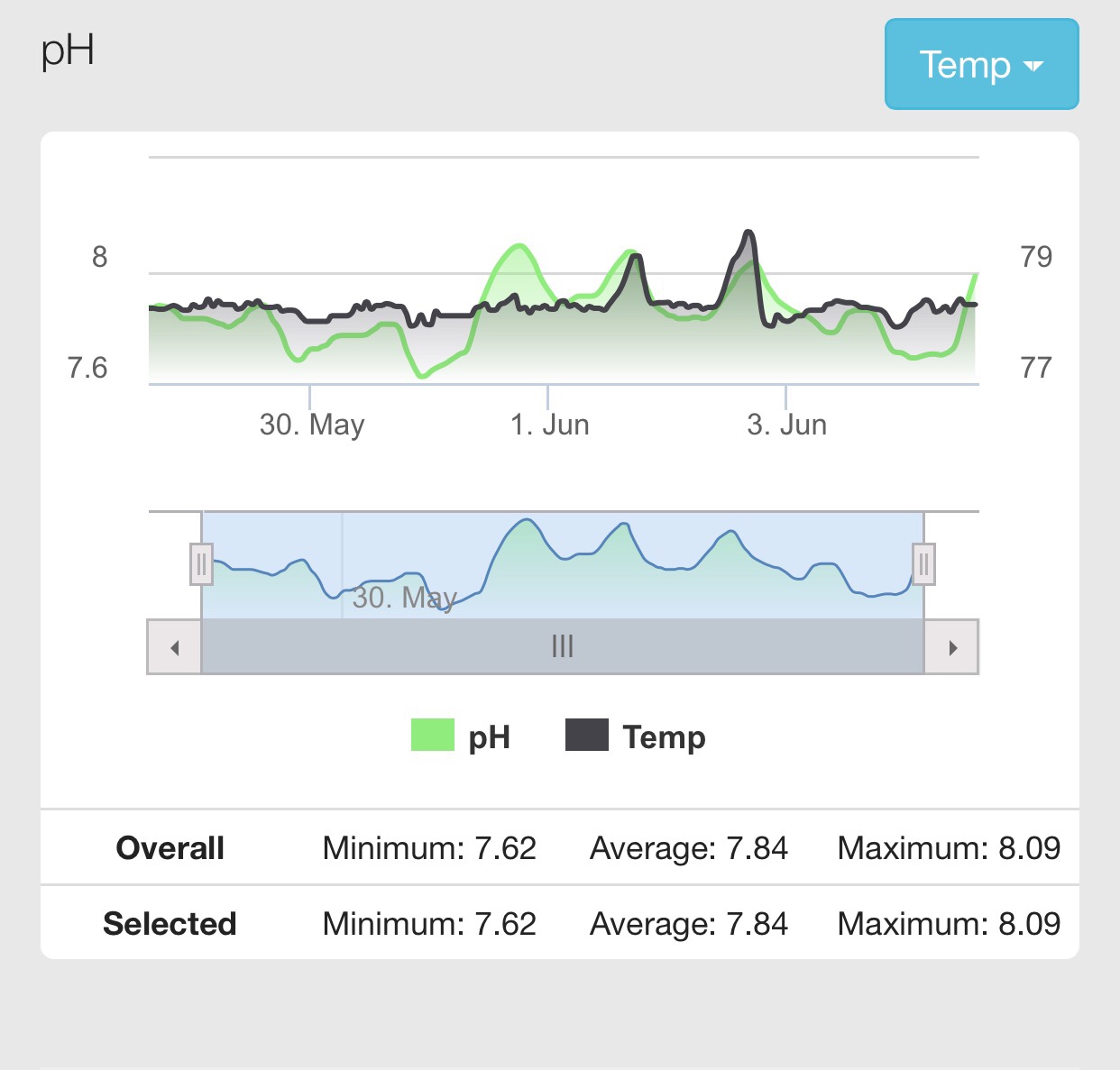
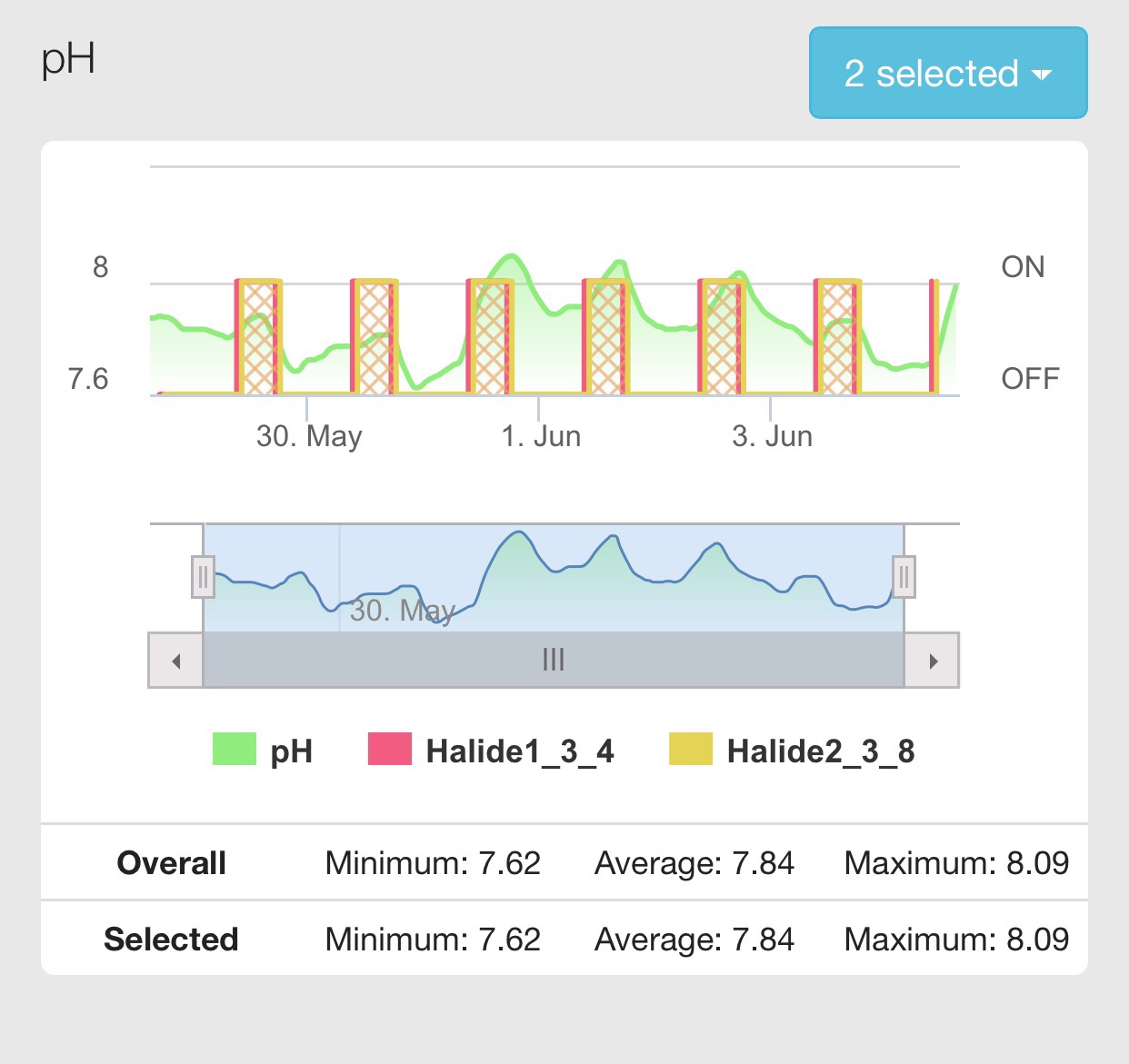
Well I'm getting a swing from 7.6...7.7 to 8.0.... Ishh. Not an alk issue and I'm not dosing anything yet, no corals as of yet. I do have a fresh air line to the skimmer. House is closed up and AC is on. I just thought it jumps around a lot . One day it's pretty consistent and the next I get a .4 swing. Strange??
I acually went to go screen shot my apex dashboard and the graph only goes to a little before the 28th, but around the middle of the month my max was around 8.14 and lowest around 7.9
I added my outside air line on the 1st
But looking at yours it seems pretty consistent swing. If you compare yours to mine as far as the range of swing and consistency you'll see what I'm talking about.
I thought that also.... Checked it , re calibrated , same results. This has been going on for awhile now.... Couple of weeks. No real adverse effects per say , but I'm hesitant to add any coral until I get more consistent readings. To me consistency is everything in this hobby , oh yea and patience . [emoji16]
No nothing other that routine stuff, clean glass like every three days.... Auto topoff is on auto pilot , temps steady, change out filter sock every 4 days or so, same with skimmer about every 4 days. Feed every other day" only 2 fish so far" 10% W/c once a week.
Lol how longs the tank ben up and how long has it ben wackey like this? If you have air comming into your skimmer id just give it some time for the ph to be consistent. 7.6/7.7 is really low.
Lol how longs the tank ben up and how long has it ben wackey like this? If you have air comming into your skimmer id just give it some time for the ph to be consistent. 7.6/7.7 is really low.
Tanks only 3 months in... Long enough to settle down some i think. Been wacky for a couple weeks maybe 3 weeks?? Added an outside airline around the same time because of the wacky numbers... My thinking was CO2. Yes 7.6/7.7 is low and this sir is my concern, but maybe we should ask Michael J. Fox what he thinks??
One of the first things that aquarists who measure pH notice is that the pH changes from day to night in coral reef aquaria. This diurnal (daily) change in pH in reef aquaria occurs because of the biological processes of photosynthesis and respiration. Photosynthesis is the process whereby organisms convert carbon dioxide and water into carbohydrate and oxygen. So there is a net consumption of carbon dioxide during the day. This causes many aquaria to become deficient in CO2 during the day, raising their pH.
Likewise, all organisms also carry out the process of respiration, which converts carbohydrates back into energy. In the net sense, it is the opposite of photosynthesis, producing carbon dioxide and reducing pH. This process is happening continuously in reef aquaria, but is most evident at night when photosynthesis is not pushing pH upward.
The net effect of these processes is that pH rises during the day and drops at night in most reef aquaria. This change varies from less than a tenth of a pH unit, to more than 0.5 pH units in typical aquaria. Complete aeration of the aquarium’s water will entirely prevent this diurnal pH swing, by driving out any excess carbon dioxide or absorbing carbon dioxide when deficient (assuming the carbon dioxide levels in the home air are steady). In practice, equilibration of carbon dioxide by aeration is difficult, and this goal is not often attained. Consequently, the pH does change between day and night.
Higher alkalinity implies more bicarbonate and carbonate in the water, and together these serve to buffer the water against pH changes (that is, they resist the change in pH as additional acids or bases are added). So the higher the alkalinity, the lower the diurnal pH swing. Also, the higher the pH, the more effective is the buffering provided by bicarbonate and carbonate in seawater (up to about pH 9), so the higher the average pH, the smaller the diurnal swing. Additional chemicals in the water also help to reduce the pH swing; borate, for example, buffers against pH changes.
With that all said, however, I do not believe that the actual change in pH each day is particularly important. I won’t go into the reasoning behind this claim here, other than stating that it is my opinion, based on my understanding of how most organisms control their internal pH, but I do not believe that diurnal pH changes that stay within the range of pH 7.8 to 8.5 are particularly stressful to most reef organisms. That is, these changes are no more stressful than being at the same pH all day. A constant pH of 7.9 may be worse for many organisms than a pH that varies from 8.0 to 8.5 each day. Of course, if the diurnal swing takes the pH outside of this range, i.e., below 7.8 or above 8.5, then certain processes take place that should be corrected, as detailed below.
One of the first things that aquarists who measure pH notice is that the pH changes from day to night in coral reef aquaria. This diurnal (daily) change in pH in reef aquaria occurs because of the biological processes of photosynthesis and respiration. Photosynthesis is the process whereby organisms convert carbon dioxide and water into carbohydrate and oxygen. So there is a net consumption of carbon dioxide during the day. This causes many aquaria to become deficient in CO2 during the day, raising their pH.
Likewise, all organisms also carry out the process of respiration, which converts carbohydrates back into energy. In the net sense, it is the opposite of photosynthesis, producing carbon dioxide and reducing pH. This process is happening continuously in reef aquaria, but is most evident at night when photosynthesis is not pushing pH upward.
The net effect of these processes is that pH rises during the day and drops at night in most reef aquaria. This change varies from less than a tenth of a pH unit, to more than 0.5 pH units in typical aquaria. Complete aeration of the aquarium’s water will entirely prevent this diurnal pH swing, by driving out any excess carbon dioxide or absorbing carbon dioxide when deficient (assuming the carbon dioxide levels in the home air are steady). In practice, equilibration of carbon dioxide by aeration is difficult, and this goal is not often attained. Consequently, the pH does change between day and night.
Higher alkalinity implies more bicarbonate and carbonate in the water, and together these serve to buffer the water against pH changes (that is, they resist the change in pH as additional acids or bases are added). So the higher the alkalinity, the lower the diurnal pH swing. Also, the higher the pH, the more effective is the buffering provided by bicarbonate and carbonate in seawater (up to about pH 9), so the higher the average pH, the smaller the diurnal swing. Additional chemicals in the water also help to reduce the pH swing; borate, for example, buffers against pH changes.
With that all said, however, I do not believe that the actual change in pH each day is particularly important. I won’t go into the reasoning behind this claim here, other than stating that it is my opinion, based on my understanding of how most organisms control their internal pH, but I do not believe that diurnal pH changes that stay within the range of pH 7.8 to 8.5 are particularly stressful to most reef organisms. That is, these changes are no more stressful than being at the same pH all day. A constant pH of 7.9 may be worse for many organisms than a pH that varies from 8.0 to 8.5 each day. Of course, if the diurnal swing takes the pH outside of this range, i.e., below 7.8 or above 8.5, then certain processes take place that should be corrected, as detailed below.
Thanks Randy. My concern is also with the low, not the swing. I've read some of the link you sent and look forward to completing the read when I'm not working 16hr days.... Lol much appreciated! [emoji16]