




- Joined
- Jun 6, 2025
- Messages
- 34
- Reaction score
- 29
- Location
- Plainville, MA, USA
- What state or country do you live in
- Massachusetts
(Please forgive my tendency to anthropomorphize.)
Three months ago, we got two blue (*) tuxedo urchins from our LFS. [There was something interesting with their coloring, but it's probably unrelated to the current issue, so I've relegated it to a pseudo-footnote at the bottom of this post.]
We have a mature 32 gal BioCube with peaceful inhabitants and plenty of algae. We floated them to get them up to temp and then drip-acclimated, and both urchins settled in uneventfully. During the next 2.5ish months, they both seemed healthy and active; even during the day, we could typically find them mowing paths through the algae on some rock or on the back wall of the tank, always adorned with some assortment of algae wigs and shell/gravel hats.
I find their covering behavior hilarious and endearing, so when the slightly smaller urchin essentially stopped camouflaging himself about a week ago, I began to track him more closely, and I realized that he was also much less active. (I’m a night owl, so I can attest that he wasn’t gallivanting around the tank at night and just returning to the same spot in the morning.) A few days ago, I got worried when I found him nearly motionless, with his tube feet more or less tucked out of sight. I remembered reading that urchins typically enjoy eating nori, so I got a box of Omega One green seaweed and put some on a clip near him. After an hour or so with no reaction from him (not even the extension of a tube foot), it occurred to me that he might be unable to sense the nori and/or move himself towards it, so I relocated the nori to the tank floor in order to place him (and thus his mouth) directly on top of it. He had been sitting on a roughly horizontal bit of rock, and I was relieved—and a bit contrite—when I felt some brief resistance upon picking him up (which I took to mean that he had chosen to be on that rock?). I then discovered that he could move just fine, because within minutes of being placed on the nori, he scooted himself off it, onto the gravel bed, and eventually up the glass wall. He then spent the rest of the day moving along the front and side walls of the tank, so I watched his mouth/teeth with a magnifying glass (the Flipper DeepSee Nano) for any indication that he might be eating. I didn't see any, but our snails and mag scraper also keep the glass pretty clean, so I’m not sure how meaningful that observation actually is.
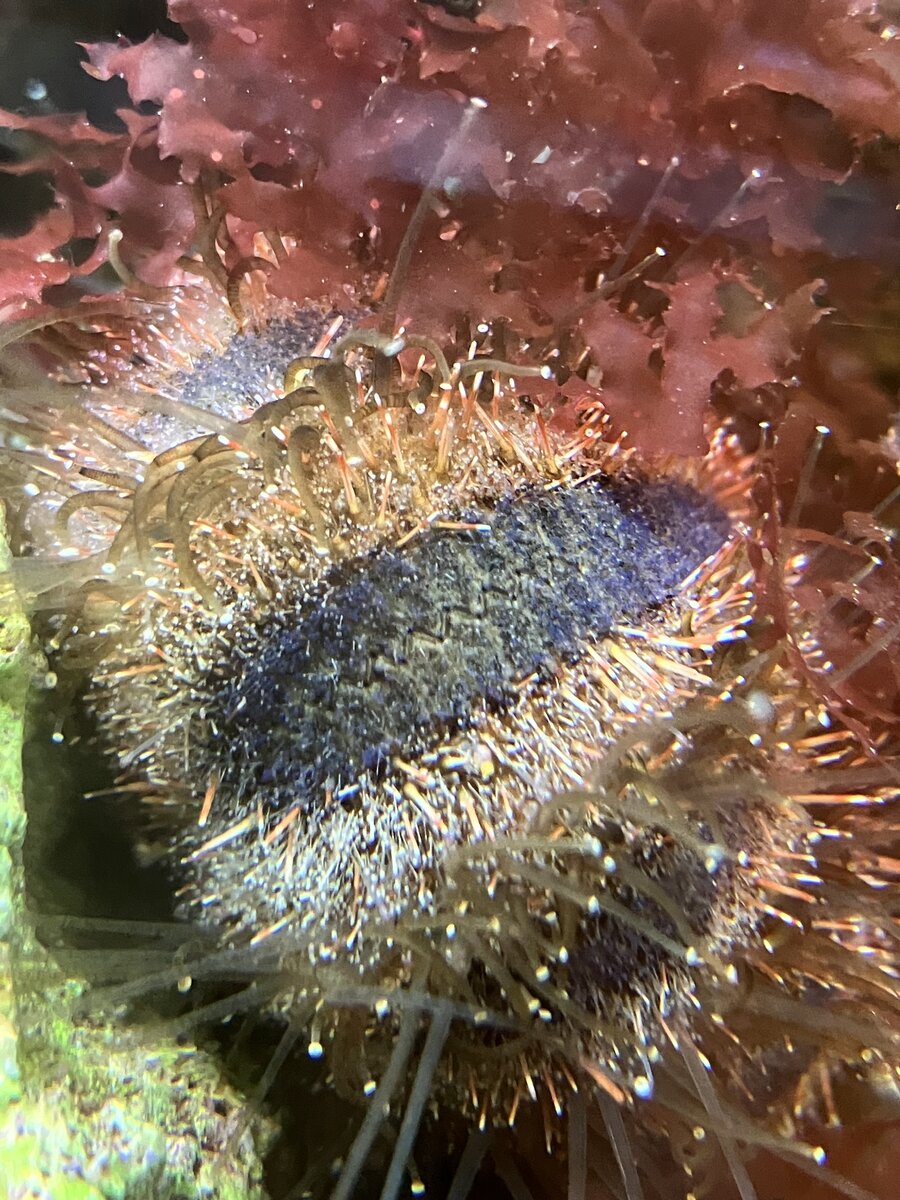
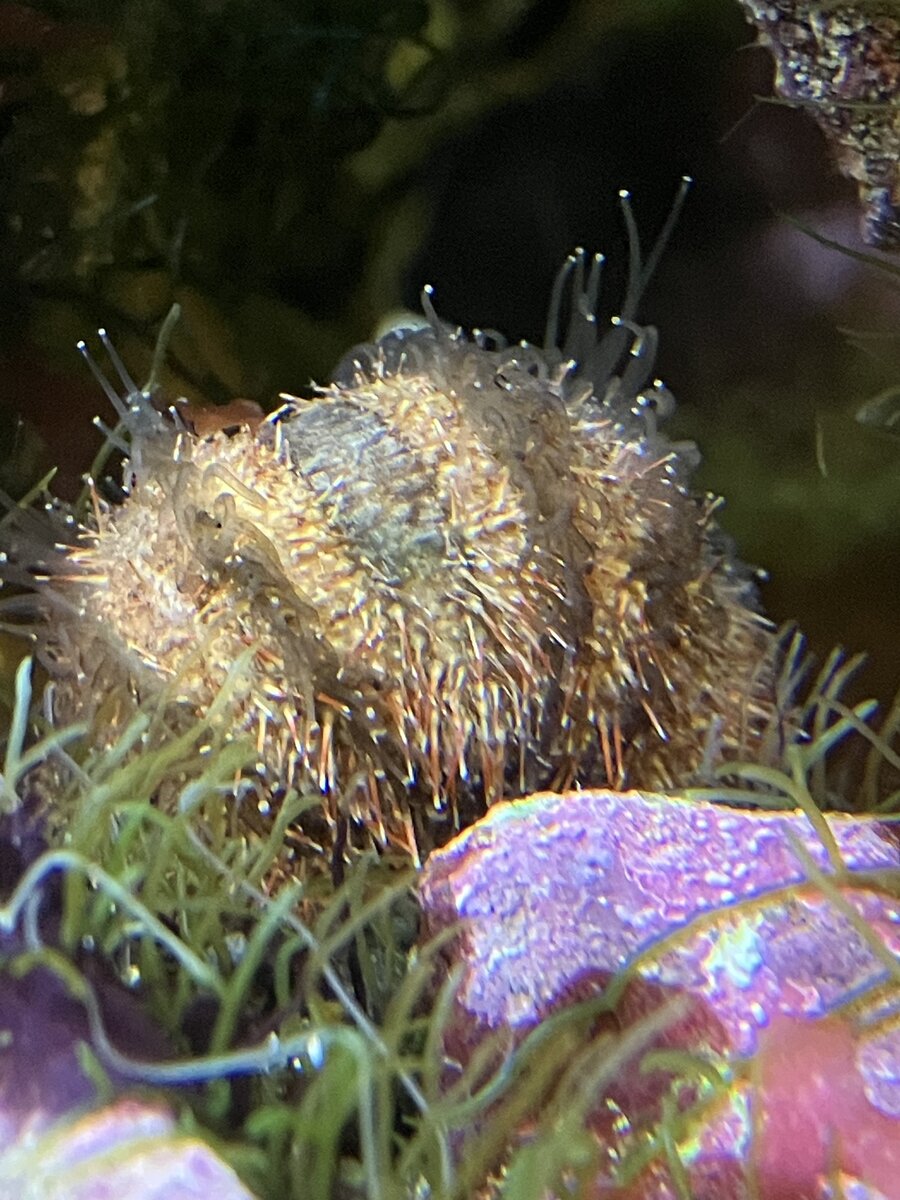
At some point that night, he moved off the glass and onto a different section of rock, and he has remained within a 3ish-inch radius of the same spot ever since (i.e., for the past two days). His spines are so short that I'm not sure I'd be able to tell if they became more droopy or less dense. Whenever I look at him, at least some of his tube feet are out, so that might be an improvement? The thing that puzzles me the most, though, is that I think the color of his interambulacral bands seems faded: instead of dark blue, it looks more like gray or gray-brown (depending on the tank lighting). The color difference doesn't seem as distinct in photos for some reason, but I gave it a shot:
Here is a picture of both urchins shortly after we added them to our tank three months ago:

The next two pictures are from yesterday evening. The urchin in the left picture is still behaving normally, and his interambulacral bands look about the same as when we first got him. The sad urchin is pictured on the right.
Potentially relevant photo details: The picture from three months ago was taken through the DeepSee Viewer by my husband with his Android, and both urchins were on top of the rock structure in the tank (and thus closer to the lights). Both pictures from yesterday were taken with my iPhone, and the healthy urchin was on a rock at the bottom of the tank, nearly touching the tank glass, so my camera was fully zoomed out, while the sad urchin was in a more shaded spot in the middle of the tank, and I did zoom in.
General Tank Info:
32 gal BioCube established about 5 years ago
Current [non-hitchhiker] inhabitants:
Temperature 77.5 F
Salinity 1.026
[Note: The rest are estimated from API's 5-in-1 test strips, but our Hanna ULR Phosphate and HR Nitrate kits are due to arrive in two days, so I'll have more accurate values then.]
KH 80 ppm (calculated dKH 4.47)
pH 8.0
Nitrite 0 - 0.5 ppm
Nitrate 40 ppm
From the bit of reading that I've done, it seems like starvation and high nitrates are frequently implicated in urchin mortalities. I know our nitrates are high, but for whatever it's worth, they've been around 20-40 ppm for quite some time now (definitely before we got the urchins), and the other tuxedo urchin's behavior hasn't changed. As for nutrient intake, the sad urchin has pretty much stayed on rocky areas with splotches of coralline algae on them, so I hope he's eating that, but I can't really tell.
Any and all thoughts/suggestions welcome. Many thanks in advance!
(*) At the store, both urchins’ interambulacral bands looked turquoise rather than the typical dark blue. Has anyone ever heard of anything like this? We’ve never seen them look turquoise again, so I assumed it was related to the lighting in the store, but the whole thing is just puzzling, because we had already said that we were going to get them (so it’s not like we needed to be persuaded that these urchins were extra special), and they weren’t being priced any differently.
Three months ago, we got two blue (*) tuxedo urchins from our LFS. [There was something interesting with their coloring, but it's probably unrelated to the current issue, so I've relegated it to a pseudo-footnote at the bottom of this post.]
We have a mature 32 gal BioCube with peaceful inhabitants and plenty of algae. We floated them to get them up to temp and then drip-acclimated, and both urchins settled in uneventfully. During the next 2.5ish months, they both seemed healthy and active; even during the day, we could typically find them mowing paths through the algae on some rock or on the back wall of the tank, always adorned with some assortment of algae wigs and shell/gravel hats.
I find their covering behavior hilarious and endearing, so when the slightly smaller urchin essentially stopped camouflaging himself about a week ago, I began to track him more closely, and I realized that he was also much less active. (I’m a night owl, so I can attest that he wasn’t gallivanting around the tank at night and just returning to the same spot in the morning.) A few days ago, I got worried when I found him nearly motionless, with his tube feet more or less tucked out of sight. I remembered reading that urchins typically enjoy eating nori, so I got a box of Omega One green seaweed and put some on a clip near him. After an hour or so with no reaction from him (not even the extension of a tube foot), it occurred to me that he might be unable to sense the nori and/or move himself towards it, so I relocated the nori to the tank floor in order to place him (and thus his mouth) directly on top of it. He had been sitting on a roughly horizontal bit of rock, and I was relieved—and a bit contrite—when I felt some brief resistance upon picking him up (which I took to mean that he had chosen to be on that rock?). I then discovered that he could move just fine, because within minutes of being placed on the nori, he scooted himself off it, onto the gravel bed, and eventually up the glass wall. He then spent the rest of the day moving along the front and side walls of the tank, so I watched his mouth/teeth with a magnifying glass (the Flipper DeepSee Nano) for any indication that he might be eating. I didn't see any, but our snails and mag scraper also keep the glass pretty clean, so I’m not sure how meaningful that observation actually is.
At some point that night, he moved off the glass and onto a different section of rock, and he has remained within a 3ish-inch radius of the same spot ever since (i.e., for the past two days). His spines are so short that I'm not sure I'd be able to tell if they became more droopy or less dense. Whenever I look at him, at least some of his tube feet are out, so that might be an improvement? The thing that puzzles me the most, though, is that I think the color of his interambulacral bands seems faded: instead of dark blue, it looks more like gray or gray-brown (depending on the tank lighting). The color difference doesn't seem as distinct in photos for some reason, but I gave it a shot:
Here is a picture of both urchins shortly after we added them to our tank three months ago:
The next two pictures are from yesterday evening. The urchin in the left picture is still behaving normally, and his interambulacral bands look about the same as when we first got him. The sad urchin is pictured on the right.
Potentially relevant photo details: The picture from three months ago was taken through the DeepSee Viewer by my husband with his Android, and both urchins were on top of the rock structure in the tank (and thus closer to the lights). Both pictures from yesterday were taken with my iPhone, and the healthy urchin was on a rock at the bottom of the tank, nearly touching the tank glass, so my camera was fully zoomed out, while the sad urchin was in a more shaded spot in the middle of the tank, and I did zoom in.
General Tank Info:
32 gal BioCube established about 5 years ago
Current [non-hitchhiker] inhabitants:
- Fish: green chromis, scissortail dartfish, zebra barred dartfish, citron clown goby, young-ish blue chromis, young green mandarin dragonet (obtained from Biota three months ago)
- Crustaceans: electric blue hermit crab, gold coral banded shrimp
- Snails: nerites (lots), ceriths (some), banded trochus (some), nassarius (we started with two, but we only see one of them regularly), and a large snail that was sold to us by a different LFS as a Nassarius ? (It does seem to behave like one, but measures 3+ inches in length...? That's a topic for a different post, though.)
- Corals: a frag plug's worth of emotional support zoas that one of the tuxedo urchins brought with him
Temperature 77.5 F
Salinity 1.026
[Note: The rest are estimated from API's 5-in-1 test strips, but our Hanna ULR Phosphate and HR Nitrate kits are due to arrive in two days, so I'll have more accurate values then.]
KH 80 ppm (calculated dKH 4.47)
pH 8.0
Nitrite 0 - 0.5 ppm
Nitrate 40 ppm
From the bit of reading that I've done, it seems like starvation and high nitrates are frequently implicated in urchin mortalities. I know our nitrates are high, but for whatever it's worth, they've been around 20-40 ppm for quite some time now (definitely before we got the urchins), and the other tuxedo urchin's behavior hasn't changed. As for nutrient intake, the sad urchin has pretty much stayed on rocky areas with splotches of coralline algae on them, so I hope he's eating that, but I can't really tell.
Any and all thoughts/suggestions welcome. Many thanks in advance!
(*) At the store, both urchins’ interambulacral bands looked turquoise rather than the typical dark blue. Has anyone ever heard of anything like this? We’ve never seen them look turquoise again, so I assumed it was related to the lighting in the store, but the whole thing is just puzzling, because we had already said that we were going to get them (so it’s not like we needed to be persuaded that these urchins were extra special), and they weren’t being priced any differently.














