Velvet pic & video

Humblefish

Dr. Fish
View Badges
Joined
Nov 9, 2014
Messages
22,424
Reaction score
31,573
Rating - 0%
0   0   0
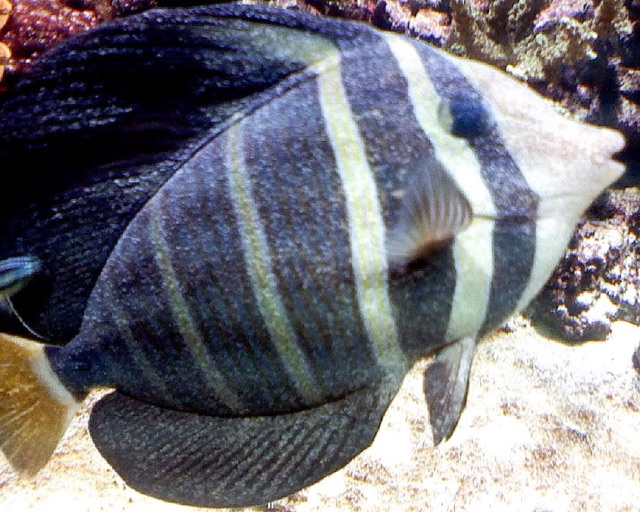
These were sent to me by @Reefahholic. First is a pic of a Sailfin Tang with an advanced case of velvet - visible physical symptoms of the disease are very noticeable. However, in the video below it you will see a Powder Brown Tang showing key behavioral symptoms of velvet. Behavioral signs often prelude the classic powdered sugar look when a fish has velvet, and it is at this point that the fish is most savable by treating with copper or Chloroquine phosphate. Thanks again to @Reefahholic for sending me these. :)


melypr1985

totally addicted
View Badges
Joined
May 4, 2014
Messages
15,113
Reaction score
22,471
Location
Dallas area
Rating - 0%
0   0   0
Perfect examples! Can we use this video when asking others about symptoms? Like for an example like we do with the pictures we accumulate?
 
OP
OP
H

Humblefish

Dr. Fish
View Badges
Joined
Nov 9, 2014
Messages
22,424
Reaction score
31,573
Rating - 0%
0   0   0
For comparison purposes, below is a Purple Tang with just the onset of velvet. The dinospores have already attached, and have begun feeding on the fish's skin which is why he looks "dirty" in certain spots:


10 hours later excess mucous has started to build up around the insertion points, which is why you now see visible white dots. As you can see, the fish is also mostly covered - another telltale sign of velvet instead of ich. But the fish doesn't look completely covered in velvet just yet because this is only the first wave:


And finally we see @Reefahholic's badly infested Sailfin Tang. In my estimation, this fish has already survived several waves of attacking dinospores:


Reefahholic

Acropora Farmer
View Badges
Joined
Sep 5, 2014
Messages
8,134
Reaction score
6,155
Location
Houston, TX
Rating - 0%
0   0   0
The PBT is mine, but the Sailfin tang is off the net, but boy is he infested with Velvet!

Just walk into Pecto, I see velvet all the time. :-)
 

4FordFamily

Tang, Angel, and Wrasse Nerd!
View Badges
Joined
Feb 26, 2015
Messages
20,508
Reaction score
45,793
Location
Carmel, Indiana
Rating - 0%
0   0   0
I will also say that velvet doesn't necessarily have to appear much smaller than ich - I had a case pop up during hyposalinity at 1.0075 salinity very quickly after adding an angel I was acclimating to hyposaline conditions in a qt - fish swam in to powerheads and the dots looked almost indistinguishable from ich even to a somewhat trained eye. The fact it was alive in hypo conditions and thriving after the fish were clear in just a matter of a couple days, coupled with being shy of light and swimming in to the powerheads was the only way I knew with that strain.

Other times the body might not show any spots at all, as happened in my angel tank of a period of several months as I incorrectly ID'd what was killing new angel additions. I expected spots if ich or velvet. I ignored all of the behavioral symptoms blaming flukes, o2 concentration, water quality, bad vendors, etc. turns out it was velvet finally a chevron tang showed classic signs and I felt stupid.

So be aware as humble said and reefaholic illustrated for other signs. With four tanks and tons of fish and only utilizing qt and treatment for the last 2 of 12 years I've seen a lot of disease, much to my embarrassment.
 

4FordFamily

Tang, Angel, and Wrasse Nerd!
View Badges
Joined
Feb 26, 2015
Messages
20,508
Reaction score
45,793
Location
Carmel, Indiana
Rating - 0%
0   0   0
Velvet Update:


Much better! You must be using cupramine.

Be warned though that I've found cupramine to be ineffective even at .6 PPM with ich. I do find cupramine more effective with velvet at lower concentrations (such as .3 ppm) but i am almost certain it has failed me on ich many times at 2.5x recommended therapeutic dose on a couple occasions.
 

Reefahholic

Acropora Farmer
View Badges
Joined
Sep 5, 2014
Messages
8,134
Reaction score
6,155
Location
Houston, TX
Rating - 0%
0   0   0
Regarding Cupramine...

You may find this of interest and also see why I prefer using Cupramine over other copper products.

Article written about Copper by Leo G. Morin, Ph.D.


Looking now at specific recommendations for the use of copper in the marine aquarium, it is evident that the use of any ionizing copper salt is equivalent and will yield [CuCl4]– – , a negatively charged complex that is only moderately resistant to magnesium carbonate adsorption. The most widely recommended copper salt is cupric citrate or a copper salt combined with citric acid. Since a ring structure is formed this is a chelate, but six and seven membered rings are not exceptionally stable. Further, covalent bonds are involved, resulting in an essentially uncharged complex. This makes cupric citrate almost insoluble. It is soluble only under strongly alkaline or acidic conditions and is useful only in keeping stable stock solutions. Cupric tartrate (copper combined with Rochelle salt) forms a more stable complex, but is also insoluble under aquarium conditions. In both of these, the copper is uncharged and unavailable, except as it complexes with chloride. Usually, "chelated copper'' refers to commercial forms of copper complexed with EDTA. This chelate is both stable and soluble under aquarium conditions. Unfortunately, it is also sequestered or inactivated, unavailable as a toxic agent either to fish or parasites. In the EDTA chelate copper is bonded through both covalent and coordinate bonds and is the center of three locked ring structures, effectively isolating any cupric charge and rendering it totally inactive. If it were not for the competition for copper from the high chloride concentration of the marine environment, it is doubtful that chelated copper would have any effectiveness. Acetic acid with a copper salt, or cupric acetate, is sometimes recommended as a more stable form of copper. This has some merit since acetate does form a complex with copper, but this is only slightly more stable than the chloride complex. Another recommendation has been to buffer acetic acid with tris (trishydroxymethylaminomethane). Although this does not appear to be recommended to stabilize copper, but to act as a buffer, the use of tris is actually one of the better recommendations to stabilize copper that have been made. Tris is an amine compound and it forms complexes with copper in the same manner that ammonia does, rendering the copper quite resistant to magnesium carbonate adsorption, leaving it fully charged, neither sequestered nor inactivated. Although the complex is not totally stable, it represents a remarkable improvement over other types of copper. There are numerous organic compounds that are capable of forming this type of complex with copper, some more effective than others, with varying degrees of toxicity. Their use requires thorough evaluation and testing. Generally, loss of the cupric positive charge, or chelation, or both decrease the effectiveness of copper. One amine-complexede copper product that has shown excellent results in stability, effectiveness, and low order toxicity to fish is Seachem’s Cupramine. What is the mechanism of parasite and fish toxicity for copper and how does this relate to marine copper types? When this question comes up it is generally suggested that copper reacts with sulfhydryl groups, inactivating vital intracellular enzymes and other proteins. Although copper does inactivate sulfhydryl enzymes and binds proteins, it does not seem likely from current knowledge of cellular biochemistry that this is a likely mechanism, Only charged (ionic) copper is effective at the usual recommended concentrations (less than 0.3 ppm copper). Membrane biochemistry suggests it’s unlikely that charged copper at such low concentrations could pass through cellular membranes sufficiently to cause severe intracellular damage. Body fluid analyses of treated fish show no significant increase of copper during normal treatment. This supports the supposition that ionic copper does not pass through cellular membranes. It seems more likely that ionic copper acts as a membrane poison, binding to membrane components, causing disruption of normal membrane functions, and leading ultimately to osmotic shock. This is suggested by personal observations of apparent swelling and distortion of Cryptocaryon tomites exposed to copper. Also, the secretion response of fish and their respiratory distress when treated with copper is consistent with this. ~ Interpretation. A comparison of the negatively charged chloride-cupric complex (using copper sulfate) and the positively charged amine-cupric complex (using Cupramine™) indicates that the amine complex destroys tomites more rapidly, or at a lower concentration, than does the chloride complex. When tomites were exposed to 0.2 ppm copper as copper sulfate, or Cupramine, those exposed to copper sulfate required close to two hours to show evidence of 50% disruption or kill, while those exposed to Cupramine™ required about 45 minutes. Fish treated with copper sulfate showed severe distress after 12 hours at 0.4 ppm and body fluids showed increased copper. Fish treated with Cupramine™ showed severe distress after 12 hours at 0.9 ppm and little increased copper in body fluids. Recovery was also more rapid after stressing with amine-complexed copper. This indicates that positively charged amine-cupric complexes are more effective than the usual negatively charged chloride-cupric complex and that larger or positively charged molecules (organically bound amine copper) are less likely to penetrate membranes (less toxic to fish) than smaller or negatively charged molecules (chloride-cupric complex). This also suggests that, possibly, the positively charged water-cupric complex is the form active against parasites while the negatively charged chloride-cupric complex is more toxic to fish. This difference between aminecomplexed copper and chloride-complexed copper probably accounts for varying experiences of success and failure in treating fish with copper, since marine aquaria contain varying amounts of natural chelates and complexing agents that will increase or decrease the effectiveness and toxicity of copper. Amino acids are good examples of such agents, as they are natural by-products of the biological environment of the aquarium, and all amino acids are powerful complexing agents. Many amine-type organics are also produced by decaying food and other decaying organic matter. The EDTA-copper chelate passes relatively freely through membranes and fish treated with it show significant elevations of copper in body fluids. Evidence suggests slow deposition of copper in internal organs, although there are no apparent short-term toxic effects. Cryptocaryon tomites treated with 2 ppm EDTA copper show only slight evidence of osmotic shock and the apparent kill rate is at least half that observed with 0.2 ppm ionic copper, although the eventual tomite mortality is high enough to suggest that for chelated copper the toxic mechanism may only partly be osmotic shock, the balance being some type of intracellular poisoning. It can only be assumed that the same type of poisoning takes place in fish, but that mortality does not occur simply because of the greater mass of fish as compared to parasites. A key factor in the treatment of fish with copper is probability. Success depends on killing susceptible parasites before reinfection can occur. The proportion of parasites killed in a given time is dependent on the copper concentration and the chances of reinfection are inversely proportional to the kill rate and directly proportional to the degree of crowding and the extent of the original infestation. It is important, then, to avoid crowding and to use as high a copper concentration as possible without harming the fish. For copper sulfate, a concentration of less than 0.18 ppm has about a 75% chance of success. If maintained for 10 days. Concentrations between 0.2-0.25 ppm have a 90% chance of success, but are approaching a precarious concentration for fish, about 0.3 ppm. The effectiveness and toxicity for copper sulfate, however, is highly dependent on the pH and organic content of the water. Increasing acidity increases toxicity while increasing organic content decreases toxicity. Aminecomplexed copper can be used safely at 0.3-0.5 ppm with virtually 98% chance of success. For heavy infestations of resistant parasites, it can be increased quite safely to 0.7-0.8 ppm. Chelated copper is ineffective at less than 1 ppm and at 2ppm it has about a 70% chance of success with little danger to fish. Chelated copper can be increased to 2.5-3.0 ppm, but this can be dangerous for some fish. The length of exposure for any copper type can be decreased from 10-14 days to 6-8 days, without sacrificing success, if the fish are transferred to another treatment tank after the initial 4 days.

 

4FordFamily

Tang, Angel, and Wrasse Nerd!
View Badges
Joined
Feb 26, 2015
Messages
20,508
Reaction score
45,793
Location
Carmel, Indiana
Rating - 0%
0   0   0
Regarding Cupramine...

You may find this of interest and also see why I prefer using Cupramine over other copper products.

Article written about Copper by Leo G. Morin, Ph.D.


Looking now at specific recommendations for the use of copper in the marine aquarium, it is evident that the use of any ionizing copper salt is equivalent and will yield [CuCl4]– – , a negatively charged complex that is only moderately resistant to magnesium carbonate adsorption. The most widely recommended copper salt is cupric citrate or a copper salt combined with citric acid. Since a ring structure is formed this is a chelate, but six and seven membered rings are not exceptionally stable. Further, covalent bonds are involved, resulting in an essentially uncharged complex. This makes cupric citrate almost insoluble. It is soluble only under strongly alkaline or acidic conditions and is useful only in keeping stable stock solutions. Cupric tartrate (copper combined with Rochelle salt) forms a more stable complex, but is also insoluble under aquarium conditions. In both of these, the copper is uncharged and unavailable, except as it complexes with chloride. Usually, "chelated copper'' refers to commercial forms of copper complexed with EDTA. This chelate is both stable and soluble under aquarium conditions. Unfortunately, it is also sequestered or inactivated, unavailable as a toxic agent either to fish or parasites. In the EDTA chelate copper is bonded through both covalent and coordinate bonds and is the center of three locked ring structures, effectively isolating any cupric charge and rendering it totally inactive. If it were not for the competition for copper from the high chloride concentration of the marine environment, it is doubtful that chelated copper would have any effectiveness. Acetic acid with a copper salt, or cupric acetate, is sometimes recommended as a more stable form of copper. This has some merit since acetate does form a complex with copper, but this is only slightly more stable than the chloride complex. Another recommendation has been to buffer acetic acid with tris (trishydroxymethylaminomethane). Although this does not appear to be recommended to stabilize copper, but to act as a buffer, the use of tris is actually one of the better recommendations to stabilize copper that have been made. Tris is an amine compound and it forms complexes with copper in the same manner that ammonia does, rendering the copper quite resistant to magnesium carbonate adsorption, leaving it fully charged, neither sequestered nor inactivated. Although the complex is not totally stable, it represents a remarkable improvement over other types of copper. There are numerous organic compounds that are capable of forming this type of complex with copper, some more effective than others, with varying degrees of toxicity. Their use requires thorough evaluation and testing. Generally, loss of the cupric positive charge, or chelation, or both decrease the effectiveness of copper. One amine-complexede copper product that has shown excellent results in stability, effectiveness, and low order toxicity to fish is Seachem’s Cupramine. What is the mechanism of parasite and fish toxicity for copper and how does this relate to marine copper types? When this question comes up it is generally suggested that copper reacts with sulfhydryl groups, inactivating vital intracellular enzymes and other proteins. Although copper does inactivate sulfhydryl enzymes and binds proteins, it does not seem likely from current knowledge of cellular biochemistry that this is a likely mechanism, Only charged (ionic) copper is effective at the usual recommended concentrations (less than 0.3 ppm copper). Membrane biochemistry suggests it’s unlikely that charged copper at such low concentrations could pass through cellular membranes sufficiently to cause severe intracellular damage. Body fluid analyses of treated fish show no significant increase of copper during normal treatment. This supports the supposition that ionic copper does not pass through cellular membranes. It seems more likely that ionic copper acts as a membrane poison, binding to membrane components, causing disruption of normal membrane functions, and leading ultimately to osmotic shock. This is suggested by personal observations of apparent swelling and distortion of Cryptocaryon tomites exposed to copper. Also, the secretion response of fish and their respiratory distress when treated with copper is consistent with this. ~ Interpretation. A comparison of the negatively charged chloride-cupric complex (using copper sulfate) and the positively charged amine-cupric complex (using Cupramine™) indicates that the amine complex destroys tomites more rapidly, or at a lower concentration, than does the chloride complex. When tomites were exposed to 0.2 ppm copper as copper sulfate, or Cupramine, those exposed to copper sulfate required close to two hours to show evidence of 50% disruption or kill, while those exposed to Cupramine™ required about 45 minutes. Fish treated with copper sulfate showed severe distress after 12 hours at 0.4 ppm and body fluids showed increased copper. Fish treated with Cupramine™ showed severe distress after 12 hours at 0.9 ppm and little increased copper in body fluids. Recovery was also more rapid after stressing with amine-complexed copper. This indicates that positively charged amine-cupric complexes are more effective than the usual negatively charged chloride-cupric complex and that larger or positively charged molecules (organically bound amine copper) are less likely to penetrate membranes (less toxic to fish) than smaller or negatively charged molecules (chloride-cupric complex). This also suggests that, possibly, the positively charged water-cupric complex is the form active against parasites while the negatively charged chloride-cupric complex is more toxic to fish. This difference between aminecomplexed copper and chloride-complexed copper probably accounts for varying experiences of success and failure in treating fish with copper, since marine aquaria contain varying amounts of natural chelates and complexing agents that will increase or decrease the effectiveness and toxicity of copper. Amino acids are good examples of such agents, as they are natural by-products of the biological environment of the aquarium, and all amino acids are powerful complexing agents. Many amine-type organics are also produced by decaying food and other decaying organic matter. The EDTA-copper chelate passes relatively freely through membranes and fish treated with it show significant elevations of copper in body fluids. Evidence suggests slow deposition of copper in internal organs, although there are no apparent short-term toxic effects. Cryptocaryon tomites treated with 2 ppm EDTA copper show only slight evidence of osmotic shock and the apparent kill rate is at least half that observed with 0.2 ppm ionic copper, although the eventual tomite mortality is high enough to suggest that for chelated copper the toxic mechanism may only partly be osmotic shock, the balance being some type of intracellular poisoning. It can only be assumed that the same type of poisoning takes place in fish, but that mortality does not occur simply because of the greater mass of fish as compared to parasites. A key factor in the treatment of fish with copper is probability. Success depends on killing susceptible parasites before reinfection can occur. The proportion of parasites killed in a given time is dependent on the copper concentration and the chances of reinfection are inversely proportional to the kill rate and directly proportional to the degree of crowding and the extent of the original infestation. It is important, then, to avoid crowding and to use as high a copper concentration as possible without harming the fish. For copper sulfate, a concentration of less than 0.18 ppm has about a 75% chance of success. If maintained for 10 days. Concentrations between 0.2-0.25 ppm have a 90% chance of success, but are approaching a precarious concentration for fish, about 0.3 ppm. The effectiveness and toxicity for copper sulfate, however, is highly dependent on the pH and organic content of the water. Increasing acidity increases toxicity while increasing organic content decreases toxicity. Aminecomplexed copper can be used safely at 0.3-0.5 ppm with virtually 98% chance of success. For heavy infestations of resistant parasites, it can be increased quite safely to 0.7-0.8 ppm. Chelated copper is ineffective at less than 1 ppm and at 2ppm it has about a 70% chance of success with little danger to fish. Chelated copper can be increased to 2.5-3.0 ppm, but this can be dangerous for some fish. The length of exposure for any copper type can be decreased from 10-14 days to 6-8 days, without sacrificing success, if the fish are transferred to another treatment tank after the initial 4 days.

That's the same stuff that led me to use it, too. But with more fish deaths and 1/4 the effectiveness at double therapeutic levels I abandoned it after about 75 fish and two years.

To be fair I didnt lose many fish with either med but chelated copper was gentler on wrasse
 

Reefahholic

Acropora Farmer
View Badges
Joined
Sep 5, 2014
Messages
8,134
Reaction score
6,155
Location
Houston, TX
Rating - 0%
0   0   0
I'm open to use any med until I have issues. Cupramine is stable, gentle, and effective. I've been using it for about 5 years with good results. If there's anything better I'm not opposed to it. I just feel safe with Cupramine.

What is your drug of choice? Coppersafe?
 

4FordFamily

Tang, Angel, and Wrasse Nerd!
View Badges
Joined
Feb 26, 2015
Messages
20,508
Reaction score
45,793
Location
Carmel, Indiana
Rating - 0%
0   0   0
I'm open to use any med until I have issues. Cupramine is stable, gentle, and effective. I've been using it for about 5 years with good results. If there's anything better I'm not opposed to it. I just feel safe with Cupramine.

What is your drug of choice? Coppersafe?
Coppersafe, yes. I've had halichoeres wrasse die regularly with cupramine but far less so with coppersafe. I've also experienced where cupramine was not effective on strains of ich. Very effective on velvet though. Just my experience
 
Last edited:

Reefahholic

Acropora Farmer
View Badges
Joined
Sep 5, 2014
Messages
8,134
Reaction score
6,155
Location
Houston, TX
Rating - 0%
0   0   0
I have a wrasse with ICH I can use as a test subject with Cupramine. I'll document the process with video.
 

Reefahholic

Acropora Farmer
View Badges
Joined
Sep 5, 2014
Messages
8,134
Reaction score
6,155
Location
Houston, TX
Rating - 0%
0   0   0
Coppersafe, yes. I've had halichoeres wrasse die regularly with cupramine but far less so with coppersafe. I've also experienced where cupramine was not effective on strains of ich. Very effective on velvet though. Just my experience

Did you use Amquel or Prime with your Copper?
 

TOP 10 Trending Threads

WHAT AMOUNT OF LIVE ROCK AND SAND SHOULD BE PRIORITIZED FOR OPTIMAL BIODIVERSITY/FILTRATION?

  • 100% live rock + bagged sand

    Votes: 38 27.1%
  • 100% dry rock + 100% live sand

    Votes: 47 33.6%
  • 50/50 live/dry rock, 50/50 live/bagged sand

    Votes: 31 22.1%
  • 75% live rock, 25% live sand

    Votes: 14 10.0%
  • 25% live rock, 75% live sand

    Votes: 10 7.1%
Back
Top