

Who still uses a wet/dry?

  • Thread starter Thread starter aws2266
  • Start date Start date
  • Tagged users Tagged users None

aws2266

Active Member
View Badges
Joined
Jul 21, 2021
Messages
354
Reaction score
597
Location
Dayton
Rating - 0%
0   0   0
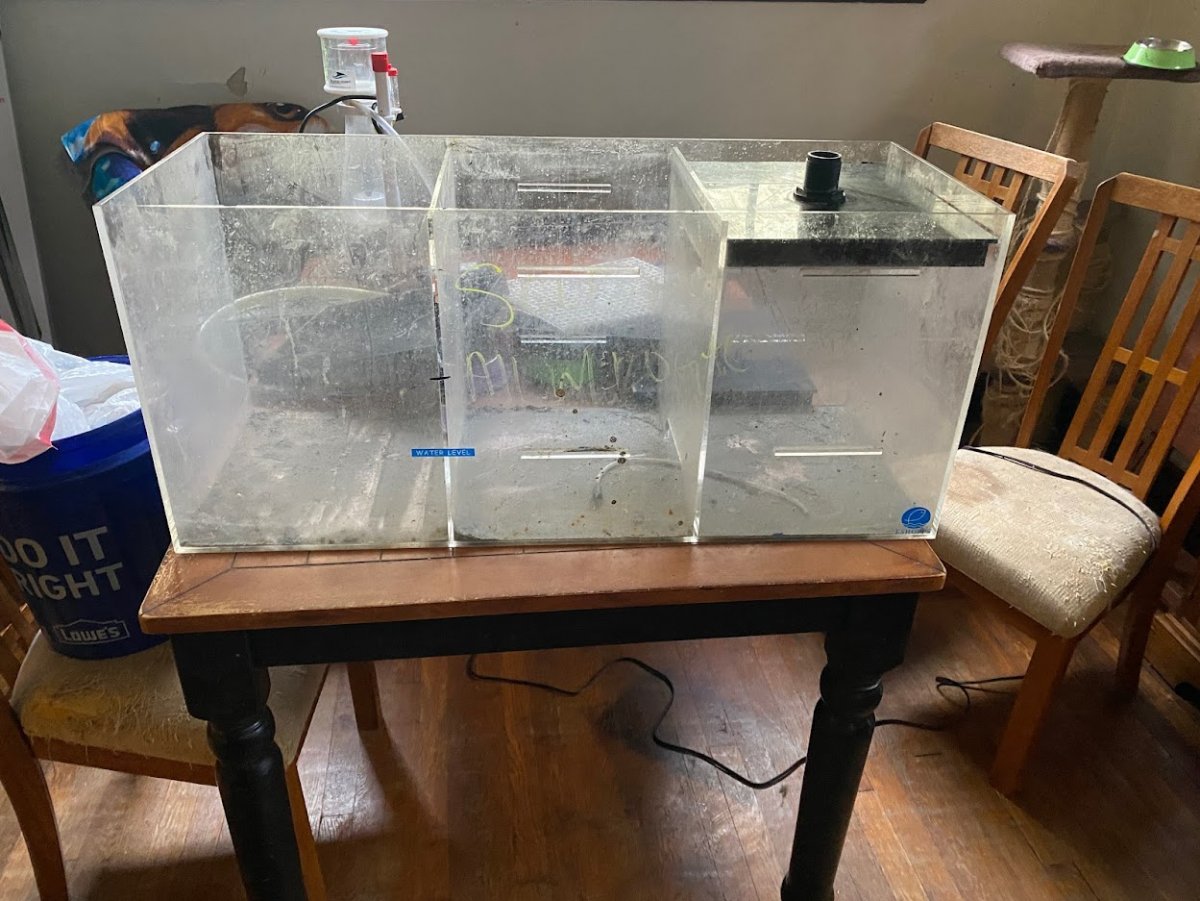
Curious how many people still use a wet/dry? I just purchased a used setup and it came with an old eshopps wet/dry. Since I've got some time before the tank gets wet I'm wondering if I should leave it a wet/dry or convert it into a sump...if possible? I'm thinking of keeping it a wet/dry and using a filter pad before the water hits the bio-media to keep detritus from building up around the bio-media. Then I'm going to put some Chaeto in the second chamber, and the skimmer and return pump in the third. Oh and the water moves between chambers by a small opening at the bottom of the baffles. Lastly, I'm setting up my 120g with mostly dry rock so there will be very little live rock to start out with. What's everyone's opinion of that setup?

IMG_1911.JPG
 
It's been years and years since I ran one, but something tells me amidst all the 'new fangled gadgets' it would still work fine to run a tank. What's old is new again at some point. :cool:
 
Curious how many people still use a wet/dry? I just purchased a used setup and it came with an old eshopps wet/dry. Since I've got some time before the tank gets wet I'm wondering if I should leave it a wet/dry or convert it into a sump...if possible? I'm thinking of keeping it a wet/dry and using a filter pad before the water hits the bio-media to keep detritus from building up around the bio-media. Then I'm going to put some Chaeto in the second chamber, and the skimmer and return pump in the third. Oh and the water moves between chambers by a small opening at the bottom of the baffles. Lastly, I'm setting up my 120g with mostly dry rock so there will be very little live rock to start out with. What's everyone's opinion of that setup?

IMG_1911.JPG
As long as you plan to accommodate the complete nitrogen cycle then there is no problem with a wet dry. There is not a more efficient filter out there to convert ammonia and oxygenate the water. Many today have a gross mis understanding of the filter and label them as nitrate factories. I am not sure if there truly are any real nitrate factories in this hobby, but rather a lack of compete understanding on the role each piece of equipment plays and your need to ensure a method for complete denitrification. Diatribe over. So as long as you have a solution for dentification (algae scrubber, denitificator, refugium or cryptic zone) then you fill have a very effective system.
 
They only real difference between and wet dry and a sump is if there is bioballs or other non-submerged bio materials in there. It is not necessary if you have lots of live rock and sand to handle bio filtration, but it also does not hurt to have the bio balls - they are good at their jobs. They just do a job that needs to be done and most tanks that start bare bottom and with dry rock could probably use some of that non-submerged bio material for the first year while their sterile tank builds life.

In the end, biology and chemistry have not changed since people used these, but the parroting mob mentality on message boards to recite cute phrases has gotten more pronounced. A wet dry will not convert more ammonia =>nitrite => nitrate than any other source with the same amount of ammonia. They don't make nitrate out of nothing.

The filter pad that you suggest is nearly identical to a sock. If you keep it clean and you physically remove stuff. Let it sit and it will grow bacteria and just be another phase in the cycle.

My general advice on new tanks is to save some money on additives, bacteria in bottles, etc. and order a 10-20 pound pack of real live rock from the gulf to get lots of good stuff into your tank.
 
Last edited:
They work fine, I never had issues with them.
 
If It works for you USE IT DON T BELIEVE EVERYTHING YOU HEAR OR READ. I have used Eheim Canister filters for 25 years on reef tanks and never a so called Nitrate factory. Knowledge is the KEY, Good luck!
 
I started out with a used wet/dry that I purchased with the 125. Just wasn't crazy about it.

From my build thread:
3. It didn't take long to realize that the wet/dry filter had to go. Nitrates were always very high and would roller coaster with my large weekly water changes. I was running a BRS carbon/GFO reactor (that came with the tank) and PO4 would go from near nothing to way too high depending on when I changed the GFO. Also, the skimmer was in the return section, causing micro bubbles to go into the display. Lastly, I had to disturb my plumbing every week to change the filter pads in the filter. I did NOT like this filter. In May or June 18, I replaced it with a Trigger systems Crystal 36 sump.
20180620_173624.jpg
You can absolutely succeed with a wet/dry, and yours looks a lot more versatile than mine was. My DT appeared to become more stable immediately after the swap. Keep in mind that this was my 1st attempt at a large reef tank, and I would hopefully be more successful with it now, or if I had asked for advice with it ;).

Since then, I've added more crap equipment to the sump that I couldn't have fit in the wet/dry. It looks like that might not be an issue for you. I do like the sump better though.

Not trying to be a "Debby Downer". Just thought you might appreciate another point of view. The upside for me was that with my stand design, swapping the wet/dry for the sump was much easier than I thought it would be. I got it done in an hour or two with water in the tank. Depending on your stand, you can always make a change if you're not satisfied with it.
 
Detritus is the inert waste bi-product of the beneficial bacteria living on the bio-media, therefore detritus will appear post (following) exposure flow of both the aerobic & anaerobic bio-medias.
Don’t confuse the material type of the secondary media in a wet fry filter (which is usually a foam pad) as some form of mechanical filtration because it is not.
A “Real” wet dry filter (one that is properly designed) will provide an area in it that is constantly submerged allowing placement of a dense media (small pores) that allow water to penetrate, yet greatly reduce oxygen penetration. This media is an essential “Cryptic Zone” providing “ANAEROBIC” treatment (exposure to “Nitrobacter”) which will consume Nitrite and convert nitrate into harmless nitrogen gas. Although multiple forms of media may be used here such as lava rock, ceramic blocks, gravel, crushed corral beds etc., 20 PPI Foam is the most practical due to its ease of access.
 

TOP 10 Trending Threads

HOW MUCH DOES A FISH’S FEEDING REQUIREMENTS AFFECT YOUR STOCKING DECISIONS?

  • A lot! - I avoid fish that require frequent or specialized feeding

    Votes: 22 32.4%
  • Quite a bit, but an automatic feeder can change my answer

    Votes: 10 14.7%
  • It depends on whether my nutrient export can handle it

    Votes: 9 13.2%
  • It depends on how badly I want the fish

    Votes: 14 20.6%
  • Not much. I’m willing to adjust my routine

    Votes: 12 17.6%
  • Not at all. Feeding demands don’t limit my stocking choices

    Votes: 12 17.6%
  • I usually learn about the demanding feeding schedule after buying the fish!

    Votes: 2 2.9%
  • I haven’t really considered this before

    Votes: 4 5.9%
  • Something else (see my comments in the thread)

    Votes: 2 2.9%
Back
Top
Home
Post thread…
Market
What's new





