




Miami Reef
Reef Chem Enthusiast
View BadgesPartner Member 2026
Excellence Award
R2R App User
Expert Contributor
Article Contributor
Rest In Peace
Hospitality Award
305 Reef Club
R2R Research
ThreadAward
My Tank Thread
- Joined
- Sep 8, 2017
- Messages
- 17,251
- Reaction score
- 29,663
- Location
- Miami
- What state or country do you live in
- Florida
It’s a question that fills countless forum threads, often leaving reefers scratching their heads. You might test your water, only to find yourself with very low, concerning magnesium levels, or you may have the opposite problem of extremely elevated magnesium of 1,500+ ppm. The most perplexing scenario is when magnesium is highly unstable throughout the week, with a consumption rate so high it feels impossible to keep up with. If any of the above describes your system, it’s important to know if the test kits are displaying accurate results prior to dosing additional magnesium.
Most hobby-grade test kits are notoriously inaccurate, and it’s the unfortunate truth. Some might retest, others might double-check their results at an LFS, a few might pick up a backup kit of the same brand, and some might even purchase multiple kits from different brands. No matter what category you fall into, the result is often the same: retesting the magnesium only confirms the concerning result. Unfortunately, the odds that a hobby-grade test is displaying accurate results are against you. Even many high-end test kits are subject to this, so abnormal values and daily swings might be more from poor test kit accuracy and resolution rather than actual magnesium fluctuations. However, there are definitely scenarios where the test kit is accurate, and the magnesium is genuinely out of range, and there are several ways to find out.
Magnesium in the ocean is very consistent at around 1,280 ppm at 35 ppt salinity across most regions. In reef aquariums, the acceptable range is fairly broad, with levels from 1,280 ppm up to 1,450 ppm being adequate. Some reefers report improved coral health at higher concentrations, while others notice little difference. After all, corals evolved and adapted to magnesium levels around 1,280 ppm.
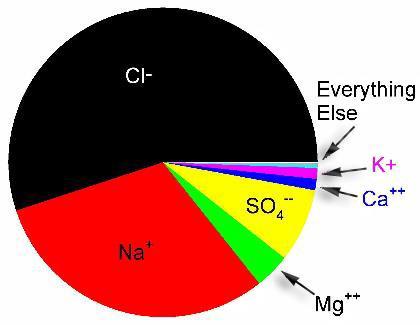
Figure 1: The composition of ions in seawater by weight.
Magnesium is one of the major ions in seawater and is the fourth most abundant by weight. Salinity can have a substantial effect on magnesium levels and apparent depletion rates. For example, at full-strength natural seawater (35 ppt, SG = 1.0264), magnesium measures about 1,280 ppm. Lowering the salinity to 32 ppt (SG ≈ 1.024) reduces magnesium by roughly 110 ppm, bringing it to about 1,170 ppm relative to natural seawater. The first step in troubleshooting magnesium issues is verifying that your salinity measurements are accurate. Fortunately, it’s simple and inexpensive to create highly accurate DIY salinity standards using regular table salt at home: https://www.reef2reef.com/ams/reef-aquarium-salinity-diy-calibration-standards.956/
Magnesium plays an important role in reef tanks by naturally inhibiting abiotic precipitation. Calcium carbonate is already supersaturated in seawater, and one of the primary reasons we’re able to maintain proper calcium and alkalinity levels is because of magnesium. Without it, the likelihood of calcium carbonate precipitation increases significantly. The hard, white crust that sometimes builds up around heaters, pumps, and dosing lines is a result of precipitation. In extreme cases, the sand bed can also harden into large chunks.
Stony corals and coralline algae both deplete magnesium, but it appears to be incorporated in their skeletons by displacing some calcium during the calcification process rather than through active uptake. Magnesium depletes at a known ratio with alkalinity and calcium: 2.8 dKH alkalinity, 18–20 ppm calcium, and 1–2 ppm magnesium. If corals are the primary consumers in the tank, the depletion rate will occur at the lower end of that range, whereas coralline algae’s high-magnesium calcite skeletons deplete it at roughly 10% of the calcium consumed, by weight (2 ppm magnesium per ~20 ppm calcium consumed).
The second way to determine whether the magnesium depletion is real is by comparing it to the calcium and alkalinity consumption rate. Let’s assume, in a generous worst-case scenario, that the magnesium is primarily being depleted by coralline algae. Most tanks will not have excessive coralline growth, but it can help put things in perspective because no process can consume magnesium at a rate exceeding 10% of calcium by weight. If magnesium drops by 10 ppm per day, alkalinity would need to drop by 14 dKH and calcium will need to deplete by about 100 ppm per day. As we can see, magnesium depletes VERY SLOWLY in reef tanks. If magnesium is significantly fluctuating or dropping each day, it likely isn’t due to actual calcification.
There are a few ways to validate and obtain accurate test results. The simplest method is to test the magnesium of freshly made saltwater at 35 ppt. Many salt brands have been repeatedly tested by high quality ICP tests over the years and have developed a reputation for consistency. It’s uncommon for bad batches of salt to occur, so if the magnesium in the new saltwater is also testing abnormally, it likely points to faulty test results. Of course, sending an ICP test of the tank water is one of the most direct ways to get accurate magnesium readings, and it can confirm whether it is truly out of range
My preferred method for validating magnesium test kits is using ICP results to create a magnesium standard. All that’s required is to store a bottle of tank water at the same time the ICP sample is collected. The ICP test measures the tank’s magnesium concentration, and that same result applies to the stored bottle, allowing you to use it later to verify the accuracy of your home test kits. When using this approach, it’s recommended to use high quality, accurate ICP brands, with my personal favorite being Oceamo ICP-MS, as their results are exceptionally precise, which is ideal when using ICP results to create a magnesium standard.
From Oceamo:
“Typical error for macroelements is this in the 2-3% range, if performed well. For us this is still too much - this is why we are measuring Na, K, Mg and Ca in addition with cation chromatography since several months, which is even more robust and brings error down to the 1% range. We are also having a control sample (SST, system suitability test) we are measuring there in every sequence.”
https://www.reef2reef.com/threads/correctness-and-repeatability-of-icp-ms-seawater-measurements.997436/page-3
This write-up wouldn’t be complete without mentioning RMM, also known as Randy’s Magnesium Method. Magnesium depletes slowly and in direct proportion to calcium and alkalinity. Using calcium consumption as a reference, you can dose a fixed amount of magnesium (5–10% of the calcium dosed), and it will naturally account for magnesium without the need for additional testing. These days, RMM is often the preferred approach to managing magnesium because test kits tend to cause more confusion than clarity when determining true magnesium levels. Magnesium’s acceptable range is broad, its depletion is gradual, it doesn’t fluctuate independently, and it simply isn’t critical to test for regularly. Its consumption rate is both slow and predictable.
Supplementing magnesium through RMM is relatively simple. Some reefers prefer to add a few ppm of magnesium to their water-change reservoir to offset consumption. Many alkalinity and calcium dosing systems already include 5–10% magnesium in their formulations. Our Balling Method DIY Three-Part recipe is one example that incorporates magnesium, eliminating the need for separate testing: DIY Balling Method Recipe.
Additionally, All-For-Reef and ESV B-Ionic also contain the necessary magnesium if corals are the primary consumers, and many other additives do as well.
Kalkwasser contains roughly 800 ppm of calcium when fully saturated, so you’d want to supplement 5–10% of that amount as magnesium. Using recipes that contain approximately 47,000 ppm of magnesium (such as Randy’s Magnesium Recipes), this would require adding 3–6 mL of solution per gallon of saturated kalkwasser dosed.
In the end, magnesium is actually one of the least finicky reef parameters. It doesn’t swing wildly, it doesn’t need constant monitoring, and most tanks maintain it naturally through regular dosing and water changes. Focus on keeping calcium, alkalinity, and salinity steady, and magnesium should be automatically accounted for. If you are skeptical and believe your magnesium is out of range, testing new saltwater and sending off an ICP analysis are two good ways to determine how far off the value really is.
Most hobby-grade test kits are notoriously inaccurate, and it’s the unfortunate truth. Some might retest, others might double-check their results at an LFS, a few might pick up a backup kit of the same brand, and some might even purchase multiple kits from different brands. No matter what category you fall into, the result is often the same: retesting the magnesium only confirms the concerning result. Unfortunately, the odds that a hobby-grade test is displaying accurate results are against you. Even many high-end test kits are subject to this, so abnormal values and daily swings might be more from poor test kit accuracy and resolution rather than actual magnesium fluctuations. However, there are definitely scenarios where the test kit is accurate, and the magnesium is genuinely out of range, and there are several ways to find out.
Magnesium in the ocean is very consistent at around 1,280 ppm at 35 ppt salinity across most regions. In reef aquariums, the acceptable range is fairly broad, with levels from 1,280 ppm up to 1,450 ppm being adequate. Some reefers report improved coral health at higher concentrations, while others notice little difference. After all, corals evolved and adapted to magnesium levels around 1,280 ppm.
Figure 1: The composition of ions in seawater by weight.
Magnesium is one of the major ions in seawater and is the fourth most abundant by weight. Salinity can have a substantial effect on magnesium levels and apparent depletion rates. For example, at full-strength natural seawater (35 ppt, SG = 1.0264), magnesium measures about 1,280 ppm. Lowering the salinity to 32 ppt (SG ≈ 1.024) reduces magnesium by roughly 110 ppm, bringing it to about 1,170 ppm relative to natural seawater. The first step in troubleshooting magnesium issues is verifying that your salinity measurements are accurate. Fortunately, it’s simple and inexpensive to create highly accurate DIY salinity standards using regular table salt at home: https://www.reef2reef.com/ams/reef-aquarium-salinity-diy-calibration-standards.956/
Magnesium plays an important role in reef tanks by naturally inhibiting abiotic precipitation. Calcium carbonate is already supersaturated in seawater, and one of the primary reasons we’re able to maintain proper calcium and alkalinity levels is because of magnesium. Without it, the likelihood of calcium carbonate precipitation increases significantly. The hard, white crust that sometimes builds up around heaters, pumps, and dosing lines is a result of precipitation. In extreme cases, the sand bed can also harden into large chunks.
Stony corals and coralline algae both deplete magnesium, but it appears to be incorporated in their skeletons by displacing some calcium during the calcification process rather than through active uptake. Magnesium depletes at a known ratio with alkalinity and calcium: 2.8 dKH alkalinity, 18–20 ppm calcium, and 1–2 ppm magnesium. If corals are the primary consumers in the tank, the depletion rate will occur at the lower end of that range, whereas coralline algae’s high-magnesium calcite skeletons deplete it at roughly 10% of the calcium consumed, by weight (2 ppm magnesium per ~20 ppm calcium consumed).
The second way to determine whether the magnesium depletion is real is by comparing it to the calcium and alkalinity consumption rate. Let’s assume, in a generous worst-case scenario, that the magnesium is primarily being depleted by coralline algae. Most tanks will not have excessive coralline growth, but it can help put things in perspective because no process can consume magnesium at a rate exceeding 10% of calcium by weight. If magnesium drops by 10 ppm per day, alkalinity would need to drop by 14 dKH and calcium will need to deplete by about 100 ppm per day. As we can see, magnesium depletes VERY SLOWLY in reef tanks. If magnesium is significantly fluctuating or dropping each day, it likely isn’t due to actual calcification.
There are a few ways to validate and obtain accurate test results. The simplest method is to test the magnesium of freshly made saltwater at 35 ppt. Many salt brands have been repeatedly tested by high quality ICP tests over the years and have developed a reputation for consistency. It’s uncommon for bad batches of salt to occur, so if the magnesium in the new saltwater is also testing abnormally, it likely points to faulty test results. Of course, sending an ICP test of the tank water is one of the most direct ways to get accurate magnesium readings, and it can confirm whether it is truly out of range
My preferred method for validating magnesium test kits is using ICP results to create a magnesium standard. All that’s required is to store a bottle of tank water at the same time the ICP sample is collected. The ICP test measures the tank’s magnesium concentration, and that same result applies to the stored bottle, allowing you to use it later to verify the accuracy of your home test kits. When using this approach, it’s recommended to use high quality, accurate ICP brands, with my personal favorite being Oceamo ICP-MS, as their results are exceptionally precise, which is ideal when using ICP results to create a magnesium standard.
From Oceamo:
“Typical error for macroelements is this in the 2-3% range, if performed well. For us this is still too much - this is why we are measuring Na, K, Mg and Ca in addition with cation chromatography since several months, which is even more robust and brings error down to the 1% range. We are also having a control sample (SST, system suitability test) we are measuring there in every sequence.”
https://www.reef2reef.com/threads/correctness-and-repeatability-of-icp-ms-seawater-measurements.997436/page-3
This write-up wouldn’t be complete without mentioning RMM, also known as Randy’s Magnesium Method. Magnesium depletes slowly and in direct proportion to calcium and alkalinity. Using calcium consumption as a reference, you can dose a fixed amount of magnesium (5–10% of the calcium dosed), and it will naturally account for magnesium without the need for additional testing. These days, RMM is often the preferred approach to managing magnesium because test kits tend to cause more confusion than clarity when determining true magnesium levels. Magnesium’s acceptable range is broad, its depletion is gradual, it doesn’t fluctuate independently, and it simply isn’t critical to test for regularly. Its consumption rate is both slow and predictable.
Supplementing magnesium through RMM is relatively simple. Some reefers prefer to add a few ppm of magnesium to their water-change reservoir to offset consumption. Many alkalinity and calcium dosing systems already include 5–10% magnesium in their formulations. Our Balling Method DIY Three-Part recipe is one example that incorporates magnesium, eliminating the need for separate testing: DIY Balling Method Recipe.
Additionally, All-For-Reef and ESV B-Ionic also contain the necessary magnesium if corals are the primary consumers, and many other additives do as well.
Kalkwasser contains roughly 800 ppm of calcium when fully saturated, so you’d want to supplement 5–10% of that amount as magnesium. Using recipes that contain approximately 47,000 ppm of magnesium (such as Randy’s Magnesium Recipes), this would require adding 3–6 mL of solution per gallon of saturated kalkwasser dosed.
In the end, magnesium is actually one of the least finicky reef parameters. It doesn’t swing wildly, it doesn’t need constant monitoring, and most tanks maintain it naturally through regular dosing and water changes. Focus on keeping calcium, alkalinity, and salinity steady, and magnesium should be automatically accounted for. If you are skeptical and believe your magnesium is out of range, testing new saltwater and sending off an ICP analysis are two good ways to determine how far off the value really is.
Last edited by a moderator:














