Ammonium dosing is a bit overrated

  • Thread starter Thread starter Miami Reef
  • Start date Start date
  • Tagged users Tagged users None
Thanks….haha! I’m not that committed, it is still a hobby.

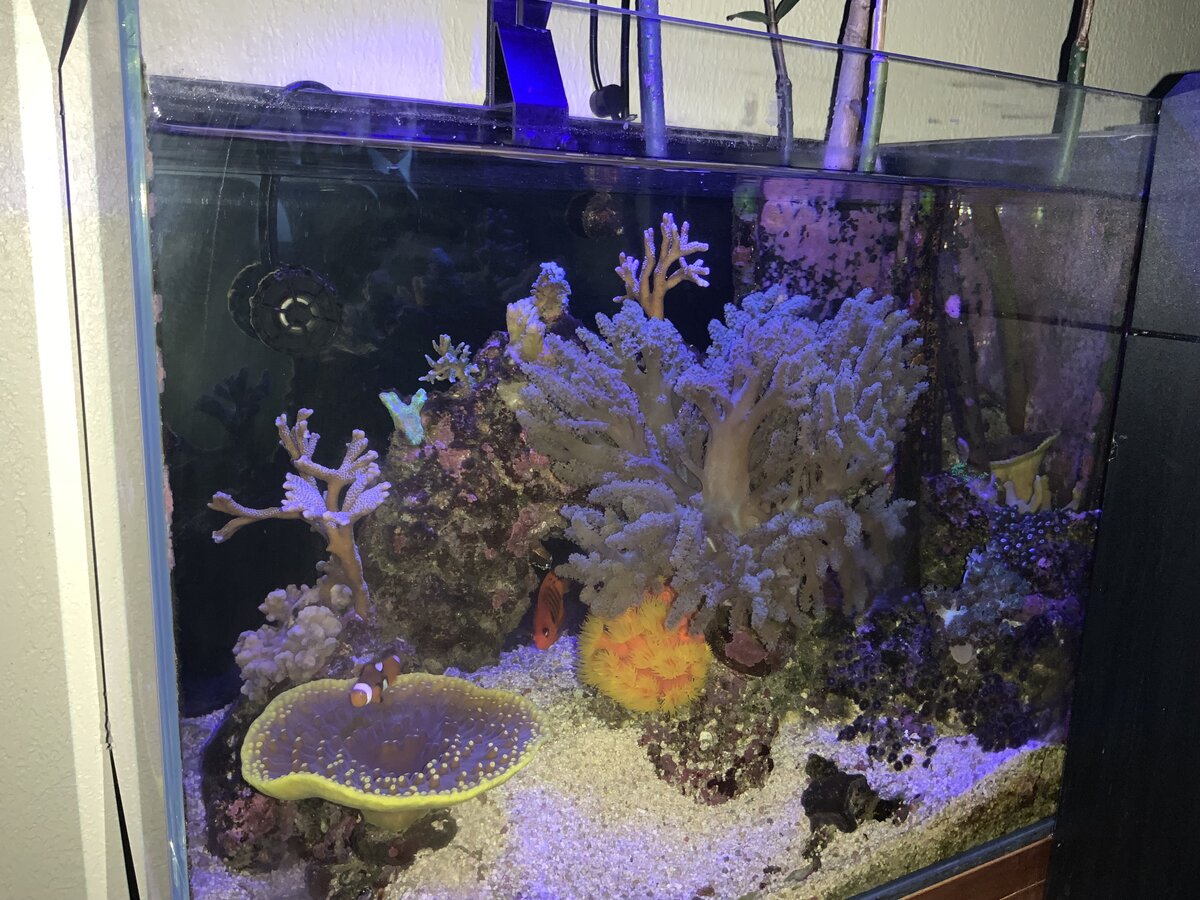
My only argument is that nature reefs, imo, have an over abundant amount of planktonic/particulate foods and most gets swept into the abyss. I think it is possible to provide an optimal amount of particle foods. My proof is success with a sun coral.

IMG_0992.jpeg
I mean.....I guess...
 
I was working on a maxima clam care guide a few months ago. I still have the file saved on my computer, but I put the idea on the back burner because I didn’t personally ever deal with pyramid snail parasites. I felt like that’s an important issue to solve if it’s on your clam, and it would be ironic for me to give advice how to treat it if I never came in contact with it.

That’s the only reason I haven’t finished or released the guide. I know what clams need for optimal health, mounting tricks, feedings (if necessary), and even treating PMD.

But pyramid snails? Nope. Never dealt with it. Are you guys saying I could still make a guide and talk about pyramid snails despite never encountering them?
 
I was working on a maxima clam care guide a few months ago. I still have the file saved on my computer, but I put the idea on the back burner because I didn’t personally ever deal with pyramid snail parasites. I felt like that’s an important issue to solve if it’s on your clam, and it would be ironic for me to give advice how to treat it if I never came in contact with it.

That’s the only reason I haven’t finished or released the guide. I know what clams need for optimal health, mounting tricks, feedings (if necessary), and even treating PMD.

But pyramid snails? Nope. Never dealt with it. Are you guys saying I could still make a guide and talk about pyramid snails despite never encountering them?
As long as you stay at a Holiday Inn express…..I don’t see why not. Better than some ChatGPT guide!

 
Last edited:
Good read Miami
 
I was working on a maxima clam care guide a few months ago. I still have the file saved on my computer, but I put the idea on the back burner because I didn’t personally ever deal with pyramid snail parasites. I felt like that’s an important issue to solve if it’s on your clam, and it would be ironic for me to give advice how to treat it if I never came in contact with it.

That’s the only reason I haven’t finished or released the guide. I know what clams need for optimal health, mounting tricks, feedings (if necessary), and even treating PMD.

But pyramid snails? Nope. Never dealt with it. Are you guys saying I could still make a guide and talk about pyramid snails despite never encountering them?

Dr. Mac over at Pacific East Aquaculture has a couple different video guides on the handling of Maxima clams. To include the identification and managing pyramid snails. Anyone asking about care of I refer them as he is an expert.
 
Dr. Mac over at Pacific East Aquaculture has a couple different video guides on the handling of Maxima clams. To include the identification and managing pyramid snails. Anyone asking about care of I refer them as he is an expert.
He’s very experienced and a great vendor. I just thought having a forum article would be beneficial to some users struggling with clams, but I understand how it would be a bit of a conundrum. That’s why I never got around finishing it.
 
He’s very experienced and a great vendor. I just thought having a forum article would be beneficial to some users struggling with clams, but I understand how it would be a bit of a conundrum. That’s why I never got around finishing it.
You could keep it as a living document. Post up what you have and add to it as things are encountered. (not that i hope you have more pest encounters for educational purposes) Finality is a wonderful goal but things in this world are temporal in nature anyways.
 
As Hans Werner put it:

“While phosphate is the principal compound used for nearly all biological processes and compounds, nitrate is not. Nitrate is rather a waste product, the ashes of burnt excess nitrogen compounds.

When after mineralization there is still ammonium left, bacteria use its chemical energy to oxidize it to nitrate, which is a kind of final waste product of nitrogen cycle.”

I see no point in dosing them personally and I dosed them for years before switching to ammonia. In my old 250 it was a night and day difference how the corals reacted and grew under each regiment.

Little dino patches on the sand were almost immediately (within 24 hours) covered in cyano and then went away when dosing ammonia. Those same patches just kept growing dinos with nitrate dosing.

I dose ammonia and rarely even test nitrate. I don’t advocate that anyone else do this especially if new, but if you have a decent grasp on the concept and a little common sense, it works great IME
I was just going to ask the question - what difference does 1ppm NO3 and 10ppm NO3 make?

I just want to keep my NO3 detectable (as long as it’s over 1ppm I don’t care what the number is), because that tells me there is enough being consumed before the rest is turned to waste (NO3).

I don’t understand the fascination with keeping elevated NO3 or hitting a specific number like “I see the best results with ‘X’ ppm of NO3”

 
2) People use ammonium dosing to increase nitrate.
Not true. Most of us dose ammonia to feed the coral more efficiently and have NO3 as the biproduct. If we want to hit a certain ppm number for our comfort level, we dose NO3 directly to do that.

But from what I’ve read (or lack of evidence from what I’ve read) and IMO, 1ppm vs 10ppm makes no difference as long as there’s not a deficiency (aka undetectable as there is no ammonia to convert to waste after corals consumed what they can).
My immediate goal is to create an ammonium dosing chart and guideline. I think it can be helpful instead of leaving people astray to figure out how many ppm ammonium to dose and in how many increments to increase it by based on nitrate testing.
I believe this already exists. can’t remember who, but someone took Randy’s DIY thread and made a dosing guide.
 
As Hans Werner put it:

“While phosphate is the principal compound used for nearly all biological processes and compounds, nitrate is not. Nitrate is rather a waste product, the ashes of burnt excess nitrogen compounds.

When after mineralization there is still ammonium left, bacteria use its chemical energy to oxidize it to nitrate, which is a kind of final waste product of nitrogen cycle.”

I see no point in dosing them personally and I dosed them for years before switching to ammonia. In my old 250 it was a night and day difference how the corals reacted and grew under each regiment.

Little dino patches on the sand were almost immediately (within 24 hours) covered in cyano and then went away when dosing ammonia. Those same patches just kept growing dinos with nitrate dosing.

I dose ammonia and rarely even test nitrate. I don’t advocate that anyone else do this especially if new, but if you have a decent grasp on the concept and a little common sense, it works great IME
I was just going to ask the question - what difference does 1ppm NO3 and 10ppm NO3 make?

I just want to keep my NO3 detectable (as long as it’s over 1ppm I don’t care what the number is), because that tells me there is enough being consumed before the rest is turned to waste (NO3).

I don’t understand the fascination with keeping elevated NO3 or hitting a specific number like “I see the best results with ‘X’ ppm of NO3”

I actually don’t know if there is a difference, good or bad, between 1 ppm and 10 ppm. I spent a long time targeting at least 5ppm, not because I thought 5 was special, but because I felt comfortable it would stay above zero.
 
I just want to keep my NO3 detectable (as long as it’s over 1ppm I don’t care what the number is), because that tells me there is enough being consumed before the rest is turned to waste (NO3).

I really don’t get the chic way of dissing nitrate by calling it waste. It has pros and cons of various sorts, but to call it it waste is misguided, IMO.

ALL of the inorganic nutrients can be called waste since it is the end product of some organism using it. Ammonia and phosphate and urea are waste products. Does that make them any better or worse as a source of N and P?
 
what difference does 1ppm NO3 and 10ppm NO3 make
I agree. I don’t understand the fascination with no3, especially elevating and maintaining to 1000s percent higher than necessary. I take it a little farther and find .1 ppm no3 more than adequate. I see the point if maintenance is performed and algae is under control allowing the aquarium to settle higher, example Ross, however forcing a higher number: no sense!
 
I agree. I don’t understand the fascination with no3, especially elevating and maintaining to 1000s percent higher than necessary. I take it a little farther and find .1 ppm no3 more than adequate. I see the point if maintenance is performed and algae is under control allowing the aquarium to settle higher, example Ross, however forcing a higher number: no sense!

Why do you believe it is impossible that folks have visually determined their tanks seem better at 5+ ppm than at 0.1 to 1 ppm?

I understand some folks don’t find it better, but that hardly proves others are somehow “wrong”.
 
Why do you believe it is impossible that folks have visually determined their tanks seem better at 5+ ppm than at 0.1 to 1 ppm?

I understand some folks don’t find it better, but that hardly proves others are somehow “wrong”.
Probably this….

Randy Holmes-Farley said:
Just like any husbandry practice and any aspect of that tank, it does not mean the practice contributed to the result, maybe the result happened in spite of the practice
 
Probably this….

Randy Holmes-Farley said:
Just like any husbandry practice and any aspect of that tank, it does not mean the practice contributed to the result, maybe the result happened in spite of the practice

Would it be fair for someone then to say:


I agree. I don’t understand the fascination with low no3 just because it is possible in some scenarios to make it work. I take it a little farther and claim that 2 ppm no3 is inadequate in my aquarium. The idea that all tanks have adequate sources of N at 1 ppm nitrate seems to lack evidence.
 
Why do you believe it is impossible that folks have visually determined their tanks seem better at 5+ ppm than at 0.1 to 1 ppm?

I understand some folks don’t find it better, but that hardly proves others are somehow “wrong”.
Also I like try to imitate nature and its beauty, process in my box. Its pest and predators for example aiptasia and Nudibranch. So part of my motivation is simply maintaining no3 near ocean level when 1 ppm may be just as adequate? I do believe however lower no3 is better.
 
Also I like try to imitate nature and its beauty, process in my box. Its pest and predators for example aiptasia and Nudibranch. So part of my motivation is simply maintaining no3 near ocean level when 1 ppm may be just as adequate? I do believe however lower no3 is better.

A goal of mimicing nature is obviously a fine way to go. That does not mean it is optimal even if done perfectly, but most especially may be suboptimal when a reefer not be properly mimicing other aspects of nature that directly impact on the parameter in question, such as (for nitrate) amount and type of particulate foods, ammonia levels, urea levels, bacteria species and numbers present, etc.
 
Would it be fair for someone then to say:


I agree. I don’t understand the fascination with low no3 just because it is possible in some scenarios to make it work. I take it a little farther and claim that 2 ppm no3 is inadequate in my aquarium. The idea that all tanks have adequate sources of N at 1 ppm nitrate seems to lack evidence.
I understand the thinking, however personally it’s opposite my beliefs and I’m not George Costanza…lol!
 
I’m a bit lost. It seems some here rely on their own observations and experiences as valid evidence, which is fine. But then dismiss others’ similar observations as unreliable because they aren’t backed by science.

To me that is very inconsistent. If personal observation is acceptable for supporting your own position, it can’t be rejected outright when it supports someone else’s. It feels a bit circular, at best.
 

TOP 10 Trending Threads

ARE YOU READY TO CONFESS TO CRAZIEST, DUMBEST, FUNNIEST THING YOU’VE EVER DONE IN REEFING?

  • Yeah, I'll confess! (Share your story in the comments!)

    Votes: 62 55.4%
  • Nah, I'll keep mine a secret...(Don't be like that, share with the class!)

    Votes: 50 44.6%
Back
Top
Home
Post thread…
Market
What's new