Follow along with the video below to see how to install our site as a web app on your home screen.
Note: This feature may not be available in some browsers.
Oxidation occurs when a reactant loses electrons during the reaction. Reduction occurs when a reactant gains electrons during the reaction.
Thanks for the info LasseThe ORP value tell you if there is either oxidative or reducing processes that is active. If it is over 0 - the oxidative processes dominate and the opposite if the reducing processes dominate. From the books
These processes happens all the time and it is the sum of these reactions that you see as the ORP potential. In a natural system - you can never distinct exactly what happens. If you in a natural system have an ORP of 450 - IMO - you are not in danger. However - if you in a natural system with ORP around 300 or lower put in a highly oxidative compound like Ozone and the ORP rise up to 450 - you can be in danger because Ozone will break down into oxygen radicals that affect biological life. De facto - Ozone can be dangerous in lower ORP to - if that is mainly the Ozone that is responsible for the ORP value. Therefore - rise ORP slowly with Ozone. If your normal ORP is around 300 - you maybe should rise it to 320 with Ozone and stop there for a while and after that adjust slowly up to 360 - 400 mV.
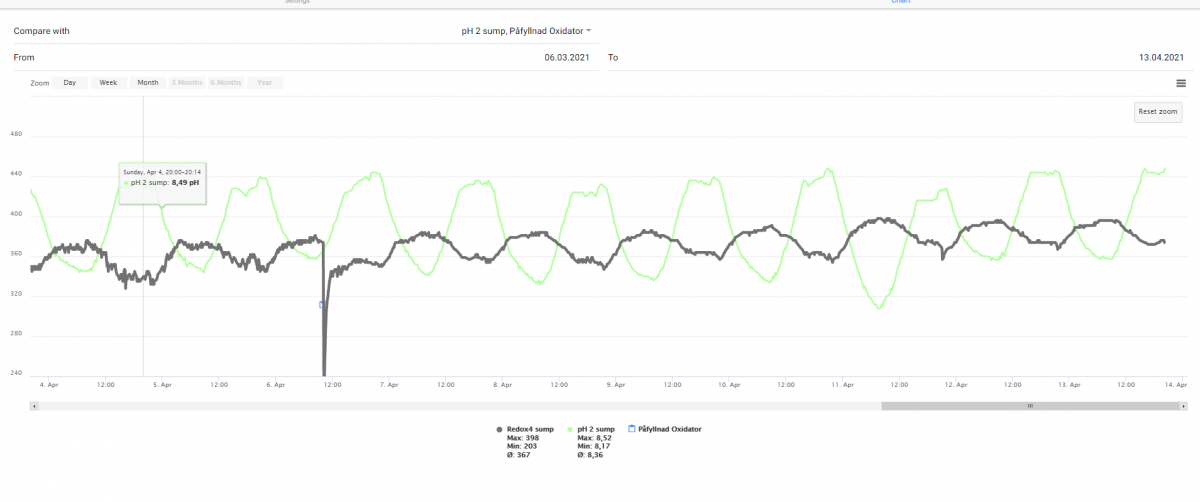
Peroxide is more tricky - if you add this - your ORP will in the first moment dip and IMO - it is because the H2O2 lose its extra O and oxygen radicals is formed. When they start to oxidize different substances - the ORP will rise but the dangerous oxygen radicals will be depleted. Hence - if you see a radical dip when adding peroxide - it could be to much breaking down to fast. Oxydators is a good tool to note do local overdoses. Often - when you start with new filled containers - you will see a dip and after that the redox potential will rise with time - this is the last time I load my oxydator. Note the daily swings that is opposite synced with the pH.
![]()
A closer look. The read marking shows the ORP when my oxidator is empty - no peroxide in it. The dip - just filled with 11 % H2O2 and 3 catalyst. Blue - the redox with 11% H2O2 and 3 catalyst. I took around a day after the dip - after that back to the normal levels. as you can see not huge difference in the ORP with and without 11 % peroxide in the oxydator
![]()
ORP is a fruit measurement - you know its fruit but not which type of fruit.
Another experiences - redox probes take some time before they adapt if they are in another solution or up in the air. If I clean my electrode - it will take 2-4 days begore it is in normal condition again.
I do not think you need to worry to much with 3 % and 2 catalyst. The ORP does not have the same importance with peroxide as it has with ozone - IMO
Sincerely Lasse

Would adding a third catalyst be beneficial or should I just stick with the 2?A week or two is normally perfect. Yes it get a little bir weaker but not very much. Of no practical concern IMO
Sincerely Lasse

You could try to increase the % H2O2 and/or add another catalyst. For reference, I'm running a model W with 2 catalysts and 12% H2O2 (~24oz solution) on a 300g sps reef with a moderate bioload. I could probably add the 3rd catalyst but it doesn't seem necessary at this time. Les may weigh in with more knowledgeable insight than me.I have a model D in the return chamber of the sump on a 30 cube. I'm using 6% with one catalyst in a lightly stocked mixed reef. In over 6 weeks the H2O2 level has barely dropped in the reservoir, and I've noticed no improvement in the film algae and GHA that I've been battling.
I'm ok with H2O2 perhaps not being the solution to my algae problems, but how can I be sure that the device is functioning properly? Is it normal for the H202 to be consumed so slowly?
Thx
I would suggest there is something not quite right here. I would expect 6% with 1 catalyst to last no more than 2 weeks. Either the % of peroxide has diminished or you have a defective catalyst. How do you store your peroxide? It should be in a cool dark place. If you are happy the peroxide has retained its % then I would buy another catalyst and try that.I have a model D in the return chamber of the sump on a 30 cube. I'm using 6% with one catalyst in a lightly stocked mixed reef. In over 6 weeks the H2O2 level has barely dropped in the reservoir, and I've noticed no improvement in the film algae and GHA that I've been battling.
I'm ok with H2O2 perhaps not being the solution to my algae problems, but how can I be sure that the device is functioning properly? Is it normal for the H202 to be consumed so slowly?
Thx
Appreciate the feedback. The peroxide was from a brand new bottle, so I suspect a bad catalyst. Anyone know where to get replacement catalysts? The Shrimp Tank is currently out of stock.I would suggest there is something not quite right here. I would expect 6% with 1 catalyst to last no more than 2 weeks. Either the % of peroxide has diminished or you have a defective catalyst. How do you store your peroxide? It should be in a cool dark place. If you are happy the peroxide has retained its % then I would buy another catalyst and try that.
UK eBay or seahorsebreeder UK shipping shouldn't cost much.Appreciate the feedback. The peroxide was from a brand new bottle, so I suspect a bad catalyst. Anyone know where to get replacement catalysts? The Shrimp Tank is currently out of stock.
Thanks again
A 5ltr container of 12% last me about 5months using it at full strength. I can't say I have noticed it dropping off in that time. Keep it in a cool dark place.So I ordered a gallon of 12% not realizing peroxide breaks down quickly after opening. I'm reading in 1-6 months. I'm using an Oxydator D in a 28.5g AIO. The plan was to dilute to 6% and have probably 2 years worth of peroxide..lol! Looks like I'm gonna have lots of extra cleaning power for the rest of the year instead.
How long have you all noticed your peroxide lasts after opening? Is there anyway to test it? Are there any good options for small bottles in bulk? Peroxide isn't a huge expense, but I do prefer bulk in this hobby to save cash and time.
Thanks!
Nope - oxygen have nothing to do with the pH - will not affect the pH in any wayHello,
Do I understand correctly that the use of an oxydator will add pure oxygen to the water, thus increasing the PH?
Will it have the same effect as using a co2 scrubber?
I understand that a scrubber increases the PH by removing Co2 from the air, thereby decreasing the amount of CO2 and increasing the amount of oxygen due to this.
The oxydator does not remove co2, but it does add oxygen. Could an oxidizer be as effective for raising PH as a CO2 scrubber?










