Phytoplankton Culture Procedure
Materials needed
Nannochloropsis only
- Source of clean saltwater at 1.019 SG
- Flexible airline
- Hard airline
- Culture container(s) and stopper(s)
- Phytoplankton Inoculant
- Micro Algae Grow
- Measuring syringe
- Airflow adjuster
- Light source
- Timer
Other phytoplankton- all the above plus
- Airline splitter if culturing several vessels (recommend the metal ones for fresh water)
- 0.2 micron air filter (only if culturing other than just Nannochloropsis)
- Silicate (if growing diatoms)
- TW only- source of clean saltwater at 1.025-1.026 SG
If reusing culturing vessels and tubing
- Cleaning brush
- Alconox or other residue-free soap (if not acid washing)
- Chlorine (recommend spa or pool granulated chlorine)
- Chlorine test strips
- De-chlorinator (sodium thiosulfate or commercial product)
- Muriatic or hydrochloric acid (optional, but recommended)
- Quick disconnects (nice to have, but don’t need)
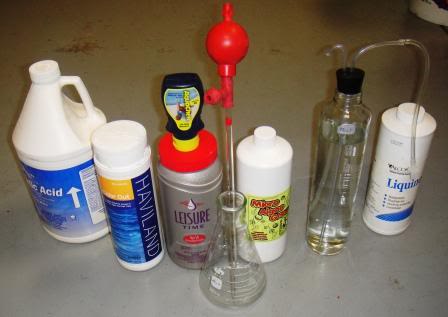
From left to right- muriatic acid, sodium thiosulfate, granulated chlorine, chlorine test strips (on top of chlorine container), measuring pipette, liquid micro algae grow, culture vessel, Alconox soap
Setup
Culture Vessel Setup
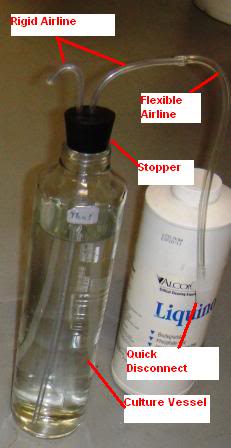
The setup is fairly simple, especially if you are only culturing Nannochloropsis. The first step is getting your culture vessel(s) ready. Drill two 7/32†holes in the top and insert the rigid airline tubing. Put the top on the culture vessel and push down the rigid airline tubing until it hits the bottom of the culture vessel. Cut the tubing off about 2-1/2†above the top of the vessel. You can use some heat (I used a soldering torch) to bend the airline. This is your inlet tube. Then put in a short piece of hard airline tubing for the outlet vent and bend it in a U shape so that nothing can fall in. Raise inlet airline tubing a little from bottom of vessel so that it’s not touching the bottom.
Next, connect flexible airline tubing between inlet airline and airflow adjuster and connect another piece between airflow adjuster and air pump. Optional- add quick disconnect between airflow adjuster and rigid airline to make the removal of the culture vessel easier. If culturing several types of phyto, add .2 micron air filter between airflow adjuster (or quick disconnect if you have it) and the rigid airline to help prevent cross contamination.
Culturing Area Setup
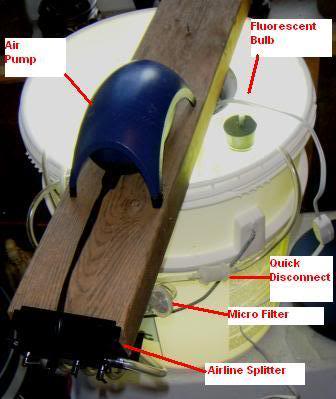
Set up a 5 gal white bucket
Attach lighting fixture into scrap 2x4
Screw in a bright light bulb (I use 150W comparable fluorescent light)
Culture Setup
The base culture water is simply salt water like what you make for your tank. For all of the cultures I listed, except TW, the culture water should be made to a specific gravity of 1.019. For TW, it needs to be around 1.025 to 1.026.
If you are reusing the culture vessels, you need to add chlorine until it is between 3-5 ppm. I make my culture water up in a 5-gallon water jug about a month and add chlorine at that time. You don't need much chlorine. It takes approximately 1/8 teaspoon of granulated chlorine to chlorinate 5 gallons of culture water.
Let the chlorinated culture water sit in the culture vessels for at least 3 hours. Add dechlorinator to dechlorinate the water. It will take some testing with the test strips and adding a small amount of dechlorinator until you find the proper amount. Try not to add way too much dechlorinator or it will strip vital minerals from the water.
Next, add proper amount of Micro Algae Grow or Guillard’s F/2. For the Micro Algae Grow, this is approximately 0.38 ml per liter of culture water. If culturing diatoms, add proper amount of silicate (a few drops for 1 liter of culture water).
Fill culture vessel to proper level- the amount of culture water should be approximately 3x-5x the size of the amount of inoculant used. I use 800ml water bottles and fill it 4/5 the way up with culture water and then most of the rest of the way up with inoculant. Be sure to leave a small air gap so that it doesn’t overflow when you turn on the air.
Procedure
Once you have the inoculated culture water, place it in the 5 gallon bucket and attach the airline. Attach the light source to the timer and set it to be on for 16 hours per day. That’s pretty much it. In about a week, you should have a fully grown culture of your phytoplankton. Use a portion of it to start the next culture and use the rest to feed your tank or zooplankton. It’s also a good idea to keep a little bit in reserve in a dark, cool place to restart your culture in case it crashes.
Cleaning
If you are reusing your materials, it is very important to keep your vessels cleaned and sanitized. The best way to clean the vessels is to acid wash them. However it is less dangerous to simply wash them out with water and Alconox and a scrub brush. Be sure to clean the stopper and rigid airline tubing. Rinse it out and store it with the chlorinated culture water with the stopper and airline until it’s time to use again.
I acid wash mine. After I empty a culture container, I fill it up with a dilute solution of hydrochloric acid. You can use muriatic acid from Home Depot or similar to make your solution as it’s the same thing. Be careful! This is an acid that can burn. Always add acid to the water and never the other way around. I usually fill the culture container about 90 percent full with tap water and then add the acid. Also be sure to have proper ventilation. The acid contains chlorine and can be very dangerous to breathe in.
I keep the acidic solution in the vessels with the airline and stopper until it’s time to reuse the vessel. Then, I rinse the vessel, rigid airline tubing and stopper thoroughly before adding the chlorinated culture water.
Sources for materials
There are many sources for phytoplankton and materials to be used for culturing them. I get most of the basic supplies from Home Depot or Lowe’s Home Improvement. The culture vessels I used are simply empty glass Voss water bottles from the grocery store. Most of the rest can be sourced from Florida Aqua Farms. They carry flexible airline tubing, rigid airline tubing, airline filters, Micro Algae Grow and the phytoplankton cultures. If you are just going to culture the Nanno, the algae disk is fine.
If you are going to grow any of the other kinds, spend a little more and use the liquid cultures, they start much easier. Billgax says that many of the clam and mussel hatcheries will give you starter cultures for free. That sounds like a great option for those in coastal areas.
Florida aqua farms also has a book, the Plankton Culture Manual. This is considered the Bible of phytoplankton (and zooplankton) culturing and is a great resource. Although it is somewhat written from the perspective of growing commercially, I highly recommend it if you are interested in learning more about culturing phytoplankton and zooplankton.