Dissolved Oxygen in an Aquarium

Dana Riddle

2500 Club Member
View Badges
Joined
Sep 10, 2011
Messages
3,162
Reaction score
7,455
Location
Dallas, Georgia
Rating - 0%
0   0   0
A little off topic, but dissolved oxygen (DO) concentrations can be related to light intensity. We could expect DO levels to drop at night when photosynthesis slows or stops. How low can DO drop at night? What is the DO transfer rate of a protein skimmer? It is common to see comments recommending pumps should be run at slower speeds at night. Does this make any sense? We'll see.
A Hach HQ40d data logger with a luminescent DO probe was programmed to record DO every 15 minutes for 24 hours. The tank is a Rubbermaid 100-gallon tub used to cure live rock (50 pounds) and contains about 25 gallons of water. A protein skimmer and circulation pump are used.
upload_2019-2-26_10-49-0.png

This makes little sense to me. DO levels fell during the day when we would expect them to rise and rose during the early morning. Photoperiod is 7am to 7 pm. I am monitoring again today.
Here is a link to DO levels on a Hawaiian reef.
https://www.advancedaquarist.com/2009/7/aafeature2

 

DCR

Valuable Member
View Badges
Joined
Jan 3, 2018
Messages
1,031
Reaction score
863
Rating - 0%
0   0   0
That is a relatively small change in DO. My initial thought is that it may be related increasing water temperature during the photo period, which would reduce the solubility of oxygen. As an engineer, I would think that a skimmer is going to be very effective at bringing the water into equilibrium with air - i.e. stripping out any excess oxygen produced by photosynthesis.
 

oreo54

5000 Club Member
View Badges
Joined
Sep 18, 2017
Messages
6,877
Reaction score
4,081
Rating - 0%
0   0   0
A little off topic, but dissolved oxygen (DO) concentrations can be related to light intensity. We could expect DO levels to drop at night when photosynthesis slows or stops. How low can DO drop at night? What is the DO transfer rate of a protein skimmer? It is common to see comments recommending pumps should be run at slower speeds at night. Does this make any sense? We'll see.
A Hach HQ40d data logger with a luminescent DO probe was programmed to record DO every 15 minutes for 24 hours. The tank is a Rubbermaid 100-gallon tub used to cure live rock (50 pounds) and contains about 25 gallons of water. A protein skimmer and circulation pump are used.
upload_2019-2-26_10-49-0.png

This makes little sense to me. DO levels fell during the day when we would expect them to rise and rose during the early morning. Photoperiod is 7am to 7 pm. I am monitoring again today.
Here is a link to DO levels on a Hawaiian reef.
https://www.advancedaquarist.com/2009/7/aafeature2

seem "dark respiration" is possibly also increasing. Thus sucking out O2.

"animal" part is growing as carbohydrates become available (assumption)..unlike terrestrial or aquatic plants that do most of the "growing" at night..

Maybe??? concurrent monitoring of CO2 levels may tell..suspect they might increase as O2 decreases.. (hypothesis)
 
U

User1

Guest
View Badges
A little off topic, but dissolved oxygen (DO) concentrations can be related to light intensity. We could expect DO levels to drop at night when photosynthesis slows or stops. How low can DO drop at night? What is the DO transfer rate of a protein skimmer? It is common to see comments recommending pumps should be run at slower speeds at night. Does this make any sense? We'll see.
A Hach HQ40d data logger with a luminescent DO probe was programmed to record DO every 15 minutes for 24 hours. The tank is a Rubbermaid 100-gallon tub used to cure live rock (50 pounds) and contains about 25 gallons of water. A protein skimmer and circulation pump are used.
upload_2019-2-26_10-49-0.png

This makes little sense to me. DO levels fell during the day when we would expect them to rise and rose during the early morning. Photoperiod is 7am to 7 pm. I am monitoring again today.
Here is a link to DO levels on a Hawaiian reef.
https://www.advancedaquarist.com/2009/7/aafeature2

Interesting. Must be a day of threads like this. 02manyfish also had a interesting post between his tanks and alk consumption w/regards to weather.

https://www.reef2reef.com/threads/o...tank-1100g-system.118636/page-18#post-5762009
 

jda

10K Club member
View Badges
Joined
Jun 25, 2013
Messages
14,342
Reaction score
21,756
Location
Boulder, CO
Rating - 0%
0   0   0
You exchanging any air at night in your home? This might be as much about ambient air as it is about tank inhabitants?
 
OP
OP
Dana Riddle

Dana Riddle

2500 Club Member
View Badges
Joined
Sep 10, 2011
Messages
3,162
Reaction score
7,455
Location
Dallas, Georgia
Rating - 0%
0   0   0
You exchanging any air at night in your home? This might be as much about ambient air as it is about tank inhabitants?
No, a little too cool in Atlanta to have any open windows... I've got the data logger on the tank again and will look at the numbers tomorrow evening. I'll pay close attention to temp and pressure. With as much algae as there is in the tank (calcareous, Chaeto, Caulerpa) I would expect the DO to rise during the photoperiod. I'll unplug the skimmer later this week and look at the DO again.
 

oreo54

5000 Club Member
View Badges
Joined
Sep 18, 2017
Messages
6,877
Reaction score
4,081
Rating - 0%
0   0   0
I have that issue of Coral Reefs in my library - I'll look it up when I get a chance. Thanks!
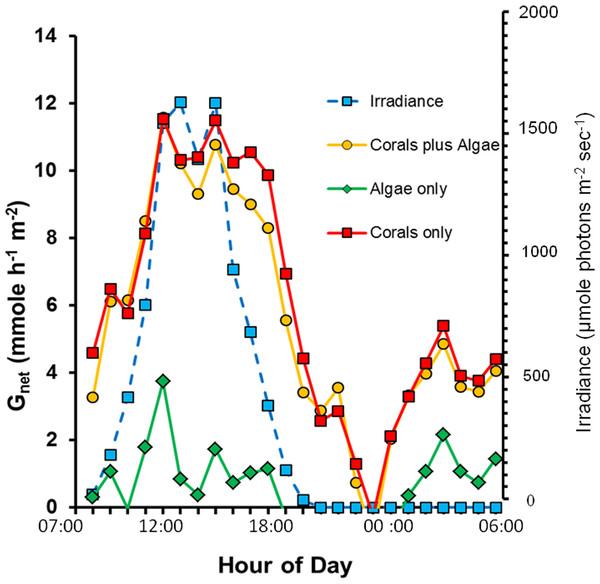
quicker read.. ;)
https://peerj.com/articles/378/

fig-5-1x.jpg


The 03:00 calcification peak observed in Fig. 1 is shown by both a decrease in O2 concentration and a drop in pH due to accelerated respiration. DO (Fig. 5D) and the pH (Fig. 5C) are measured independently and both show this effect to corroborate the observation.

fig-1-1x.jpg


Silly me.. forgot about "sinking" CO2 in the skeleton.. skip the CO2 part in first post..
 
Last edited:
OP
OP
Dana Riddle

Dana Riddle

2500 Club Member
View Badges
Joined
Sep 10, 2011
Messages
3,162
Reaction score
7,455
Location
Dallas, Georgia
Rating - 0%
0   0   0
OP
OP
Dana Riddle

Dana Riddle

2500 Club Member
View Badges
Joined
Sep 10, 2011
Messages
3,162
Reaction score
7,455
Location
Dallas, Georgia
Rating - 0%
0   0   0
More data. Background (again): 100-gallon Rubbermaid tub. 50 lbs. live rock. Water volume about 25 gallons. Protein skimmer and circulation pump. BuildMyLED 'SolarMax' strip light on timer, 12 hour photoperiod. Dissolved oxygen remained just below saturation during the procedure, O2 fell slightly with rising temperature. Skimmer and large circulation pump removed at 8:15 am (circulation pump replaced with a smaller unit.) Temperature fell by 1.44 F over the next 1.5 hours (due to removal of two 'warm' pumps.) Dissolved oxygen dropped also, by 0.32 ppm. Light on at 9:15 am, and recovery of O2 began. It appears, in this case anyway, the protein skimmer and pump were sufficient to maintain O2 near saturation and possibly prevented supersaturation in lighted conditions. The data logger is on the tank and we'll see possible impacts of photosynthesis.
upload_2019-2-27_11-12-36.png

upload_2019-2-27_11-13-8.png
 

TOP 10 Trending Threads

WHAT AMOUNT OF LIVE ROCK AND SAND SHOULD BE PRIORITIZED FOR OPTIMAL BIODIVERSITY/FILTRATION?

  • 100% live rock + bagged sand

    Votes: 37 27.4%
  • 100% dry rock + 100% live sand

    Votes: 46 34.1%
  • 50/50 live/dry rock, 50/50 live/bagged sand

    Votes: 30 22.2%
  • 75% live rock, 25% live sand

    Votes: 12 8.9%
  • 25% live rock, 75% live sand

    Votes: 10 7.4%
Back
Top