Does your calibration solution need calibrated?

Tigweldpro

Community Member
View Badges
Joined
Nov 11, 2017
Messages
99
Reaction score
109
Location
Calgary, Alberta, Canada
Rating - 0%
0   0   0
A sodium chloride solution cannot match any two of SG, conductivity, or refractive index. It is slightly different for all three. I show recipes for each using NaCl here:

Reef Aquarium Salinity: Homemade Calibration Standards by Randy Holmes-Farley - Reefkeeping.com
http://reefkeeping.com/issues/2004-06/rhf/index.htm

from it:

Interpolating between these data points suggests that a solution of 3.65 weight percent sodium chloride has the same refractive index as S=35 seawater, and can be used as an appropriate standard (Table 2).

...

Interpolating between these data points suggests that a solution of 3.714 weight percent sodium chloride has the same specific gravity (and density) as S=35 seawater, and can be used as an appropriate specific gravity standard (Table 5). For most purposes, 3.7 weight percent is accurate enough.

...

Without going into detail about how they were measured, the data from these papers indicate that a 53 mS/cm conductivity solution is provided by a 33.64 g/L (0.576 M) sodium chloride solution. That solution corresponds to 3.29 weight percent sodium chloride.2

Hi Randy, I am no scientist but would like to make my own refractometer calibration fluid. I am from Canada and we do not have the Mortons salt here.
We do however have Costco Kirkland brand Mediterranean Sea Salt which is found in the US & Canada. I mixed up a batch of fluid containing 39.65g of the mentioned Mediterranean Sea Salt that was baked @ 300*F for 30 mins to remove any moisture the salt may have absorbed, With 1052g zero TDS RODI water(half batch of your described recipe). When first trying the fluid with my refractometer (calibrated to 35SG with pinpoint fluid) it showed 36SG.
After reading about how much the hobby grade calibration fluids can be off I don't know what to believe. Could using a salt like Kirkland sea salt be more accurate that iodized table salt?
Is there any way you could mix up my recipe with this salt and confirm its accuracy against some lab grade solution to help out the people who don't have access to Mortons?
Salt Link HERE The white one.

 

Randy Holmes-Farley

Reef Chemist
View Badges
Joined
Sep 5, 2014
Messages
89,236
Reaction score
92,254
Location
Massachusetts, United States
Rating - 0%
0   0   0
I would not use sea salt since it has some other chemical components in it that normal table salt does not. The recipe is designed for pure sodium chloride and anything else in it can only make it less accurate. I would use a regular table salt, and mix it by weight, not volume.
 

Tigweldpro

Community Member
View Badges
Joined
Nov 11, 2017
Messages
99
Reaction score
109
Location
Calgary, Alberta, Canada
Rating - 0%
0   0   0
I would not use sea salt since it has some other chemical components in it that normal table salt does not. The recipe is designed for pure sodium chloride and anything else in it can only make it less accurate. I would use a regular table salt, and mix it by weight, not volume.

Thanks for taking the time to reply Randy,

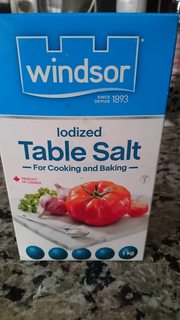
Here is a box of "Canadian" table salt...(tastes like poison, I only use for cleaning)
dVJ4N23m.jpg


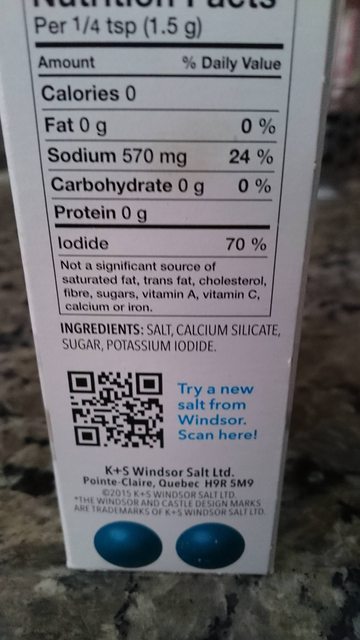
Sugar..... what the heck, they also don't list a sodium chloride%
9DF2F9wl.jpg


At least Kirkland says it is 99.8% calcium chloride
ChXRlFBl.jpg


The recipe was made measuring in weight.. It read 1 SG point high compared to pinpoint. I guess ill roll with it and keep my tank at 34 SG using this diy fluid.
 

Randy Holmes-Farley

Reef Chemist
View Badges
Joined
Sep 5, 2014
Messages
89,236
Reaction score
92,254
Location
Massachusetts, United States
Rating - 0%
0   0   0
Thanks for taking the time to reply Randy,

Here is a box of "Canadian" table salt...(tastes like poison, I only use for cleaning)
dVJ4N23m.jpg


Sugar..... what the heck, they also don't list a sodium chloride%
9DF2F9wl.jpg


At least Kirkland says it is 99.8% calcium chloride
ChXRlFBl.jpg


The recipe was made measuring in weight.. It read 1 SG point high compared to pinpoint. I guess ill roll with it and keep my tank at 34 SG using this diy fluid.

That's a reasonable plan, although I expect it should read 35 ppt with that mix that is 99.8% NaCl. :). :)
 

Tigweldpro

Community Member
View Badges
Joined
Nov 11, 2017
Messages
99
Reaction score
109
Location
Calgary, Alberta, Canada
Rating - 0%
0   0   0
That's a reasonable plan, although I expect it should read 35 ppt with that mix that is 99.8% NaCl. :). :)
Yes I would also assume it should read 35, possibly your mortons recipe it taking in to account for whatever else is in it that kirkland salt doesn't have. Being more pure it reads a touch high, or pinpoint is out to lunch once again. I think at the end of the day it reads close enough and I just need to keep stable.
 

Randy Holmes-Farley

Reef Chemist
View Badges
Joined
Sep 5, 2014
Messages
89,236
Reaction score
92,254
Location
Massachusetts, United States
Rating - 0%
0   0   0
Yes I would also assume it should read 35, possibly your mortons recipe it taking in to account for whatever else is in it that kirkland salt doesn't have. Being more pure it reads a touch high, or pinpoint is out to lunch once again. I think at the end of the day it reads close enough and I just need to keep stable.

No, my recipe assumes 100% NaCl, and other impurities are not "wasted", they just may have slightly different effects on refractive index than Na+ and Cl-. So I expect it is not off by even 0.2%.
 

rayjay

Well-Known Member
View Badges
Joined
Aug 23, 2017
Messages
548
Reaction score
504
Location
LONDON ONTARIO CANADA
Rating - 0%
0   0   0
I know I'm old, but I can't get my mind around using a DIY standard of NaCl to calibrate a seawater refractometer.
What am I missing?
 

Randy Holmes-Farley

Reef Chemist
View Badges
Joined
Sep 5, 2014
Messages
89,236
Reaction score
92,254
Location
Massachusetts, United States
Rating - 0%
0   0   0
I know I'm old, but I can't get my mind around using a DIY standard of NaCl to calibrate a seawater refractometer.
What am I missing?

I don't know. What are you worried about? :D

Seawater at 35 ppt has a certain refractive index. A sodium chloride solution at some concentration (not 35 ppt) exactly matches that refractive index, so will read 35 ppt on a refractometer.

That's how it works. :)
 

Randy Holmes-Farley

Reef Chemist
View Badges
Joined
Sep 5, 2014
Messages
89,236
Reaction score
92,254
Location
Massachusetts, United States
Rating - 0%
0   0   0

Tigweldpro

Community Member
View Badges
Joined
Nov 11, 2017
Messages
99
Reaction score
109
Location
Calgary, Alberta, Canada
Rating - 0%
0   0   0

Randy Holmes-Farley

Reef Chemist
View Badges
Joined
Sep 5, 2014
Messages
89,236
Reaction score
92,254
Location
Massachusetts, United States
Rating - 0%
0   0   0
I think I've read the article 7 times now, I think I'm starting to understand lol

Randy what is the most accurate way to check salinity in a lab environment? some sort of spectral analysis or do they just use refractometers also?

Conductivity is the most precise way to measure salinity of seawater. The current PSU (practical salinity unit) scale (now used in place of PPT by chemical oceanographers) is actually defined by conductivity.
 

rayjay

Well-Known Member
View Badges
Joined
Aug 23, 2017
Messages
548
Reaction score
504
Location
LONDON ONTARIO CANADA
Rating - 0%
0   0   0
I don't know. What are you worried about? :D
Seawater at 35 ppt has a certain refractive index. A sodium chloride solution at some concentration (not 35 ppt) exactly matches that refractive index, so will read 35 ppt on a refractometer.
That's how it works. :)
I guess it stems from not really understanding fully how the refractometers work and that one standard can be used for both seawater and saltwater refractometers even though I had read your article back when it first came out. I've never had a refractometer myself as they were not even mentioned around here when I started in Jan 94. When they did become available, I didn't see the need for it as my swing arms worked just fine.

I've been using Box type Seatest swing arm hydrometers since 94. I make up standard for testing occasionally by using my Fisher Scientific certified hydrometer in a glass cylinder to make a solution of I.O. to 1.026 at 60°F which is the certification temperature. I dismantled the swing arm and on one I shaved a bit of the arm until the reading read correct, and the other I shaved the weight to get the correction. I still haven't had to ever adjust again since then, washing after each use and soaking overnight in vinegar weekly.
I don't like the new Seatest swing arms as they cannot be taken apart for correction, and, they are too cumbersome to use compared to how I use the box type.
 

Randy Holmes-Farley

Reef Chemist
View Badges
Joined
Sep 5, 2014
Messages
89,236
Reaction score
92,254
Location
Massachusetts, United States
Rating - 0%
0   0   0
I guess it stems from not really understanding fully how the refractometers work and that one standard can be used for both seawater and saltwater refractometers even though I had read your article back when it first came out. I've never had a refractometer myself as they were not even mentioned around here when I started in Jan 94. When they did become available, I didn't see the need for it as my swing arms worked just fine.
I've been using Box type Seatest swing arm hydrometers since 94. I make up standard for testing occasionally by using my Fisher Scientific certified hydrometer in a glass cylinder to make a solution of I.O. to 1.026 at 60°F which is the certification temperature. I dismantled the swing arm and on one I shaved a bit of the arm until the reading read correct, and the other I shaved the weight to get the correction. I still haven't had to ever adjust again since then, washing after each use and soaking overnight in vinegar weekly.
I don't like the new Seatest swing arms as they cannot be taken apart for correction, and, they are too cumbersome to use compared to how I use the box type.

So just to be clear, using a 35 ppt standard (whether it is real 35 ppt seawater or a sodium chloride equivalent) makes either a salt refractometer or a seawater refractometer able to read 35 ppt seawater correctly as 35 ppt.

BUT, the salt refractometer will be off more and more as you move away from 35 ppt, so that by the time you try to read 0 ppt, it will be off by 1.7 ppt. That is the best you can do with a salt refractometer, since it can never be made to read seawater perfectly at all salintiy levels, and most folks want to measure near 35 ppt.

The swing arm calibration sounds like a fine plan. I had a Tropic Marin floating glass hydrometer that worked great. :)
 

Cory

More than 25 years reefing
View Badges
Joined
Oct 30, 2014
Messages
6,882
Reaction score
3,105
Location
Canada
Rating - 0%
0   0   0
Randy im curious if sugar, and calcium silicate in that table salt in the pic above could cause any problems when making a diy calibration solution?

Bump for a good thread.
 

Randy Holmes-Farley

Reef Chemist
View Badges
Joined
Sep 5, 2014
Messages
89,236
Reaction score
92,254
Location
Massachusetts, United States
Rating - 0%
0   0   0
Randy im curious if sugar, and calcium silicate in that table salt in the pic above could cause any problems when making a diy calibration solution?

Bump for a good thread.

Generally no. That type of error will likely be less than the error in your ability to accurately measure liquid volumes, for example. Much less than a 1% error.
 

TOP 10 Trending Threads

WHAT AMOUNT OF LIVE ROCK AND SAND SHOULD BE PRIORITIZED FOR OPTIMAL BIODIVERSITY/FILTRATION?

  • 100% live rock + bagged sand

    Votes: 34 27.0%
  • 100% dry rock + 100% live sand

    Votes: 45 35.7%
  • 50/50 live/dry rock, 50/50 live/bagged sand

    Votes: 27 21.4%
  • 75% live rock, 25% live sand

    Votes: 11 8.7%
  • 25% live rock, 75% live sand

    Votes: 9 7.1%
Back
Top