


GHA Progress!

hllb

Valuable Member
View Badges
Joined
Aug 30, 2019
Messages
2,341
Reaction score
1,614
Rating - 0%
0   0   0
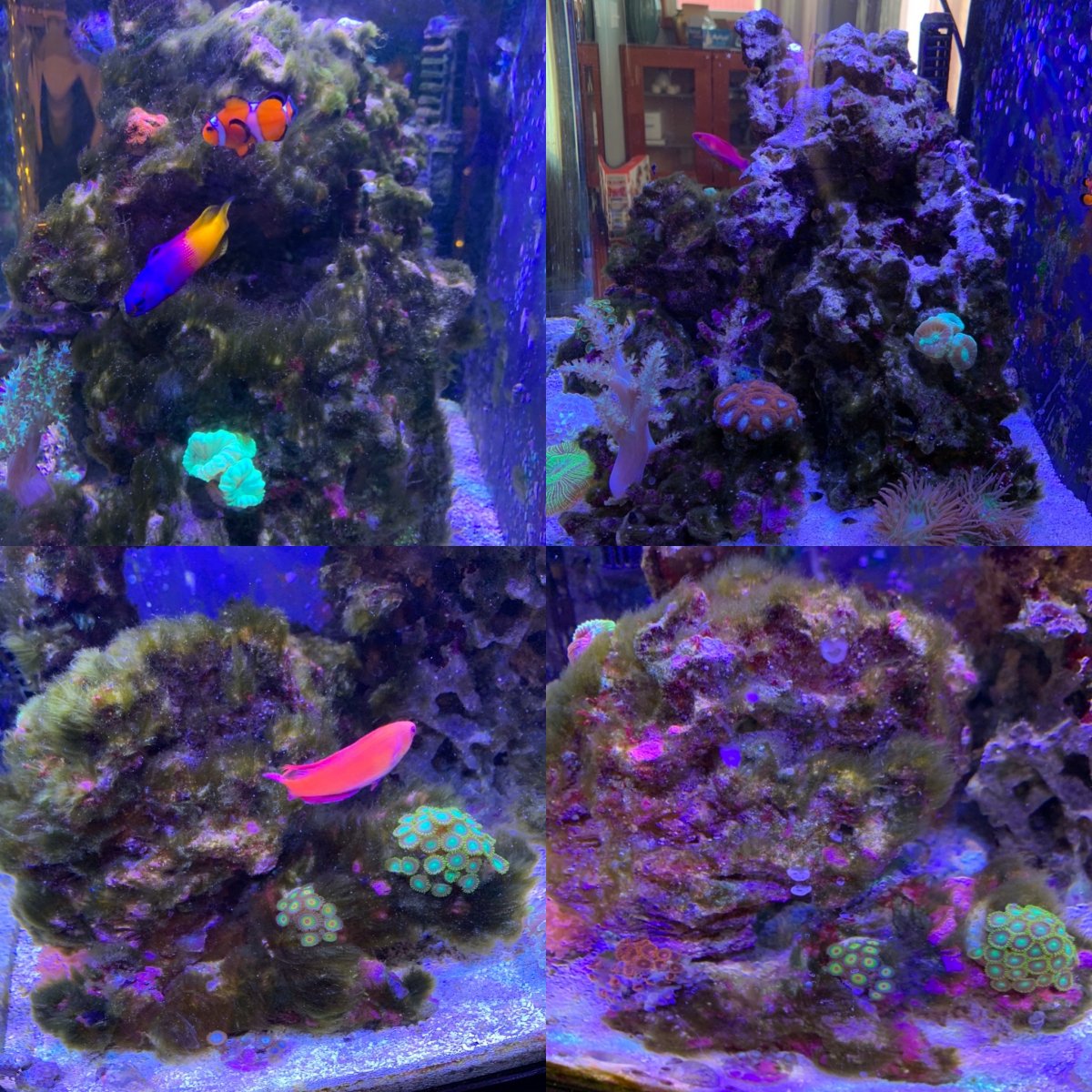
I’ve been battling GHA since late November. While working on nutrients (which were low when this started growing), I’ve tried lots of other things. Reef flux did nothing. No CUC would eat it - even the sea hare. Manual removal was difficult at best and it just came back. I decided to try peroxide spot treatments with 35% H2O2, 3 ml for my 32g tank. It worked well but just for the GHA that got direct treatment. I did 2 treatments, a week apart. Two days after the spot treatment, I would scrub that section with a toothbrush to remove most of the dying GHA. With the second treatment, I also started dosing vibrant twice a week. I’m not sure which treatment is making the difference, but I realized today that there is significantly less GHA even in places I didn’t do spot treatments with peroxide. Still a ways to go, but finally making progress! Before on the left. The top pictures are a rock I did two spot treatments on. The bottom pictures are a rock I didn’t touch

AA0F8BFA-DB44-441E-8E3B-6BB0661CB5D6.jpeg
 

John3

Valuable Member
View Badges
Joined
Dec 24, 2017
Messages
1,301
Reaction score
1,313
Rating - 0%
0   0   0
I just dosed the peroxide daily and added a hungry small yellow tang and my GHA was completely gone in a few weeks. I’ve never seen any come back, it’s been almost 2 years.
 
OP
OP
hllb

hllb

Valuable Member
View Badges
Joined
Aug 30, 2019
Messages
2,341
Reaction score
1,614
Rating - 0%
0   0   0
I just dosed the peroxide daily and added a hungry small yellow tang and my GHA was completely gone in a few weeks. I’ve never seen any come back, it’s been almost 2 years.
It must be the peroxide because Vibrant doesn’t work that fast. Odd though because with the spot treatments it turns white but the other areas of the tank aren’t turning white, but still disappearing.
 

Jeeperz

Valuable Member
View Badges
Joined
Sep 28, 2019
Messages
1,637
Reaction score
1,064
Rating - 0%
0   0   0
I tried peroxide 2x a day for a several weeks at 1-2 ml per 10 gallons with absolutely no progress. I even did spot treatment with flow off and it wouldn't even bleach where the peroxide touched.
 
OP
OP
hllb

hllb

Valuable Member
View Badges
Joined
Aug 30, 2019
Messages
2,341
Reaction score
1,614
Rating - 0%
0   0   0
I tried peroxide 2x a day for a several weeks at 1-2 ml per 10 gallons with absolutely no progress. I even did spot treatment with flow off and it wouldn't even bleach where the peroxide touched.
I swear, nothing works the same way for two people. Makes everything harder!
 

Jeeperz

Valuable Member
View Badges
Joined
Sep 28, 2019
Messages
1,637
Reaction score
1,064
Rating - 0%
0   0   0
I had high hopes for it working too. Now it's chemicals as the next step and I'm really not wanting to do it.
 

John3

Valuable Member
View Badges
Joined
Dec 24, 2017
Messages
1,301
Reaction score
1,313
Rating - 0%
0   0   0
I tried peroxide 2x a day for a several weeks at 1-2 ml per 10 gallons with absolutely no progress. I even did spot treatment with flow off and it wouldn't even bleach where the peroxide touched.

Are you sure the peroxide wasn’t old? Even off the shelf new I have seen bad peroxide. If you put it directly on GHA it should turn white within hours and is dead. When I dosed it took a couple of weeks but you could see a difference in color. It was no longer dark green, it significantly lightened. At that point it was no longer spreading and my cuc and small yellow tang cleaned all away.
 

brandon429

what, exactly, are you doing in your avatar
View Badges
Joined
Dec 9, 2014
Messages
31,035
Reaction score
23,923
Location
tejas
Rating - 0%
0   0   0
Also, one party is dosing the tank, and the other party is treating rocks directly, externally outside the tank is that correct or are all these comparisons adding peroxide to tank water?
 
Last edited:
OP
OP
hllb

hllb

Valuable Member
View Badges
Joined
Aug 30, 2019
Messages
2,341
Reaction score
1,614
Rating - 0%
0   0   0
Also, one party is dosing the tank, and the other party is treating rocks directly, externally outside the tank is that correct or are all these comparisons adding peroxide to tank water?
I've done both. For an arch rock (not pictured) I did one treatment in the tank, another outside the tank (since that rock is easy to remove). That big rock in the top picture has so many holes and so many critters in it, there's no way I could treat it outside the tank without killing tons of stuff. The bottom rock, I didn't treat at all, so not sure if it's the peroxide in the water that helped it, or the vibrant.
 
OP
OP
hllb

hllb

Valuable Member
View Badges
Joined
Aug 30, 2019
Messages
2,341
Reaction score
1,614
Rating - 0%
0   0   0
Here’s a picture of the GHA when it’s started turning white. You can see exactly where I did a direct treatment with peroxide and where I didn’t.

753B065F-75BC-4E07-80D7-86DBA6DE230F.jpeg

Here’s the treatment itself. My crazy fish loved playing in the bubbles:
AED8816C-1FC2-49DE-9619-D5E85F91C09B.jpeg
 

Bruce60

Active Member
View Badges
Joined
Oct 28, 2018
Messages
213
Reaction score
251
Location
Bloomsburg, PA
Rating - 0%
0   0   0
Are you saying that you can safely treat the rock inside the tank? I thought you had to remove the rock. If I try this in the tank, do I use a long syringe or thin baster and hit each patch? The rock I want to treat most could be removed, but is quite large and heavy - it is a large shelf rock.

I have been manually removing with long tweezers and then scrubbing the rock while holding a vacuum to collect as much of the debris as possible. Some areas of the tank have been successful with this routine while this shelf rock keep having the GHA grow back.

 

brandon429

what, exactly, are you doing in your avatar
View Badges
Joined
Dec 9, 2014
Messages
31,035
Reaction score
23,923
Location
tejas
Rating - 0%
0   0   0
You sure can treat in tank, and there's a list of organisms to check off to make sure if not present, things wont get burned to death.

*that mode cannot beat external detailing whatsoever. in any condition, what we can do with rock removal wins every single time. most people that kill algae in the tank let it degrade, and add to waste/detritus stores that already promote algae growth (cyclic)

taking rocks out means you get to dislodge their waste, along with algae detailing. opposite of tank dosing.


when rocks are out being worked, you can clean filthy sand...and only then have you really addressed GHA feed sourcing.

peroxide is powerful either way, another benefit of non-water dosing is you burn zero nontargets by doing external work. if you dont mind burning them, most peroxide work in reefing is done in-tank, and from that patterns have emerged that are rock solid.

for starters, no degree of peroxide work in tank even using higher % will kill your cycle, we never seen it done across a thousand peroxide runs. not once. aerobes dont mind it when you make their water highly aerobic.
 

Bruce60

Active Member
View Badges
Joined
Oct 28, 2018
Messages
213
Reaction score
251
Location
Bloomsburg, PA
Rating - 0%
0   0   0
Okay, as I said, I can remove the rock, treat it and scrub it outside the tank. Only two corals on it now that I can easily move temporarily.

Can you point me to a good procedure for how this works? H2O2 or scrub rock first? How long do I keep out of tank? Any follow-up cleaning after I return rock to tank?
 

brandon429

what, exactly, are you doing in your avatar
View Badges
Joined
Dec 9, 2014
Messages
31,035
Reaction score
23,923
Location
tejas
Rating - 0%
0   0   0
sensitives:

1. lysmata cleaner and its cousings. most sensitive
2. hermodice fireworms nearly always die
3. decorative macros in contact
4. xenia and anemones often retract angry but dont die.
5. coralline lightens and bleaches in cases, but comes back


no known fish are sensitive

outliers from any category dont count; sickly this or that might go if you glance at it sideways.
 

brandon429

what, exactly, are you doing in your avatar
View Badges
Joined
Dec 9, 2014
Messages
31,035
Reaction score
23,923
Location
tejas
Rating - 0%
0   0   0
yes for sure it works like this:


take a test rock out first, assess how well this detailing works, and sustains, before we upscale your whole tank to the job. test proofing is in.


take out a rock and pocket knife debride all the algae off. detailing, working around good stuff attacking bad.

peroxide on the former algae anchor spots, that you rinsed away with saltwater. this is all over the sink work.

put back a clean rock. if you like how that sustains in a week, we rock it all.

if you want it all done in one pass, we can. and it will rock.

post full tank shot. I have a 25 page thread on peroxide cleans/saving you the headache read. can customize right here.

in the end, the goal is to: assess algae degree of rasping needed to sustain kill. work rocks. detail sand so that clouding is gone, basically reassemble a dental-cleaned reef. exactly like a dentist works, we'd permit no accumulations and scrape them off and rinse them down a sink

after having burned with an oxidizer but only on bad spots not good ones.
 

Bruce60

Active Member
View Badges
Joined
Oct 28, 2018
Messages
213
Reaction score
251
Location
Bloomsburg, PA
Rating - 0%
0   0   0
IMG_0837.jpeg

This is the rock with the major issue. The others still have a few patches on them but will be more difficult to take apart and remove - those seem to have responded to the manual removal I described above.
 

brandon429

what, exactly, are you doing in your avatar
View Badges
Joined
Dec 9, 2014
Messages
31,035
Reaction score
23,923
Location
tejas
Rating - 0%
0   0   0
thats confirmation enough. the peroxide kill step, in the former spot is how its different than what the masses do. see my friends recent job, so proud of WV!

most people dump peroxide on the algae, we are opposite. its knife scraped off first, totally clean, then peroxide on the former algae spot. oblit.


*algae itself, left in place, begets more algae via direct feed acquisition. fronds actually catch and hold waste, for onsite degredation, independent from starved out reef water. this is why so many corals bleach in the process of dealing with GHA with only partially willing tank owners.

you can shake in the dead of night, with a flashlight aiming in the tank, a test rock with algae on it from any system and what will cast off will be a total gha feed cloud. algae is retentive, anything retentive including sandbeds and actual rock, will farm algae.

preventing growback has nothing to do with instating the clean condition. Those are independent actions. one is lucky, the other is directly caused by action.
 
Last edited:

TOP 10 Trending Threads

WHAT AMOUNT OF LIVE ROCK AND SAND SHOULD BE PRIORITIZED FOR OPTIMAL BIODIVERSITY/FILTRATION?

  • 100% live rock + bagged sand

    Votes: 37 27.4%
  • 100% dry rock + 100% live sand

    Votes: 46 34.1%
  • 50/50 live/dry rock, 50/50 live/bagged sand

    Votes: 30 22.2%
  • 75% live rock, 25% live sand

    Votes: 12 8.9%
  • 25% live rock, 75% live sand

    Votes: 10 7.4%
Back
Top






