Follow along with the video below to see how to install our site as a web app on your home screen.
Note: This feature may not be available in some browsers.
Are they false? Are you sure?
Sincerely Lasse
From https://climate.nasa.gov/faq/Yes, I am fairly positive that variations from the sun impact temperatures on Earth.
To give a more extreme example as to why I say that; imagine the sun disappeared... You might get a little chilly.
But the the scientist say the oposite - who´s right?Climate change is real, but it's a natural cycle Earth goes thru. We are in the middle of a solar maximum right now. Yes, the sun goes the hot and cool phases...
From https://climate.nasa.gov/faq/
Is the sun causing global warming?
No. The sun can influence the Earth’s climate, but it isn’t responsible for the warming trend we’ve seen over the past few decades. The sun is a giver of life; it helps keep the planet warm enough for us to survive. We know subtle changes in the Earth’s orbit around the sun are responsible for the comings and goings of the ice ages. But the warming we’ve seen over the last few decades is too rapid to be linked to changes in Earth’s orbit, and too large to be caused by solar activity. In fact, recently (2005-2010) the sun has become less active, while temperatures have marched upwards.
One of the “smoking guns” that tells us the sun is not causing global warming comes from looking at the amount of the sun’s energy that hits the top of the atmosphere. Since 1978, scientists have been tracking this using sensors on satellites and what they tell us is that there has been no upward trend in the amount of the sun’s energy reaching Earth.
[https://climate]
![]()
Global surface temperature (top, blue) and the sun's energy received at the top of Earth's atmosphere (red, bottom), from 1978 to 2009. The amount of solar energy received at the top of our atmosphere has followed its natural 11-year cycle of small ups and downs, but with no net increase. Over the same period, global temperature has risen markedly. It is therefore extremely unlikely that the sun has been behind the global temperature trend we’ve seen over several decades. Credit: NOAA National Climatic Data Center.
A second smoking gun is that if the sun were responsible for global warming, we would expect to see warming throughout all layers of the atmosphere, from the surface all the way up to the upper atmosphere (stratosphere). But what we actually see is warming at the surface and cooling in the stratosphere. This is consistent with the warming being caused by a build-up of heat-trapping gases near the surface of the Earth, and not by the sun getting “hotter.”
READ MORE
Sun & climate: moving in opposite directions
How do we know the sun is not the cause of recent warming?
Earth’s energy budget remained out of balance despite unusually low solar activity

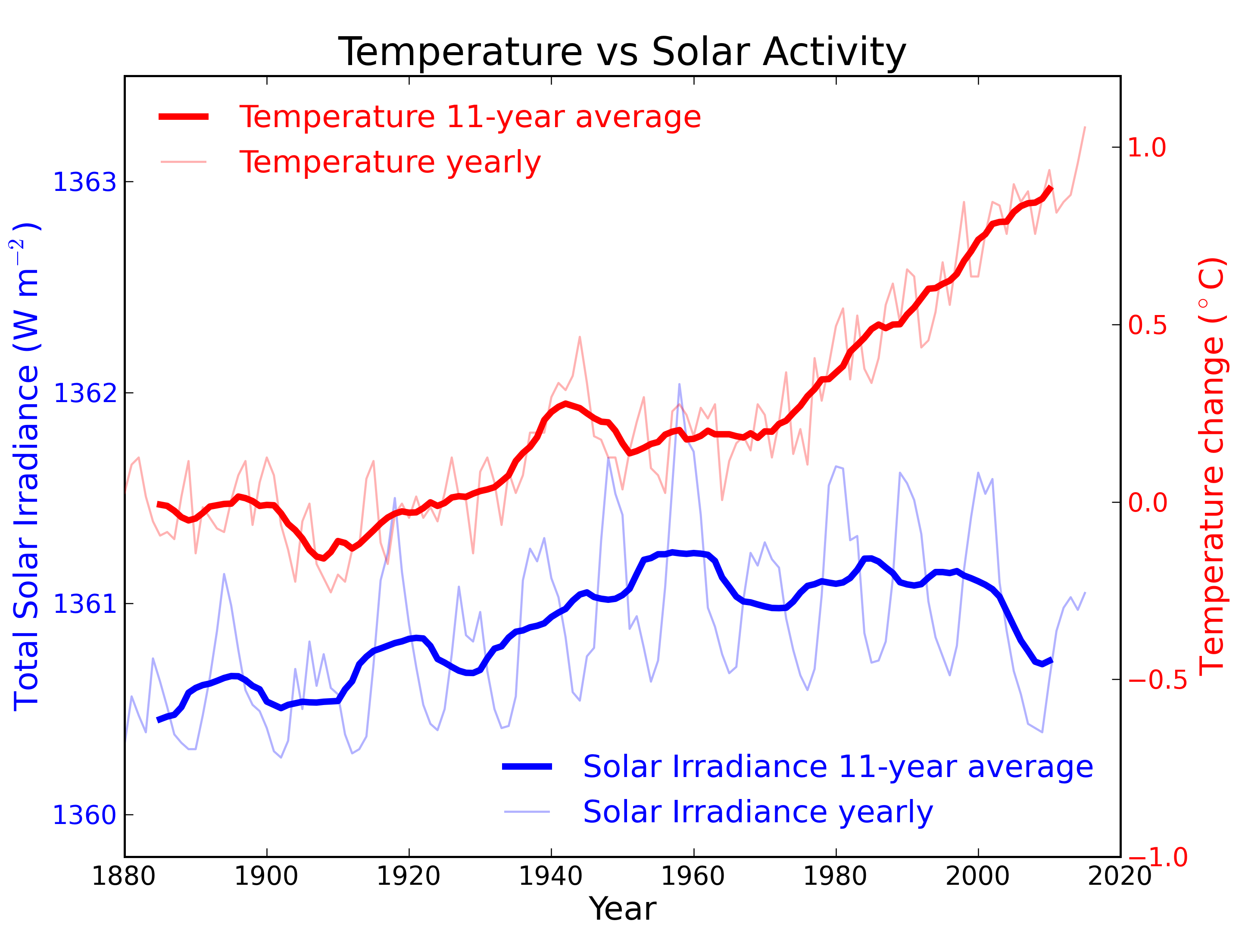
I never said the sun is causing global warming. My post had the single purpose of debunking the quote "Solar variation does not seem to impact the temperature". I definetly see overlaps in the rises and declines of global temps and the suns energy output in the above graph prior to ~2002.
Sincerely LasseThey expect the Earth's temperature to fall by half a degree when solar activity reaches its next minimum.
According to project head Werner Schmutz, who is also Director of PMOD, this reduction in temperature is significant, even though it will do little to compensate for human-induced climate change. "We could win valuable time if solar activity declines and slows the pace of global warming a little. That might help us to deal with the consequences of climate change." But this will be no more than borrowed time, warns Schmutz, since the next minimum will inevitably be followed by a maximum.
Read more at: https://phys.org/news/2017-03-sun-impact-climate-quantified.html#jCp
I never said the sun is causing global warming. My post had the single purpose of debunking the quote "Solar variation does not seem to impact the temperature". I definetly see overlaps in the rises and declines of global temps and the suns energy output in the above graph prior to ~2002.
Solar variation does not seem to impact the temperature trend.
I suppose you refer to the Berkley investigation - and they did not state that. They state (my bold)
Sincerely Lasse
Oh, in that case I would just point out that they certainly do no say that "Solar variation does not seem to impact the temperature".I never said the sun is causing global warming. My post had the single purpose of debunking the quote "Solar variation does not seem to impact the temperature". I definetly see overlaps in the rises and declines of global temps and the suns energy output in the above graph prior to ~2002.
Ah, well dangerous to dismiss a large scale scientific study on a critical issue based on second hand quotes from a forum. That applies to my own posts as well to be sure, which is why I try to include links to sources.My apologies, I did not actually read the Berkeley investigation and took the quote directly from @SPSREEFS
Oh, in that case I would just point out that they certainly do no say that "Solar variation does not seem to impact the temperature".
You left the last word off the sentence, which quite dramatically changes the meaning of it. The text states "Solar variation does not seem to impact the temperature trend". And it says that right over a graph showing temperature changes since the 1700s. Talking about temperature trends over hundreds of years is very very different than just talking about what the temperature is.
As you point out, if the sun disappeared it would get very cold. And of course we see that every night. But (also of course) they are not saying that the sun doesn't affect temperature. They are saying that "Solar variation does not seem to impact the temperature trend" over the long term period that they are discussing.
So to pull out part of a sentence, and use that as an argument for why the whole body of evidence is false seems terribly unfair.
Doesn't more CO2 = more plant growth = more O2? .
It would seem to be a mixed bag, with some areas developing better climate conditions and others worse. A big problem will be the ability to adapt as areas become drier or after rapidly. It takes time for would conditions to change and so weather and soil may not match. Farming infrastructure and the like will need to shift. All possible but also very expensive and disruptive, so likely to drive prices up dramatically for a while.Doesn't more CO2 = more plant growth = more O2? Doesn't higher temps mean more areas open to growing/farming? Someone suggested a mass extinction is the only solution but it looks like the "problem" is, in fact the solution. I'd say the Earth found a way to support its inhabitants. 100% of government funding needs to stop for this so-called "research". I don't want to pay upwards of 50% in taxes like most European countries to fund this elitist pet project.