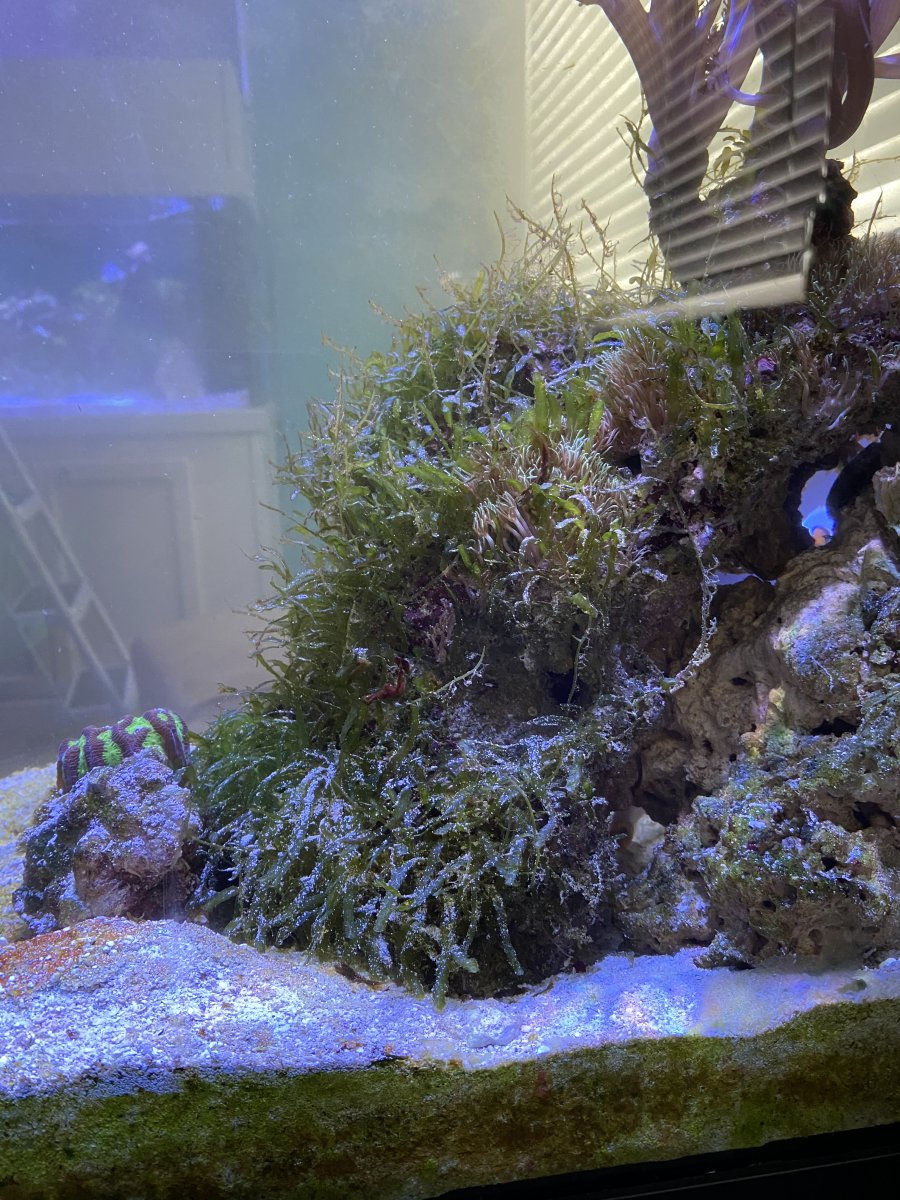
Invasive algae - ID and will anything eat it?

fox0521

Active Member
View Badges
Joined
Oct 25, 2020
Messages
149
Reaction score
71
Location
Grand Rapids
Rating - 0%
0   0   0
What is it and will anything eat it?

I have an unknown invasive algae taking over my tank. I’ve tried removing the rock and scrubbing it away, however it came back with a vengeance! It’s slowing showing up on other pieces of rock, so removing the rock isn’t going to solve the issue


5AF1A421-65C7-4A07-836F-8BBE9545358D.jpeg
304F754D-39CC-435D-87F0-9C847331160F.jpeg
 

brandon429

what, exactly, are you doing in your avatar
View Badges
Joined
Dec 9, 2014
Messages
31,035
Reaction score
23,923
Location
tejas
Rating - 0%
0   0   0
the tank is eutrophicated meaning full up on waste and plant dominated, most reefs will become this way if currents change/sediments increase and if grazers are driven out for one reason or another, its not a bad water param, its lack of a matched grazer to remove the plant/caulerpa

You have a way to fix that tank and I'd prefer that to dinos for sure, this can be saved for sure. You need to consider using peroxide it will burn that plant right off, we do a test spot of it not the whole rock. we then set back, and chart regrowth if any as we make plans for the whole tank.

in the end you need to clean your sandbed correctly its a source of plant feed we can see it in the stratification. that's long term though, I bet a perox test w work nicely
 

brandon429

what, exactly, are you doing in your avatar
View Badges
Joined
Dec 9, 2014
Messages
31,035
Reaction score
23,923
Location
tejas
Rating - 0%
0   0   0
its important we wouldn't try and cure it In one pass we would model the expected kill and sustain on a side of the rock and set back, comparing to unworked areas.

many real reefs in fine shape look like that, its quite nice actually. our eyes for marine tank keeping are trained to want it another way, but its very natural looking and you have 1.6 million pods in that.

your sandbed status directly means you should not use animals to fix this. they relocate plant mass as waste pellets to be sinked further.

it should be modeled kill, proven, then whole tank rip cleaned bottom up per our 40 page rip clean skip cycle thread, the rock detailed, set back this time knowing how its going to work on top of clean sand, with no mass to rot inside the tank.

fluconazole is likely to kill it, however your waste compounding will be stratospheric and literally nothing can work better than the rip clean above. you can get bandaids that turn into a year long cyano battle, but you can't beat a rip clean for the specifics shown above.

if you choose test rock let me know and we'll work the area in a unique way.
its not about adding peroxide on top of the plant or adding it to the water. there is a surgical way that is likely to really help, in the test spot.

notice how all other methods subject your whole tank to a maybe...or they compound waste never mentioning the root of the issue along with unlucky hitchhiking

 
Last edited:

moulton1853

Active Member
View Badges
Joined
Jul 31, 2015
Messages
243
Reaction score
131
Location
New York
Rating - 0%
0   0   0
I've had this issue. New cuc is needed. After I got a proper mix of creatures I haven't had the problem again. I've found the best critters were a pencil urchin, porcelain crab, and turbo snails. I have had many other types of snails and crabs but they never did as well. Pull as much of it out as you can or take the rock out and scrub it down. Peroxide will help but it will just grow back if you stop applying it. Increase flow in the tank if you can.

 

TOP 10 Trending Threads

WHAT AMOUNT OF LIVE ROCK AND SAND SHOULD BE PRIORITIZED FOR OPTIMAL BIODIVERSITY/FILTRATION?

  • 100% live rock + bagged sand

    Votes: 38 27.3%
  • 100% dry rock + 100% live sand

    Votes: 47 33.8%
  • 50/50 live/dry rock, 50/50 live/bagged sand

    Votes: 30 21.6%
  • 75% live rock, 25% live sand

    Votes: 14 10.1%
  • 25% live rock, 75% live sand

    Votes: 10 7.2%
Back
Top