




Is this predation or bleaching? Or something else?

Euphylliaphyle

Just your average schmo.
View Badges
Joined
Sep 28, 2025
Messages
1,092
Reaction score
1,556
Location
Eastern NC
Rating - 0%
0   0   0
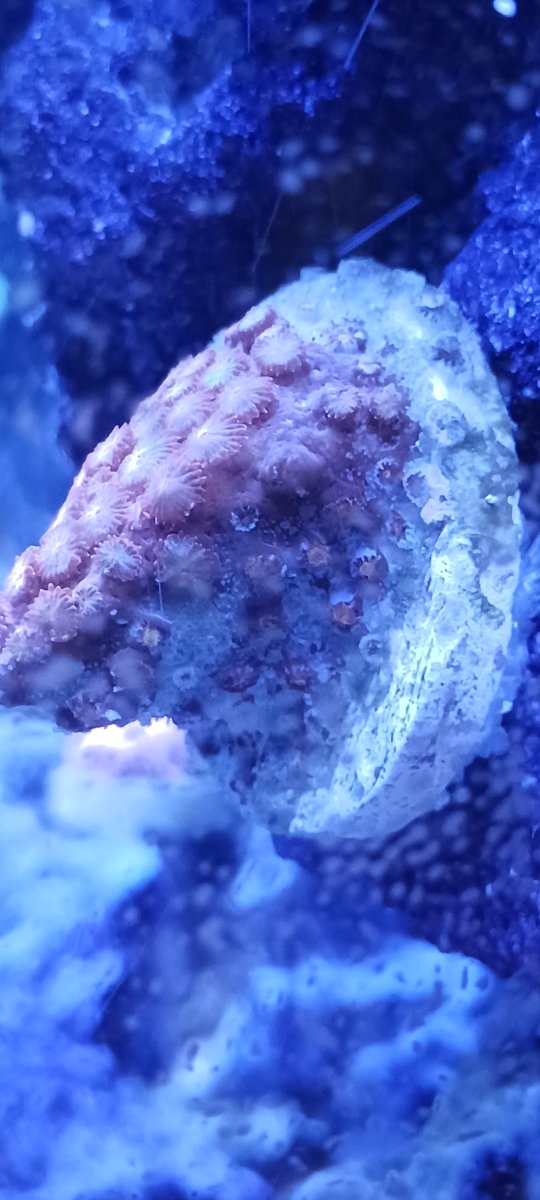
My Cyphastrea seems to be receeding. I'm leaning toward predation, because the area with greatest flow and light exposure seems least affected.

It is mounted on a shaded side of the rock and in such a way that the light hits the coral obliquely.

This is today:
34d71185-ffba-4ce6-8f0f-7c2e10e0c21c.jpg
a49a04f8-9b66-4e00-a756-e718cbd2fdfc.jpg

Note that the areas of the mat adjacent to the exposed frag plug are worst off. These are also the areas most accessible from the rock.

This was a couple of weeks ago:
71c047f2-2b5f-4e83-9eb7-61a994f3920f.jpg


Parameters (today):

○ Ca: 520 ppm
(target: 400-450 ppm)
per Salifert titration

○ Alk: 8.7 dKH
(target: 8-12 dkH)
per Salifert titration

○ Mg: 1,210 ppm
(target: 1,250-1,400 ppm)
per Salifert titration

○ pH: 8.2
(target: 8.1-8.4)
per API colorimetric

○ Salinity: 1.0261 SpG/ 35 ppt
(target: 35 ppt)
per TropicMarin precision
glass hydrometer

○ Temperature: 78.7°F
(target: 73-84°F)
per Weber digital therm.

○ Nitrate: 36.2 ppm
(target: 5-50 ppm*)
per Hanna HR Checker

○ Phosphate: 0.66 ppm
(target: 0.06-0.3 ppm*)
per Hanna ULR Checker
 

sfin52

So many pedestrians so little time
View Badges
Joined
Jun 19, 2016
Messages
25,004
Reaction score
92,960
Location
Usa
Rating - 0%
0   0   0
Its bleaching. What's the par is under
 
OP
OP
Euphylliaphyle

Euphylliaphyle

Just your average schmo.
View Badges
Joined
Sep 28, 2025
Messages
1,092
Reaction score
1,556
Location
Eastern NC
Rating - 0%
0   0   0
Thank you for the response. PAR (at 100%) was 115 at this depth nearby, BUT this coral's spot is on a vertical face near the front of the tank and shaded by the rock, and I'm only running at 65% on the light. Also, fwiw, my light at most can only put out 240 PAR at 3" depth on top of this rock near the centerline of the light at 100% intensity. All considered, I am guessing this coral is getting around 50 PAR or less. All of it is coming reflected off the front glass, so the effective depth may be greater than the vertical measurement.

Would the bleaching normally occur at the mat edges rather than in the most exposed surfaces?
 

sfin52

So many pedestrians so little time
View Badges
Joined
Jun 19, 2016
Messages
25,004
Reaction score
92,960
Location
Usa
Rating - 0%
0   0   0

Really good info on these guys. His videos are fantastic. I would aim for about 50-75 par. Indirect flow moderate. To determine flow i lime to use a string or air bubbles.

@fishguy242 suggestions help.
 

Shirak

2500 Club Member
View Badges
Joined
Nov 3, 2019
Messages
3,362
Reaction score
1,912
Location
Thousand Islands, NY
Rating - 0%
0   1   0
Thank you for the response. PAR (at 100%) was 115 at this depth nearby, BUT this coral's spot is on a vertical face near the front of the tank and shaded by the rock, and I'm only running at 65% on the light. Also, fwiw, my light at most can only put out 240 PAR at 3" depth on top of this rock near the centerline of the light at 100% intensity. All considered, I am guessing this coral is getting around 50 PAR or less. All of it is coming reflected off the front glass, so the effective depth may be greater than the vertical measurement.

Would the bleaching normally occur at the mat edges rather than in the most exposed surfaces?
How far down is it? 240par max at 3" deep directly under the light is quite low. How have you determined this and 115par at the same depth nearby the coral? I wouldn't call it bleaching. The tissue is gone. I don't think it's predation as it is all around the edges. Predation would be more random and in the easiest accessible spots. Guessing it's 50par is not a good idea. Get a par meter or find one to use so you can map the par in your tank for future reference.

Parameters seem fine so if I had to guess I would say it's a light issue. The parts with the least amount of light seem most affected and you have already determined it's in a very low par situation. My guess it's even less than you are estimating since you are running the light at 65% which is at most 156 par at 3" depth.
 
OP
OP
Euphylliaphyle

Euphylliaphyle

Just your average schmo.
View Badges
Joined
Sep 28, 2025
Messages
1,092
Reaction score
1,556
Location
Eastern NC
Rating - 0%
0   0   0
Thank you. The coral is at 10" deep. My PAR values came from a mapping I did Nov 8, 2025 using an Apogee quantum sensor borrowed from a LFS. I measured depth of each site using a plastic engineer's ruler.
I was thinking predation from a hermit crab or something else on the rock, rather than fish. If so, then these are the most accessible spots that are affected.
I need to go back to the LFS with the PAR meter and check this exact position to confirm actual and rule PAR out. I would have done so already, but this LFS is not so "L" at an hour's drive from here.
 

Shirak

2500 Club Member
View Badges
Joined
Nov 3, 2019
Messages
3,362
Reaction score
1,912
Location
Thousand Islands, NY
Rating - 0%
0   1   0
Did you map it at 100% intensity and are now running 65%? Note how the vertical surfaces (face of the plug and sides of the coral, and the underside are the most affected and they would be receiving the least light. Top of the plug is under a ledge which will limit light on the rock side also.

How long have you had it and is this a new location for it? The photo from a couple weeks ago looks pretty good, but maybe seeing a few spots here and there with tissue loss. Upper left, bottom right and around the top edge of the plug close to the rock might be some spots of tissue loss around the tops of some of the polyps

Do you see anything at night going over and picking at it? I am still leaning towards a par issue. Maybe in conjunction with feeding? Nutrients in the water seem fine but with low par the coral would rely more on captured food.
 
OP
OP
Euphylliaphyle

Euphylliaphyle

Just your average schmo.
View Badges
Joined
Sep 28, 2025
Messages
1,092
Reaction score
1,556
Location
Eastern NC
Rating - 0%
0   0   0
Yes, I mapped at 100% and now running at 65%. I have had this a couple of months. It has been in this location since acclimation. It looked fine until about 3 days ago. The "before" pic is the most recent I had of this before noticing the problem. I have not yet caught anything picking at it. If I do, I will remove it.
I target feed every coral 2x/week, including this one. I use frozen reef plankton and reconstituted Brightwell Reef Blizzard "S" for this coral.
 

fishguy242

Cronies..... INSERT BUILD THREAD BADGE HERE !!
View Badges
Joined
Jan 21, 2020
Messages
50,683
Reaction score
256,416
Location
Illinois
Rating - 100%
1   0   0
I'd say cal too high running 8.7 alk, try a couple of water changes to get cal down 460-480 but maintain alk 8-9
 

sfin52

So many pedestrians so little time
View Badges
Joined
Jun 19, 2016
Messages
25,004
Reaction score
92,960
Location
Usa
Rating - 0%
0   0   0
tissue loss technically, not bleaching.
Well you can see some of the polyps out amongst the white usually indicates bleaching. But either way the op was looking for help and you offered none just came in trying to correct.

Please next time offer help and not criticism. Thank you for reminding me to ask how the coral is doing.
 

sfin52

So many pedestrians so little time
View Badges
Joined
Jun 19, 2016
Messages
25,004
Reaction score
92,960
Location
Usa
Rating - 0%
0   0   0
My Cyphastrea seems to be receeding. I'm leaning toward predation, because the area with greatest flow and light exposure seems least affected.

It is mounted on a shaded side of the rock and in such a way that the light hits the coral obliquely.

This is today:
34d71185-ffba-4ce6-8f0f-7c2e10e0c21c.jpg
a49a04f8-9b66-4e00-a756-e718cbd2fdfc.jpg

Note that the areas of the mat adjacent to the exposed frag plug are worst off. These are also the areas most accessible from the rock.

This was a couple of weeks ago:
71c047f2-2b5f-4e83-9eb7-61a994f3920f.jpg


Parameters (today):

○ Ca: 520 ppm
(target: 400-450 ppm)
per Salifert titration

○ Alk: 8.7 dKH
(target: 8-12 dkH)
per Salifert titration

○ Mg: 1,210 ppm
(target: 1,250-1,400 ppm)
per Salifert titration

○ pH: 8.2
(target: 8.1-8.4)
per API colorimetric

○ Salinity: 1.0261 SpG/ 35 ppt
(target: 35 ppt)
per TropicMarin precision
glass hydrometer

○ Temperature: 78.7°F
(target: 73-84°F)
per Weber digital therm.

○ Nitrate: 36.2 ppm
(target: 5-50 ppm*)
per Hanna HR Checker

○ Phosphate: 0.66 ppm
(target: 0.06-0.3 ppm*)
per Hanna ULR Checker
How is it doing now?
 
OP
OP
Euphylliaphyle

Euphylliaphyle

Just your average schmo.
View Badges
Joined
Sep 28, 2025
Messages
1,092
Reaction score
1,556
Location
Eastern NC
Rating - 0%
0   0   0
My Cyphastrea seems to be receeding. I'm leaning toward predation, because the area with greatest flow and light exposure seems least affected.

It is mounted on a shaded side of the rock and in such a way that the light hits the coral obliquely.

This is today:
34d71185-ffba-4ce6-8f0f-7c2e10e0c21c.jpg
a49a04f8-9b66-4e00-a756-e718cbd2fdfc.jpg

Note that the areas of the mat adjacent to the exposed frag plug are worst off. These are also the areas most accessible from the rock.

This was a couple of weeks ago:
71c047f2-2b5f-4e83-9eb7-61a994f3920f.jpg


Parameters (today):

○ Ca: 520 ppm
(target: 400-450 ppm)
per Salifert titration

○ Alk: 8.7 dKH
(target: 8-12 dkH)
per Salifert titration

○ Mg: 1,210 ppm
(target: 1,250-1,400 ppm)
per Salifert titration

○ pH: 8.2
(target: 8.1-8.4)
per API colorimetric

○ Salinity: 1.0261 SpG/ 35 ppt
(target: 35 ppt)
per TropicMarin precision
glass hydrometer

○ Temperature: 78.7°F
(target: 73-84°F)
per Weber digital therm.

○ Nitrate: 36.2 ppm
(target: 5-50 ppm*)
per Hanna HR Checker

○ Phosphate: 0.66 ppm
(target: 0.06-0.3 ppm*)
per Hanna ULR Checker
How is it doing now?
Thanks for following up!
Not much change yet. I really haven't done anything significant but a water change since posting. It appeared today that a few new polyps were emerging from the old mat. At the very least, it was stable from yesterday. I didn’t take a pic though, and now the lights are dimming so all my corals are going to bed. I haven't caught any nibbler in the act yet, but I still am suspicious of my CUC. Some of my Dwarf Hermit Crabs are real jerks; no matter how much I feed they rob other inverts, so I have no reason to trust them around well-fed polyps.

I want to rule out PAR, but I won't be able to get to the not-so LFS (the only one in the area with a meter) for a few weeks due to upcoming surgery. I don't want to move the coral or ramp up lighting without having a PAR number.
 

thamnasteroid

2500 Club Member
View Badges
Joined
Aug 24, 2020
Messages
3,518
Reaction score
2,890
Location
Washington State
Rating - 100%
1   0   0
tissue loss technically, not bleaching.
Well you can see some of the polyps out amongst the white usually indicates bleaching. But either way the op was looking for help and you offered none just came in trying to correct.

Please next time offer help and not criticism. Thank you for reminding me to ask how the coral is doing.
The polyps in-between the white are just the remaining tissue. You can see the bare skeleton in-between the polyps.

The main reason why I didn't offer any advice was because I felt all advice was already given and I didn't have any advice of my own to add.
 
OP
OP
Euphylliaphyle

Euphylliaphyle

Just your average schmo.
View Badges
Joined
Sep 28, 2025
Messages
1,092
Reaction score
1,556
Location
Eastern NC
Rating - 0%
0   0   0
Aha! I think I have figured it out! In December, I moved my heater from horizontally mounted and near the sand bed and behind the aquascaping to vertically mounted in the corner near the top. Guess what is behind the rock that the Cyphastrea is mounted on? Moving the heater tipped that rock ever so slightly forward, casting more shade upon my coral! I need to chip off a small rock protrusion that contacts the heater to give clearance.
Thanks everyone for their help!
BTW, I brought my Ca down to 465 with a series of water changes.
 

sfin52

So many pedestrians so little time
View Badges
Joined
Jun 19, 2016
Messages
25,004
Reaction score
92,960
Location
Usa
Rating - 0%
0   0   0
Aha! I think I have figured it out! In December, I moved my heater from horizontally mounted and near the sand bed and behind the aquascaping to vertically mounted in the corner near the top. Guess what is behind the rock that the Cyphastrea is mounted on? Moving the heater tipped that rock ever so slightly forward, casting more shade upon my coral! I need to chip off a small rock protrusion that contacts the heater to give clearance.
Thanks everyone for their help!
BTW, I brought my Ca down to 465 with a series of water changes.
Fantastic.
 
OP
OP
Euphylliaphyle

Euphylliaphyle

Just your average schmo.
View Badges
Joined
Sep 28, 2025
Messages
1,092
Reaction score
1,556
Location
Eastern NC
Rating - 0%
0   0   0
The rock chipping was apparently a successful operation. I don't think the corals liked coming out of the water very much, but it was only for at most two minutes. They probably didn't enjoy the physical shock of the single precision chisel & hammer strike very much either, but it didn't dislodge either of them. I cushioned the main rock with a stack of towels beneath it to absorb the shock as much as possible, and the target nub came off cleanly with one blow. The corals were not contacted by anything during any part of the operation. We'll see what happens from here.
20260111_151117.jpg
20260111_144916.jpg
20260111_144843.jpg
 

TOP 10 Trending Threads

WHAT AMOUNT OF LIVE ROCK AND SAND SHOULD BE PRIORITIZED FOR OPTIMAL BIODIVERSITY/FILTRATION?

  • 100% live rock + bagged sand

    Votes: 34 26.4%
  • 100% dry rock + 100% live sand

    Votes: 45 34.9%
  • 50/50 live/dry rock, 50/50 live/bagged sand

    Votes: 29 22.5%
  • 75% live rock, 25% live sand

    Votes: 11 8.5%
  • 25% live rock, 75% live sand

    Votes: 10 7.8%
Back
Top






