



- Joined
- Sep 21, 2018
- Messages
- 10,165
- Reaction score
- 10,103
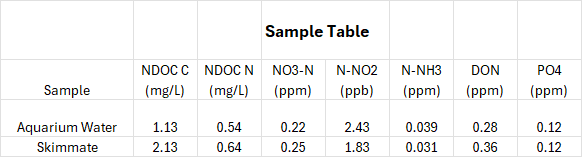
I am sharing the results of a brief study of two methods for measuring and trending dissolved organic matter: BOD5 and basic potassium permanganate consumption (COD). Study samples which served as reference standards were characterized with Triton’s NDOC test which measures the amount of organic carbon and organic nitrogen. The samples in this study were sterile filtered aquarium water and sterile filtered newly collected skimmate. BOD5 and COD tests were performed within two hours of collecting the samples. Each sample was also submitted to Oceamo for the recently introduced Organo-MS test (https://www.reef2reef.com/threads/introducing-the-oceamo-organo-ms-analysis.1112943/). Nitrate, nitrite, total ammonia and phosphate concentrations were measured for both samples (see Sample Table).
Study Samples Analysis
Water chemistry and NDOC results show that the skimmate enrichment is primarily organic carbon (1.9X) with a lower enrichment (1.3X) of dissolved organic nitrogen (DON: NDOC total nitrogen minus inorganic nitrogen species). The skimmate was colorless. The amount of organic nitrogen in the aquarium water is equivalent to 1.2 ppm nitrate.
BOD5 Results
This test measures the amount of oxygen consumed by bacteria in a water sample held in the dark at room temperature for five days. The oxygen consumption is related to the amount of digestible organic matter contained in the sample. Not all organic matter is consumed by bacteria, and therefore, the results only reflect a portion of the dissolved organic carbon present. Unless calibrated, the results from this test are used for relative comparisons.
Skimmate sample preparation involved passing the water through a 0.45 micron filter to remove particulates which included bacteria. Therefore, bacteria were added back by diluting a small amount (10%) of skimmate with sterile filtered skimmate. From previous work, the particulates added with the unfiltered skimmate increase the BOD5 by about 4%. The aquarium water sample was not filtered because previous work showed little or no difference in BOD5 results for sterile filtered aquarium water with bacteria added back. BOD5 study results are presented in the table below.

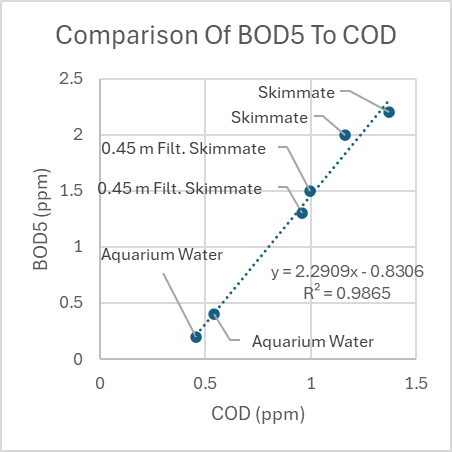
While we can’t directly compare NDOC to BOD5 results, we can note that skimmate has 1.9X more organic C than aquarium water but consumed 7.5X more oxygen (unfiltered skimmate has the highest BOD5. NDOC test not conducted). How might this be explained?
For aquarium water, 0.2 ppm O2 was consumed in the BOD5 test. If we assume all the oxygen went to making CO2, then only 0.075 ppm carbon was consumed in the process. Since the aquarium water is not nitrogen or phosphorous limited, the bulk of the organic carbon (NDOC result) is likely not readily digestible (labile) carbon. In the case of the skimmate sample, a larger BOD5 was observed, consuming up to 0.56 ppm carbon. This likely means that the 1 ppm organic carbon enrichment in the skimmate sample had a much higher proportion of labile carbon than aquarium water, and evidence that the skimmer is doing its job.
COD
This test like BOD5 measures oxygen consumption, but in this case, bacteria are replaced with a chemical oxidizer, potassium permanganate. The amount of permanganate reduced to manganese dioxide is related to the amount of organic matter in the sample. Because permanganate does not oxidize all organic matter, like BOD5, COD results reflect a portion of the total organic matter present. Study results are shown in the table below. The amount of permanganate consumed is converted to a chemical oxygen demand.
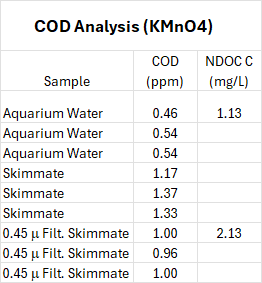
The COD results parallel the NDOC total organic results more closely then the BOD5 results. The estimated amount of organic carbon, assuming all the oxygen is converted to CO2, is about 16% of the NDOC test result for both samples. This relationship may vary as the proportion of organic matter susceptible to permanganate oxidation varies. Caution is required when comparing COD results from different samples. For this study’s samples, there is a strong correlation between COD and BOD5 results (see plot below).
Organo-MS
This test is a bit different from NDOC, BOD5 and COD. It is focused on identifying molecules of interest in the aquarium such as amino acids, vitamins, pesticides, herbicides, PFAS, pharmaceutical and plasticizers. When a molecule is detected and identified, the concentration is reported. To understand what fraction of the organic carbon is identified by this method, each sample was submitted for the Organo-MS analysis. The concentration of organic carbon and nitrogen was calculated for each chemical species that was reported with a concentration and summed (see table below).
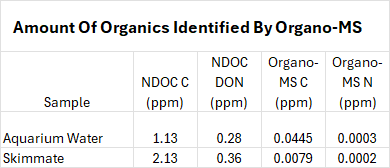
As is clear from the results, Organo-MS is reporting on a small subset of the organic matter found in the aquarium samples. A more complete review of the data can be found in post #87 in
https://www.reef2reef.com/threads/organo-ms-results-and-evaluations.1134232/
Conclusion
The data gives me a level of confidence to use BOD5 and COD to trend the concentration of organic matter in an aquarium water.
Any questions, comments?
Study Samples Analysis
Water chemistry and NDOC results show that the skimmate enrichment is primarily organic carbon (1.9X) with a lower enrichment (1.3X) of dissolved organic nitrogen (DON: NDOC total nitrogen minus inorganic nitrogen species). The skimmate was colorless. The amount of organic nitrogen in the aquarium water is equivalent to 1.2 ppm nitrate.
BOD5 Results
This test measures the amount of oxygen consumed by bacteria in a water sample held in the dark at room temperature for five days. The oxygen consumption is related to the amount of digestible organic matter contained in the sample. Not all organic matter is consumed by bacteria, and therefore, the results only reflect a portion of the dissolved organic carbon present. Unless calibrated, the results from this test are used for relative comparisons.
Skimmate sample preparation involved passing the water through a 0.45 micron filter to remove particulates which included bacteria. Therefore, bacteria were added back by diluting a small amount (10%) of skimmate with sterile filtered skimmate. From previous work, the particulates added with the unfiltered skimmate increase the BOD5 by about 4%. The aquarium water sample was not filtered because previous work showed little or no difference in BOD5 results for sterile filtered aquarium water with bacteria added back. BOD5 study results are presented in the table below.
While we can’t directly compare NDOC to BOD5 results, we can note that skimmate has 1.9X more organic C than aquarium water but consumed 7.5X more oxygen (unfiltered skimmate has the highest BOD5. NDOC test not conducted). How might this be explained?
For aquarium water, 0.2 ppm O2 was consumed in the BOD5 test. If we assume all the oxygen went to making CO2, then only 0.075 ppm carbon was consumed in the process. Since the aquarium water is not nitrogen or phosphorous limited, the bulk of the organic carbon (NDOC result) is likely not readily digestible (labile) carbon. In the case of the skimmate sample, a larger BOD5 was observed, consuming up to 0.56 ppm carbon. This likely means that the 1 ppm organic carbon enrichment in the skimmate sample had a much higher proportion of labile carbon than aquarium water, and evidence that the skimmer is doing its job.
COD
This test like BOD5 measures oxygen consumption, but in this case, bacteria are replaced with a chemical oxidizer, potassium permanganate. The amount of permanganate reduced to manganese dioxide is related to the amount of organic matter in the sample. Because permanganate does not oxidize all organic matter, like BOD5, COD results reflect a portion of the total organic matter present. Study results are shown in the table below. The amount of permanganate consumed is converted to a chemical oxygen demand.
The COD results parallel the NDOC total organic results more closely then the BOD5 results. The estimated amount of organic carbon, assuming all the oxygen is converted to CO2, is about 16% of the NDOC test result for both samples. This relationship may vary as the proportion of organic matter susceptible to permanganate oxidation varies. Caution is required when comparing COD results from different samples. For this study’s samples, there is a strong correlation between COD and BOD5 results (see plot below).
Organo-MS
This test is a bit different from NDOC, BOD5 and COD. It is focused on identifying molecules of interest in the aquarium such as amino acids, vitamins, pesticides, herbicides, PFAS, pharmaceutical and plasticizers. When a molecule is detected and identified, the concentration is reported. To understand what fraction of the organic carbon is identified by this method, each sample was submitted for the Organo-MS analysis. The concentration of organic carbon and nitrogen was calculated for each chemical species that was reported with a concentration and summed (see table below).
As is clear from the results, Organo-MS is reporting on a small subset of the organic matter found in the aquarium samples. A more complete review of the data can be found in post #87 in
https://www.reef2reef.com/threads/organo-ms-results-and-evaluations.1134232/
Conclusion
The data gives me a level of confidence to use BOD5 and COD to trend the concentration of organic matter in an aquarium water.
Any questions, comments?














