Can u SSH into your pi and run this command.
ls /sys/bus/w1/devices/
Do that and see if it lists any sensors.
If not there is a wiring problem somewhere
I get w1_bus_master1 as a return value.

Follow along with the video below to see how to install our site as a web app on your home screen.
Note: This feature may not be available in some browsers.
Can u SSH into your pi and run this command.
ls /sys/bus/w1/devices/
Do that and see if it lists any sensors.
If not there is a wiring problem somewhere
If one wire is enabled and you have a working, properly wired sensor, that command should return all one wire devices on the bus listed by serial number,
Doublecheck all your wiring...what colors are the sensor wires...sometimes color codes have been known to be different on some of them, or wired with wrong colors.
How about a pic of the sensor to the male jack as wellSounds like I managed to screw something up with my soldering or wiring. The pictures on the Adafruit guide are very unclear when it comes to the audio jack wiring.
For the barrel jack, assuming the long terminal is down on my table, pointed towards me (with the opening of the jack pointed away) which sides are the red & yellow wires supposed to go to? No matter how hard I tried, I couldn't determine if this picture showed the long terminal up in the air, or down on the table.
![]()
Very nice, even in a freshwater tropical, i keep my temp steady so it looks like temp compensation wont be an issue. I cant imagine temps swinging more than that unless its an outdoor application.Further updates on the pH side. BRS Double Junction probe with the new v2 I2C firmware on the blueAcro Pico board:

![]()
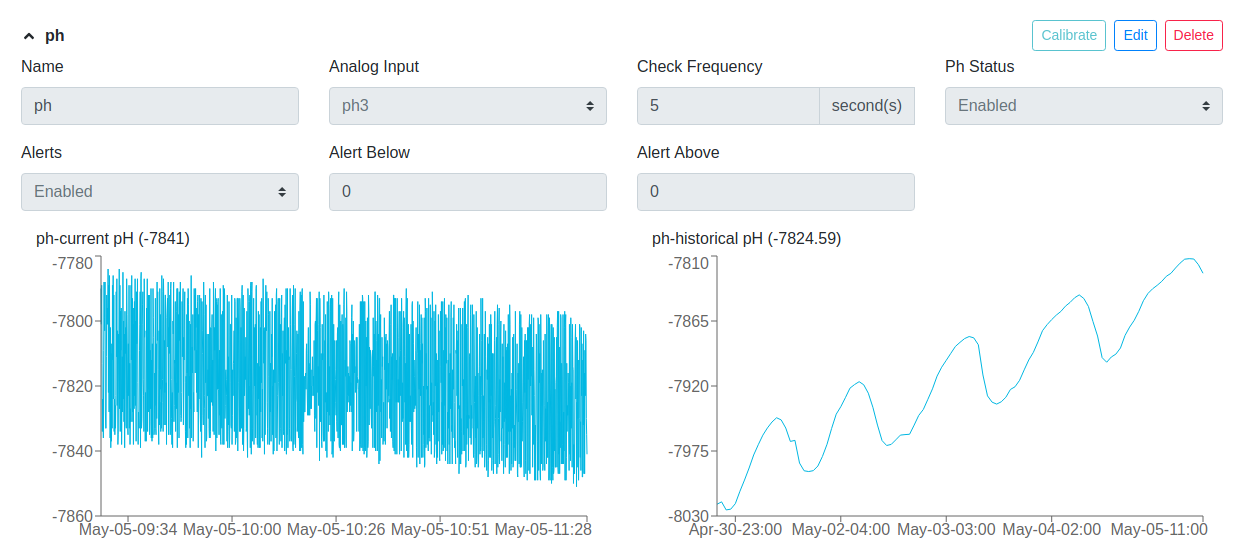
This is sitting in the pH 10 calibration solution. The daily temperature changes are obvious at this chart level, but full span from pH 7 to pH 10 represent a 0.06 pH error over about 15 degrees F (68-82 F). Since we don't oscillate reef tanks that much its not really useful to add temperature compensation, however it may be worthwhile if a freshwater habitat goes through wider swings or outdoor / pond applications.

So a couple of ideas. 1. You could have shorted it. 2. You could have broken it with too much current. What are you using as power source or what is buck converter set on. 3. What resistor is that?So, update-still no luck. I think there's a good chance I shorted that connection when I took the heat shrink off, so that probably wasn't the problem initially.
Here are pictures of how I have everything wired. I've double checked & I definitely have continuity along the ground & line wires.
![]()
![]()
So a couple of ideas. 1. You could have shorted it. 2. You could have broken it with too much current. What are you using as power source or what is buck converter set on. 3. What resistor is that?
If you shorted the sensor it could have killed it. I would try another if you have one. Make sure your wireing is right first1. Could have shorted which part? I've gone back & inspected both the male & female ends of the audio connector soldering & both are good for sure now. Are you talking about the sensor itself? I may just go ahead & wire another one to see if I get any better results.
2. I'm just using the micro USB as a power source for now. it's a 5V 2a charger, shouldn't be any issues there.
3. Resistor is a 4.7k
Look at itI just made a new sensor & I'm still got the same issue, wiring is definitely right.
Is there a good way to check if I'm getting a connection to the GPIO 4 pin?
Look at it
Check the resistor is actually 4.7 I have had bad ones beforeThe way I have it soldered on, I can't actually see if there's continuity. However, I just confirmed there is a good connection with my multimeter from the backside of the pi to the wire connected to the pin.
I'm still getting this error:
{"error":"Item 'usage' does not exist in bucket 'temperature'"} | HTTP 404
I assume that just means it doesn't detect the sensor.
I'm going to keep messing with it, but I'm pretty much out of ideas. I've rebuilt the entire thing at this point
Check the resistor is actually 4.7 I have had bad ones before
Im curious why the swing is heading upwards ?Further updates on the pH side. BRS Double Junction probe with the new v2 I2C firmware on the blueAcro Pico board:
![]()
This is sitting in the pH 10 calibration solution. The daily temperature changes are obvious at this chart level, but full span from pH 7 to pH 10 represent a 0.06 pH error over about 15 degrees F (68-82 F). Since we don't oscillate reef tanks that much its not really useful to add temperature compensation, however it may be worthwhile if a freshwater habitat goes through wider swings or outdoor / pond applications.
Can you power down the unit and run a set of connectivity tests with multi meter across 3.3v, GND and data pins. Cross check if any of those are shorted,So, update. Still not working, here are the things I've verified:
I traced it through, the red wire is connected to the tip of the male end & the tip socket of the female end. Black is connected to the bottom, & yellow to the middle. I've also tried swapping the yellow & red, no luck.
- No short in the sensor.
- Correctly wired
- Getting 3.3V at the sensor.
- Connection to the GPIO pin.
Edit: At the jack, I'm seeing 3.3V on both the red & yellow wires. I know the resistor is there to pull the signal up to 3.3V when there's no signal... So does that indicate there's something wrong with the sensor?
Im curious why the swing is heading upwards ?