Sky rocketed PH

I’m going to hold on the water change due to No3. I’ve been running 7.0/ .08. I’ve been dosing ammonia the last 2 months, frankly I’ve also been putting No3 in the last couple days too. I feel I am danger low. Now with this, no way I should do a water change as I talk my self through it. I think I am going to have to add No3 maybe more aggressively if I drop. ? I can check daily with my MT and on demand by hand.
 
Soda water is good. Vinegar can work but may lower O2 and cause a bacterial bloom.

Here’s some info:

https://www.reefedition.com/ph-and-the-reef-aquarium/
Solutions to High pH Problems

Some solutions to pH problems are peculiar to a specific cause, such as adding vinegar directly to limewater, or using less limewater than normal. Some general solutions, however, are frequently effective. Water changes are generally not an effective long-term solution to any pH problems. My recommendations on how to deal with high pH problems are detailed below.

Adding a buffer is a very poor way to control high pH. The best option in this regard is to add straight baking soda, but it lowers pH only slightly and provides a large boost to alkalinity. I showed experimentally in a previous article that adding enough baking soda to lower artificial seawater’s pH by 0.04 pH units raises alkalinity by 1.4 dKH (0.5 meq/L).

The most benign way to reduce high pH is to aerate the water more. Whether the aquarium looks well-aerated or not, and regardless of its oxygen level, if its pH is above 8.5 and its alkalinity is below 11 dKH (4 meq/L), then the aquarium is not fully equilibrated with carbon dioxide in the air (if its alkalinity is much higher than 11 dKH, then that may also require correction). Equilibrating carbon dioxide can be much more difficult than equilibrating oxygen. Air contains very little carbon dioxide (about 350 ppm) relative to oxygen (210,000 ppm). Consequently, a lot more air needs to be driven through the water to introduce the same amount of carbon dioxide as oxygen. Perfect aeration will solve nearly any high pH problem, and will rarely cause any problem of its own.

That said, sufficient aeration is not always easily accomplished, and other methods can be useful. These other methods are:

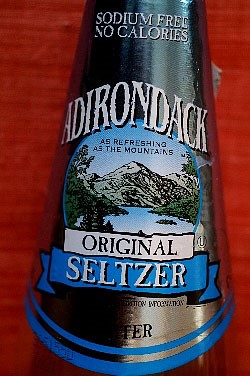
  1. Direct addition of carbon dioxide: Bottled soda water (seltzer) can be used to instantly reduce an aquarium’s pH. Be sure to select unflavored soda water, and check its ingredients to be sure it doesn’t contain anything that should be avoided (phosphate, etc.). Many manufacturers list water and carbon dioxide as the only ingredients.
I recommend adding 6 mL of soda water per gallon of tank water to reduce pH by about 0.3 units. Add it to a high flow area away from organisms (such as in a sump). The local pH where it first is added will be very low. Going about this procedure slowly is better than proceeding too fast. If you do not have a sump, add it especially slowly. Some soda water may have more or less carbon dioxide in it than others, and the lower the aquarium’s alkalinity, the more the pH will drop. Also, the higher the pH, the less the pH will drop, because seawater’s buffering capability declines steadily as the pH drops from about 9 to 7.5.

seltzer

Figure 3. Adirondack Seltzer, used to add carbon dioxide and lower pH.

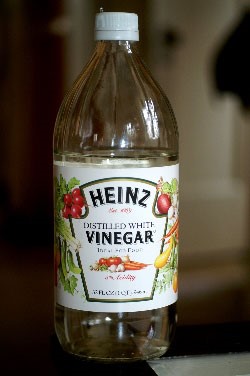
  1. Direct addition of vinegar: Commercial distilled white vinegar (typically 5% acetic acid or “5% acidity”) can be used to instantly reduce an aquarium’s pH. Do not use wine vinegars because they may contain undesirable organics in addition to the acetic acid.
I recommend adding 1 mL of distilled white vinegar per gallon of tank water to initially reduce pH by about 0.3 units. Once again, add it to a high flow area away from organisms (such as in a sump). The local pH where it first is added will be very low. Going about this procedure slowly is better than proceeding too fast. If you do not have a sump, add it especially slowly. The lower the aquarium’s alkalinity, the more the pH will drop. Also, the higher the pH, the less the pH will drop, because seawater’s buffering capability declines steadily as the pH drops from about 9 to 7.5. Remember, there may be an additional later drop in pH as the aquarium’s organisms metabolize the vinegar to carbon dioxide.

vinegar

Figure 4. Heinz Distilled White Vinegar, used to lower pH.

  1. Addition of vinegar via limewater: Commercial distilled white vinegar can be used to reduce a tank’s pH by adding it to limewater that is subsequently added to the aquarium (instead of using limewater alone). Do not use wine vinegars because they may contain undesirable organics in addition to the acetic acid. A reasonable dose to start with is 45 ml of vinegar per gallon of limewater.

 
I’m going to hold on the water change due to No3. I’ve been running 7.0/ .08. I’ve been dosing ammonia the last 2 months, frankly I’ve also been putting No3 in the last couple days too. I feel I am danger low. Now with this, no way I should do a water change as I talk my self through it. I think I am going to have to add No3 maybe more aggressively if I drop. ? I can check daily with my MT and on demand by hand.
seems good. I see little risk in dosing NO3
 
Alkalinity is down to 9.1, all dosing has resumed. However, I’m taken the s. Hydroxide offline right now. Timing is a ****. I was quit literally thinking I should shut down the S. hydroxide and see how my ph goes. I’m hitting 8.4 before my lights go on. I was thinking there was no real need or reward for the S hydroxide. Besides out my daily dosing amount of alk, 85%’is being dosed by S. BiCarb. Ph is current 8.47. I hooked my scrubber back up and my kalk has started to drip. Everything is within tolerance. Let me go read Randy’s information.
 
How long does the potential for low oxygen exist? I added a second skimmer to my sump, with the cup off just foaming away. My primary skimmer is skimming like it normally does. I also have a giant air stone in my sumo going. I don’t have any air bubblers going in my display. I can if need be. Thoughts
 
One post back in the day said , a vitamin c tablet , lower ph fast
 
How long does the potential for low oxygen exist? I added a second skimmer to my sump, with the cup off just foaming away. My primary skimmer is skimming like it normally does. I also have a giant air stone in my sumo going. I don’t have any air bubblers going in my display. I can if need be. Thoughts
I think 2 skimmers and an airstone is good.

When I overdosed vinegar I had a cloudiness in less than 24 hrs but no harm done, fish seemed fine, and my aeration was just a skimmer. Skimmer was super foamy.

I think you are nearly in the clear. Test nutrients in the morning.


Despite my fascination with running elevated pH I’ve never used NaOH. It’s totally doable, and I may try it some day, but I’ve overdosed most chemicals at some point and that one is potent. Glad you caught it when you did and it seems your response was really good.
 
@rishma - oddly, my nutrients spiked (!?!?!). No3 8.8 and Po4 .18. I’m not sure what to make of that. Tank is acting and looking normal. dKH 9.1 and PH 8.48. I lowered all my guard rails. PH will shut stuff down now above 8.48 and DKH 9.4. I’ve got my MT set to test at 5 am. I’ll do manually and compare.
 
@rishma - oddly, my nutrients spiked (!?!?!). No3 8.8 and Po4 .18. I’m not sure what to make of that. Tank is acting and looking normal. dKH 9.1 and PH 8.48. I lowered all my guard rails. PH will shut stuff down now above 8.48 and DKH 9.4. I’ve got my MT set to test at 5 am. I’ll do manually and compare.
Well that’s interesting…I’m not worried but certainly curious.
 
My regular tank pH is 8.0-8.4 (CO2 scrubber on), but when we (two humans and one dog puppy) leave for a vacation the pH can go up to 8.9-9.0 in the end of the day (even if I remove the CO2 scrubber altogether). I have not noticed any major impact on coral health, except much higher alkalinity consumption and faster growth during the same time. But in general, I try to avoid it and looking the pH much climb higher keeps me pretty nervous :D
 
Just out of curiosity… could a calcium reactor, or just a straight CO2 bubbler off a compressed CO2 tank be applied here to have a more precise control over the PH reduction of the system?

— I think of this from my planted tank as a potential solution; given that you can rent CO2 bottles/regulators!
 
Just out of curiosity… could a calcium reactor, or just a straight CO2 bubbler off a compressed CO2 tank be applied here to have a more precise control over the PH reduction of the system?
Calcium reactors add alkalinity, which may be redundant during overdoses. The pH decrease isn’t significant because most is used up to dissolve the CaCo₃ in the reactor. Directly adding CO₂ will decrease pH, and both gas tanks and carbonated water can accomplish that.
 
Somehow my sodium hydroxide switched on. Maybe wet hands and my phone. I dumped about 1100 mil. Big system, 525, I go through more than that in a day right now. Sky only went to 11.3, that’s only 1.4-1.7 where I live. Oh went above 9, I brought it right down with vinegar. What can I expect? I’ve got some SPS sliming right now.

I’ve hit 8.8-8.9 in the past. But never over 9.0. Thoughts? The entire event was less than 45 minutes. I’m making 300g of water right now. But, I am not thinking a water change is needed. I guess we will see if all these swings I’ve put my tank through have toughened it up.

I felt with this last December, be careful with big water changes, I would match the dkh (with sodium bicarbonate, to keep ph down) of the water change to the tank even if it is high.

I found my corals did fine with a super high dkh and ph but dropping it down is what sparked them to peel. On the other side the fish did not do well with a high ph, so its a fine balance.

It doesn’t look like you have a ton of precipitate so that a plus.

IMG_7623.jpeg
 
How long does the potential for low oxygen exist? I added a second skimmer to my sump, with the cup off just foaming away. My primary skimmer is skimming like it normally does. I also have a giant air stone in my sumo going. I don’t have any air bubblers going in my display. I can if need be. Thoughts

I’d think most O2 depletion potential is done in 24 h, although it could be longer in a tank that does not regularly dose vinegar.
 
Just out of curiosity… could a calcium reactor, or just a straight CO2 bubbler off a compressed CO2 tank be applied here to have a more precise control over the PH reduction of the system?

— I think of this from my planted tank as a potential solution; given that you can rent CO2 bottles/regulators!
Oh man, that’s really interesting. 7 feet from that system is my freshwater tank with an abandoned co2 system. I could have put the bubbler in my tank. I wasn’t even thinking of that. I kept 4 liters of vinegar on hand “in case of emergency break glass”. Stupid me. When I switched my A2 for an A3 and had to completely redo my entire system, I never put my audible alarm online for high PH and High temp. By the grace of god I caught it early.
 
I felt with this last December, be careful with big water changes, I would match the dkh (with sodium bicarbonate, to keep ph down) of the water change to the tank even if it is high.

I found my corals did fine with a super high dkh and ph but dropping it down is what sparked them to peel. On the other side the fish did not do well with a high ph, so its a fine balance.

It doesn’t look like you have a ton of precipitate so that a plus.

IMG_7623.jpeg
Interestingly I did notice the fish were for sure not happy at all when I caught it. The second the PH dropped below 8.9. They came out and started eating nori like nothing happened.
 
I felt with this last December, be careful with big water changes, I would match the dkh (with sodium bicarbonate, to keep ph down) of the water change to the tank even if it is high.

I found my corals did fine with a super high dkh and ph but dropping it down is what sparked them to peel. On the other side the fish did not do well with a high ph, so its a fine balance.

It doesn’t look like you have a ton of precipitate so that a plus.

IMG_7623.jpeg
Interestingly I did notice the fish were for sure not happy at all when I caught it. The second the PH dropped below 8.9. They came out and started eating nori like nothing happened.
pH of 8.9 isn’t that bad, my pH was so high it was unreadable, it was late at night, and I forgot to take a picture, but my Apex read some ridiculous number. It was just flat, it didn’t look like it could go any higher.
 
pH of 8.9 isn’t that bad, my pH was so high it was unreadable, it was late at night, and I forgot to take a picture, but my Apex read some ridiculous number. It was just flat, it didn’t look like it could go any higher.
Are you sure it wasn’t a test error? 8.9 pH has a substantial risk for precipitation and may significantly stress corals with prolonged exposure.
 
pH of 8.9 isn’t that bad, my pH was so high it was unreadable, it was late at night, and I forgot to take a picture, but my Apex read some ridiculous number. It was just flat, it didn’t look like it could go any higher.
I caught it at 9.3 she was headed to Pluto.
 

TOP 10 Trending Threads

WHAT MOST EARNS A REEFING BUSINESS YOUR "BEST OF THE BEST" NOMINATION?

  • Excellent livestock or product quality

    Votes: 16 27.6%
  • Honest listings and accurate expectations

    Votes: 8 13.8%
  • Helpful, knowledgeable customer service

    Votes: 4 6.9%
  • Standing behind a product when something goes wrong

    Votes: 14 24.1%
  • Fair prices and good value

    Votes: 7 12.1%
  • A unique selection or innovative products

    Votes: 0 0.0%
  • Supporting the reefing community or sustainability

    Votes: 0 0.0%
  • Consistent quality over time

    Votes: 8 13.8%
  • Other (Post in the comments)

    Votes: 1 1.7%
Back
Top
Home
Post thread…
Market
What's new