Somebody help with plumbing issue please

GothFishKeeper

Active Member
View Badges
Joined
May 8, 2024
Messages
419
Reaction score
181
Location
Bolingbrook
Rating - 0%
0   0   0
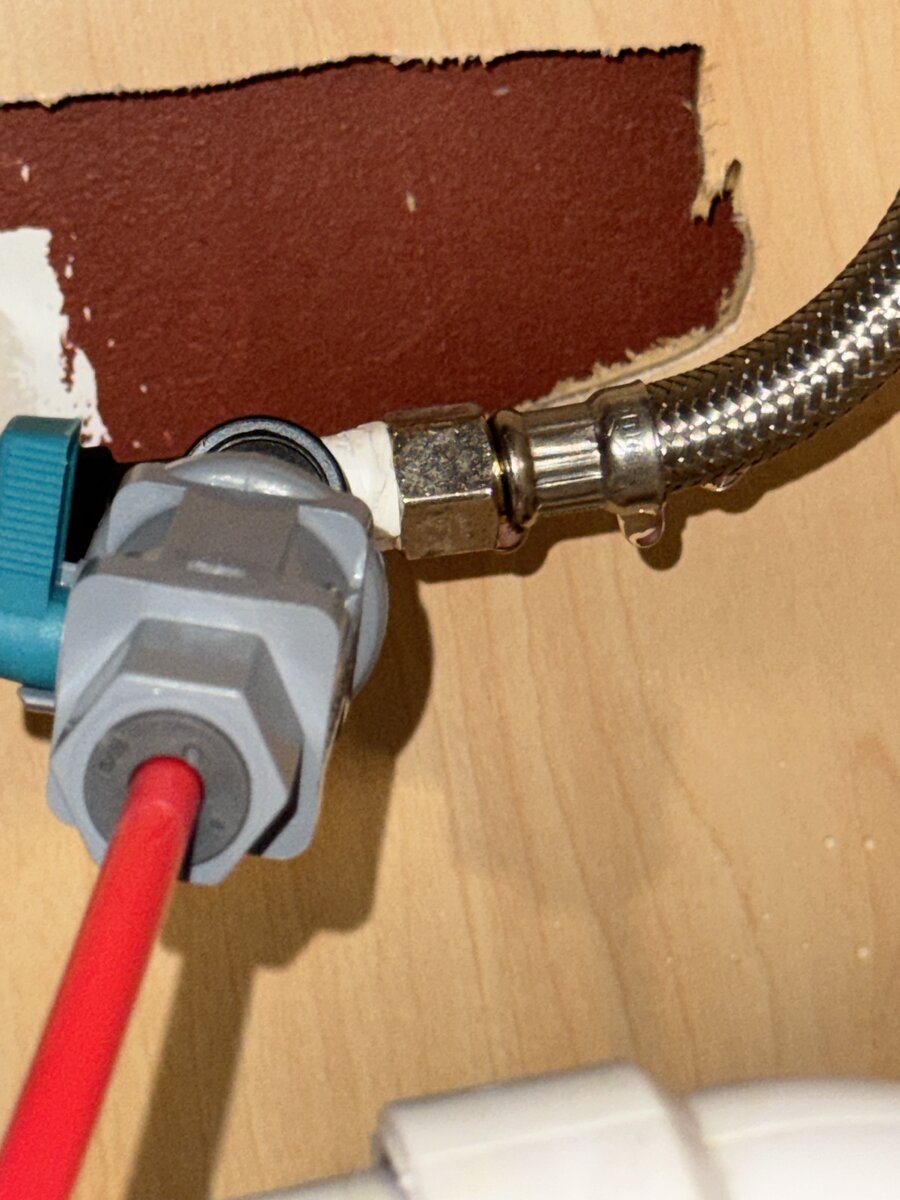
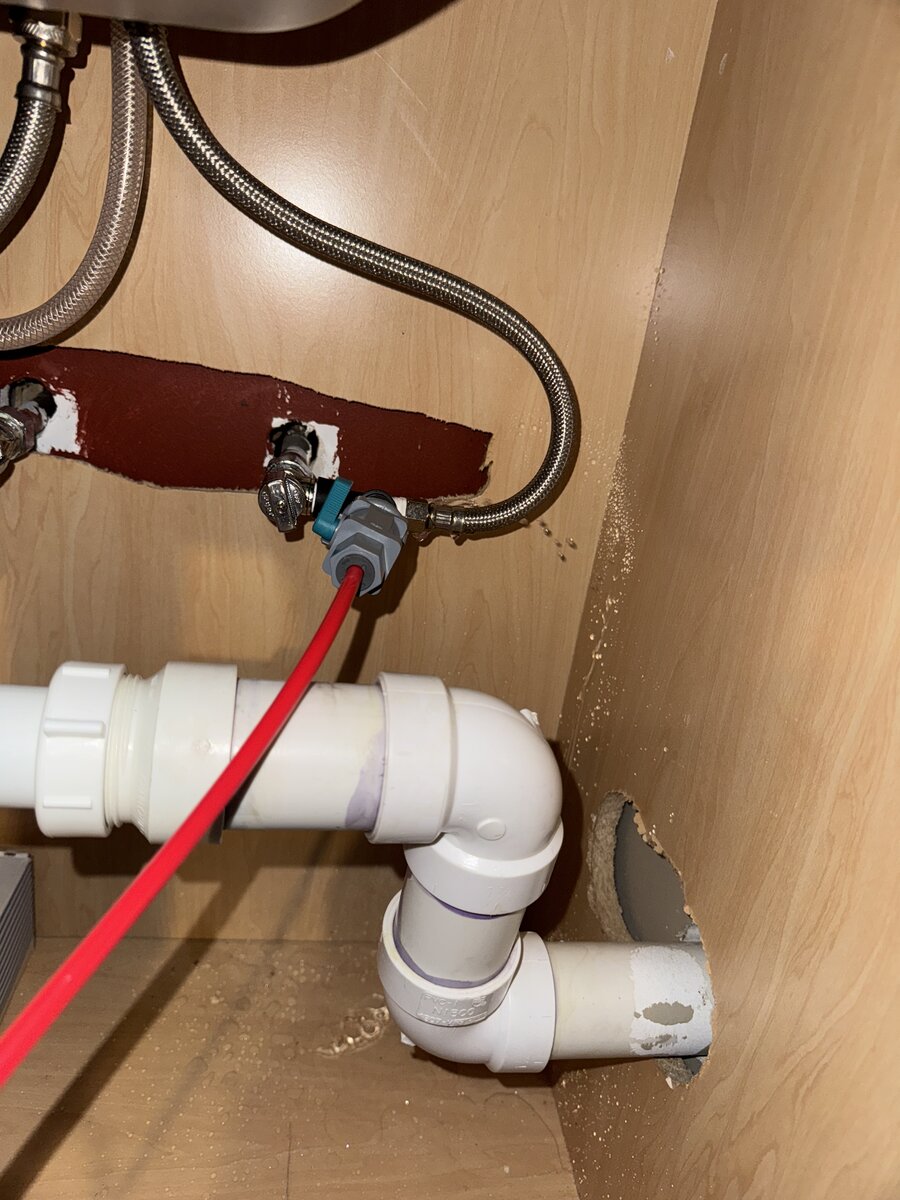
I just bought my first RODI system (5 stage brs unit), and after connecting the nut to the black piece seen here to split the water and be able to still use the sink normally, I tested to see how tight it was and im glad i did because the section of tubing leading to the sink started spraying when i turned opened the valve again. Does this have to do with the way i connected it, or did i somehow bust my sink plumbing? Any advice on what to do would be greatly helpful.

IMG_0551.jpeg

IMG_0552.jpeg
 

UncommonSense

2500 Club Member
View Badges
Joined
May 4, 2025
Messages
4,264
Reaction score
4,992
Location
Monterey Bay area, California
Rating - 0%
0   0   0
I just bought my first RODI system (5 stage brs unit), and after connecting the nut to the black piece seen here to split the water and be able to still use the sink normally, I tested to see how tight it was and im glad i did because the section of tubing leading to the sink started spraying when i turned opened the valve again. Does this have to do with the way i connected it, or did i somehow bust my sink plumbing? Any advice on what to do would be greatly helpful.

IMG_0551.jpeg

IMG_0552.jpeg
My immediate guess would be that this faucet hose is actually a compression fitting, not NPT!

Check to see if the hose is tight to the RO hookup fitting, but this may call for a different RO hookup fitting!
 

KStatefan

5000 Club Member
View Badges
Joined
Jun 24, 2015
Messages
5,589
Reaction score
5,014
Location
MHK
Rating - 0%
0   0   0
What was said above and no tape on the threads of compression fittings.

What is the black tee you are using?
 
OP
OP
GothFishKeeper

GothFishKeeper

Active Member
View Badges
Joined
May 8, 2024
Messages
419
Reaction score
181
Location
Bolingbrook
Rating - 0%
0   0   0
My immediate guess would be that this faucet hose is actually a compression fitting, not NPT!

Check to see if the hose is tight to the RO hookup fitting, but this may call for a different RO hookup fitting!
If I’m being completely honest I’m not sure what exactly what those are or what the difference would be. Sorry, I know that makes me sound dumb.
It appears that the rubber washer inside the end of the faucet hose is all busted and ripped up. Correct me if I’m wrong, but wouldn’t that be the cause considering the leaking/spraying is coming from the part between the nut and the hose instead of the tee and the nut? I’m not sure if that happened in the process of connecting it last night, or when it was installed years ago. Regardless of that I went to home depot looking for a new washer and they didn’t have any so i just got a new hose for $5.

What was said above and no tape on the threads of compression fittings.

What is the black tee you are using?
IMG_0555.png
 
OP
OP
GothFishKeeper

GothFishKeeper

Active Member
View Badges
Joined
May 8, 2024
Messages
419
Reaction score
181
Location
Bolingbrook
Rating - 0%
0   0   0
My immediate guess would be that this faucet hose is actually a compression fitting, not NPT!

Check to see if the hose is tight to the RO hookup fitting, but this may call for a different RO hookup fitting!
Would you happen to know which of those this is by looking at it? This is the new hose but it’s the exact same one that’s on there
IMG_0556.jpeg

IMG_0557.jpeg

IMG_0558.jpeg
 

UncommonSense

2500 Club Member
View Badges
Joined
May 4, 2025
Messages
4,264
Reaction score
4,992
Location
Monterey Bay area, California
Rating - 0%
0   0   0
If I’m being completely honest I’m not sure what exactly what those are or what the difference would be. Sorry, I know that makes me sound dumb.
Not dumb, it is a very technical topic; not many really understand it without some googling or practical application!

National Pipe Thread (NPT): threads which taper slightly, these rely on thread sealant to make a leak tight/pressure rated seal! (paint on, or Teflon tape (latter for metal parts only)! — these are the most common threaded fittings seen in water and air plumbing!

Compression (Comp): relies on a smooth metal (usually brass) mating surface, and/or rubber o-ring. No taper to threads — most common on flexible plumbing fixture supply hoses, hydraulic fittings, misc. higher pressure applications!

It appears that the rubber washer inside the end of the faucet hose is all busted and ripped up. Correct me if I’m wrong, but wouldn’t that be the cause considering the leaking/spraying is coming from the part between the nut and the hose instead of the tee and the nut?
You are correct! The o-ring is likely very old and/or cheap, rubber does harden and crack with age! (Keep this in mind regarding tank bulkhead gaskets, too!)

I’m not sure if that happened in the process of connecting it last night, or when it was installed years ago.
It was likely petrified and kinda melted to both sealing surfaces, subsequently ripping itself apart when you unscrewed the hose!

Would you happen to know which of those this is by looking at it? This is the new hose but it’s the exact same one that’s on there
This also appears to be a compression fitting, and may not work with your current water tee (NPT).. I’ve probably tried it, but it’s been so long that the memory’s hazy…. Something tells me that having a new o-ring should solve this problem…

if it doesn’t; you’ll need a 3/8” compression to 1/4” push connect tee! — there are some sold with built-in ball valves to shut off just the RO water supply, too!

 
OP
OP
GothFishKeeper

GothFishKeeper

Active Member
View Badges
Joined
May 8, 2024
Messages
419
Reaction score
181
Location
Bolingbrook
Rating - 0%
0   0   0
If I’m being completely honest I’m not sure what exactly what those are or what the difference would be. Sorry, I know that makes me sound dumb.
Not dumb, it is a very technical topic; not many really understand it without some googling or practical application!

National Pipe Thread (NPT): threads which taper slightly, these rely on thread sealant to make a leak tight/pressure rated seal! (paint on, or Teflon tape (latter for metal parts only)! — these are the most common threaded fittings seen in water and air plumbing!

Compression (Comp): relies on a smooth metal (usually brass) mating surface, and/or rubber o-ring. No taper to threads — most common on flexible plumbing fixture supply hoses, hydraulic fittings, misc. higher pressure applications!

It appears that the rubber washer inside the end of the faucet hose is all busted and ripped up. Correct me if I’m wrong, but wouldn’t that be the cause considering the leaking/spraying is coming from the part between the nut and the hose instead of the tee and the nut?
You are correct! The o-ring is likely very old and/or cheap, rubber does harden and crack with age! (Keep this in mind regarding tank bulkhead gaskets, too!)

I’m not sure if that happened in the process of connecting it last night, or when it was installed years ago.
It was likely petrified and kinda melted to both sealing surfaces, subsequently ripping itself apart when you unscrewed the hose!

Would you happen to know which of those this is by looking at it? This is the new hose but it’s the exact same one that’s on there
This also appears to be a compression fitting, and may not work with your current water tee (NPT).. I’ve probably tried it, but it’s been so long that the memory’s hazy…. Something tells me that having a new o-ring should solve this problem…

if it doesn’t; you’ll need a 3/8” compression to 1/4” push connect tee! — there are some sold with built-in ball valves to shut off just the RO water supply, too!

This is exactly the explanation and confirmation I needed! Thank you so so much for taking the time to write it all out, I truly appreciate it!

Just to verify, I should be skipping the teflon tape this time around, right?
 

UncommonSense

2500 Club Member
View Badges
Joined
May 4, 2025
Messages
4,264
Reaction score
4,992
Location
Monterey Bay area, California
Rating - 0%
0   0   0
This is exactly the explanation and confirmation I needed! Thank you so so much for taking the time to write it all out, I truly appreciate it!

Just to verify, I should be skipping the teflon tape this time around, right?
Only skip Teflon tape if there’s a rubber seal, or a clear brass compression seat (smooth machined metal face)!

Teflon tape is usually for metal NPT threads, paint-on pipe thread sealant is usually used for plastic NPT threads (and all threads when you get over 2”-3” diameter!)
 
OP
OP
GothFishKeeper

GothFishKeeper

Active Member
View Badges
Joined
May 8, 2024
Messages
419
Reaction score
181
Location
Bolingbrook
Rating - 0%
0   0   0
This is exactly the explanation and confirmation I needed! Thank you so so much for taking the time to write it all out, I truly appreciate it!

Just to verify, I should be skipping the teflon tape this time around, right?
Only skip Teflon tape if there’s a rubber seal, or a clear brass compression seat (smooth machined metal face)!

Teflon tape is usually for metal NPT threads, paint-on pipe thread sealant is usually used for plastic NPT threads (and all threads when you get over 2”-3” diameter!)
Oh okay gotcha! Sorry for all the questions, do you mean a rubber seal different from the fresh o-ring? And if so do you mean on the faucet hose or the tee adapter?
 

UncommonSense

2500 Club Member
View Badges
Joined
May 4, 2025
Messages
4,264
Reaction score
4,992
Location
Monterey Bay area, California
Rating - 0%
0   0   0
OP
OP
GothFishKeeper

GothFishKeeper

Active Member
View Badges
Joined
May 8, 2024
Messages
419
Reaction score
181
Location
Bolingbrook
Rating - 0%
0   0   0
OP
OP
GothFishKeeper

GothFishKeeper

Active Member
View Badges
Joined
May 8, 2024
Messages
419
Reaction score
181
Location
Bolingbrook
Rating - 0%
0   0   0
Not dumb, it is a very technical topic; not many really understand it without some googling or practical application!

National Pipe Thread (NPT): threads which taper slightly, these rely on thread sealant to make a leak tight/pressure rated seal! (paint on, or Teflon tape (latter for metal parts only)! — these are the most common threaded fittings seen in water and air plumbing!

Compression (Comp): relies on a smooth metal (usually brass) mating surface, and/or rubber o-ring. No taper to threads — most common on flexible plumbing fixture supply hoses, hydraulic fittings, misc. higher pressure applications!


You are correct! The o-ring is likely very old and/or cheap, rubber does harden and crack with age! (Keep this in mind regarding tank bulkhead gaskets, too!)


It was likely petrified and kinda melted to both sealing surfaces, subsequently ripping itself apart when you unscrewed the hose!


This also appears to be a compression fitting, and may not work with your current water tee (NPT).. I’ve probably tried it, but it’s been so long that the memory’s hazy…. Something tells me that having a new o-ring should solve this problem…

if it doesn’t; you’ll need a 3/8” compression to 1/4” push connect tee! — there are some sold with built-in ball valves to shut off just the RO water supply, too!

Success!!
IMG_0563.jpeg
 
OP
OP
GothFishKeeper

GothFishKeeper

Active Member
View Badges
Joined
May 8, 2024
Messages
419
Reaction score
181
Location
Bolingbrook
Rating - 0%
0   0   0
Hopefully this thread isn’t completely dead because I wanna make sure of something:
Is 80psi too much? The minimum i can get without having the source valve shut off is 70 but if possible id prefer not to switch it back and forth every time i need to use the sink

Also is my unit supposed to make this noise?


UncommonSense

2500 Club Member
View Badges
Joined
May 4, 2025
Messages
4,264
Reaction score
4,992
Location
Monterey Bay area, California
Rating - 0%
0   0   0
Is 80psi too much?
No. it’s high, but not too high (>85PSI)!

— higher pressure is good for RO membranes! You’re likely producing closer to 100gpd of water, at a potentially lower TDS!

If you have pressure spiking to >85psi, a pressure regulator can be installed on the city water supply side of the filtration system!

Also is my unit supposed to make this noise?
This is a STRANGE noise! It should not be making that!

If I had to venture a guess; I’d think it could be air trapped in the system somewhere doing weird stuff… possibly try flushing the membrane/system with the black handled valve behind the membrane housing?
 
OP
OP
GothFishKeeper

GothFishKeeper

Active Member
View Badges
Joined
May 8, 2024
Messages
419
Reaction score
181
Location
Bolingbrook
Rating - 0%
0   0   0
Is 80psi too much?
No. it’s high, but not too high (>85PSI)!

— higher pressure is good for RO membranes! You’re likely producing closer to 100gpd of water, at a potentially lower TDS!

If you have pressure spiking to >85psi, a pressure regulator can be installed on the city water supply side of the filtration system!

Also is my unit supposed to make this noise?
This is a STRANGE noise! It should not be making that!

If I had to venture a guess; I’d think it could be air trapped in the system somewhere doing weird stuff… possibly try flushing the membrane/system with the black handled valve behind the membrane housing?
Okay got it, im glad haha

As for the noise, i tried flushing. While flushing the noise stops, but when i flip it back it starts again. I held my ear against each spot on the unit and it seems to be coming from these two places:

20250921_222827_1DBB6B24-8303-438D-9375-1DE604CE1B9D.png

20250921_222827_5D8ECC37-F2EF-41F3-8C55-DB5A92228C3F.png

The thing that they have in common would be the product water line, but I don’t know how to stop it regardless of that. As far as i can tell the tubing is pushed in all the way.

Also… there’s a very slow leak in this part right here:

20250921_223607_D335ACCC-22CE-453D-B4F5-1EDA4551B5C4.png

Is it possible that the unit just can’t handle the pressure?
 

UncommonSense

2500 Club Member
View Badges
Joined
May 4, 2025
Messages
4,264
Reaction score
4,992
Location
Monterey Bay area, California
Rating - 0%
0   0   0
As for the noise, i tried flushing. While flushing the noise stops, but when i flip it back it starts again.
Interesting! Yeah that noise is not right at all… it should make a gentle hiss like a tire leaking air at most!

I held my ear against each spot on the unit and it seems to be coming from these two places:
Okay, great start! — I’m suspicious of a defective moving part, of which there are only a few… this seems like water hammer from extremely high velocity through a restrictive orifice!


— Top circled line in first pic is waste water out from RO membrane housing

— bottom circled line in first pic is product water out of RO membrane housing… this guy’s got a check valve built into the 1/8” NPT to 1/4” push connect elbow… this might be a culprit…

In the second pic, you’ve got The Automatic Shutoff Valve: this is there to shut off city water supply (red) to the RO membrane when the product water supply line (blue) reaches 40PSI (when you close a valve on the product water side of the system)!

— can you look at the faces of this white brick for “in” and “out” labels cast into the plastic? “In” should face the center of the RO system, “out” should face the left side of the system!

— assuming it hasn’t been factory installed upside-down (seen this more than once recently), I’m suspicious of a mechanical defect…

— can you feel the white brick in question, and that lower elbow fitting in your first photo while it’s making that crazy noise? I’m hoping you’ll be able to feel vibration feedback from the park making that racket!


Also… there’s a very slow leak in this part right here:

20250921_223607_D335ACCC-22CE-453D-B4F5-1EDA4551B5C4.png

Is it possible that the unit just can’t handle the pressure?
Oh, I’d chock that up to assembly error…

I’ve seen these BRS units leaking from almost every possible fitting straight out of the box over the years… (the most recent one was last month; a local reefer called me in a panic because the top circled elbow in your first pic has it’s push-connect internals all broken/was spraying water, straight out of the box!)

— I’d recommend depressurizing the unit, disconnecting that red line, then unscrewing that 1/4” NPT to 1/4” push connect elbow to wrap 3 wraps of Teflon tape around it before reinstalling! — you can redo it with proper paint on thread sealant later if it still leaks (I assume you don’t have that on-hand right now)!
 

TOP 10 Trending Threads

WHAT AMOUNT OF LIVE ROCK AND SAND SHOULD BE PRIORITIZED FOR OPTIMAL BIODIVERSITY/FILTRATION?

  • 100% live rock + bagged sand

    Votes: 38 26.2%
  • 100% dry rock + 100% live sand

    Votes: 48 33.1%
  • 50/50 live/dry rock, 50/50 live/bagged sand

    Votes: 33 22.8%
  • 75% live rock, 25% live sand

    Votes: 15 10.3%
  • 25% live rock, 75% live sand

    Votes: 11 7.6%
Back
Top