The Wrasse Lover's Thread!

Does anyone have any experience with Caribbean razor wrasses? I have a chance to get a pearly but cannot find any information. Thanks for assistance.
If you are referring to Xyrichtys martinicensis, I do.

They are cool little fish, but will decimate every single invert in a tank (excluding larger snails). They are also very territorial and will attempt to kill other fish that get into the "area" or will just hide in the sand until those fish move away. Due to this, I have had issues getting them to actually come out and be "part of the tank" or they "terrorize" any smaller fishes.

Due to the above, I stopped collecting them and just leave them be.

I have been curious though about if one could take a juvenile and introduce it into an aquarium and not have the above issues, as all I have ever had is adult males and females.
 
If you are referring to Xyrichtys martinicensis, I do.

They are cool little fish, but will decimate every single invert in a tank (excluding larger snails). They are also very territorial and will attempt to kill other fish that get into the "area" or will just hide in the sand until those fish move away. Due to this, I have had issues getting them to actually come out and be "part of the tank" or they "terrorize" any smaller fishes.

Due to the above, I stopped collecting them and just leave them be.

I have been curious though about if one could take a juvenile and introduce it into an aquarium and not have the above issues, as all I have ever had is adult males and females.
Thanks for the reply. It would go into a 125 FOWLR with six butterflies, assorted other fish and a wrasse population of two Caribbean creole wrasse, a pintail wrasse and a Red Sea eightline wrasse.
 
I'm up to 8 wrasse and its been a couple days at least so here's another All my wrasse:
 

Attachments

  • IMG_2633.jpeg
    IMG_2633.jpeg
    109.4 KB · Views: 78
  • IMG_2624.jpeg
    IMG_2624.jpeg
    139.8 KB · Views: 59
  • IMG_2622.jpeg
    IMG_2622.jpeg
    126.9 KB · Views: 65
  • IMG_2621.jpeg
    IMG_2621.jpeg
    116.5 KB · Views: 60
  • IMG_2617.jpeg
    IMG_2617.jpeg
    118.8 KB · Views: 69
  • IMG_2615.jpeg
    IMG_2615.jpeg
    110.9 KB · Views: 60
  • IMG_2594.jpeg
    IMG_2594.jpeg
    94.5 KB · Views: 75
  • IMG_2585.jpeg
    IMG_2585.jpeg
    108.2 KB · Views: 68
  • IMG_2599.jpeg
    IMG_2599.jpeg
    160.6 KB · Views: 71
  • IMG_2582.jpeg
    IMG_2582.jpeg
    137.4 KB · Views: 78
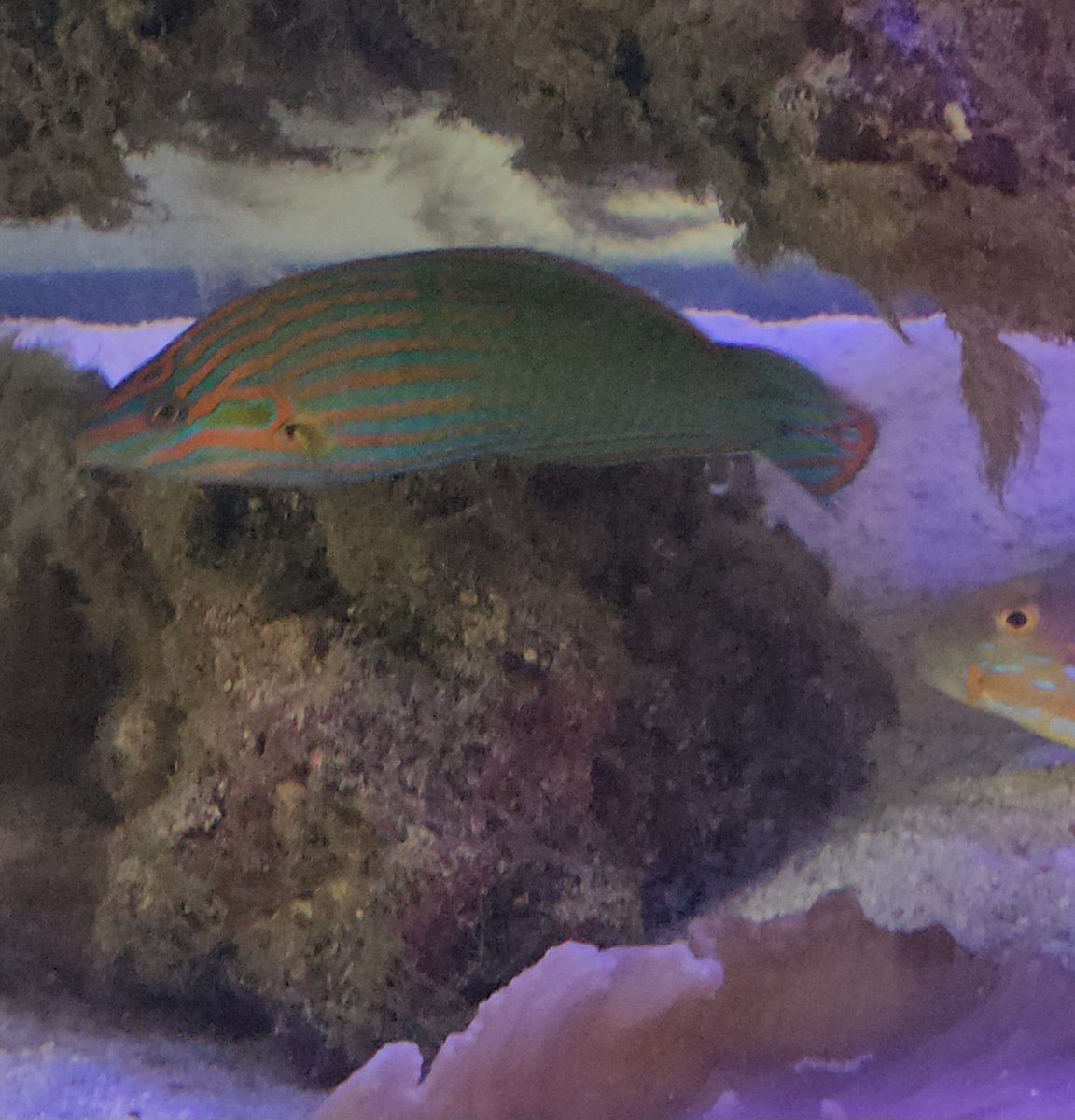
Oh my god, I cant believe I haven’t shared this yet. Look what i finally remembered to get a photo of earlier :)
Please ignore the bleaching coral - the bleaching is due to lack of light and only on the underside of the coral.
646DC578-78C2-4B8F-ACCC-CA66FAE7833B.jpeg
 
Oh my god, I cant believe I haven’t shared this yet. Look what i finally remembered to get a photo of earlier :)
Please ignore the bleaching coral - the bleaching is due to lack of light and only on the underside of the coral.
646DC578-78C2-4B8F-ACCC-CA66FAE7833B.jpeg
She is playing you can’t see me.
 
Oh my god, I cant believe I haven’t shared this yet. Look what i finally remembered to get a photo of earlier :)
Please ignore the bleaching coral - the bleaching is due to lack of light and only on the underside of the coral.
646DC578-78C2-4B8F-ACCC-CA66FAE7833B.jpeg

How does she do in the larger tank (is she in the 3' or 4') tank with the other wrasses? I've been contemplating moving mine to the 120.
 
How does she do in the larger tank (is she in the 3' or 4') tank with the other wrasses? I've been contemplating moving mine to the 120.
Mine does really well in a 110 but then mine is the bravest and boldest P. ataenia
IMG_2621.jpeg
 
How does she do in the larger tank (is she in the 3' or 4') tank with the other wrasses? I've been contemplating moving mine to the 120.
All three are in the 3’ tank however I guess some would say it’s not really ‘nano’ at that.
She actually does really well (well all three do). But I guess at the minute it’s not a high active tank. I have tried one adding it later down the line and unfortunately it passed due to stress (this is why I wanted a low activity tank but still have ‘a lot’ of fish).
 
Mine does really well in a 110 but then mine is the bravest and boldest P. ataenia
IMG_2621.jpeg
Yours is a stunner!
Mine aren’t quite so brave yet however they are still juveniles. And I mean. That’s pretty much half of the body seen in the photo I got, they’re tiny!
 
so...given recent events i have the fish itch...

i have the following to choose from. they will be shipped, but only from an hour away so no air travel:
- Katherines
- Naokoae
- Lubbocks (very small)
- radiant (i think this is a definite)

which ones will survive my orange back....
 
I assume you’re looking at the Indonesian Lubbocki for your 3’ tank? I can see a Cebu Lubbocki in your photos and I wouldn’t do this pairing in a 3’ tank - my two display nightly (sometimes even twice a day) and their displays can be more so like a Flasher’s display once they start growing.
Nope, the indo would be going in my 4' 75 gallon, or maybe even my empty 75 gallon if I ever get around to setting that up. I have 3 empty tanks waiting for me to get them going...
 
so...given recent events i have the fish itch...

i have the following to choose from. they will be shipped, but only from an hour away so no air travel:
- Katherines
- Naokoae
- Lubbocks (very small)
- radiant (i think this is a definite)

which ones will survive my orange back....
Well the radiant is a different genus and inhabits a different niche in the tank. Naoko and Lubbock's are much smaller but none are closely related to the orange back.

So for your question. Best to worst with the orange back I think:
  1. Radiant
  2. Katherines
  3. Naoko
  4. Lubbocks
 
I’m crushed.

Got this guy yesterday. Shipment took well less than 24 hours to get to my home. Box and bag in great condition. But, he was pretty stressed from the trip.

Salinity in his bag water was identical to my tank so I floated the bag to equalize temperature and then placed him in an acclimation box (with a pvc pipe for hiding) in my DT. He perked up a little, even swam a bit, but then slowly declined. Found him dead this morning :(
I'm so sorry, that's a gorgeous fish too! I'm really hard on myself when I lose fish as well. Literally just lost 4 new ones this week and still don't know what went wrong. (Technically they WERE sensitive fish... but still, it hurt). :downcast-face-with-sweat: Now I'm feeling pretty hesitant to try again, particularly because I couldn't determine what happened to them. I've only been in the reef hobby a year but this is the first time I've had something like that happen... I've never lost multiple fish like that even in the 30+ years I kept freshwater.
 
I would love to see photos of your Mel and help you sex it! Generally, males are much more green whilst females are more on the blue side with yellow/orange striping (I saw one stunning male melanurus and I would love one but my iridis probably wouldn’t).

Of course you can pick my brain out and feel free to ask questions! I love helping people (as I’m sure anyone does) and one thing I tend to tell others is;
Why have knowledge but never share it?

Male Wrasses only really care about males of the same or similar (often called ‘sister’) species. If we talk about a Melanurus then these may not like males of Halichoeres vroliki or Halichoeres chrysotaenia.

Adding other Halichoeres links to what I said above about the Melanurus, these guys don’t seem to care about males of other species that are totally different however females/juveniles are preferred for both our sake but also the fish’s liking. So adding something like Halichoeres iridis or Halichoeres leucoxanthus to an established Halichoeres melanurus shouldn’t be too much of an issue. Obviously with every introduction you have some sort of aggression however this is expected since it is forming a Hierarchy and showing who is the big boss of the tank and who is the big boss of the group of fish (in this case, the big boss of the wrasses).

This one is controversial however my best fish for invert eating is my iridis. Now, I say it’s controversial as some have bad luck with iridis and eating pests however others have good luck. Halichoeres chrysus and Halichoeres leucoxanthus are both good for pest hunting. I would personally go the route of Leucoxanthus as they’re in my opinion the nicer of those two sister species.

A Tamarin would work with a Melanurus however you will need to use an acclimation box as these are more sensitive than the Halichoeres. I don’t use acclimation boxes with any of my fish but if I had a brand new Anampses, I most likely would use an acclimation box. I know the way I do it is highly unrecommended however I have yet to fail introducing any fish without an acclimation box in my time in this hobby (10+ years).

Now, the Flasher and Fairy Wrasses are odd ones. I assume by ‘type’ you mean they will only display to others in their genus or the other genus (Cirrhilabrus/Paracheilinus). I had a flasher (unfortunately he decided to leg it when I added my newest fish) and although their name is literally ‘flasher wrasse’ mine rarely displayed. My lubbocki’s may as well be flasher wrasses because of how much they show off (it’s a daily occurrence). Cirrhilabrus species will display however they need a reason a lot of the time. This is why Paracheilinus can be a good pairing with Cirrhilabrus. Cirrhilabrus species display to other Cirrhilabrus species that are close in the hierarchy to show off whose boss IME. They also tend to display to other species with similar body shapes and patterns/colours to them, possibly due to them looking incredibly similar.
THANK YOU!!! This is exactly the information/explanation I was looking for. I really appreciate how willing you are to share your knowledge! :beaming-face-with-smiling-eyes: I think I saw one of Inappropriate Reefer's youtube videos where he brought home what he thought was a "yellow coris" (H. chrysus), but was actually H. leucoxanthus - and I was thinking, the one he got is actually a prettier fish in my opinion, lol! LA calls it a "yellow and purple wrasse" apparently. I had no idea what the common name was to even look for one.
Not sure I will end up with a tamarin as I just learned a big lesson with sensitive fish... lost 4 evansi anthias within a couple days of delivery, and I'm still pretty upset about it. I don't know the cause for sure but... I did catch my yellow tang following them around a few times which was stressing them out. She was trying to show all the new fish who's boss actually... except for the lawnmower blenny. One guess who the sole survivor is... :rolleyes:

I tried to get a current decent pic of my melanurus, but this was about as good as I could do - hopefully it's clear enough to tell? I swear he KNEW I was trying to get his picture, and kept zooming across the tank and then hiding under the rock, lol! I wish I could catch his dorsal fin on camera because it's absolutely stunning, he just doesn't flare it up hardly ever. I've also included a couple pics from the day I got him (last August), so you can see the vertical blue bars on his body are not as visible anymore. I saw a ReefChasers article that stated females would have an eye spot on the dorsal fin and base of the tail, and this one never has since I brought him home, so my guess (along with the description you gave of being more green in color) would be that he is in fact a HE. Regardless, he/she/it is one of the main fish that made me want to start a saltwater tank and I'm just in awe of the colors every time I see him doing his wrasse business around the tank, lol. Thoughts? (Oh and please excuse the cyano in the old pics and GHA in the current one... at least I beat the cyano, now just working on the algae, lol!):
melanurus.jpg

Current pic - bad lighting, sorry!
melanurus 1.jpg

The day I brought my dream fish home from the LFS (around 5 months ago)
melanurus 2.jpg

There's that gorgeous dorsal fin!
melanurus 3.jpg

Better side view of the vertical stripes that are now almost completely gone.

 
THANK YOU!!! This is exactly the information/explanation I was looking for. I really appreciate how willing you are to share your knowledge! :beaming-face-with-smiling-eyes: I think I saw one of Inappropriate Reefer's youtube videos where he brought home what he thought was a "yellow coris" (H. chrysus), but was actually H. leucoxanthus - and I was thinking, the one he got is actually a prettier fish in my opinion, lol! LA calls it a "yellow and purple wrasse" apparently. I had no idea what the common name was to even look for one.
Not sure I will end up with a tamarin as I just learned a big lesson with sensitive fish... lost 4 evansi anthias within a couple days of delivery, and I'm still pretty upset about it. I don't know the cause for sure but... I did catch my yellow tang following them around a few times which was stressing them out. She was trying to show all the new fish who's boss actually... except for the lawnmower blenny. One guess who the sole survivor is... :rolleyes:

I tried to get a current decent pic of my melanurus, but this was about as good as I could do - hopefully it's clear enough to tell? I swear he KNEW I was trying to get his picture, and kept zooming across the tank and then hiding under the rock, lol! I wish I could catch his dorsal fin on camera because it's absolutely stunning, he just doesn't flare it up hardly ever. I've also included a couple pics from the day I got him (last August), so you can see the vertical blue bars on his body are not as visible anymore. I saw a ReefChasers article that stated females would have an eye spot on the dorsal fin and base of the tail, and this one never has since I brought him home, so my guess (along with the description you gave of being more green in color) would be that he is in fact a HE. Regardless, he/she/it is one of the main fish that made me want to start a saltwater tank and I'm just in awe of the colors every time I see him doing his wrasse business around the tank, lol. Thoughts? (Oh and please excuse the cyano in the old pics and GHA in the current one... at least I beat the cyano, now just working on the algae, lol!):
melanurus.jpg

Current pic - bad lighting, sorry!
melanurus 1.jpg

The day I brought my dream fish home from the LFS (around 5 months ago)
melanurus 2.jpg

There's that gorgeous dorsal fin!
melanurus 3.jpg

Better side view of the vertical stripes that are now almost completely gone.

Your melanurus is definitely a male. A very nice one.
 
Your melanurus is definitely a male. A very nice one.
Awesome, thank you! I can't wait to get some better pics of him as he has grown quite a bit since I've had him. I couldn't believe my luck when I found him at my LFS (wasn't planning on getting a fish that day as I was frustratedly going through the whole cyano-battle at the time, but I couldn't pass him up)! Now I'm curious, is there a way to know roughly how old he may have been when I got him (based on the pics)? I'd also be interested in how long people here have kept them. You see general lifespans listed online but I'd prefer to know from experience. I hope he's around many years!
 
Awesome, thank you! I can't wait to get some better pics of him as he has grown quite a bit since I've had him. I couldn't believe my luck when I found him at my LFS (wasn't planning on getting a fish that day as I was frustratedly going through the whole cyano-battle at the time, but I couldn't pass him up)! Now I'm curious, is there a way to know roughly how old he may have been when I got him (based on the pics)? I'd also be interested in how long people here have kept them. You see general lifespans listed online but I'd prefer to know from experience. I hope he's around many years!
He was already a fully developed male when you got him so he’s probably over 2 years but beyond that is just a guess. He looks like he’s in his prime so I’m sure you’ll be able to enjoy him for many years.
 
Awesome, thank you! I can't wait to get some better pics of him as he has grown quite a bit since I've had him. I couldn't believe my luck when I found him at my LFS (wasn't planning on getting a fish that day as I was frustratedly going through the whole cyano-battle at the time, but I couldn't pass him up)! Now I'm curious, is there a way to know roughly how old he may have been when I got him (based on the pics)? I'd also be interested in how long people here have kept them. You see general lifespans listed online but I'd prefer to know from experience. I hope he's around many years!
From males, usually their lifespan is 4-5 years in captivity however this is more often for the Paracheilinus and Cirrhilabrus genera. Halichoeres wrasses can live for 10+ years IME, the melanurus is a larger species so it wouldn’t surprise me if they can get to that 7-10 year range.

As yours is already male (and looked to be a mature male when you got him), I would agree with Salty in him being Atleast 2 years so I would say you’ll have around 6-8 years with him.
 
Well the radiant is a different genus and inhabits a different niche in the tank. Naoko and Lubbock's are much smaller but none are closely related to the orange back.

So for your question. Best to worst with the orange back I think:
  1. Radiant
  2. Katherines
  3. Naoko
  4. Lubbocks
thanks, thats what i was thinking based off the chart as well. im just paranoid about possible aggression now, katherines and naoko are that in between range color lol...
 

TOP 10 Trending Threads

ARE YOU READY TO CONFESS TO CRAZIEST, DUMBEST, FUNNIEST THING YOU’VE EVER DONE IN REEFING?

  • Yeah, I'll confess! (Share your story in the comments!)

    Votes: 33 57.9%
  • Nah, I'll keep mine a secret...(Don't be like that, share with the class!)

    Votes: 24 42.1%
Back
Top
Home
Post thread…
Market
What's new