


What is salt creep?
Salt creep is what you have occur around the top of your aquarium. Basically it is salt from the water that has built up on the top brace or trim, chords, pipes filters etc of your tank due to excess splashing. The water droplets from splashing evaporate leaving behind the salt crystals from the water. When salt water evaporates it the fresh water separates from the salt leaving the salt behind.
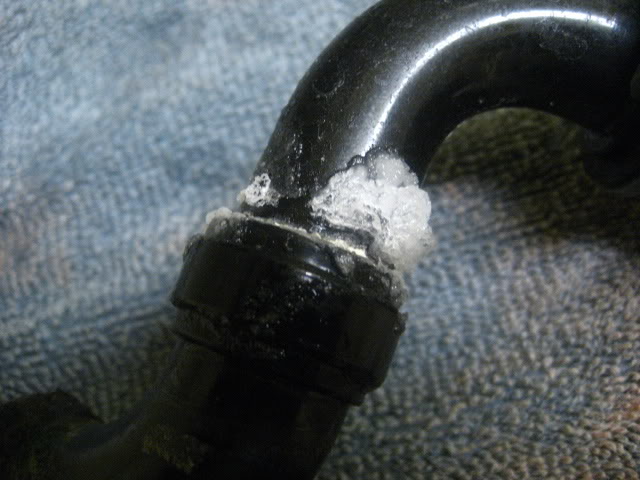
The white substance on this tube is salt creep
Salt creep is a common problem for saltwater aquarists. Because sodium chloride is a corrosive substance, it can affect anything it touches IE "lights, hinges on doors, metal hose clamps, etc". The amount of damage depends on how long an item is exposed to salt, and based on what type of material it comes in contact with, its effects are seen in many ways.
To slow down the effects of salt creep, the best way to deal with it is to regularly keep it cleaned up, and take steps to prevent unnecessary damage to anything near the aquarium.
The good news is that when cleaning up salt creep it usually just easily wipes off, unless it is on a light that has been cooking it on. Then you can use a towel with some vinegar on it to help break it down and clean it off. Just be sure that the lighting component is off and has cooled down. Light burns are nasty.
Believe me I know.

The bad news is if you are wiping the salt creep away from the top of the tank and some falls into the tank and on your coral it can burn the flesh of the coral and possibly kill it. Extreme caution is to be taken when there is a possibility of this happening.
Some easy steps to take to avoid salt creep damage are:
Keep the tank, hood, stand, light fixture and other such items clean by wiping them down with a cotton rag or wash cloth rinsed in freshwater. For white water spots that can develop on plastic items that are outside of the aquarium, a touch of vinegar applied to the cloth may help to reduce their appearance.
Keep the water level up to or just above the tank's trim line to help reduce etching of the aquarium material. Plus doing this will make it so you can't look under the hood and see the lights.
Remove and rinse off pieces of equipment that can be cleaned in freshwater regularly.
Direct the flow of outlets that return water to the aquarium, as well as equipment that is used to move water inside the aquarium in a way that reduces excess splashing.
You can protect nearby walls by attaching a sheet of clear acrylic to act as a splash board.
Always place towels on the floor around the bottom of the aquarium during all maintenance procedures.
Position all electrical equipment out of range of splash zones if possible.
Avoid using bubble wands or air stones, as these only contribute to an increase of salt creep problems. They also cause micro bubbles in the aquarium which are very bad for coral health.
Unplug and wipe down electrical equipment power cords, plugs, and outlets.
Salt creep is what you have occur around the top of your aquarium. Basically it is salt from the water that has built up on the top brace or trim, chords, pipes filters etc of your tank due to excess splashing. The water droplets from splashing evaporate leaving behind the salt crystals from the water. When salt water evaporates it the fresh water separates from the salt leaving the salt behind.
The white substance on this tube is salt creep
Salt creep is a common problem for saltwater aquarists. Because sodium chloride is a corrosive substance, it can affect anything it touches IE "lights, hinges on doors, metal hose clamps, etc". The amount of damage depends on how long an item is exposed to salt, and based on what type of material it comes in contact with, its effects are seen in many ways.
To slow down the effects of salt creep, the best way to deal with it is to regularly keep it cleaned up, and take steps to prevent unnecessary damage to anything near the aquarium.
The good news is that when cleaning up salt creep it usually just easily wipes off, unless it is on a light that has been cooking it on. Then you can use a towel with some vinegar on it to help break it down and clean it off. Just be sure that the lighting component is off and has cooled down. Light burns are nasty.
Believe me I know.
The bad news is if you are wiping the salt creep away from the top of the tank and some falls into the tank and on your coral it can burn the flesh of the coral and possibly kill it. Extreme caution is to be taken when there is a possibility of this happening.
Some easy steps to take to avoid salt creep damage are:
Keep the tank, hood, stand, light fixture and other such items clean by wiping them down with a cotton rag or wash cloth rinsed in freshwater. For white water spots that can develop on plastic items that are outside of the aquarium, a touch of vinegar applied to the cloth may help to reduce their appearance.
Keep the water level up to or just above the tank's trim line to help reduce etching of the aquarium material. Plus doing this will make it so you can't look under the hood and see the lights.
Remove and rinse off pieces of equipment that can be cleaned in freshwater regularly.
Direct the flow of outlets that return water to the aquarium, as well as equipment that is used to move water inside the aquarium in a way that reduces excess splashing.
You can protect nearby walls by attaching a sheet of clear acrylic to act as a splash board.
Always place towels on the floor around the bottom of the aquarium during all maintenance procedures.
Position all electrical equipment out of range of splash zones if possible.
Avoid using bubble wands or air stones, as these only contribute to an increase of salt creep problems. They also cause micro bubbles in the aquarium which are very bad for coral health.
Unplug and wipe down electrical equipment power cords, plugs, and outlets.