What NOT to do...

aquatic26

Community Member
View Badges
Joined
Aug 9, 2023
Messages
80
Reaction score
47
Location
USA
Rating - 0%
0   0   0
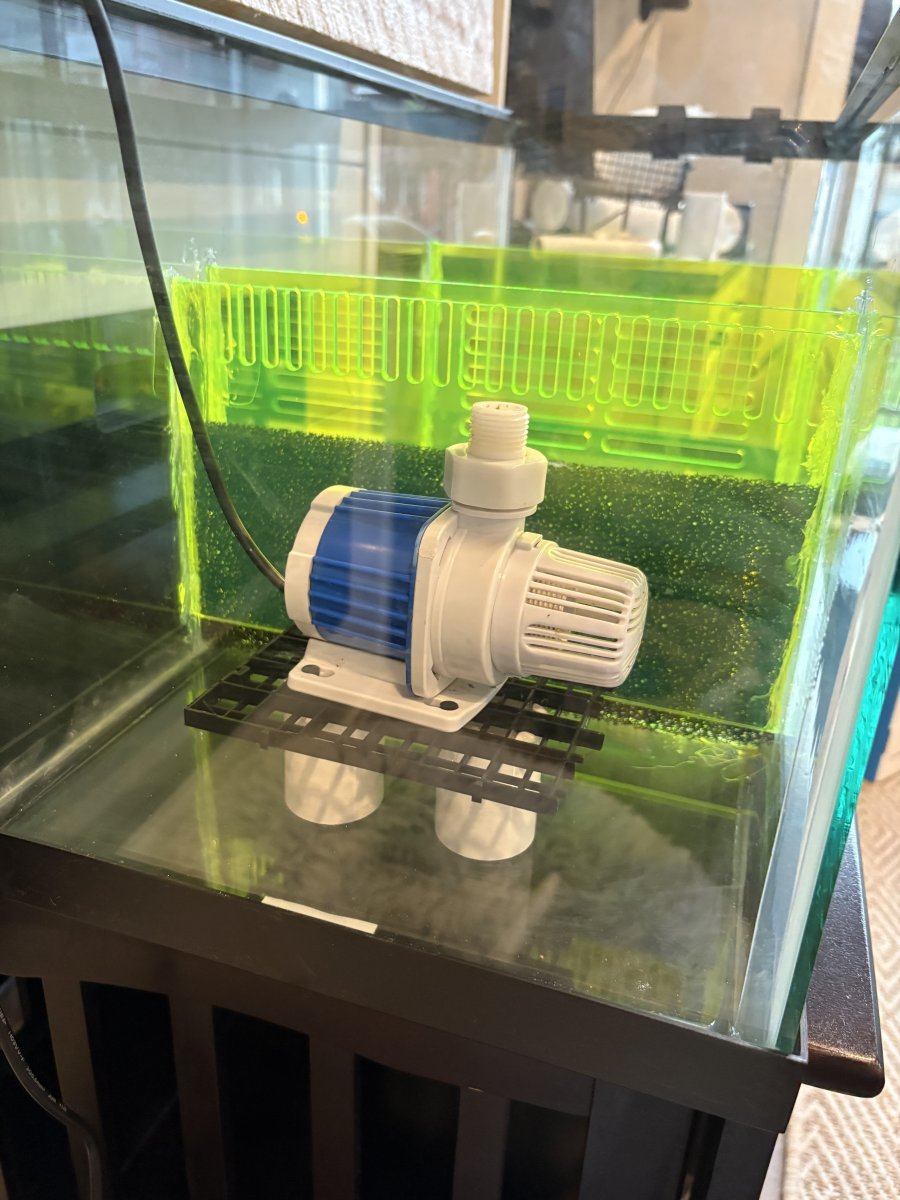
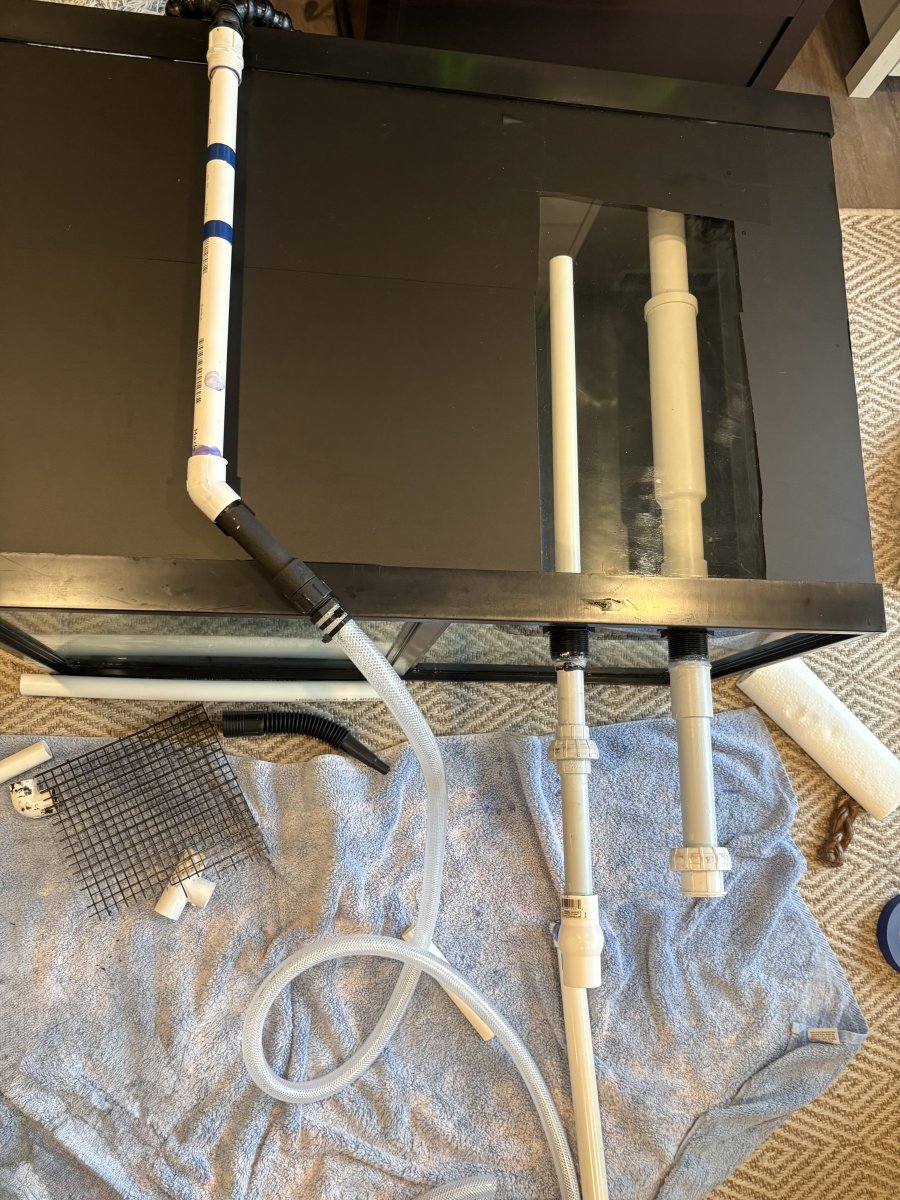
Been reefing for a couple years, always been space limited to small nano tanks. Super excited to be upgrading to a 65g reef ready (Aqueon). It's my first time having a sump or doing any plumbing and WOW it is kicking my butt... this may be the ugliest most Mr. Potato-head-looking build ever, but it will be hidden beneath the stand. The back of the tank I wrapped in car vinyl wrap, but left a "window" to see what my pipes look like from behind while setting up (hidden by black tower in the front). The tank comes with tubing to have it function with 1 durso drain and 1 return. I'm reconfiguring it to a herbie system. The tank's bottom glass is drilled with two 1.5" bulkheads that reduce to 3/4" and 1", respectively. Making the 3/4" my primary siphon and the 1" the emergency. Running the return up and over the back glass. The sump is a 20gL and I siliconed in (terribly) some baffles I got off Amazon. Made a little stand for the return pump to sit on so it can't overflow my tank as a redundancy measure. My return line snakes up higher than my drains, so I am hoping that is the redundancy I need? The locline is going to be around water surface height, around the same height, roughly, as the emergency drain. Was going to do a check valve in the return line, but read too many posts that scared me out of that.
IMG_3256.jpeg

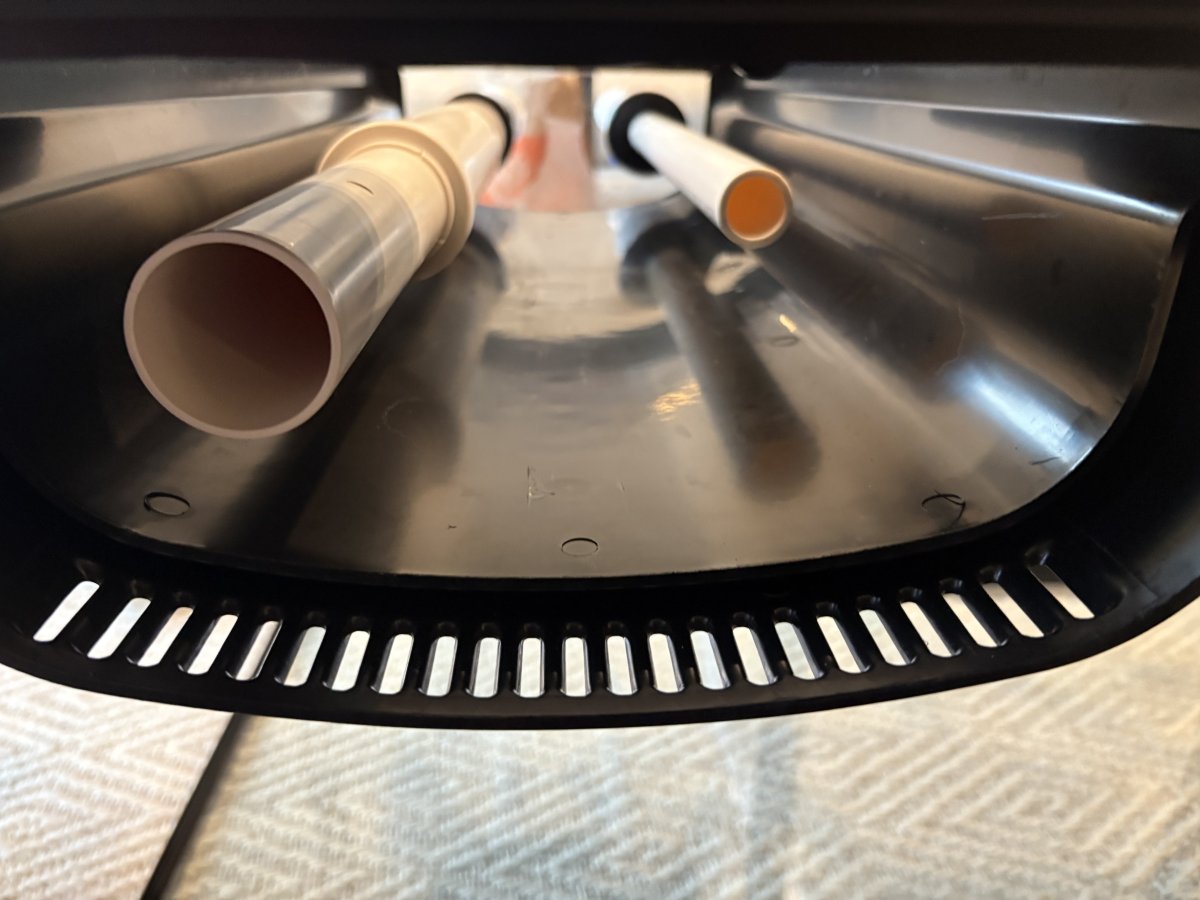
The emergency drain on the right retained the adjustable height tube from Aqueon, so I can adjust the water surface height easily, but it's set right now 1/2" below the weir teeth. The primary siphon is 6" beneath the upper height of the emergency drain. Ball valve on the primary drain, too. I know, I know, gate valves are better. This ball valve will make do for now. The remainder of the hard tubing will be glued in tomorrow once the tank is up on it's stand.
IMG_3257.jpeg

IMG_3255.jpeg


The stand comes tomorrow, then I'll get the tank set up with the sump underneath and run a leak test. All the hard plumbing is primed and cemented with Oatey's. Ended up silicon-ing the bulkheads on the dry side to the PVC for additional water seal. It's not going to win a single prize in terms of aesthetics or "best practices", but it may win some for the most materials used incorrectly, redone, reconfigured, and rejiggered. Have silicone, cement, glue, and PVC dust stuck all over me, a sore back, and purple stained fingers from the Oatey's primer. But, at the end of the day, I *think* it is going to be water tight and has some measure of redundancy built in. Please, if anyone sees something dramatically wrong, don't tell me. Just let me drown in a tidal wave of despair and salt water 🤣

 
OP
OP
A

aquatic26

Community Member
View Badges
Joined
Aug 9, 2023
Messages
80
Reaction score
47
Location
USA
Rating - 0%
0   0   0
You could add a check valve as an additional safety measure…but obviously don’t rely on it as the only safety mechanism.

Hopefully everything checks out with the leak test.
I have one and I was debating doing that, but I read so many threads on here of people saying not to do check valves because they clog and fail often and the result is worse than just elevating the sump in the chamber so it only pumps a gallon or two before running dry. I'd rather kill my pump than flood my apartment. Have you had any issues running a check valve?
 

Asm481

Active Member
View Badges
Joined
Jul 23, 2022
Messages
289
Reaction score
269
Location
Kenosha
Rating - 0%
0   0   0
I hope you didn't glue the pvc inside the overflow. You're going to want to adjust your herbie once it is running by adding or subtracting pipe to the siphon size. Also periodic cleaning it is nice to pull that pvc out. On your return line you can drop the ends of the locking IF you drill siphon breaks at just below running water level.
 

Vivid Creative Aquatics

Upgrade Your Flow!
View Badges
Joined
Oct 12, 2017
Messages
1,720
Reaction score
2,302
Location
Phoenix, AZ
Rating - 0%
0   0   0
Personally, I would probably ditch the check valve – at least as a means of holding back a potential flood from the display tank.

If you take care of them, they don't always fail, but when they do fail, it's never a good time.

The easiest way to prevent an overflow is just do a little bit of math. You need to determine how low your return line can be in your display tank without Back siphoning too much to the sump.

To figure this out, you just need to know two things:

1) how much water per inch your display tank holds
2) versus how much reserve space you have in the sump.

Math is pretty easy:
L * W * 1 / 231 = gallons per inch

Assuming your tank dimension are 36” x 18” x 24”

gallons per inch in your display tank
36 * 18 * 1 / 231 = 2.8 gallons per inch

Then estimate the gallons of reserve space you have in your sump. To do this, use the same formula above except you're going to replace the 1 with distance from the top of the sump to the average water height.

I’ll make a few assumptions: the 20L is a 30”x12”x12” tank

The average water height can usually be conservatively estimated to be is usually 2 to 3 inches above your lowest baffle. In this case let’s assume that the distance is 4 inches.

Gallons of Reserve space
30 * 12 * 4 / 231 = 6.23 gallons

Finally, Calculate your maximum depth for your return line.

6.23 / 2.8 6.23 = 2.225 inches

That gives you a good place to start in terms of how deep you can push the return line without causing an overflow - especially if you plan on adding a Random Flow Generator nozzle to your tank, which would be super easy since you already have Loc-Line ;-)

Obviously you'll want to check this in person once you have everything up and running and make adjustments as needed, but at least you have a place to start. And you won need to worry about a check valve failing.
 
OP
OP
A

aquatic26

Community Member
View Badges
Joined
Aug 9, 2023
Messages
80
Reaction score
47
Location
USA
Rating - 0%
0   0   0
I hope you didn't glue the pvc inside the overflow. You're going to want to adjust your herbie once it is running by adding or subtracting pipe to the siphon size. Also periodic cleaning it is nice to pull that pvc out. On your return line you can drop the ends of the locking IF you drill siphon breaks at just below running water level.
Nope, wet side is just pressed into the bulkheads for easy removal.
 
OP
OP
A

aquatic26

Community Member
View Badges
Joined
Aug 9, 2023
Messages
80
Reaction score
47
Location
USA
Rating - 0%
0   0   0
Personally, I would probably ditch the check valve – at least as a means of holding back a potential flood from the display tank.

If you take care of them, they don't always fail, but when they do fail, it's never a good time.

The easiest way to prevent an overflow is just do a little bit of math. You need to determine how low your return line can be in your display tank without Back siphoning too much to the sump.

To figure this out, you just need to know two things:

1) how much water per inch your display tank holds
2) versus how much reserve space you have in the sump.

Math is pretty easy:
L * W * 1 / 231 = gallons per inch

Assuming your tank dimension are 36” x 18” x 24”

gallons per inch in your display tank
36 * 18 * 1 / 231 = 2.8 gallons per inch

Then estimate the gallons of reserve space you have in your sump. To do this, use the same formula above except you're going to replace the 1 with distance from the top of the sump to the average water height.

I’ll make a few assumptions: the 20L is a 30”x12”x12” tank

The average water height can usually be conservatively estimated to be is usually 2 to 3 inches above your lowest baffle. In this case let’s assume that the distance is 4 inches.

Gallons of Reserve space
30 * 12 * 4 / 231 = 6.23 gallons

Finally, Calculate your maximum depth for your return line.

6.23 / 2.8 6.23 = 2.225 inches

That gives you a good place to start in terms of how deep you can push the return line without causing an overflow - especially if you plan on adding a Random Flow Generator nozzle to your tank, which would be super easy since you already have Loc-Line ;-)

Obviously you'll want to check this in person once you have everything up and running and make adjustments as needed, but at least you have a place to start. And you won need to worry about a check valve failing.
Wow. Thank you SO much. This was above and beyond, I really appreciate it!
 

Catawba_Valley_Reef

Well-Known Member
View Badges
Joined
May 26, 2025
Messages
854
Reaction score
2,207
Location
VA
Rating - 0%
0   0   0
I have one and I was debating doing that, but I read so many threads on here of people saying not to do check valves because they clog and fail often and the result is worse than just elevating the sump in the chamber so it only pumps a gallon or two before running dry. I'd rather kill my pump than flood my apartment. Have you had any issues running a check valve?
I have them installed on my returns, but simply as a back up to the back up. I have my locline returns up out of the water so minimal back siphoning occurs when power is lost.

I lose power more than I’d like, so I’ve tested quite a few times with no issues.

The check valves do get dirty quickly and need to be cleaned. I would never rely on them as the only thing keeping my basement from flooding.
 
OP
OP
A

aquatic26

Community Member
View Badges
Joined
Aug 9, 2023
Messages
80
Reaction score
47
Location
USA
Rating - 0%
0   0   0
I have them installed on my returns, but simply as a back up to the back up. I have my locline returns up out of the water so minimal back siphoning occurs when power is lost.

I lose power more than I’d like, so I’ve tested quite a few times with no issues.

The check valves do get dirty quickly and need to be cleaned. I would never rely on them as the only thing keeping my basement from flooding.
Would you mind posting a photo of your locline and where they sit in relation to water surface level?
 
OP
OP
A

aquatic26

Community Member
View Badges
Joined
Aug 9, 2023
Messages
80
Reaction score
47
Location
USA
Rating - 0%
0   0   0
Update: making water, rinsing new sand. Worried that the return pump I was going to use, which was an IM Mighty Jet 538gph, is going to be too weak, so I ordered a new DC return pump off amazon rated for 1300gph and can dial it back as needed.

Who is going to break it to him that his condo is getting renovated? 🤣
493092104_10161302656173036_3639837411875767277_n.jpg
 

Catawba_Valley_Reef

Well-Known Member
View Badges
Joined
May 26, 2025
Messages
854
Reaction score
2,207
Location
VA
Rating - 0%
0   0   0
Would you mind posting a photo of your locline and where they sit in relation to water surface level?
IMG_2801.jpeg

IMG_2800.jpeg


The bottom part of the nozzle is maybe 1/4” below the water line. Also, I have it bent slightly upward and then the nozzle pointing down to keep water from going backwards after a power outage.

If you zoom in on the photo below you can see I have 4 returns and all of the locline is going up to the water surface.

IMG_2793.jpeg
 
OP
OP
A

aquatic26

Community Member
View Badges
Joined
Aug 9, 2023
Messages
80
Reaction score
47
Location
USA
Rating - 0%
0   0   0
The stand I purchased from a local reefer works awesome, sump is underneath and ready to go. I picked up a Bubble Magus Curve 5 used and half off from my LFS. Currently filling with water... We all know how slow that goes 🫠
IMG_3264.jpeg

IMG_3270.jpeg

IMG_3268.jpeg


I purchased a Nicrew Gen2 HyperReef 200W light hoping one would be sufficient for the footprint of my tank. While I think it probably would be from a PAR perspective, the mounting arm won't mount over or around the center tank brace (dumb eurobrace tanks). Probably should have thought of that before, but I've only had the usual IM, Waterbox, rimless style tanks, never anything braced. For now I have it mounted just off center and have another identical light coming tomorrow. Two 200W HyperReefs will definitely be overkill, but I really don't like the look of two mis-matched lights if I opted for the 150W for the second light and I figure more power I don't need is better than not having enough PAR.

IMG_3273.jpeg
 
OP
OP
A

aquatic26

Community Member
View Badges
Joined
Aug 9, 2023
Messages
80
Reaction score
47
Location
USA
Rating - 0%
0   0   0
Tank is finally up and running. My return had a leak, so I opted to do the flexible vinyl tubing the entire way up. Took some jiggering to match the return pump speed with the ball valve on the drain, but now it's running completely silently. How do you know how much flow through the sump? There is no discernible water movement through the sump, I.e. no "flow" or turbulent movement, but obviously water is moving through it. I am drowning in cords, so any and all recommendations on cord management, especially photos, is welcome!
 

Gumbies R Us

God, Bouldering, and Reefing
View Badges
Joined
Nov 10, 2022
Messages
28,984
Reaction score
51,386
Location
North Georgia
Rating - 0%
0   0   0
Tank is finally up and running. My return had a leak, so I opted to do the flexible vinyl tubing the entire way up. Took some jiggering to match the return pump speed with the ball valve on the drain, but now it's running completely silently. How do you know how much flow through the sump? There is no discernible water movement through the sump, I.e. no "flow" or turbulent movement, but obviously water is moving through it. I am drowning in cords, so any and all recommendations on cord management, especially photos, is welcome!
Use some of those Velcro zip ties that will help with cord management!
 

Catawba_Valley_Reef

Well-Known Member
View Badges
Joined
May 26, 2025
Messages
854
Reaction score
2,207
Location
VA
Rating - 0%
0   0   0
Tank is finally up and running. My return had a leak, so I opted to do the flexible vinyl tubing the entire way up. Took some jiggering to match the return pump speed with the ball valve on the drain, but now it's running completely silently. How do you know how much flow through the sump? There is no discernible water movement through the sump, I.e. no "flow" or turbulent movement, but obviously water is moving through it. I am drowning in cords, so any and all recommendations on cord management, especially photos, is welcome!
You don’t really want a ton of flow through the sump. You want your skimmer, reactors, and any other equipment to have enough contact time. I don’t really measure flow through the sump. Just set your drain so it’s silent. Most of your flow should be coming from powerheads in the tank and not your return pump.

One note on cord management…don’t make it so good that it becomes a pain to remove any cords when it comes time to clean pumps, etc. A buddy put them in cable throughs one time and quickly realized how hard it was to remove anything.
 
OP
OP
A

aquatic26

Community Member
View Badges
Joined
Aug 9, 2023
Messages
80
Reaction score
47
Location
USA
Rating - 0%
0   0   0
All good points, thank you! Everything seems pretty happy!
Salinity: 1.025
Alk: 10.1
Ca+: 450
Mag: 1300
Nitrates: 2
Phos: 0.02
Temp: 78
Lights: Two Nicrew Gen2 HyperReef 200W, daisy chained together with Nicrew controller. Currently set at blues 30%, violet 25%, W, G , R all below 10%. Will slowly increase as corals adjust.
IMG_3303.jpeg
 

CBonito

2500 Club Member
View Badges
Joined
Aug 20, 2023
Messages
2,855
Reaction score
8,126
Location
Detroit Area
Rating - 0%
0   0   0
Personally, I would probably ditch the check valve – at least as a means of holding back a potential flood from the display tank.

If you take care of them, they don't always fail, but when they do fail, it's never a good time.

The easiest way to prevent an overflow is just do a little bit of math. You need to determine how low your return line can be in your display tank without Back siphoning too much to the sump.

To figure this out, you just need to know two things:

1) how much water per inch your display tank holds
2) versus how much reserve space you have in the sump.

Math is pretty easy:
L * W * 1 / 231 = gallons per inch

Assuming your tank dimension are 36” x 18” x 24”

gallons per inch in your display tank
36 * 18 * 1 / 231 = 2.8 gallons per inch

Then estimate the gallons of reserve space you have in your sump. To do this, use the same formula above except you're going to replace the 1 with distance from the top of the sump to the average water height.

I’ll make a few assumptions: the 20L is a 30”x12”x12” tank

The average water height can usually be conservatively estimated to be is usually 2 to 3 inches above your lowest baffle. In this case let’s assume that the distance is 4 inches.

Gallons of Reserve space
30 * 12 * 4 / 231 = 6.23 gallons

Finally, Calculate your maximum depth for your return line.

6.23 / 2.8 6.23 = 2.225 inches

That gives you a good place to start in terms of how deep you can push the return line without causing an overflow - especially if you plan on adding a Random Flow Generator nozzle to your tank, which would be super easy since you already have Loc-Line ;-)

Obviously you'll want to check this in person once you have everything up and running and make adjustments as needed, but at least you have a place to start. And you won need to worry about a check valve failing.
I still have mine in my tank! 👍
 

TOP 10 Trending Threads

WHAT AMOUNT OF LIVE ROCK AND SAND SHOULD BE PRIORITIZED FOR OPTIMAL BIODIVERSITY/FILTRATION?

  • 100% live rock + bagged sand

    Votes: 38 27.3%
  • 100% dry rock + 100% live sand

    Votes: 47 33.8%
  • 50/50 live/dry rock, 50/50 live/bagged sand

    Votes: 30 21.6%
  • 75% live rock, 25% live sand

    Votes: 14 10.1%
  • 25% live rock, 75% live sand

    Votes: 10 7.2%
Back
Top