Why red in my LED lights?

saltyfilmfolks

Lights! Camera! Reef!
View Badges

Joined
Feb 25, 2014
Messages
28,739
Reaction score
40,625
Location
California
Rating - 0%
0   0   0
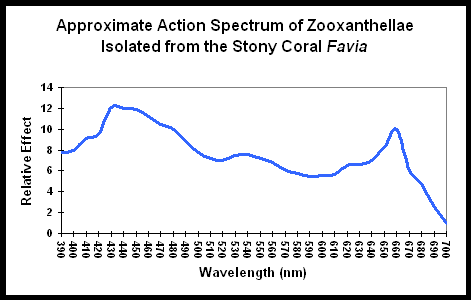
Thanks for posting that article. I read it kind of quickly yesterday and I felt like I might have missed something so I took another look. Reading it again I noticed that the "Action Spectrum" for zooxanthellae includes red, but the article goes on to say that the other spectrums are able to support it as well.

I wanted more information so I followed up with one of the references.

  1. Kinzie, R.A. and T. Hunter, 1987. Effect of light quality on photosynthesis of the reef coral Montipora verrucosa. Mar. Biol., 94:95-109.
The study was interesting. There are some design factors to be considered when viewing the results. Specifically the method used to quantify coral growth and the temperature control of the coral growth tanks. However the findings were that coral (as well as the zooxanthellae) grew just fine in the control group that was restricted to light in the 370-550nm range. If I am reading the article correctly, then coral without any of the red (or even orange) spectrum actually out preformed growth of other groups. (See page 242)

I have been out of the research loop for some time so there may be some obvious thing I have overlooked. I would appreciate any feedback.

https://eurekamag.com/pdf/005/005311959.pdf
You’re welcome. Not coincidentally, led development has tracked this progress in design.
Thus, now most all of them have red now.

 
OP
OP
w2inc

w2inc

Active Member
View Badges
Joined
Aug 30, 2017
Messages
411
Reaction score
366
Location
San Diego
Rating - 0%
0   0   0
You’re welcome. Not coincidentally, led development has tracked this progress in design.
Thus, now most all of them have red now.
Thanks for the quick response. However, it looks like the Advanced Aquarist article say that you don't need red and that it is just one of the many wavelengths in the action spectrum? Then the study by "Kinzie and Hunter" that was referenced says coral grew fine without red, so what am I missing?

Here is the part of the advanced Aquarist article that throws me off a little:

image_preview

Figure 1. An "Action Spectrum" for zooxanthellae. See text. After Muscatine, 1980.

"To believe that blue (430-480 nm) and red (600- 700 nm) wavelengths are required is only partially true. As Figure 1 demonstrates, a wide range of wavelengths are absorbed by chlorophylls A and C2; however, peridinin and perhaps other photopigments, effectively harvest light energy outside of the range normally associated with photosynthesis."

Maybe you could clarify it for me. Thanks again for the quick response.
 

oreo54

5000 Club Member
View Badges
Joined
Sep 18, 2017
Messages
6,877
Reaction score
4,081
Rating - 0%
0   0   0
Short answer:
Ancillary pigments can capture wavelengths of light that chlorophyll "misses" or i inefficient in.
This captured energy is transferred to the photosynthesis train thus acting like chlorophyll..
peridinin (not shown below) is one of these..
onephotosystem.gif


per.JPG
 
OP
OP
w2inc

w2inc

Active Member
View Badges
Joined
Aug 30, 2017
Messages
411
Reaction score
366
Location
San Diego
Rating - 0%
0   0   0
Short answer:
Ancillary pigments can capture wavelengths of light that chlorophyll "misses" or i inefficient in.
This captured energy is transferred to the photosynthesis train thus acting like chlorophyll..
peridinin (not shown below) is one of these..
onephotosystem.gif


per.JPG
Thanks, that article makes more sense now, but as far as I know Peridinin doesn't respond to red light. Here is some info I was just reading about it.

Spectral Reflectance of Palauan Reef-Building Coral with Different Symbionts in Response to
Elevated Temperature. (Page 13 about 1/2 way down)

"Peridinin, a diagnostic pigment for many dinoflagellates [12] has an absorption maximum at 475 nm that creates an upward slope in reflectance between 500 and 550 nm [24], which is evident in our measurements though partially masked in Inshore C. serailia (Figure 4) by a large fluorescence feature. The concentrations and identities of symbiont pigments in this system will be the subject of forthcoming research."

Do you know of something else that needs 600nm and higher. I am still wondering if red is needed, or if it is just ok to have?
 

oreo54

5000 Club Member
View Badges
Joined
Sep 18, 2017
Messages
6,877
Reaction score
4,081
Rating - 0%
0   0   0
No but ch a and c do...........

"Needed" is a loaded term.

There are functions that are not photosynthesis and there is "look" as well..
Actually most LED's could use more low blue or blue/green or green if one wanted to "hit" peridine

Let's use some "inferences" about light effects.
Many say max. growth can be obtained w/ 6500K MH's..and I have little doubt about that.
6500K MH's are pretty rich in all the spectrum including red..
Why would they be better than say a 20,000k or 15,000K MH?

There is also growth vs look.....
AFAICT most of the negatives of red light were w/ VERY high quantities or very high ratios of red to other..as I remember them. but could be wrong.

Current 'hypothesis" have to do w/ IR (very low wavelength red) and effects on corals..mostly positive.. so there is that..
 

TOP 10 Trending Threads

WHAT AMOUNT OF LIVE ROCK AND SAND SHOULD BE PRIORITIZED FOR OPTIMAL BIODIVERSITY/FILTRATION?

  • 100% live rock + bagged sand

    Votes: 37 27.4%
  • 100% dry rock + 100% live sand

    Votes: 46 34.1%
  • 50/50 live/dry rock, 50/50 live/bagged sand

    Votes: 30 22.2%
  • 75% live rock, 25% live sand

    Votes: 12 8.9%
  • 25% live rock, 75% live sand

    Votes: 10 7.4%
Back
Top