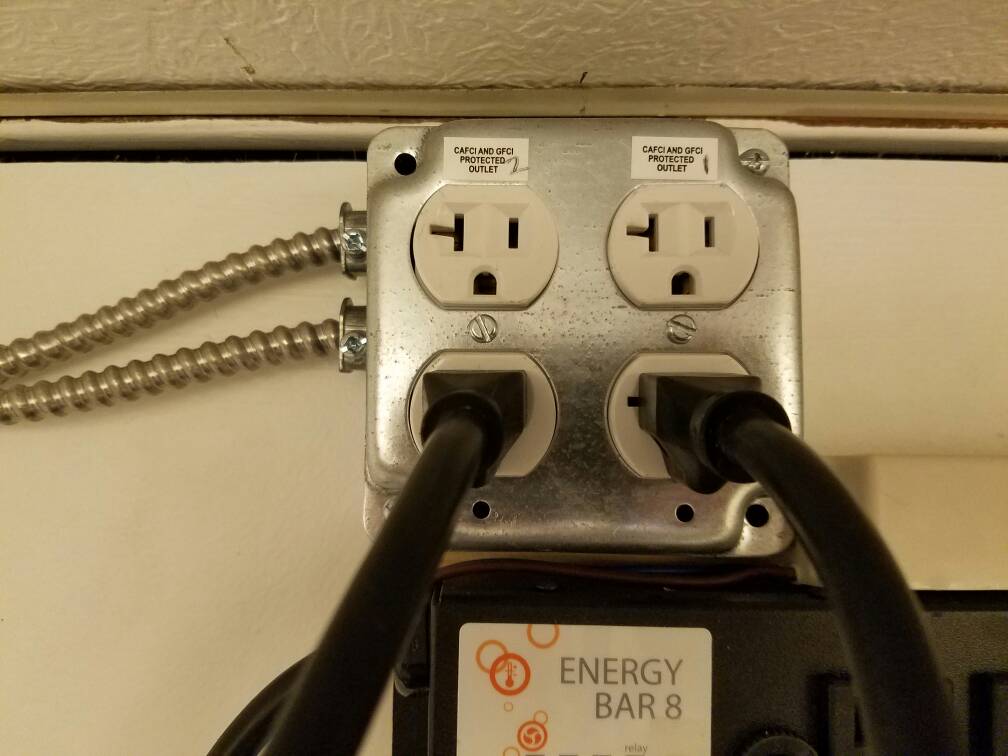
Wiring for Reef Tank

BoB_25

Community Member
View Badges
Joined
Apr 1, 2016
Messages
48
Reaction score
20
Location
Nebraska
Rating - 0%
0   0   0
****FYI, IF THIS IS THE WRONG SECTION PLEASE MOVE.****

So I just finished studding out my basement and getting ready for electrical.

I have the spot picked out where I placing the aquarium. and need wiring advice.

Nothing is purchased for the tank yet but my belief is I need at least 11 power outlets. My plan is 120 (48"X24"X24") or 150XH (48"X24"X30") gallon tank.

Number of plugs I believe I will have:
Heater - 1 (or should I have 2)???
Return pump - 1
2 vortex - 2
3 radion lights - 3
1 refugium light - 1
Skimmer pump - 1
GFO and Carbon pump - 1 ( might not use a pump, might use plumbing from my return)
ATO - 1 (Never used a ATO so don't know how many power supplies there are)

What am I missing?

I will eventually get a tank controller.

So how many outlets should I do?

I was thinking 2-4 outlets with a nice GFI power strip on a 20 AMP breaker.

Or does someone with better experience then me know something better they would want to share?

FYI My cousin is a certified electrician in my area and he is wiring my basement and is going of my recommendation I receive from this forum. Power is not my thing...I just know not to touch it unless the breaker is turned off.

V/R

BoB

 

abecker

Well-Known Member
View Badges
Joined
Aug 14, 2015
Messages
520
Reaction score
188
Location
Charlotte, NC
Rating - 0%
0   0   0
4 outlets gives you good flexibility for plugging items in, and having multiple surge protectors depending on which side of the tank you want the items plugged in. Also, when you get the aquarium controller you will probably end up plugging in the heaters, skimmer, refugium light and return pump in to the controller. I would go with two heaters so when (not if) one dies the tank will still be able to stay warm until you get the heater replaced. If your tank needs a 500 watt heater to stay at temp, then 2 300 watt heaters would work well (just as an example).
 

TheHarold

5000 Club Member
View Badges
Joined
Oct 3, 2015
Messages
5,173
Reaction score
8,516
Rating - 0%
0   0   0
Don't make all GFCI. If it trips youll come home to a dead tank. Make one outlet "Non-GFCI" for a powerhead or your return pump.
 

fragit

2500 Club Member
View Badges
Joined
Nov 21, 2012
Messages
2,509
Reaction score
1,869
Location
Freeport
Rating - 0%
0   0   0
If you do all GFCI you can wire them not inline so that if one trips they don't all trip. I have a 120, I have 3 gfci near the tank, and 3 gfci in the basement above my sump. Each set of 3 on it's own 20amp circuit. You can always run a DJ power strip if you need more plugs.
 
OP
OP
BoB_25

BoB_25

Community Member
View Badges
Joined
Apr 1, 2016
Messages
48
Reaction score
20
Location
Nebraska
Rating - 0%
0   0   0
Thank you all great info. keep them coming if someone else has something!

Thanks Again!!!!
 

p7willm

Active Member
View Badges
Joined
May 25, 2016
Messages
206
Reaction score
144
Location
Lansdale, PA
Rating - 0%
0   0   0
You need to consider placement. I curse every time I need to get to the outlets behind my tank, thankfully not often. I would not have them out from behind the tank but close to the edge so you can get to them from the side, or easily accessible through the back of the stand without a sump in the way.
 

jason2459

Not a paid scientist
View Badges
Joined
Jul 28, 2015
Messages
4,695
Reaction score
3,144
Rating - 0%
0   0   0
I would do a minimum of 2 dedicated CAFCI circuits to the tank.

GFCI at each outlet and spread out life support across outlets and circuits.

A good surge protector that is checked and replaced as needed.

I have 4 dedicated CAFCI/GFCI circuits going to my tank. Whole home surge protector and surge protectors at the outlets (over 30' of 12/2 from panel.)

The CAFCI will protect your house from burning down due to a few different types of arc faults.
The GFCI will protect you from electrocution.
The surge protector will protect your electronics. (but again make note that they don't last forever and could blow out after a bad lighting storm but still provide electricity.)
 
OP
OP
BoB_25

BoB_25

Community Member
View Badges
Joined
Apr 1, 2016
Messages
48
Reaction score
20
Location
Nebraska
Rating - 0%
0   0   0
You need to consider placement. I curse every time I need to get to the outlets behind my tank, thankfully not often. I would not have them out from behind the tank but close to the edge so you can get to them from the side, or easily accessible through the back of the stand without a sump in the way.

I would do a minimum of 2 dedicated CAFCI circuits to the tank.

GFCI at each outlet and spread out life support across outlets and circuits.

A good surge protector that is checked and replaced as needed.

I have 4 dedicated CAFCI/GFCI circuits going to my tank. Whole home surge protector and surge protectors at the outlets (over 30' of 12/2 from panel.)

The CAFCI will protect your house from burning down due to a few different types of arc faults.
The GFCI will protect you from electrocution.
The surge protector will protect your electronics. (but again make note that they don't last forever and could blow out after a bad lighting storm but still provide electricity.)

Both great Ideas. Keep them coming!

Thanks again!
 

Bruce Burnett

Valuable Member
View Badges
Joined
Aug 27, 2015
Messages
1,300
Reaction score
969
Rating - 0%
0   0   0
I would do 2 ea. of 4 outlets, be sure they are separate from anything else in the room. They both should be on same side of supply in breaker box. Use GFI breakers as GFI outlets fail frequently and they can be hard to reach to replace. Be sure to place outlets where they can be reached. You may never need all the outlets but it is better to have extras than not enough, it also allows you to split the load between two circuits. You also don't have to worry if you go larger on your tank or decide to have more than one. Many people are at the limit of a circuit with just their lighting.
 

Ocelaris

Valuable Member
View Badges
Joined
May 3, 2016
Messages
1,786
Reaction score
1,156
Rating - 0%
0   0   0
Anything near water needs to have GFCI, and these days all circuits must be CAFCI breakers as well. They make some Dual function GFCI/AFCI breakers. I highly reccomend the AFCI breakers, they've saved my hands a few times. GFCI cuts power when hot hits ground, AFCI amongst other things cuts power when Neutral and Hot are not even, i.e. leaking to ground.

I ran 2x 12gauge 20 amp circuits to the tank, and they're both on CAFCI breakers with GFCI receptacles which is now required in 2014 NEC code. At a minimum get CAFCI breakers at the box or you won't pass code, and possibly when you go to sell the house they'll ask you to upgrade them. Any outlets near water need to have GFCI receptacles. Ideally the receptacles would be located outside the sump area as it's moist, and I personally don't keep any plugs inside the sump.

GFCI breakers may trip (infrequently), but worse is when your fish (or you) get electrocuted due to not having the breakers. You'd want to split the load between both halves of your supply so you even out the load. It's a bad idea to load up one side of the supply. The way US power works, it's really just 220v and a Neutral/ground, more appropriately called split phase. The Neutral goes out to the transformer at the street, and the ground goes to your house ground, but they're tied in at your panel. When you're building your house circuits it's important to try and split the loads amongst both halves of the supply, but realistically you're not going to be pulling too much with a tank; just try and have them on the same side of the breaker adjacent and that usually divides it onto the separate supplies.
 

jason2459

Not a paid scientist
View Badges
Joined
Jul 28, 2015
Messages
4,695
Reaction score
3,144
Rating - 0%
0   0   0
I would do 2 ea. of 4 outlets, be sure they are separate from anything else in the room. They both should be on same side of supply in breaker box. Use GFI breakers as GFI outlets fail frequently and they can be hard to reach to replace. Be sure to place outlets where they can be reached. You may never need all the outlets but it is better to have extras than not enough, it also allows you to split the load between two circuits. You also don't have to worry if you go larger on your tank or decide to have more than one. Many people are at the limit of a circuit with just their lighting.
I somewhat agree. But it looks like the OP wants more then two outlets. Having the GFCI at the outlet (NOT the kind you plug into a regular outlet for anyone else reading and wondering) has the benefit that if one trips its not going to effect the other outlet (potentially).

I have 4 outlets for my tank. Each on a dedicated circuit. 2 for my sump and 2 for my display. Life supports spread across each.

9dd28d61f1317efdd29e41b649f3629a.jpg


It does cost more in wiring and breakers. And does take up more space in the panel if you're limited and tandem/quad breakers may need to be purchased to free up space if supported by the panel or a subpanel.
 

Bruce Burnett

Valuable Member
View Badges
Joined
Aug 27, 2015
Messages
1,300
Reaction score
969
Rating - 0%
0   0   0
I somewhat agree. But it looks like the OP wants more then two outlets. Having the GFCI at the outlet (NOT the kind you plug into a regular outlet for anyone else reading and wondering) has the benefit that if one trips its not going to effect the other outlet (potentially).

I have 4 outlets for my tank. Each on a dedicated circuit. 2 for my sump and 2 for my display. Life supports spread across each.

9dd28d61f1317efdd29e41b649f3629a.jpg


It does cost more in wiring and breakers. And does take up more space in the panel if you're limited and tandem/quad breakers may need to be purchased to free up space if supported by the panel or a subpanel.
actually I said two boxes with 4 outlets each which gives a total of eight outlets. 4 outlets on each circuit.
 

Bruce Burnett

Valuable Member
View Badges
Joined
Aug 27, 2015
Messages
1,300
Reaction score
969
Rating - 0%
0   0   0
Anything near water needs to have GFCI, and these days all circuits must be CAFCI breakers as well. They make some Dual function GFCI/AFCI breakers. I highly reccomend the AFCI breakers, they've saved my hands a few times. GFCI cuts power when hot hits ground, AFCI amongst other things cuts power when Neutral and Hot are not even, i.e. leaking to ground.

I ran 2x 12gauge 20 amp circuits to the tank, and they're both on CAFCI breakers with GFCI receptacles which is now required in 2014 NEC code. At a minimum get CAFCI breakers at the box or you won't pass code, and possibly when you go to sell the house they'll ask you to upgrade them. Any outlets near water need to have GFCI receptacles. Ideally the receptacles would be located outside the sump area as it's moist, and I personally don't keep any plugs inside the sump.

GFCI breakers may trip (infrequently), but worse is when your fish (or you) get electrocuted due to not having the breakers. You'd want to split the load between both halves of your supply so you even out the load. It's a bad idea to load up one side of the supply. The way US power works, it's really just 220v and a Neutral/ground, more appropriately called split phase. The Neutral goes out to the transformer at the street, and the ground goes to your house ground, but they're tied in at your panel. When you're building your house circuits it's important to try and split the loads amongst both halves of the supply, but realistically you're not going to be pulling too much with a tank; just try and have them on the same side of the breaker adjacent and that usually divides it onto the separate supplies.
I would normally agree that you should split the load between the supply line to keep it balanced. With the outlets so close to each other there is a risk of shorting 220 volts but also probes that are not fully isolated can cause possible interference with each other if they are not on the same side of the supply most people are using one or two outlets in the same room which are on the same side of the supply. No matter how you setup the GFCI if you want full proof in case of failure of gfci or loss of power would be to have battery backup on return pump.
 

jason2459

Not a paid scientist
View Badges
Joined
Jul 28, 2015
Messages
4,695
Reaction score
3,144
Rating - 0%
0   0   0
actually I said two boxes with 4 outlets each which gives a total of eight outlets. 4 outlets on each circuit.

Yes, which was my point as well with having more then one receptacle per circuit. If that circuit is protected by a single GFCI breaker or receptacle the the entire chain is lost once popped. If each receptacle is wired to protect itself then there's more redundancy.

If running critical equipment I prefer a dedicated protected circuit with a single receptacle. If the choice is to go with multiple outlets and devices plugged in aren't critical then I'd still go with the protection at the breaker. But if there's critical equipment plugged into each then I'd move the protection to each receptacle individually.
 
Last edited:

Ocelaris

Valuable Member
View Badges
Joined
May 3, 2016
Messages
1,786
Reaction score
1,156
Rating - 0%
0   0   0
I got hit with a surge last month, our house served as a ground and fried $5,000 of equipment, luckily any of the AFCI breakers tripped and protected my equipment behind that. Where I had standard breakers and GFCI receptacles, the GFCI took the hit and lost half of the receptacles. Unfortunately the A/C was on a standard breaker without GFCI or AFCI and was fried. I have a whole house surge protector and that did nothing as it wasn't a lighting strike? Either way, I put point source surge protectors on the A/C equipment and will always use a surge protector strip as that saved a few pieces of equipment.

I'm not sure what the focus on multiple receptacles is, aren't you going to plug in a power strip/controller anyways? Just buy multiple GFCI receptacles if you don't want them daisey chained. The only time I've lost a GFCI (except for the surge last month) was from a disposal which was a large inductive load, maybe if you had 1000w Metal halide ballasts you might run into issues over the long run, but otherwise I've never seen a GFCI die? Not trusting a device isn't a good reason to make your home dangerous, if the fish die, the fish die, but if you or your family gets hurt that's in excusable. I had a friend's house burn down because he ran an extension cable through the wall, there's reasons for code, and a battery backup and/or alarm is the only solution if you're afraid of the GFCI dying.
 

jason2459

Not a paid scientist
View Badges
Joined
Jul 28, 2015
Messages
4,695
Reaction score
3,144
Rating - 0%
0   0   0
I got hit with a surge last month, our house served as a ground and fried $5,000 of equipment, luckily any of the AFCI breakers tripped and protected my equipment behind that. Where I had standard breakers and GFCI receptacles, the GFCI took the hit and lost half of the receptacles. Unfortunately the A/C was on a standard breaker without GFCI or AFCI and was fried. I have a whole house surge protector and that did nothing as it wasn't a lighting strike? Either way, I put point source surge protectors on the A/C equipment and will always use a surge protector strip as that saved a few pieces of equipment.

I'm not sure what the focus on multiple receptacles is, aren't you going to plug in a power strip/controller anyways? Just buy multiple GFCI receptacles if you don't want them daisey chained. The only time I've lost a GFCI (except for the surge last month) was from a disposal which was a large inductive load, maybe if you had 1000w Metal halide ballasts you might run into issues over the long run, but otherwise I've never seen a GFCI die? Not trusting a device isn't a good reason to make your home dangerous, if the fish die, the fish die, but if you or your family gets hurt that's in excusable. I had a friend's house burn down because he ran an extension cable through the wall, there's reasons for code, and a battery backup and/or alarm is the only solution if you're afraid of the GFCI dying.

What brand and model SPD did you have? Was it located right behind or ahead of the main breaker? And you sure the SPD wasn't already failed? All surge devices need replaced periodically. The MOVs wear out and fail as designed.

And not all surges are produced by lightening or even external. Some can be generated in house. And surges can happen multiple times in a row killing a surge protector fast.

Whole house SPDs are just a first line of defence. You can go all the way down the line with Type 1, 2, 3, etc. I use both a Whole house Type 1 SPD and type 3 plugged into the outlet that all the other equipment is plugged into.
 

TOP 10 Trending Threads

WHAT AMOUNT OF LIVE ROCK AND SAND SHOULD BE PRIORITIZED FOR OPTIMAL BIODIVERSITY/FILTRATION?

  • 100% live rock + bagged sand

    Votes: 34 27.9%
  • 100% dry rock + 100% live sand

    Votes: 42 34.4%
  • 50/50 live/dry rock, 50/50 live/bagged sand

    Votes: 27 22.1%
  • 75% live rock, 25% live sand

    Votes: 11 9.0%
  • 25% live rock, 75% live sand

    Votes: 8 6.6%
Back
Top