adjusting leds with a meter ???

cracker

5000 Club Member
View Badges
Joined
Dec 11, 2014
Messages
7,163
Reaction score
16,191
Location
north east Fl
Rating - 0%
0   0   0
Hello, I finally got my hands on a meter today. It's an Apogee Quantum. Sure enough I had the lights set way too high . Like 650 at the top and over 200 at the bottom. I think I have them properly set and blue enough so not to look yellow.
so now I have about 350 2 inches below the surface and around 140 at the bottom. This sound about right? Also I have quite a bit of blue in the mix. I'd say it's about a 50/50 mix between the two. should I increase the white/yellow till I get closer to 400 at the top? It's just the bottom par keeps rising. I can lose a little blue with out the tank looking too yellow. Thanks for any OP's

 

saltyfilmfolks

Lights! Camera! Reef!
View Badges
Joined
Feb 25, 2014
Messages
28,739
Reaction score
40,625
Location
California
Rating - 0%
0   0   0
it's complicated. From what I understand and experienced, some corals that are mainly shallower water so the prefer a fuller spectrum, deeper corals prefer bluer.

I recently changed a MH from 20k to 14k and several corals colored up in less than a month. Same intensity.

Par intensity is the same. There are lower light corals. Color aside, they just prefer less intensity. No sadly I dont have a comprehensive list. I do know several med light will or are, actually higher light, and the max according to my research is actually 450 par before photosynthesis shuts down, not dies or bleaches but the natural sunscreen kicks in.

So in answer to your question, look at the coral you have and figure out what they prefer and base the color and par intensity on that.
IMO if theres a Par difference in the colors its negligible based on the spectrum preference of the coral.

My approach is now to find the color most pleasing to my eye(selfish yes:D), and set the intensity low based on the research on my animals and acclimate upwards from there.
Then work on colors over long (acclimation) periods of time.

my first tri color valeda when I researched it comes from waters thousands of miles apart and at different depths.

interesting tid bit, science still does not understand the mechanism and photo saturation point of photosynthetic clams. They take 2000 par. full sun.(shallow reef tops and lagoons), or 200 par. weird right?

Thats my .02

@mcarroll
@reefwiser
 
OP
OP
cracker

cracker

5000 Club Member
View Badges
Joined
Dec 11, 2014
Messages
7,163
Reaction score
16,191
Location
north east Fl
Rating - 0%
0   0   0
Thanks salty, I just removed my 250 M?h lights. I was running 20 k radiums. They worked just fine! But NO! I had to try LED lighting and all the complications that follow. I think I will leave the lights alone and see what happens. I could tell something was wrong. My few corals were bleaching. I think it was to light was too strong. We shall see. Thanks again for the reply.
 

saltyfilmfolks

Lights! Camera! Reef!
View Badges
Joined
Feb 25, 2014
Messages
28,739
Reaction score
40,625
Location
California
Rating - 0%
0   0   0
Thanks salty, I just removed my 250 M?h lights. I was running 20 k radiums. They worked just fine! But NO! I had to try LED lighting and all the complications that follow. I think I will leave the lights alone and see what happens. I could tell something was wrong. My few corals were bleaching. I think it was to light was too strong. We shall see. Thanks again for the reply.
I have a Maxspect about to replace My MH on the 30 cube:(.
And a lux meter.o_O
 
OP
OP
cracker

cracker

5000 Club Member
View Badges
Joined
Dec 11, 2014
Messages
7,163
Reaction score
16,191
Location
north east Fl
Rating - 0%
0   0   0
Blue Lip, care to elaborate on the iodine dosing? Also there is a history with this tank so many variables and issues involved. I think the complications are why I love this hobby/endeavor.
 

mcarroll

10K Club member
View Badges
Joined
Jan 8, 2012
Messages
15,213
Reaction score
8,968
Location
Virginia
Rating - 0%
0   0   0
Thanks salty, I just removed my 250 M?h lights. I was running 20 k radiums. They worked just fine! But NO! I had to try LED lighting and all the complications that follow. I think I will leave the lights alone and see what happens. I could tell something was wrong. My few corals were bleaching. I think it was to light was too strong. We shall see. Thanks again for the reply.

What PAR or lux readings were you getting on your old lights?

The main idea when switching is that you want to match intensity as closely as you can. Matching color wouldn't hurt too, but that can be a secondary worry, if at all.

the mechanism and photo saturation point of photosynthetic clams.

It's pure conjecture so far, but my theory is just that clams have significantly less photosynthetic area per body mass than your average coral - probably giving them a greater capacity to deal with oxidative stress.

This could explain why they aren't found as deep as corals, as well as why they can generally take more sun exposure than corals....but I don't know if it's correct. ;)
 

ksc

Well-Known Member
View Badges
Joined
Jul 21, 2008
Messages
576
Reaction score
362
Rating - 0%
0   0   0
"according to my research is actually 450 par before photosynthesis shuts down, not dies or bleaches but the natural sunscreen kicks in."

I keep most of my sps @500 par up to 1000. They grow well and have nice color. I don't think photosynthesis shuts down...
 

reefwiser

LMAS
View Badges
Joined
Nov 24, 2013
Messages
7,539
Reaction score
7,200
Location
Louisville,Kentucky
Rating - 0%
0   0   0
450 par is a good level to use for the upper level of your rock work. With 80 to 100 par at the bottom areas of the tank. Corals react and change to the lighting given. As you increase the Par you have a greater chance of Light shock killing new corals after a couple of weeks. What brand of LED are you using. I to used MH for years but with my new tank wanted to try the new hotness of LED. LED can be tricky to set up properly. Some fixtures with just give you enough light that they will let you keep SPS. While others give you so much light you can kill them if you have your intensity set too high.
You have your lights setup right now. :)
 

saltyfilmfolks

Lights! Camera! Reef!
View Badges
Joined
Feb 25, 2014
Messages
28,739
Reaction score
40,625
Location
California
Rating - 0%
0   0   0
If it works, go with it, its not saying its wrong it's just the current reasearch. Dana Riddle who's work is most easily followed and found by a hobbiest like me admits it ongoing, its just the current state of our(his) science and research)

With light as only only one parameter, it's most interesting to me, that once a balance has been struck in a tank(even if one or more parameters is "incorrect") that life flourishes, as the animal is still able to adapt within those given parameters.

It's pure conjecture so far, but my theory is just that clams have significantly less photosynthetic area per body mass than your average coral - probably giving them a greater capacity to deal with oxidative stress.

This could explain why they aren't found as deep as corals, as well as why they can generally take more sun exposure than corals....but I don't know if it's correct. ;)

"according to my research is actually 450 par before photosynthesis shuts down, not dies or bleaches but the natural sunscreen kicks in."

I keep most of my sps @500 par up to 1000. They grow well and have nice color. I don't think photosynthesis shuts down...

Heres the article's I reference. If Im mis interpreting please let me know and discuss, I like the mental exercise.
http://www.advancedaquarist.com/2004/7/aafeature

http://www.advancedaquarist.com/2007/3/aafeature1/
 

ksc

Well-Known Member
View Badges
Joined
Jul 21, 2008
Messages
576
Reaction score
362
Rating - 0%
0   0   0
Those tests were done on low light corals like pavona and montipora, which were a lovely brown color. At the end of that first article he was asking for some florescent sps frags so he could do more experiments.

I've seen some pictures of mariculture facilities where the sps are grown in 5ft of water. These corals would receive over 1500par at noon on a sunny day. I don't think they're inhibited...

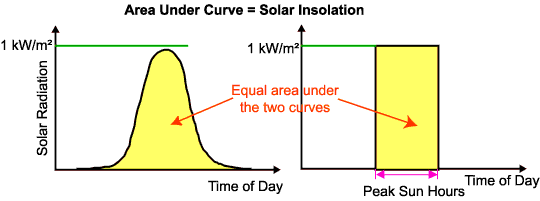
On another note, I've read that plants utilize morning sunlight better than afternoon sun, which is much brighter. There's also the "sum of the par" theory that Sanjay wrote about, 6 hours of 500par equals 12 hours of 250 par.
 

saltyfilmfolks

Lights! Camera! Reef!
View Badges
Joined
Feb 25, 2014
Messages
28,739
Reaction score
40,625
Location
California
Rating - 0%
0   0   0
mmm from the article.
Figure 10. Porites lobata is one of the most common corals in Hawai’i. This particular specimen lives in a shallow Kahalu’u tide pool on the west side of the Big Island of Hawai’i.
  • Known Zooxanthella Clade (in Hawaii): C15
  • Onset Saturation Point: ~250 µmol·m²·second (or about 12,500 lux, see Figure 11).
  • Onset Photoinhibition Point: ~350 µmol·m²·second (or about 17,500 lux).
There's also the "sum of the par" theory that Sanjay wrote about, 6 hours of 500par equals 12 hours of 250 par.
yup and its that photoinhibition point "shut down" thats the interesting thing and part of the theory. The animal?plant is only using what it needs. So as much as we give it it only uses what it needs.

So the the theory and his experiment being, even if we give it 1000 par on the meter does it need it? Or is it the cumulative sum of par @ 250 to 450 par adequate for the specific clades of algae.
AND (are there) differences in the need of the clades as they have evolved regionally.

Another of his and others have written that by avoiding the photoinhibition point that the fluorescing pigments actually become brighter in color. A fine and difficult balance to strike im sure. And likely why more is actually better and easier with acclimation depending on the clade of algae present. But also may explain why many corals are brown until they are in captivity

neat stuff. And I need to read up on sanjay more and get some more recent trials too.


At the end of that first article he was asking for some florescent sps frags so he could do more experiments.
He's just fishing for frags:D
 

mcarroll

10K Club member
View Badges
Joined
Jan 8, 2012
Messages
15,213
Reaction score
8,968
Location
Virginia
Rating - 0%
0   0   0
There's also the "sum of the par" theory that Sanjay wrote about, 6 hours of 500par equals 12 hours of 250 par.

It's not a theory...it's calculus. :) (Which is over my head...but I can read a chart! :p)

The solar power people use the concept to engineer photovoltaic systems.....try googling 'peak sun hours".
PEAK-SUN.gif

Source: http://www.pveducation.org/pvcdrom/properties-of-sunlight/average-solar-radiation

I don't think photosynthesis shuts down...

Understandable theory....but the reality is that our ability to observe the state of our corals is pretty limited and, as it seems to be with most things, it's not that simple.

A paper titled "Is the coral-algae symbiosis really ‘mutually beneficial’ for the partners?" is interesting and will....ahem...shed more light on the subject: :p sorry)

I found it for free on the author's page on ResearchGate.

"Fast Growth May Impair Regeneration Capacity" is another article that you might find interesting.

You can find it on PlosOne website....everything there is thankfully free.

I keep most of my sps @500 par up to 1000. They grow well and have nice color.

Having said all that....1000 PAR is about 50,000 lux. Approimately 50% of surface irradiance levels.

"Bright" relative to some reef tanks....but not very bright in the scheme of sunlight. :D:D:D

50,000 lux is probably on the edge of where corals start to stress over the byproducts of photosynthesis. However, lots of corals appear to do fine up to around 80,000 lux, but things are definitely stressful. They're working for it at that point! :p

Beyond 80,000 lux (around 1600 PAR and up) you are likely to see observable symptoms of stress in some corals and they are definitely maxing out their coping skills at those levels. (I.e. they are under stress)

Interestingly, clams appear to be much more tolerant of surface irradiance levels....but don't thrive down to the same depths as corals.
 
Last edited:

ksc

Well-Known Member
View Badges
Joined
Jul 21, 2008
Messages
576
Reaction score
362
Rating - 0%
0   0   0
Interesting stuff
Back on topic, I think many of the problems led users have is not due to par changes but spectrum changes. Us mh users can't change the spectrum unless we change bulbs. I think most mh users lower their lighting intensity when changing bulbs, as do t5 users. The led camp just turns a few knobs and can change the spectrum drastically.

Maybe someone can do a simple test: Turn one channel up, one down and acclimate the coral. Now reverse the channels but make sure the par stays the same. I'd bet the sps coral experiences a color change..
 

saltyfilmfolks

Lights! Camera! Reef!
View Badges
Joined
Feb 25, 2014
Messages
28,739
Reaction score
40,625
Location
California
Rating - 0%
0   0   0
Beyond 80,000 lux (around 1600 PAR and up) you are likely to see observable symptoms of stress in some corals and they are definitely maxing out their coping skills at those levels. (I.e. they are under stress)
Interestingly. Is that under our light(and environmental conditions) or when the tide goes out leaving them dry in the sun (100,000 + lux);):)
 

saltyfilmfolks

Lights! Camera! Reef!
View Badges
Joined
Feb 25, 2014
Messages
28,739
Reaction score
40,625
Location
California
Rating - 0%
0   0   0
Interesting stuff
Back on topic, I think many of the problems led users have is not due to par changes but spectrum changes. Us mh users can't change the spectrum unless we change bulbs. I think most mh users lower their lighting intensity when changing bulbs, as do t5 users. The led camp just turns a few knobs and can change the spectrum drastically.

Maybe someone can do a simple test: Turn one channel up, one down and acclimate the coral. Now reverse the channels but make sure the par stays the same. I'd bet the sps coral experiences a color change..
ABSOLUTELY. It takes away from the stability too.
My "Brick Red Monti" (as was sold but is brown really), and had for a year, just went from brick red to sea foam green and exploded in growth. I changed the 20k mh to 14k.:)

And (sigh), with summer coming, Im changing the MH to LED. :( Maxspect. Great light. So I will be doing that test.
Sadly Im doing both tanks so no money for the PAR meter. I have several Lux/fc meters and Kelvin color meters and spectrometer.
I intend to match the colors as best possible, note the Lux intensity, drop 40% for acclimation.

I do love me some Arc lamps though.
 

mcarroll

10K Club member
View Badges
Joined
Jan 8, 2012
Messages
15,213
Reaction score
8,968
Location
Virginia
Rating - 0%
0   0   0
No way you can even get a loaner/rental PAR meter (I hear about these things, so I presume they must exist....) so you can get a true conversion factor for your lux meter(s)?
 

saltyfilmfolks

Lights! Camera! Reef!
View Badges
Joined
Feb 25, 2014
Messages
28,739
Reaction score
40,625
Location
California
Rating - 0%
0   0   0
No way you can even get a loaner/rental PAR meter (I hear about these things, so I presume they must exist....) so you can get a true conversion factor for your lux meter(s)?
Working on it.:D

Also an interesting experiment to see how close I can get it. Ie test par last.;)

and looking for comparisons of Sun Systems meters.
 
OP
OP
cracker

cracker

5000 Club Member
View Badges
Joined
Dec 11, 2014
Messages
7,163
Reaction score
16,191
Location
north east Fl
Rating - 0%
0   0   0
Thanks for the wealth of good info! Somebody back asked what the par readings were what the heck the 250 m/h light I had. I have the notes ahh around here somewhere.Also I bought the Mars Aqua's, 6 over a 6 foot tank. They were affordable and I think now are a good light for somebody just getting into LED lighting and on a budget.
I know too much blue stops growth. This subject starts getting more complicated as You go! There is a fine line between corals looking pretty and just living and corals that are thriving and growing. Thanks again for the discussion !
 

Waters

"...in perfect isolation, here behind my wall."
View Badges
Joined
Nov 5, 2013
Messages
9,349
Reaction score
20,857
Location
Mentor, OH
Rating - 0%
0   0   0
Interesting stuff
Back on topic, I think many of the problems led users have is not due to par changes but spectrum changes. Us mh users can't change the spectrum unless we change bulbs. I think most mh users lower their lighting intensity when changing bulbs, as do t5 users. The led camp just turns a few knobs and can change the spectrum drastically.

Maybe someone can do a simple test: Turn one channel up, one down and acclimate the coral. Now reverse the channels but make sure the par stays the same. I'd bet the sps coral experiences a color change..
I actually just learned this the hard way. I have been running my spectrum between 19-20K and decided I wanted more of a whiter light. I slowly (not slow enough I guess) moved the spectrum closer to 17K and left the intensity the same. I ended up bleaching 2 Acros. Could have been caused by the spectrum change...also could have been caused by the increase in PAR due to the whiter light. Nothing else had changed.
 

TOP 10 Trending Threads

WHAT AMOUNT OF LIVE ROCK AND SAND SHOULD BE PRIORITIZED FOR OPTIMAL BIODIVERSITY/FILTRATION?

  • 100% live rock + bagged sand

    Votes: 34 26.4%
  • 100% dry rock + 100% live sand

    Votes: 45 34.9%
  • 50/50 live/dry rock, 50/50 live/bagged sand

    Votes: 29 22.5%
  • 75% live rock, 25% live sand

    Votes: 11 8.5%
  • 25% live rock, 75% live sand

    Votes: 10 7.8%
Back
Top