Follow along with the video below to see how to install our site as a web app on your home screen.
Note: This feature may not be available in some browsers.
I have a rock breaching the surface for the hermits to catch a break and I always see normal size small asterina and sand sifting star also going to the surface every now and then.Definitely not an asterina, make sure you keep it in the water in the future. Many echinoderms, just like sponges, will get air bubbles in their tissue that can be fatal even if they are only out of the water for a short time.
5’8” short kingOr are you a REALLY tiny person![]()

Those are exceptions, not rhe rule, its best to play it safe.I have a rock breaching the surface for the hermits to catch a break and I always see normal size small asterina and sand sifting star also going to the surface every now and then.
Or are you a REALLY tiny person![]()
Harlequin Shrimp AYCE. (All You Can Eat)
Asterina is a whole genus of starfish so there are various species, a few of which might simply be larger. In that sense, "yes, it might be an Asterina". However, there are different starfish genera like Aquilonastra which look similar and are therefore often confused with Asterina.
Yes and they get large. Here a couple ive caught and was compared to a nickel

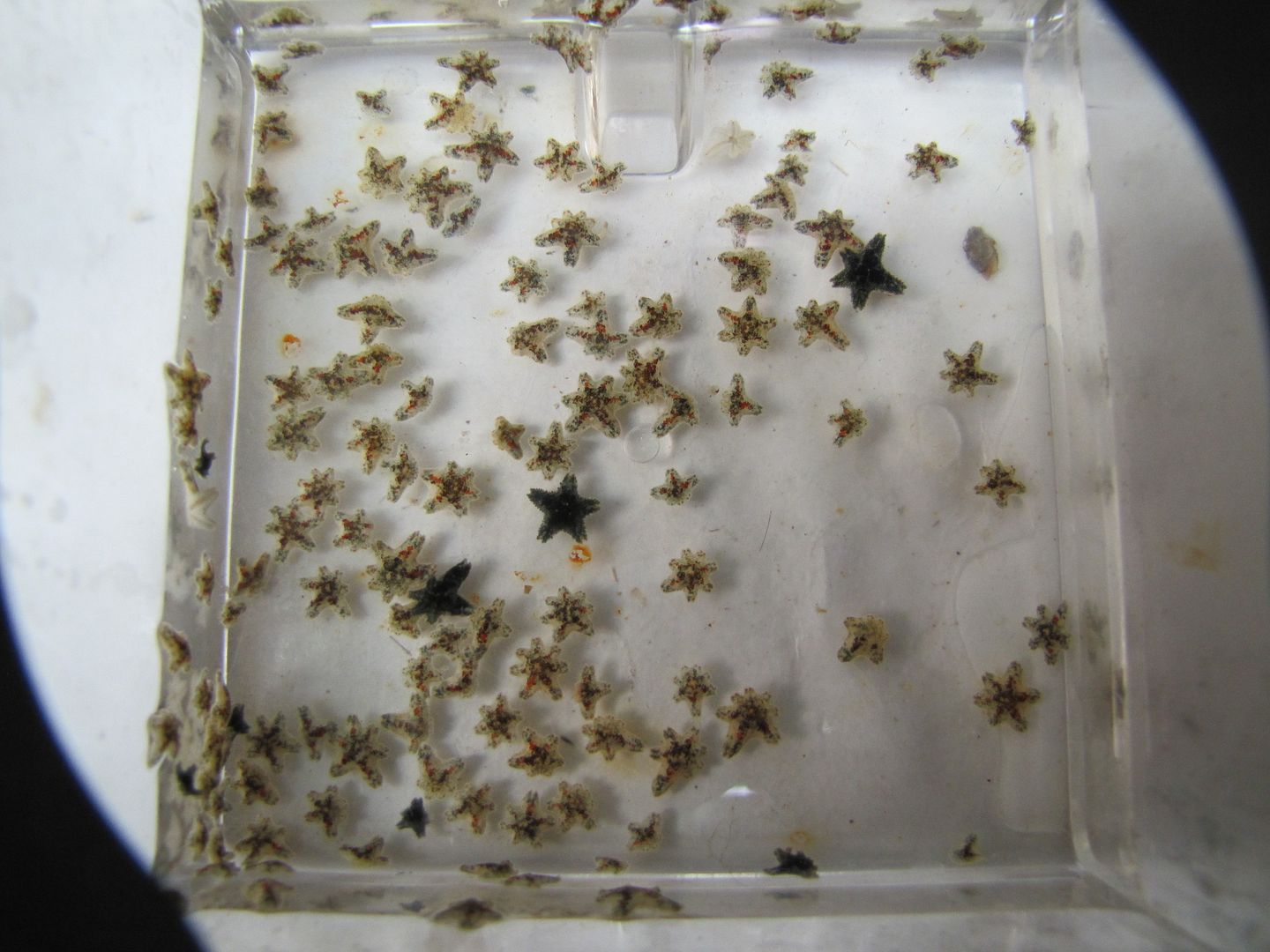
First thought is that it is most likely an Asterinid star (taxonomic family Asterinidae), but it definitely looks a bit different than the usual Aquilonastra stars we get in our tanks (the "Asterinas" - Asterina actually being a different, typically predatory genus in the same family as Aquilonastra).@ISpeakForTheSeas
I'm going to guess it is not, but I really do not know.... its just not matching up with pics I see.
Yeah, looking more into ID'ing these to the species level, I can see why (it took a bit of work to piece together what parts of the stars I needed to look at and where to find them on the specimens).
It'll take me a bit to work through, but I may be able to ID most of the stars which I can get microscope pics of - the spinelets (the tiny, spikey little things sticking up in clusters off of the star's skin) are the most important features for ID via the keys (specifically the number of spikes in each cluster and the shape of each spike/spike cluster), so as long as the pics can provide clear images of those spines (both on the top of the star and the bottom) and where specifically they're located on the star (i.e. near the mouth, near the ambulacral groove, etc.), I should be able to ID them.
With your pics, taricha, I can see the spinelets relatively clearly on the actinal side (the side with the star's mouth; the "underside" of the star) but not on the abactinal side (the "topside" of the star).