Basic DIY Stand Calculator

RocketEngineer

Valuable Member
View Badges
Joined
Sep 3, 2019
Messages
1,355
Reaction score
1,515
Rating - 0%
0   0   0
This is a repost of my previous calculations. Again, this is not my design but has become connected with my name over the years.
88993565-323E-468A-8D45-E2D543922CC3-29337-00001A2F0B0F6F06.jpeg

The basic principle of the design is two box frames connected by four legs. The upper one supports the tank and transfers the load to the legs. The legs are made of several pieces of 2X4 to assist in construction and sheething the stand in plywood for strength and cosmetics. The bottom frame transmits the load of the tank into the floor.

Design notes:
*The plan for this stand consists of 21 pieces. All pieces that are the same color are the same length and of the same board size.
*The box frames are screwed together first, then the legs are built off the bottom frame, the top frame is then placed on top and secured to the legs.
*The green pieces are screw strips. These provide limited load strength but serve to make assembly easier and help keep the stand square.
*The blue piece between the upper rails (red) works to keep the upper rails from twisting.

Cut list:
The length calculations below are based off of a stand that is "W" inches wide X "D" inches front-to-back X "H" inches high.

(2) Red - Upper Rails: Length = W
These will be sized according to length:
- 2X4 for 48" or less for smaller tanks (Rule of thumb is 75g-90g)
- 2X6 up to 72" with 125g-150g being acceptable
- 2X8 recommended for longer spans and larger tanks

(2) Yellow - Upper Ends: Length = D-3"
Theses should be made of the same material as the upper rails.

(4) Green - Screw Strips: Length = H-2"
These 2X4s are shorter then the tank is tall to ensure the tank and stand sit properly. These can also be turned 90 degrees for more opening room.

(8) Purple - Uprights: Length varies:
- 2X4 Upper Rails: Length = H -7"
- 2X6 Upper Rails: Length = H-9"
- 2X8 Upper Rails: Length = H-10.75"
These 2X4s support the weight of the tank. They can be shifted to give more opening clearance. Ensure there are no gaps for greatest strength.

(2) Orange - Bottom Rails: Length = W
These 2X4s act to spread the weight of the tank over a larger area.

(3) Blue - Bottom Ends: Length = D-3"

Covering up to 4 sides of the stand with plywood will help to stiffen the stand against twisting and shifting.
 
Last edited:

twentyleagues

5000 Club Member
View Badges
Joined
Mar 27, 2023
Messages
6,275
Reaction score
7,181
Location
Flint
Rating - 100%
1   0   0
Here are some alternate designs for specific cases. No calculations included but you should be able to work out sizes based on the info above.
B99887A0-F109-44B1-873F-A7547EE49D63-29337-00001A2FBEE04194.jpeg


CD6659A8-ACC7-4357-BB20-2E3CC0ABB1B7-29337-00001A30184187BC.jpeg
I built my stacked 125g stand just like the bottom one. I used 2x4 for the uprights and 2x6 for the horizontals. Has stood firm for 6+ years. Thanks for posting these again!
 

JTP424

2500 Club Member
View Badges
Joined
Jan 10, 2022
Messages
2,762
Reaction score
3,195
Location
US
Rating - 0%
0   0   0
This is a repost of my previous calculations. Again, this is not my design but has become connected with my name over the years.
88993565-323E-468A-8D45-E2D543922CC3-29337-00001A2F0B0F6F06.jpeg

The basic principle of the design is two box frames connected by four legs. The upper one supports the tank and transfers the load to the legs. The legs are made of several pieces of 2X4 to assist in construction and sheething the stand in plywood for strength and cosmetics. The bottom frame transmits the load of the tank into the floor.

Design notes:
*The plan for this stand consists of 21 pieces. All pieces that are the same color are the same length and of the same board size.
*The box frames are screwed together first, then the legs are built off the bottom frame, the top frame is then placed on top and secured to the legs.
*The green pieces are screw strips. These provide limited load strength but serve to make assembly easier and help keep the stand square.
*The blue piece between the upper rails (red) works to keep the upper rails from twisting.

Cut list:
The length calculations below are based off of a stand that is "W" inches wide X "D" inches front-to-back X "H" inches high.

(2) Red - Upper Rails: Length = W
These will be sized according to length:
- 2X4 for 48" or less for smaller tanks (Rule of thumb is 75g-90g)
- 2X6 up to 72" with 125g-150g being acceptable
- 2X8 recommended for longer spans and larger tanks

(2) Yellow - Upper Ends: Length = D-3"
Theses should be made of the same material as the upper rails.

(4) Green - Screw Strips: Length = H-2"
These 2X4s are shorter then the tank is tall to ensure the tank and stand sit properly. These can also be turned 90 degrees for more opening room.

(8) Purple - Uprights: Length varies:
- 2X4 Upper Rails: Length = H -7"
- 2X6 Upper Rails: Length = H-9"
- 2X8 Upper Rails: Length = H-10.75"
These 2X4s support the weight of the tank. They can be shifted to give more opening clearance. Ensure there are no gaps for greatest strength.

(2) Orange - Bottom Rails: Length = W
These 2X4s act to spread the weight of the tank over a larger area.

(3) Blue - Bottom Ends: Length = D-3"

Covering up to 4 sides of the stand with plywood will help to stiffen the stand against twisting and shifting.
Thanks for posting this!
I think this follows your math 😅
Rocket Engineer Calc
 

Freenow54

5000 Club Member
View Badges
Joined
Mar 5, 2021
Messages
6,566
Reaction score
5,092
Location
Ontario Canada
Rating - 0%
0   0   0
This is a repost of my previous calculations. Again, this is not my design but has become connected with my name over the years.
88993565-323E-468A-8D45-E2D543922CC3-29337-00001A2F0B0F6F06.jpeg

The basic principle of the design is two box frames connected by four legs. The upper one supports the tank and transfers the load to the legs. The legs are made of several pieces of 2X4 to assist in construction and sheething the stand in plywood for strength and cosmetics. The bottom frame transmits the load of the tank into the floor.

Design notes:
*The plan for this stand consists of 21 pieces. All pieces that are the same color are the same length and of the same board size.
*The box frames are screwed together first, then the legs are built off the bottom frame, the top frame is then placed on top and secured to the legs.
*The green pieces are screw strips. These provide limited load strength but serve to make assembly easier and help keep the stand square.
*The blue piece between the upper rails (red) works to keep the upper rails from twisting.

Cut list:
The length calculations below are based off of a stand that is "W" inches wide X "D" inches front-to-back X "H" inches high.

(2) Red - Upper Rails: Length = W
These will be sized according to length:
- 2X4 for 48" or less for smaller tanks (Rule of thumb is 75g-90g)
- 2X6 up to 72" with 125g-150g being acceptable
- 2X8 recommended for longer spans and larger tanks

(2) Yellow - Upper Ends: Length = D-3"
Theses should be made of the same material as the upper rails.

(4) Green - Screw Strips: Length = H-2"
These 2X4s are shorter then the tank is tall to ensure the tank and stand sit properly. These can also be turned 90 degrees for more opening room.

(8) Purple - Uprights: Length varies:
- 2X4 Upper Rails: Length = H -7"
- 2X6 Upper Rails: Length = H-9"
- 2X8 Upper Rails: Length = H-10.75"
These 2X4s support the weight of the tank. They can be shifted to give more opening clearance. Ensure there are no gaps for greatest strength.

(2) Orange - Bottom Rails: Length = W
These 2X4s act to spread the weight of the tank over a larger area.

(3) Blue - Bottom Ends: Length = D-3"

Covering up to 4 sides of the stand with plywood will help to stiffen the stand against twisting and shifting.
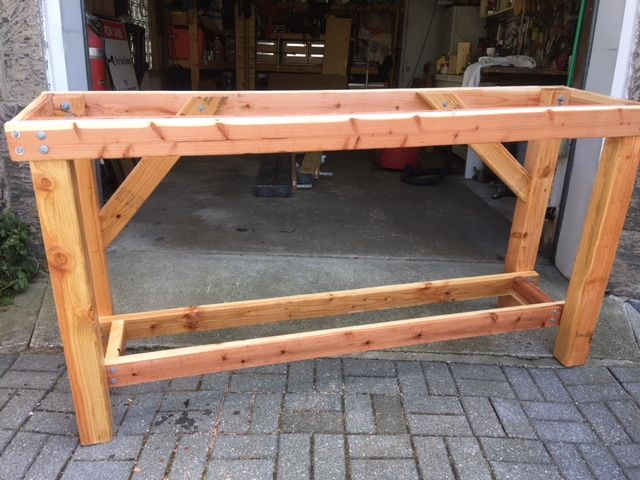
I like 4x 4 legs and 45 % supports at the top . I was taught the 45% angle is the most weight transferable design
 
OP
OP
R

RocketEngineer

Valuable Member
View Badges
Joined
Sep 3, 2019
Messages
1,355
Reaction score
1,515
Rating - 0%
0   0   0
I like 4x 4 legs and 45 % supports at the top . I was taught the 45% angle is the most weight transferable design
4X4s don’t dry right in most cases. The thickness means they tend to twist or split. Also, the ones I’ve seen tend to be more towards the center of the log so the grain can be a bit odd.

Having gussets depends on the design. In this case, we are building a bridge. I typically only see bracing on cantilever situations. To get the most out of the opening, I like a plywood frame that’s cut with a flush bit following the boards.
 

Freenow54

5000 Club Member
View Badges
Joined
Mar 5, 2021
Messages
6,566
Reaction score
5,092
Location
Ontario Canada
Rating - 0%
0   0   0
4X4s don’t dry right in most cases. The thickness means they tend to twist or split. Also, the ones I’ve seen tend to be more towards the center of the log so the grain can be a bit odd.

Having gussets depends on the design. In this case, we are building a bridge. I typically only see bracing on cantilever situations. To get the most out of the opening, I like a plywood frame that’s cut with a flush bit following the boards.
Don't buy green wood , also It is not my knowledge about 45 % yes 45 % bracing but by others. To each is own this could go on forever but lets not. If you want to display your Large Ego with your Handle and claiming a Stand design as yours be my guest
 

JTP424

2500 Club Member
View Badges
Joined
Jan 10, 2022
Messages
2,762
Reaction score
3,195
Location
US
Rating - 0%
0   0   0
Don't buy green wood , also It is not my knowledge about 45 % yes 45 % bracing but by others. To each is own this could go on forever but lets not. If you want to display your Large Ego with your Handle and claiming a Stand design as yours be my guest
The... The first thing he says is it's not his design....

But yes! Cool head prevail :)
 

Fish Fan

Master of Disaster
View Badges
Joined
Dec 8, 2017
Messages
12,916
Reaction score
33,622
Location
461 Ocean Boulevard
Rating - 100%
6   0   0
@RocketEngineer thank you for reposting these plans here, I know this will help a lot of members!
 
OP
OP
R

RocketEngineer

Valuable Member
View Badges
Joined
Sep 3, 2019
Messages
1,355
Reaction score
1,515
Rating - 0%
0   0   0
Don't buy green wood , also It is not my knowledge about 45 % yes 45 % bracing but by others. To each is own this could go on forever but lets not. If you want to display your Large Ego with your Handle and claiming a Stand design as yours be my guest

I totally agree, buying green wood is a bad idea. What I meant by my statement was my experience looking for lumber to use. I've found that I can find clear, decently straight 2X4s easier than finding a 4X4 that's straight and clear. Just my experience. You may have better luck in your area. I know there's a lumber yard where my parents used to live that was also a custom molding shop. They had some very nice stuff, kiln dried and milled. But you paid for it. Again, your availablility may differ significantly from my own experience.

Bracing has its place. 45 degree bracing tends to work best at transfering load from vertical to horizontal which is the goal in most instances. It all depends on the situation and what loads are being considered. For a tank stand, nearly all of the load is vertical. We do want our stands to resist side loading to ensure they don't collapse from a bump sideways. Now, how we add this resistance to side loading differs based on what our goals are. A metal plate between the legs and the horizontal beams is one option but metal and saltwater is normally not a friendly combination. Plywood has a lot of resistance to shear so even comparatively thin plywood secured to a strong frame could provide all the resistance to twisting that a stand needs. Now, should someone be building a stand in say an earthquake prone part of the world, I would certainly recommend more robust bracing to ensure the legs stay vertical despite lateral motion. In this sitation, 45 degree angle braces are a very good option. Its a matter of designing to the situation.

Now, lets get to the personal attack and fill in a little of my personal history. The original post on Reef Central was all the way back in 2007. At no time in the last 18 years have I claimed the design to be my own. Since that time, the thread gained so much attention within the reef community that my handle became shorthand for a specific style of DIY stand, namely 2X material. I just put together what others had done in one place and by happenstance my name became attached to it.

Now, my handle comes from my first job. I worked as a mechanical engineering contractor for NASA designing payloads for the Sounding Rocket Program Office. In other words, a rocket engineer. After leaving Sounding Rockets, I worked as a mechanical engineer designing hardware for various aerospace customers. Currently, I work as a mechanical design engineer for the Mid-Atlantic Regional Spaceport. So, in my 20 year career, nearly all of it has been spent working on hardward related to space in one form or fashion. As to being an engineer, I come by that description naturally. Between how I approach problems and look at the world, I fit the stereotypical engineer far too well. Just ask my wife. :D

I think its fair to say, I only claim to be what I am: an engineer who's spent many years working in the rocket industry who just happens to have posted something a lot of folks found useful. Am I all knowing? Absolutely not. There are much more professional ways to build a stand. There are also ways that are better suited for specific cases. But in the end, this simple design has served many people well and happens to be my little contribution to the vast collection of knowledge that is our hobby.

Remember, the idea behind these forums is to have a conversation on topics we find interesting. We all have different approaches to this hobby, but in the end its about enjoying this for ourselves in our own way.

Ok, friendly response over. Carry on. :)
 

Freenow54

5000 Club Member
View Badges
Joined
Mar 5, 2021
Messages
6,566
Reaction score
5,092
Location
Ontario Canada
Rating - 0%
0   0   0
Very interesting story , and I read it from top to bottom. I am not going to hide behind any excuse but I should not have been writing responses yesterday. I apologized yesterday , However this I hope and as I am doing this on the forum not a private reply I do owe you a large Apology.
Sincerely WD. It was Childish at best
 

Paul B

10K Club member
View Badges
Joined
Nov 3, 2010
Messages
21,284
Reaction score
71,372
Location
Long Island NY
Rating - 0%
0   0   0
The only issue I with most DIY stands is that most people use a lot of board on board construction instead of building inherently strong by using appropriate wood and the correct type of wood.

Pressure treated wood is a very cheap pine that warps, a lot. It just doesn't rot as fast.

Anyplace where there is moisture, Board on Board will keep that water in between the boards and it will never dry.

Also, I would never use any type of screws on a stand.

I built mine out of redwood because it doesn't rot or warp much. The 4X4 legs are sufficiently strong that no other woods are needed.

I also used all hot dipped galvanized, bolt through hardware where strength is needed. The top rails are sitting on set backs on the 4X4s.

My tank was on my last stand for 40 years so I build to last. As a commercial/ industrial construction electrician in Manhattan, I built a lot of stands for very heavy equipment that had to last for decades.


Freenow54

5000 Club Member
View Badges
Joined
Mar 5, 2021
Messages
6,566
Reaction score
5,092
Location
Ontario Canada
Rating - 0%
0   0   0
Here is
1000001910.jpg
Mine . Totally agree. I painted it all with oil paint I had and put plexi glass on the bottom inside plywood to be able to clean up salt creep from sump glass
 

Gumbies R Us

God, Bouldering, and Reefing
View Badges
Joined
Nov 10, 2022
Messages
28,967
Reaction score
51,317
Location
North Georgia
Rating - 0%
0   0   0
This is a repost of my previous calculations. Again, this is not my design but has become connected with my name over the years.
88993565-323E-468A-8D45-E2D543922CC3-29337-00001A2F0B0F6F06.jpeg

The basic principle of the design is two box frames connected by four legs. The upper one supports the tank and transfers the load to the legs. The legs are made of several pieces of 2X4 to assist in construction and sheething the stand in plywood for strength and cosmetics. The bottom frame transmits the load of the tank into the floor.

Design notes:
*The plan for this stand consists of 21 pieces. All pieces that are the same color are the same length and of the same board size.
*The box frames are screwed together first, then the legs are built off the bottom frame, the top frame is then placed on top and secured to the legs.
*The green pieces are screw strips. These provide limited load strength but serve to make assembly easier and help keep the stand square.
*The blue piece between the upper rails (red) works to keep the upper rails from twisting.

Cut list:
The length calculations below are based off of a stand that is "W" inches wide X "D" inches front-to-back X "H" inches high.

(2) Red - Upper Rails: Length = W
These will be sized according to length:
- 2X4 for 48" or less for smaller tanks (Rule of thumb is 75g-90g)
- 2X6 up to 72" with 125g-150g being acceptable
- 2X8 recommended for longer spans and larger tanks

(2) Yellow - Upper Ends: Length = D-3"
Theses should be made of the same material as the upper rails.

(4) Green - Screw Strips: Length = H-2"
These 2X4s are shorter then the tank is tall to ensure the tank and stand sit properly. These can also be turned 90 degrees for more opening room.

(8) Purple - Uprights: Length varies:
- 2X4 Upper Rails: Length = H -7"
- 2X6 Upper Rails: Length = H-9"
- 2X8 Upper Rails: Length = H-10.75"
These 2X4s support the weight of the tank. They can be shifted to give more opening clearance. Ensure there are no gaps for greatest strength.

(2) Orange - Bottom Rails: Length = W
These 2X4s act to spread the weight of the tank over a larger area.

(3) Blue - Bottom Ends: Length = D-3"

Covering up to 4 sides of the stand with plywood will help to stiffen the stand against twisting and shifting.
Thanks for sharing this!
 

TOP 10 Trending Threads

WHAT AMOUNT OF LIVE ROCK AND SAND SHOULD BE PRIORITIZED FOR OPTIMAL BIODIVERSITY/FILTRATION?

  • 100% live rock + bagged sand

    Votes: 34 26.8%
  • 100% dry rock + 100% live sand

    Votes: 45 35.4%
  • 50/50 live/dry rock, 50/50 live/bagged sand

    Votes: 27 21.3%
  • 75% live rock, 25% live sand

    Votes: 11 8.7%
  • 25% live rock, 75% live sand

    Votes: 10 7.9%
Back
Top