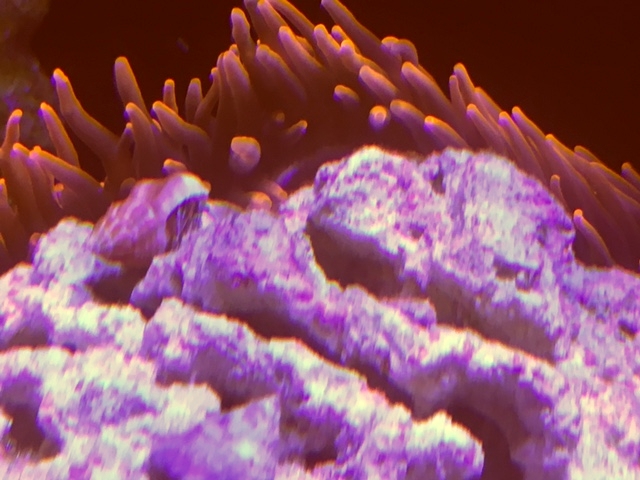
Dry Pukani rock

rkpetersen

walked the sand with the crustaceans
View Badges
Joined
Sep 14, 2017
Messages
4,529
Reaction score
5,665
Location
Near Seattle
Rating - 0%
0   0   0
Update:

Things are now going surprisingly well. I may have to rescind my last comment about dry rock.

This tank was started on 2/24. On 3/31, after only 5 weeks, I started to see coralline algae growing on the glass in the sump. Now, just yesterday, after exactly two months, I suddenly noticed that it is appearing on all the dry rocks, while at the same time, the brown filamentous algae is being eaten away by snails and for the most part, not growing back.

I think this effort was a success. It wasn't instantaneous, but two months to enthusiastic coralline algae growth and absence of overwhelming growth of other algaes on dry rocks in a new tank is making me pretty happy.

In summary, what I did was:

1. Treat all dry rocks with acid, lanthanum chloride, and accelerated cycling in a Brute before adding to the DT on startup.
2. Use Red Sea Coral Pro salt to start the tank with high calcium, magnesium and alkalinity levels.
3. Transfer fragments of coralline algae from the back wall and sump of the old tank to the new.
4. Transfer coralline-encrusted trochus snails, overflow combs, return nozzle, and algae scrapers from the old tank to the new.
5. Illuminate with Ecotech Radions on a modified AB+ profile.
6. Intermittently dose small quantities of strontium (not sure this does anything, but years ago, it was considered the key to coralline.)
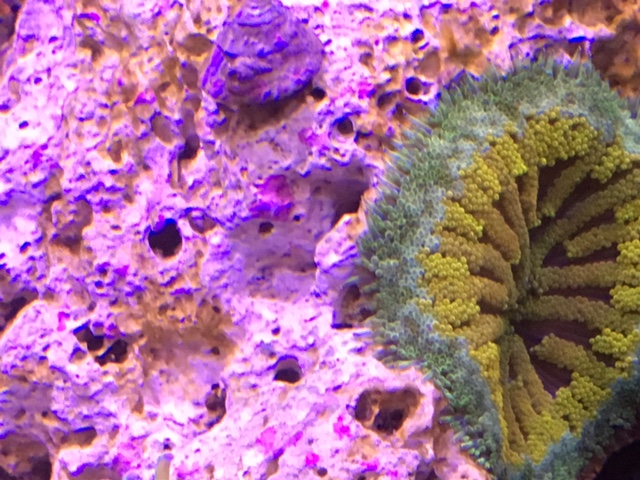
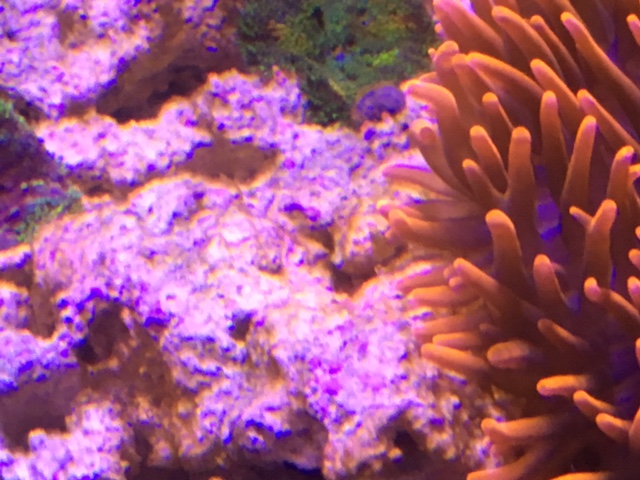
IMG_4894.JPG


IMG_4895.JPG


IMG_4898.JPG


IMG_4902.JPG
 
Last edited:
U

User1

Guest
View Badges
I'll have to take a photo of mine. It seems you and I started a new cycle around the same time. I started on 2/8/2018 when I first dosed ammonia to 2.0 ppm. First 0 reading was on or around 2/20 which I then dosed again to 2 ppm to verify it was processed in 24 hours. Anyway also used dry pukani about 150 lbs of it. I think you had a better process than I. I pressure washed them, then distributed into 4 20 gallon tubs, added water, bleach, and set for 24 hours. Rinsed, more water, bleach, repeat for about 3 days. Then did the same thing with lanthanum chloride. 24 hour soaks, dump water, refill, more lanthanum chloride, 24 hours, then pressure wash everything, then set in the tank.

I'm in the midst of a diatom bloom now which is cool and like you I am seeing spots of coralline although your rocks look a lot more covered than mine. What is funny is that you also have rose bubble tips and an azure damsel. Me too. I'm up to 7 now from the original 1 I purchased 5 years ago sadly. Great progress you have going there. Looks really nice.
 

rtparty

7500 Club Member
View Badges
Joined
Jan 19, 2010
Messages
8,666
Reaction score
14,879
Location
Utah
Rating - 100%
4   0   0
Both of you sound almost identical to my progress as well. Months 3 and 4 were also fantastic. Coraline growth was good, corals were doing fine, my SPS stayed alive but not really growing yet and then chrysophytes showed up. That was the beginning of the "end" for my system. (Maybe that was the point where I needed to make sure my N and P didn't bottom out but I wasn't paying close attention since everything was doing well minus the cryshophytes. I had no idea what cryshophytes were at the time.)

Since that time I have fought cyano, dinos, hair algae, hair algae with some cyano mixed in and now some type of hair algae that nothing will eat. I've started dosing Vibrant and it is really wiping out the algae I have currently. I also added Fiji Mud a while back to help diversity in the tank.

I'm not trying to play negative Nancy here. Just hoping to share some insight so you can watch for certain things and hopefully avoid the mess so many of us have fallen victim to with a dry rock setup.
 

rkpetersen

walked the sand with the crustaceans
View Badges
Joined
Sep 14, 2017
Messages
4,529
Reaction score
5,665
Location
Near Seattle
Rating - 0%
0   0   0
That was the beginning of the "end" for my system. (Maybe that was the point where I needed to make sure my N and P didn't bottom out but I wasn't paying close attention since everything was doing well minus the cryshophytes. I had no idea what cryshophytes were at the time.)
Valid points, and sorry you've run into problems. I might yet too; as mentioned early, dry rock is an experiment for me, one that isn't over yet. I do think that now is the time to start gradually allowing my nutrient levels to rise a bit. I'm not enthusiastic about actually dosing NO3 or PO4, but cutting the amount of chaeto in my fuge in half (which I did a couple of days ago) and soon adding about 30 clownfish should help keep those numbers in the low but non-zero range.
 

rtparty

7500 Club Member
View Badges
Joined
Jan 19, 2010
Messages
8,666
Reaction score
14,879
Location
Utah
Rating - 100%
4   0   0
Valid points, and sorry you've run into problems. I might yet too; as mentioned early, dry rock is an experiment for me, one that isn't over yet. I do think that now is the time to start gradually allowing my nutrient levels to rise a bit. I'm not enthusiastic about actually dosing NO3 or PO4, but cutting the amount of chaeto in my fuge in half (which I did a couple of days ago) and soon adding about 30 clownfish should help keep those numbers in the low but non-zero range.
If I can provide any advice, get your nutrients up and don't worry if they're up. If it helps avoid dinos, you're light years ahead of a lot of us.

A full tank of clowns is cool to see. I couldn't do it since they'd all attack me. Clown fish hate me
 
U

User1

Guest
View Badges
30 clowns? How many anemones do you have? I'm at 7 - I am pretty sure I moved only 6 that I counted on the rocks I moved over so I'm guessing either I split or hurt one during the move (unintentional) or it stressed out after the move and did it on its own. So now up to 7 - hoping I hold steady at this number because, well, 1 became 2 in my 29 gallon biocube. Then 2 became three and I had to move it to another biocube. I guess it was lonely and 1 became 2 again. Of those they held steady in their respected cubes and pairs but grew a bit too big for the 29 gallon tanks so I moved them into a 40 breeder for a couple years but the 4 soon became 6 and I said enough is enough. Thus the tank upgrade process over a year of slowly working on the tank, parts, plumbing, etc. Price of the tank isn't bad right - it is the little things that add up that you forget about like a simple box of salt mix for that much water...

Anyway I thought maybe they would be happy but I guess they just want to troll me - 7th was born sometime last week. Go figure. Like I said I could have caused it during the move - they are hard to see what rock they are attached to. In any case - what sort of clowns are you using. I bet it will be impressive.

And any other fish?
 

rkpetersen

walked the sand with the crustaceans
View Badges
Joined
Sep 14, 2017
Messages
4,529
Reaction score
5,665
Location
Near Seattle
Rating - 0%
0   0   0
Currently, in a RSR 450, 13 green and rose btas, including two large rbtas that I got from another hobbyist and a medium size one that split off from the nem in my older tank. Plus two moderate size haddoni Saddle carpets in pink and purple, and 1 purple/green/yellow LTA. So far. I want them all to be settled and more or less happy before adding clowns. Also a couple of LT plate corals because I've heard that clowns sometimes enjoy them too. And a large extremely happy Elegance Coral. And a few Euphyllia frags. And 17 mini maxi carpet nems (these don't host clowns but I like the way they look, they're low maintenance, and some exceptionally beautiful ones have appeared online recently.) Only a few fish currently - 2 Azure Damsels, Orange Spot Blenny, Purple Tang and Coral Beauty.

And actually it will be somewhere between 20 and 30 clowns; exact number yet to be determined. Hoping for a designer ocellaris harem, if all the stars are in alignment. The anemones I have and ocellaris clowns aren't found together in nature, but these clowns I'll be buying will adjust eventually, and they themselves aren't found much in nature either. :)
 
Last edited:

Finatik

FINatik about my Tanks !
View Badges
Joined
Feb 4, 2017
Messages
381
Reaction score
275
Location
East Coast - USA
Rating - 0%
0   0   0
Stay away from the acid. Just lose money in the long run since it will eat away your investment...what starts at 60lbs of dry Pukani in an acid bath end up with a percentage less. Just how much depends on your mixture rate. In any case acid and/or bleach are means to help remove decay on the rock(s). Having just finished 150lbs of dry Pukani (never to do again btw) on my own here recently I chose to:

1. Unbox
2. Pressure wash
3. 24 hours in tap water / bleach combo
4. Dump water - repeat 24 hour tap water / bleach combo
5. Dump water - refill with tap water
6. 24 hours lanthanum chloride bath
7. Dump water - repeat 24 hour lanthanum chloride bath
8. pressure wash

Added sand and then filled the tank with RI/RO per-made salt using Instant Ocean. Added rocks, then turned on Sea Swirls, return pump, and gryre, and dechlorinated the water. Let sit for 24 hours, measured ammonia, then added Ammonia to reach 2 mg/L (ppm), and started the fishless cycle. Once ammonia reached what I wanted I added Dr. Tim's one and only bottle of bacteria and that was it. More or less tested until ammonia went to 0 then add ammonia to reach 2 mg/L (ppm) and have it processed to 0 in less than 24 hours. Once this was good I new the cycle was more or less done on the ammonia front. That was about 20 something days (traveling so don't have exact :) ). I've since watched over time Nitrites going to zero and know I'm ready.

During this whole time no skimmer or lighting outside natural light. I am expecting, and looking forward, to diatoms and hair algae. I'll drop a 50% water change then move over my 40 breeder so the clean up crew, fish, and corals, will have stuff to munch on. Pukani is really nice rock but honestly having used it now compared to the live Fiji I had years ago it doesn't compare. Hitch hikers is part of the fun but if I had to do it again I would go with TBS rock. 2 children in college lead me down the Pukani path :) All part of the ride in this hobby.

Just say away from the acid bath - go slow and you will be fine. Lots of people using the rock with great success.

What is "TBS Rock" ?
 
OP
OP
SuncrestReef

SuncrestReef

That Apex guy
View Badges
Joined
Jan 18, 2018
Messages
4,214
Reaction score
8,685
Location
Oregon
Rating - 0%
0   0   0
Yes, this has gotten away from the original question of whether I can cure the dry Pukani directly in my new display tank and turned more into a debate of acid/bleach or not.

I spoke directly with someone at BRS who said curing in the DT without bleaching or acid will be fine, and several other R2R members emailed me directly with first-hand experience also confirming it should be fine. Since I'm already set up with media reactors and a 100% automated water change system, here's what I am going to do:

1. I have removed all the sand from my display tank to avoid infesting it with any material coming off the rocks. Since it was still dry, this was relatively easy.
2. I removed 3 larger free-standing pieces of Pukani that were not glued to the rest of the aquascape and placed them in a tub with heated RO/DI water and a powerhead. They have been soaking now for over 24 hours and there is no smell whatsoever, and very little detritus or coloration in the water. Several people warned the rock will stink link crazy as soon as it gets wet. Either they were exaggerating, or perhaps my Pukani is much cleaner than theirs was, but so far that has not been the case. I basically wanted to get a sense of how dirty the initial water will be.
3. I am going to leave the rest of the aquascape in place in the DT and fill it with salt water tomorrow after I finally get my return pump installed.
4. I am going to leave the return pump and powerheads running.
5. If it starts to smell, I will turn on my carbon reactor.
6. I'll be monitoring for phosphates and if they start getting high, I'll turn on my GFO reactor.
7. I'll set my automatic water changes to flush about 5 gallons per day.
8. Every couple of days I will blast the rocks with a turkey baster and/or go over each rock with the powerhead to hopefully release any dead material. Then I will vacuum out what I can from the bottom of the tank. This should be much easier without the sand.
9. I'll check and clean out the filter socks every couple days or more if needed.
10. I might run the skimmer to see if it collects anything.
11. Once the phosphates are under control, I'll turn off the reactors, add the sand back in, turn off the auto water change, and begin a normal cycling process starting with Dr. Tim's.

Thanks for all your opinions, but I don't think I'm going to get a definitive answer to my original question unless I just try it.

Just a quick update on my original question and progress. On April 3rd I began curing the Pukani rock in my display tank following the process outlined above. I ran my carbon and GFO reactors pretty much the whole time, and never had any problems with odors or cloudy water. I did a few partial water changes in the first 2 weeks, and the phosphate levels remained at below 0.1 ppm after day 10. I did a 100% water change on April 20 and then began cycling the tank using Dr. Tim's bacteria and so far things are progressing nicely. The phosphate levels are still very low and the ammonia/nitrite/nitrate test results are normal for the cycling process.

I don't know if my Pukani rock was simply cleaner than what others have experienced, or if the carbon and GFO played a significant role, but I never experienced any of the horror stories others have reported with foul smells and ugly water. I have photos of the progress posted in my build thread if anyone wants to take a look: https://www.reef2reef.com/threads/s...eefer-xl-425-build.358990/page-4#post-4614879
 

TOP 10 Trending Threads

WHAT AMOUNT OF LIVE ROCK AND SAND SHOULD BE PRIORITIZED FOR OPTIMAL BIODIVERSITY/FILTRATION?

  • 100% live rock + bagged sand

    Votes: 37 27.4%
  • 100% dry rock + 100% live sand

    Votes: 46 34.1%
  • 50/50 live/dry rock, 50/50 live/bagged sand

    Votes: 30 22.2%
  • 75% live rock, 25% live sand

    Votes: 12 8.9%
  • 25% live rock, 75% live sand

    Votes: 10 7.4%
Back
Top