




Lasse
10K Club member
View Badges
Ultimate Member
Reef Squad
Excellence Award
Reef Tank 365
Reef Of The Month
R2R App User
Article Contributor
My Tank Thread
- Joined
- Mar 20, 2016
- Messages
- 12,979
- Reaction score
- 31,950
- Location
- Källarliden 14 D Bohus, Sweden
- What state or country do you live in
- Other International
The use of hydrogen peroxide is more and more common in saltwater aquaria both in the form of using oxidators and directly dosing.
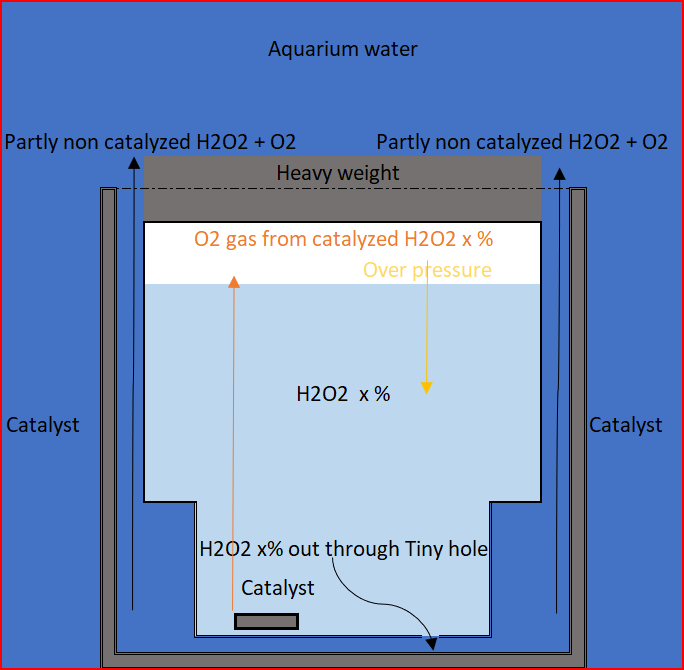 It is believed that hydrogen peroxide residence time in an aquarium is hours or maybe a day or two.
Hydrogen peroxide has been (and still is) used as a controller of both gill parasites and salmon lice in commercial fish farms. Treatment concentrations between 300 and 1500 ppm. Some investigations around fish farms in fjords have indicated that the residence of uncatalyzed H2O2 in open water is much. much longer than earlier believed
I have started some tests to get a picture of how H2O2 breakdown in normal aquarium water and how it oxidizes other compounds. It’s clear that the whole molecule can act as an oxidizer, but the main oxidizing power seems to be by the metabolites of the process when H2O2 transfers to H2O and some oxygen radicals (the O atom itself and the hydroxide radical). Here the O will form some O2 gas, and it is the amount of this and its production rate I can measure with my simple method.
I use 2 pcs of 500 ml bottles with a cap that have a 4 ml hole in it. The bottles are filled with aquarium water and the amount of H2O2 I want to test. After that I turn the upside down and place them in a coca cola glass that allow the hole in the cap to "float" in the air and when gas is formed in the vessel – it rise to the bottom (remember upside down) of the bottle and for a gas bubble. The amount of water that is pressed out into the Coca Cola glass through the hole in the cap is equal to the volume of gas at the top. The theory is that if gas is produced - it’s still uncatalyzed H2O2 in the solution.
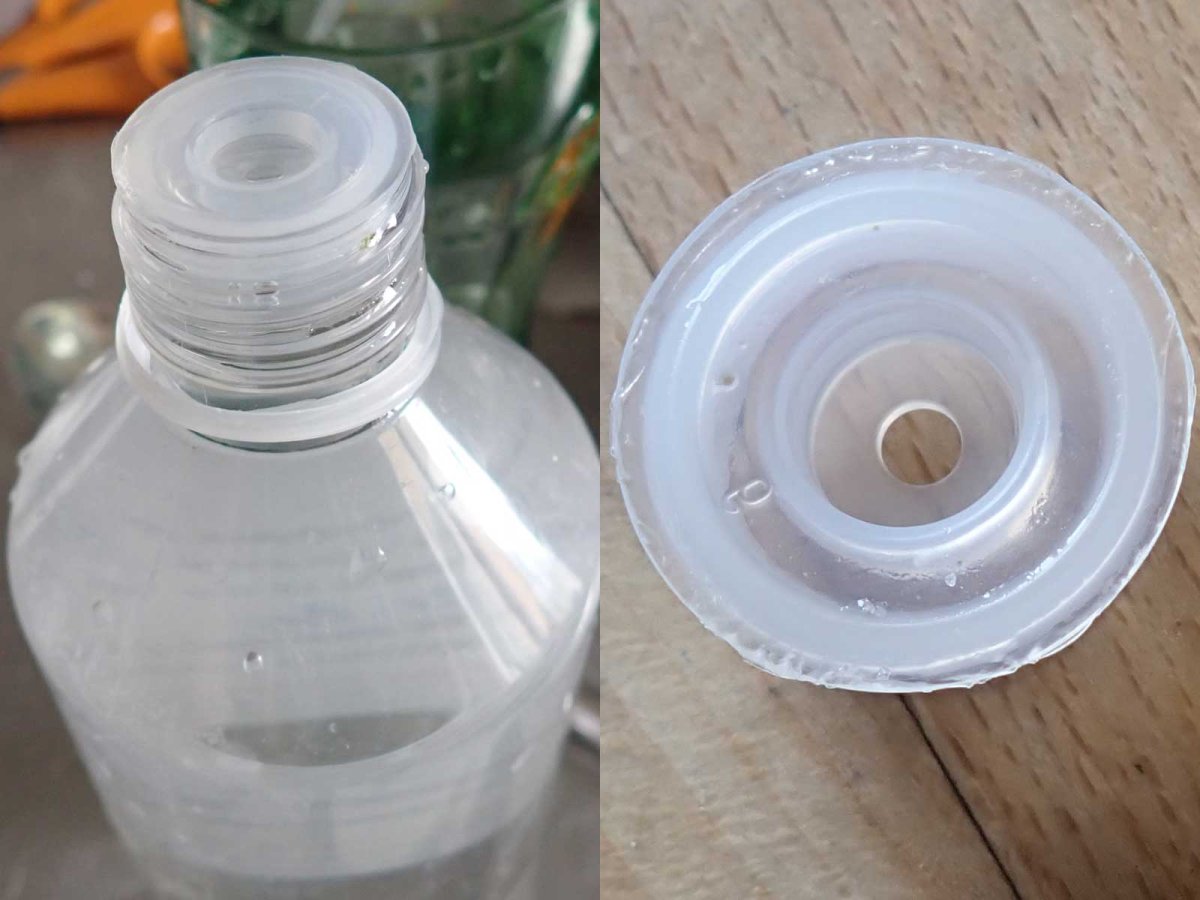
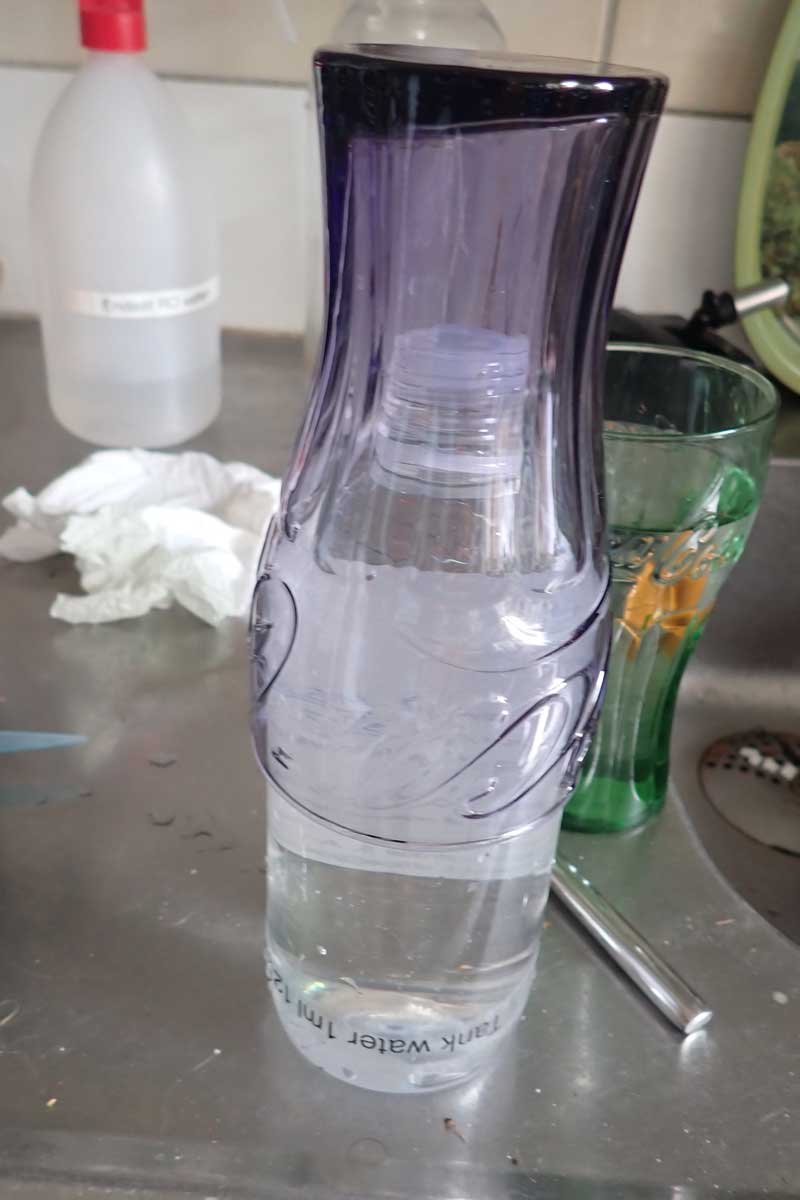
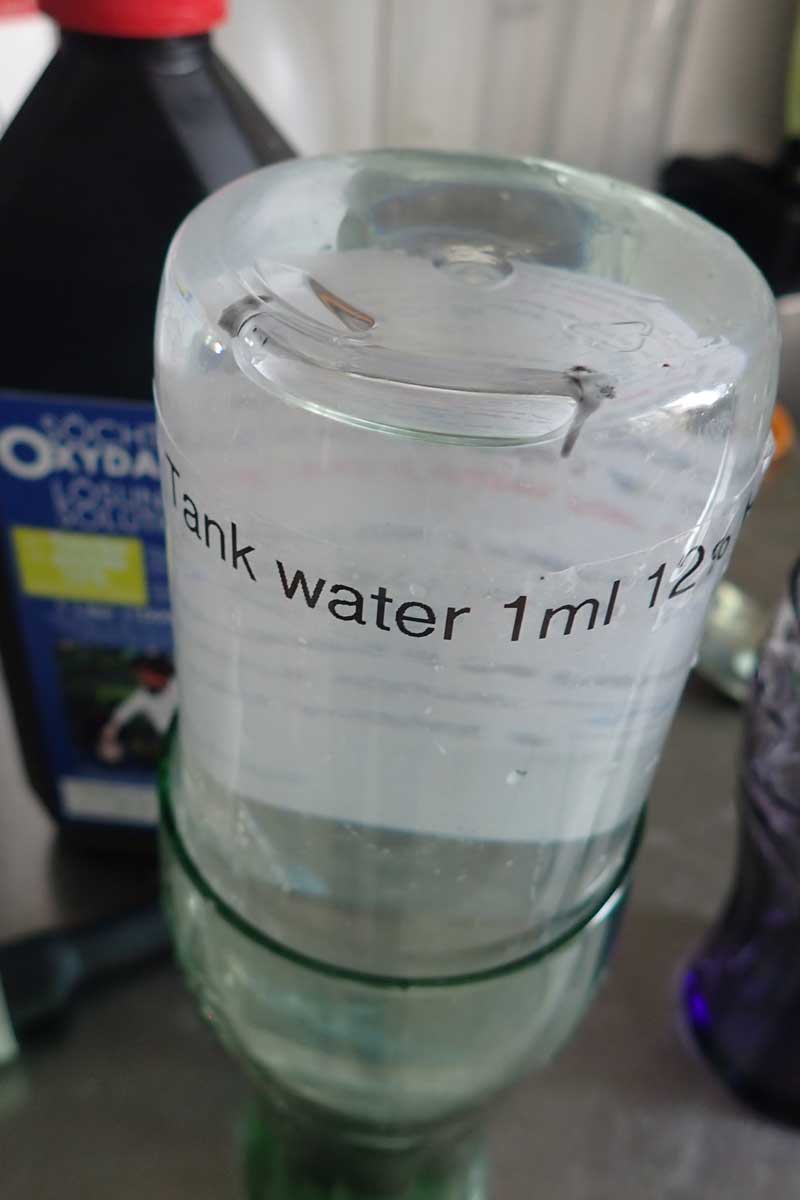
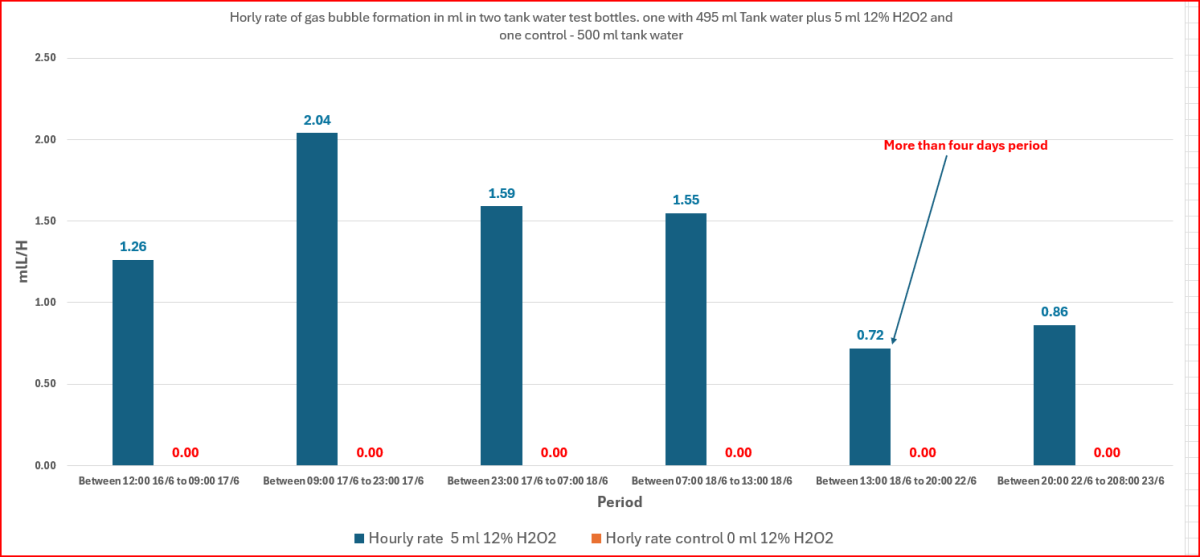
In tge first run – for 164 hours - I used 5 ml 12% H2O2 in 500 ml total and one bottle without any H2O2 at all. The zero sample was because I want to see if there was any other gas production taking place. The test was done with natural light.
After 164 hours – it was still gas production in the bottle with 5 ml 12% H2O2 added and no gas at all produced in the control bottle.
2025-06-23 I start a second run - now including one bottle with added 5 ml 12% H2O2 and one with 1 ml 12% H2O2, The reason why I use this rather high concentrations is that they are around the concentration for dip treatment in fish farms. I want to see the pattern here before I test with lower concentrations of H2O2
Calculation 1 ml H2O2 (100%) is 1,45 g - in order to make 12 % solution (volume) I mix 12 ml 100% H2O2 with 88 ml water. The weight of 12 ml 100 H2O2 is 17.4 gram - which means that each ml of 12 % (volume) H2O2 contain 0.174 g or 174 mg H2O2. I mix 1 ml in 500 ml water -> 348 mg/L. The 5 ml solution will be 1740 mg/L. The extra O in H2O2 is 47% of the weight of the whole molecule - each ml 12% H2O2 contain 0.47*174 mg = 82 mg O or 82 mg O2 or around 60 ml O2 and my 5 ml 12% H2O2 will correspond to 410 mg free O and hence around 287 ml O2 gas. - Please - someone - correct me if I´m wrong - I´m no chemist.
However - I have run this experiment for more than 10 days now and the result is rather surprising. The bottle with 5 ml 12% H2O2 act rather like the first experiment with a total gas formation of around 156 ml gas in both runs (run 1 = 164 hours - run 2 = 168 hours)
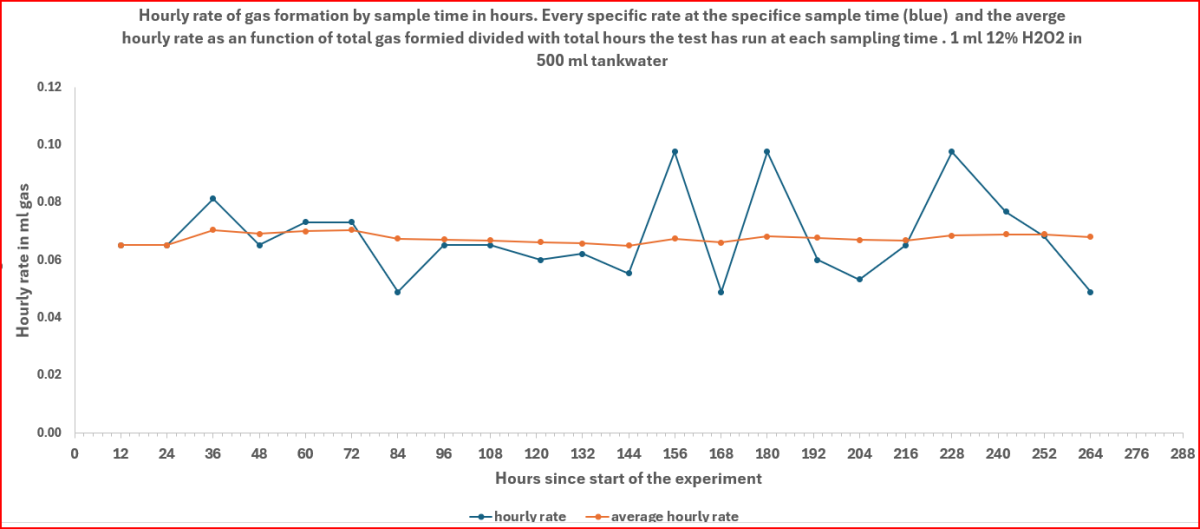
However - the bottle with 1 ml 12% H2O2 acts a little different - it has been a rather steady production of gas and much lesser than expected
The 5 ml 12% H2O2 shows another pattern - note the decline of both the specific and average hourly rate
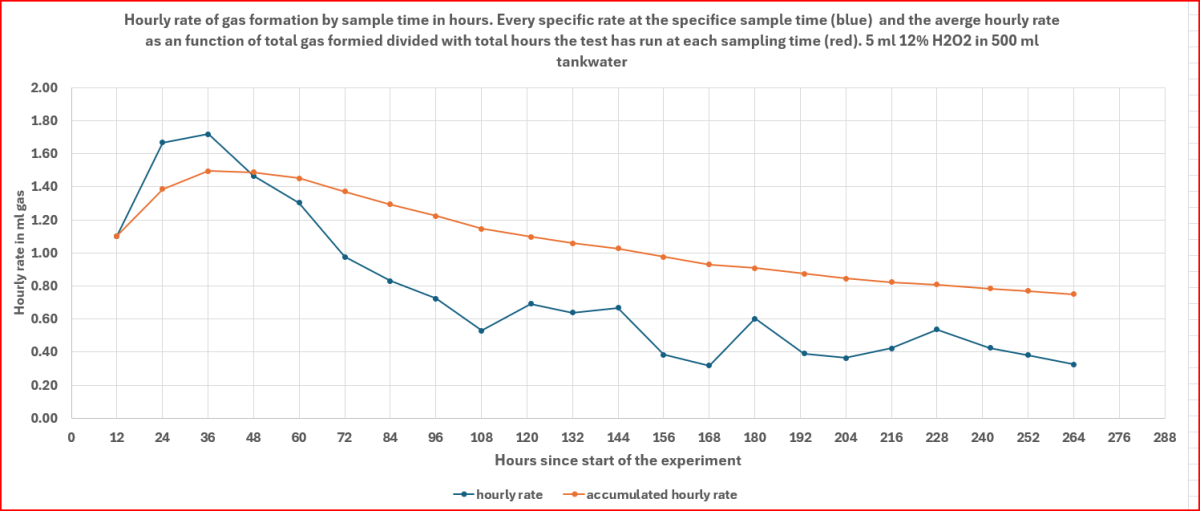
Interesting is also that in both 5 ml experiment - the hourly rate is highest after around 36 hours
After more than 10 days - its clear that it still H2O2 left in the test solution. However - the 1 ml sample is very different - it needs to be tested again.
At the moment - my test indicate that even in aquarium water - the lifetime of H2O2 molecule is larger than earlier believed
The test is still ongoing
Sincerely Lasse
Hydrogen peroxide has been (and still is) used as a controller of both gill parasites and salmon lice in commercial fish farms. Treatment concentrations between 300 and 1500 ppm. Some investigations around fish farms in fjords have indicated that the residence of uncatalyzed H2O2 in open water is much. much longer than earlier believed
I have started some tests to get a picture of how H2O2 breakdown in normal aquarium water and how it oxidizes other compounds. It’s clear that the whole molecule can act as an oxidizer, but the main oxidizing power seems to be by the metabolites of the process when H2O2 transfers to H2O and some oxygen radicals (the O atom itself and the hydroxide radical). Here the O will form some O2 gas, and it is the amount of this and its production rate I can measure with my simple method.
I use 2 pcs of 500 ml bottles with a cap that have a 4 ml hole in it. The bottles are filled with aquarium water and the amount of H2O2 I want to test. After that I turn the upside down and place them in a coca cola glass that allow the hole in the cap to "float" in the air and when gas is formed in the vessel – it rise to the bottom (remember upside down) of the bottle and for a gas bubble. The amount of water that is pressed out into the Coca Cola glass through the hole in the cap is equal to the volume of gas at the top. The theory is that if gas is produced - it’s still uncatalyzed H2O2 in the solution.
After 164 hours – it was still gas production in the bottle with 5 ml 12% H2O2 added and no gas at all produced in the control bottle.
2025-06-23 I start a second run - now including one bottle with added 5 ml 12% H2O2 and one with 1 ml 12% H2O2, The reason why I use this rather high concentrations is that they are around the concentration for dip treatment in fish farms. I want to see the pattern here before I test with lower concentrations of H2O2
Calculation 1 ml H2O2 (100%) is 1,45 g - in order to make 12 % solution (volume) I mix 12 ml 100% H2O2 with 88 ml water. The weight of 12 ml 100 H2O2 is 17.4 gram - which means that each ml of 12 % (volume) H2O2 contain 0.174 g or 174 mg H2O2. I mix 1 ml in 500 ml water -> 348 mg/L. The 5 ml solution will be 1740 mg/L. The extra O in H2O2 is 47% of the weight of the whole molecule - each ml 12% H2O2 contain 0.47*174 mg = 82 mg O or 82 mg O2 or around 60 ml O2 and my 5 ml 12% H2O2 will correspond to 410 mg free O and hence around 287 ml O2 gas. - Please - someone - correct me if I´m wrong - I´m no chemist.
However - I have run this experiment for more than 10 days now and the result is rather surprising. The bottle with 5 ml 12% H2O2 act rather like the first experiment with a total gas formation of around 156 ml gas in both runs (run 1 = 164 hours - run 2 = 168 hours)
However - the bottle with 1 ml 12% H2O2 acts a little different - it has been a rather steady production of gas and much lesser than expected
The 5 ml 12% H2O2 shows another pattern - note the decline of both the specific and average hourly rate
Interesting is also that in both 5 ml experiment - the hourly rate is highest after around 36 hours
After more than 10 days - its clear that it still H2O2 left in the test solution. However - the 1 ml sample is very different - it needs to be tested again.
At the moment - my test indicate that even in aquarium water - the lifetime of H2O2 molecule is larger than earlier believed
The test is still ongoing
Sincerely Lasse
Last edited:



















