



Experiments with Hydrogen peroxide

Lasse

10K Club member
View Badges
Joined
Mar 20, 2016
Messages
12,660
Reaction score
31,345
Location
Källarliden 14 D Bohus, Sweden
Rating - 0%
0   0   0
The use of hydrogen peroxide is more and more common in saltwater aquaria both in the form of using oxidators and directly dosing.
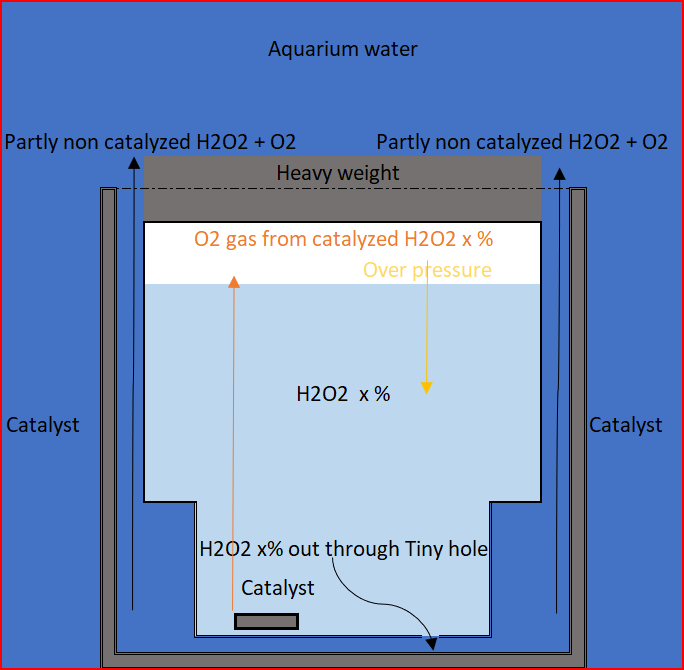
1751627368861.png
It is believed that hydrogen peroxide residence time in an aquarium is hours or maybe a day or two.

Hydrogen peroxide has been (and still is) used as a controller of both gill parasites and salmon lice in commercial fish farms. Treatment concentrations between 300 and 1500 ppm. Some investigations around fish farms in fjords have indicated that the residence of uncatalyzed H2O2 in open water is much. much longer than earlier believed


I have started some tests to get a picture of how H2O2 breakdown in normal aquarium water and how it oxidizes other compounds. It’s clear that the whole molecule can act as an oxidizer, but the main oxidizing power seems to be by the metabolites of the process when H2O2 transfers to H2O and some oxygen radicals (the O atom itself and the hydroxide radical). Here the O will form some O2 gas, and it is the amount of this and its production rate I can measure with my simple method.

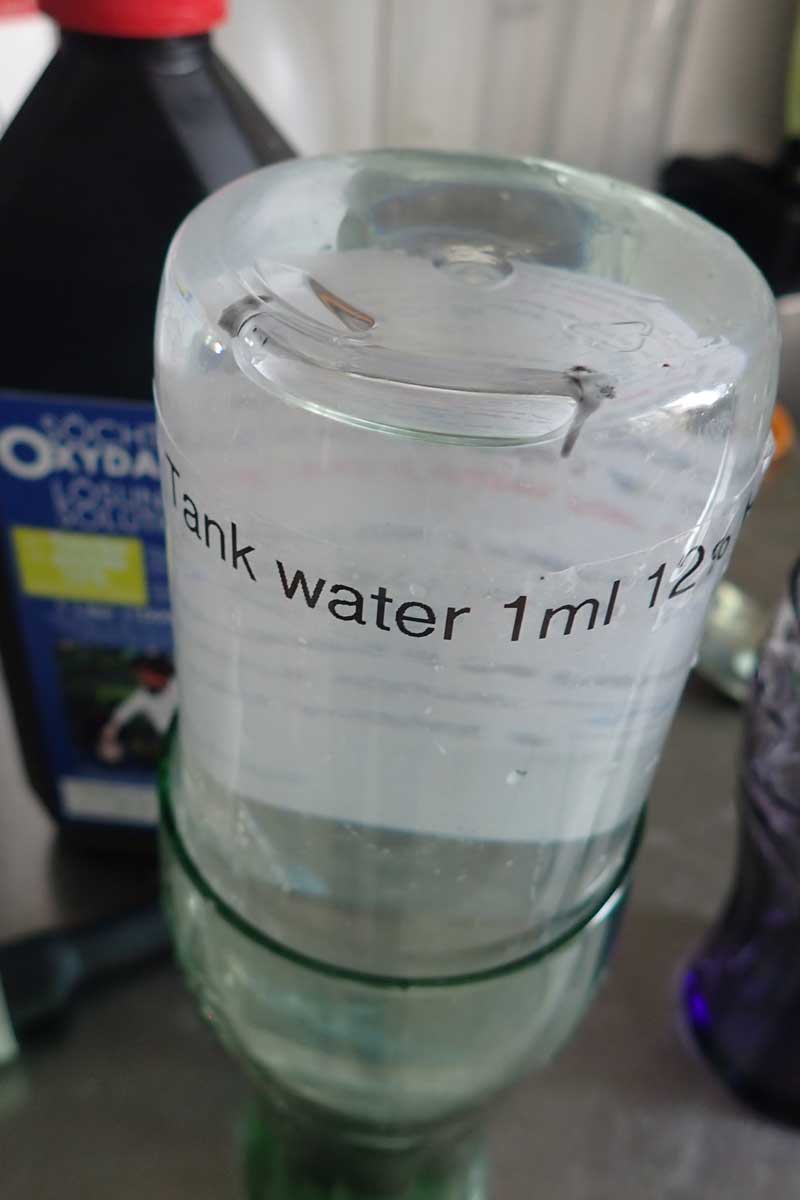
I use 2 pcs of 500 ml bottles with a cap that have a 4 ml hole in it. The bottles are filled with aquarium water and the amount of H2O2 I want to test. After that I turn the upside down and place them in a coca cola glass that allow the hole in the cap to "float" in the air and when gas is formed in the vessel – it rise to the bottom (remember upside down) of the bottle and for a gas bubble. The amount of water that is pressed out into the Coca Cola glass through the hole in the cap is equal to the volume of gas at the top. The theory is that if gas is produced - it’s still uncatalyzed H2O2 in the solution.
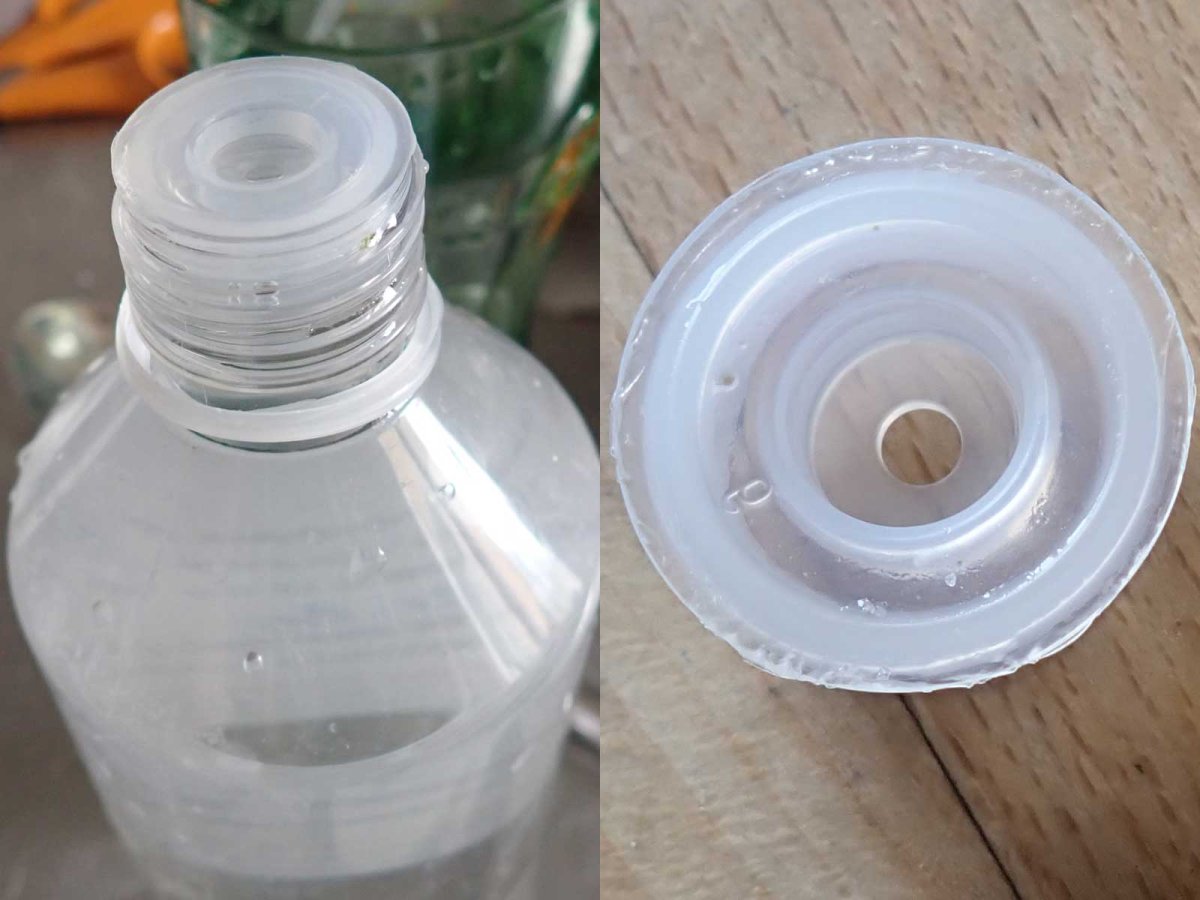
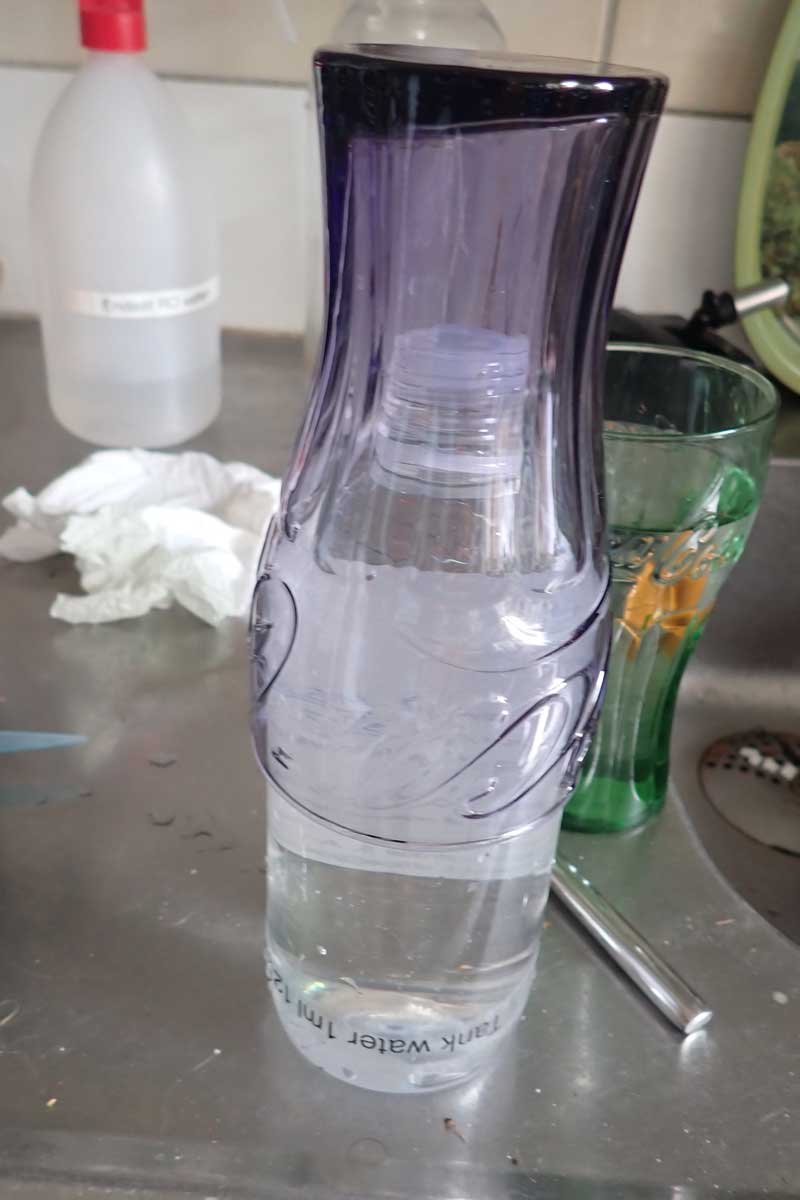
design-1.jpg


design-2.jpg
design-3.jpg

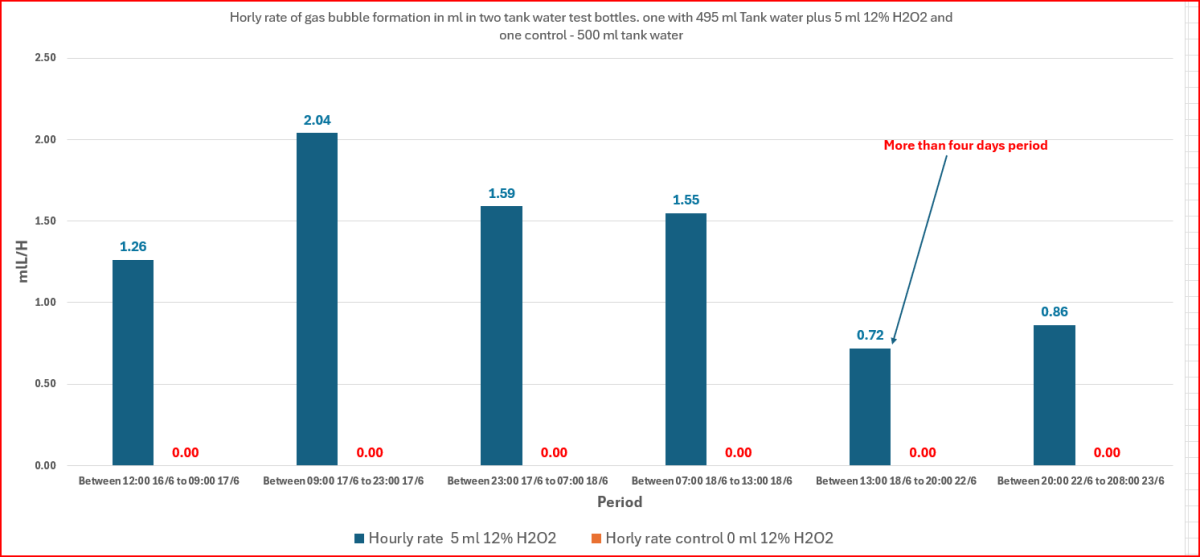
In tge first run – for 164 hours - I used 5 ml 12% H2O2 in 500 ml total and one bottle without any H2O2 at all. The zero sample was because I want to see if there was any other gas production taking place. The test was done with natural light.

After 164 hours – it was still gas production in the bottle with 5 ml 12% H2O2 added and no gas at all produced in the control bottle.

1751627844265.png


2025-06-23 I start a second run - now including one bottle with added 5 ml 12% H2O2 and one with 1 ml 12% H2O2, The reason why I use this rather high concentrations is that they are around the concentration for dip treatment in fish farms. I want to see the pattern here before I test with lower concentrations of H2O2

Calculation 1 ml H2O2 (100%) is 1,45 g - in order to make 12 % solution (volume) I mix 12 ml 100% H2O2 with 88 ml water. The weight of 12 ml 100 H2O2 is 17.4 gram - which means that each ml of 12 % (volume) H2O2 contain 0.174 g or 174 mg H2O2. I mix 1 ml in 500 ml water -> 348 mg/L. The 5 ml solution will be 1740 mg/L. The extra O in H2O2 is 47% of the weight of the whole molecule - each ml 12% H2O2 contain 0.47*174 mg = 82 mg O or 82 mg O2 or around 60 ml O2 and my 5 ml 12% H2O2 will correspond to 410 mg free O and hence around 287 ml O2 gas. - Please - someone - correct me if I´m wrong - I´m no chemist.

However - I have run this experiment for more than 10 days now and the result is rather surprising. The bottle with 5 ml 12% H2O2 act rather like the first experiment with a total gas formation of around 156 ml gas in both runs (run 1 = 164 hours - run 2 = 168 hours)

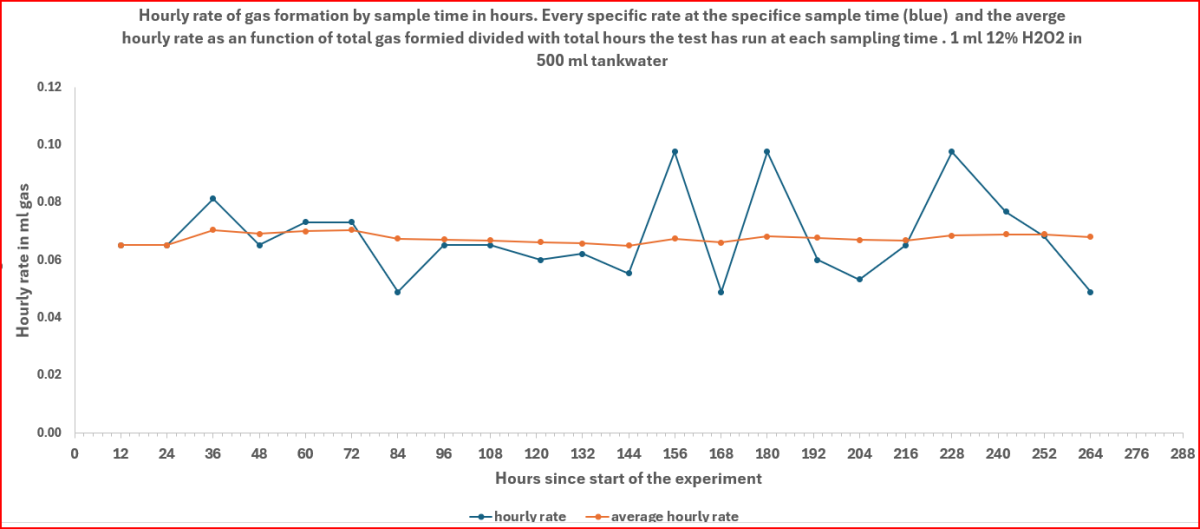
However - the bottle with 1 ml 12% H2O2 acts a little different - it has been a rather steady production of gas and much lesser than expected

1751632954496.png


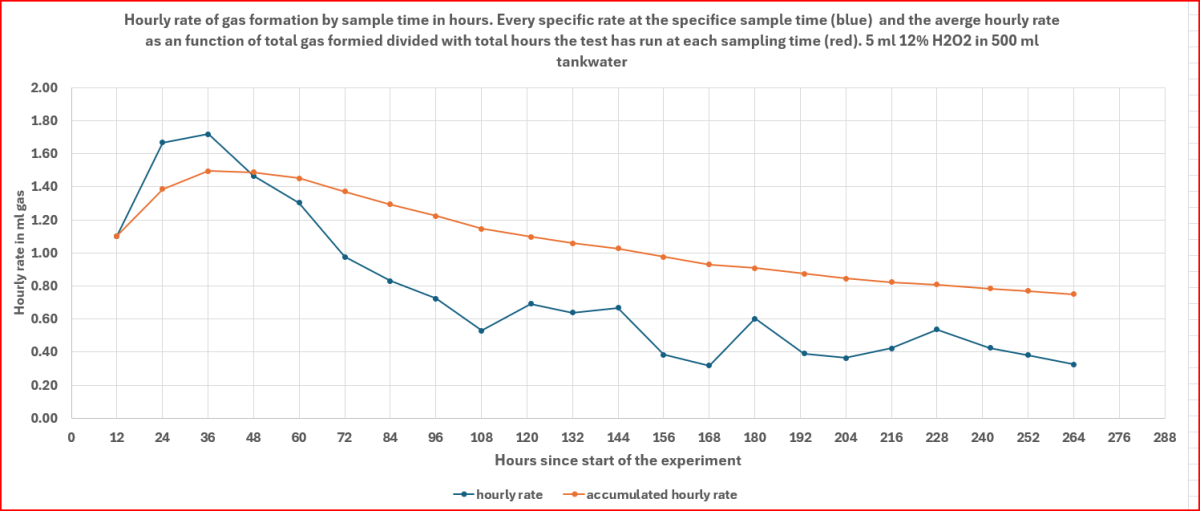
The 5 ml 12% H2O2 shows another pattern - note the decline of both the specific and average hourly rate

1751633098709.png


Interesting is also that in both 5 ml experiment - the hourly rate is highest after around 36 hours

After more than 10 days - its clear that it still H2O2 left in the test solution. However - the 1 ml sample is very different - it needs to be tested again.

At the moment - my test indicate that even in aquarium water - the lifetime of H2O2 molecule is larger than earlier believed

The test is still ongoing

Sincerely Lasse
 
Last edited:

ColorMeGone

Well-Known Member
View Badges
Joined
Jan 14, 2024
Messages
731
Reaction score
825
Location
Georgia
Rating - 0%
0   0   0
I just did a 3% Peroxide bath of all my rocks and corals last Sat. Most of my Zoes are fine with my shrooms not to happy. It also killed everything living like pods and other little critters along with all my snails except for one? I want to get a new CUC but not sure when to add them. I was under the impression that it dissipates within 24hrs or so. I also have been dosing MB7 everyday. Thought by tomorrow I could go get my some new snails and some hermits.🤔
 
OP
OP
Lasse

Lasse

10K Club member
View Badges
Joined
Mar 20, 2016
Messages
12,660
Reaction score
31,345
Location
Källarliden 14 D Bohus, Sweden
Rating - 0%
0   0   0
I just did a 3% Peroxide bath of all my rocks and corals last Sat. Most of my Zoes are fine with my shrooms not to happy. It also killed everything living like pods and other little critters along with all my snails except for one? I want to get a new CUC but not sure when to add them. I was under the impression that it dissipates within 24hrs or so. I also have been dosing MB7 everyday. Thought by tomorrow I could go get my some new snails and some hermits.🤔
How much 3 % did you use and in how much water?

Important to say its also that my test have been done with only water in contact with the peroxide. Only the catalyst that is present in seawater is responsible for the breakdown. I have also run the test in normal daylight and in the shadow - without any artificial light source. I will retest in artificial light too - light is known to be an important catalyst. This means that my findings is not engraved on stone tablets - its valid fot my aquarium water but may indicate something to think about

Sincerely Lasse
 
Last edited:

ColorMeGone

Well-Known Member
View Badges
Joined
Jan 14, 2024
Messages
731
Reaction score
825
Location
Georgia
Rating - 0%
0   0   0
I took all the rock out since it was full of Bubble algae. Poured straight 3% on all of it and let it sit for a few minutes. Then put it straight back in the tank without rinsing it off. This is in 7 gallons of water. The remainder of the algae on the sand and walls/back of AIO all died. Water was a mess and did a 2 gallon water change the next day and started dosing 2ml of MB7 and will continue for one more week. Do you think the peroxide has depleted yet?
 
OP
OP
Lasse

Lasse

10K Club member
View Badges
Joined
Mar 20, 2016
Messages
12,660
Reaction score
31,345
Location
Källarliden 14 D Bohus, Sweden
Rating - 0%
0   0   0
3 0z is around 90 ml 7 G is around 25 L. 1 ml 12 % H2O2 have a weight of 174 mg H2O2. 1 ml 3% will contain 1/4 of that -> 43,5 mg. 90 ml 3% is nearly 4000 mg - you start with around 160 mg/L H2O2 in your aquarium!

I would do a WC of all water ASAP or divided into a serie of small WC Below you can see the effect of different size of the WC if your start is around 100 ppm (mg/L) - you have already done 1 wc of 2 G

1751641770686.png


Sincerely Lasse
 

VintageReefer

10K Club member
View Badges
Joined
Nov 16, 2023
Messages
19,172
Reaction score
34,122
Location
USA
Rating - 100%
3   0   0
I took all the rock out since it was full of Bubble algae. Poured straight 3% on all of it and let it sit for a few minutes. Then put it straight back in the tank without rinsing it off. This is in 7 gallons of water. The remainder of the algae on the sand and walls/back of AIO all died. Water was a mess and did a 2 gallon water change the next day and started dosing 2ml of MB7 and will continue for one more week. Do you think the peroxide has depleted yet?
In future, you can get hydrogen peroxide in a spray bottle on Amazon. Saves product :)

Yes it will kill pods and asterina and tiny critters it comes in contact with.

As for bacteria, you probably have a lot inside the rock, this will multiply naturally and repopulate the rock
 

ColorMeGone

Well-Known Member
View Badges
Joined
Jan 14, 2024
Messages
731
Reaction score
825
Location
Georgia
Rating - 0%
0   0   0
3 0z is around 90 ml 7 G is around 25 L. 1 ml 12 % H2O2 have a weight of 174 mg H2O2. 1 ml 3% will contain 1/4 of that -> 43,5 mg. 90 ml 3% is nearly 4000 mg - you start with around 160 mg/L H2O2 in your aquarium!

I would do a WC of all water ASAP or divided into a serie of small WC Below you can see the effect of different size of the WC if your start is around 100 ppm (mg/L) - you have already done 1 wc of 2 G

1751641770686.png


Sincerely Lasse
Thanks for that. I have been doing my normal 3 cups a day water changes and am making some more water now. Maybe I should do larger WCs for a week or so. I'm guessing I should not add any CUC for a bit?
 

ColorMeGone

Well-Known Member
View Badges
Joined
Jan 14, 2024
Messages
731
Reaction score
825
Location
Georgia
Rating - 0%
0   0   0
In future, you can get hydrogen peroxide in a spray bottle on Amazon. Saves product :)

Yes it will kill pods and asterina and tiny critters it comes in contact with.

As for bacteria, you probably have a lot inside the rock, this will multiply naturally and repopulate the rock
Peroxide is .98 cents at wallmart. lol. I had no intensions of doing what I did to my tank but not being able to control the Bubble algae I just went crazy on it adn tore it down. Cost me some corals and critters but I could not take it any longer. Shame to since everything was so happy (but not me) lol
 

VintageReefer

10K Club member
View Badges
Joined
Nov 16, 2023
Messages
19,172
Reaction score
34,122
Location
USA
Rating - 100%
3   0   0
Peroxide is .98 cents at wallmart. lol. I had no intensions of doing what I did to my tank but not being able to control the Bubble algae I just went crazy on it adn tore it down. Cost me some corals and critters but I could not take it any longer. Shame to since everything was so happy (but not me) lol
Pithos crabs are almost a guarantee to eat bubble algae. Once problem is under control you could add a couple to get any straggler bubbles
 

ColorMeGone

Well-Known Member
View Badges
Joined
Jan 14, 2024
Messages
731
Reaction score
825
Location
Georgia
Rating - 0%
0   0   0
I have tried to get some but the two LFS said they can't order them so I gave up. I could have paid over $80 to get a few online but it's a crap shot if they work or not. Some say yes, and some say no. I am not going to put any more corals in this tank so if I killed it all then I'm good to go. Just want to add a new cuc and not sure when it will be safe. The one Astrea snail is still kicking though.
 

VintageReefer

10K Club member
View Badges
Joined
Nov 16, 2023
Messages
19,172
Reaction score
34,122
Location
USA
Rating - 100%
3   0   0
I have tried to get some but the two LFS said they can't order them so I gave up. I could have paid over $80 to get a few online but it's a crap shot if they work or not. Some say yes, and some say no. I am not going to put any more corals in this tank so if I killed it all then I'm good to go. Just want to add a new cuc and not sure when it will be safe. The one Astrea snail is still kicking though.
Yea when you factor in the shipping. They aren’t common for LFS to get. I ordered mine from reef cleaners as part of a bigger order. They ate bubble algae I dropped right in the shipping bag. It only took 4 to nearly completely eradicate the bubble algae in my 75g
 

Dread Pirate Dave

Valuable Member
View Badges
Joined
Jul 5, 2024
Messages
1,426
Reaction score
2,310
Location
Amherst, WI
Rating - 100%
1   0   0
I have tried to get some but the two LFS said they can't order them so I gave up. I could have paid over $80 to get a few online but it's a crap shot if they work or not. Some say yes, and some say no. I am not going to put any more corals in this tank so if I killed it all then I'm good to go. Just want to add a new cuc and not sure when it will be safe. The one Astrea snail is still kicking though.
I think if you factor in an LFS markup, gas and time to get them, $48 or $56 to have one or two delivered to your door the next day isn't that bad? And they are from fallow systems so less chance of introducing a pest.
 

ColorMeGone

Well-Known Member
View Badges
Joined
Jan 14, 2024
Messages
731
Reaction score
825
Location
Georgia
Rating - 0%
0   0   0
I understand but they may or may not work so I fixed the problem myself. lol
Nothing but CUC will enter my tank again and I will pour peroxide over their shells before they go in my new clean tank. My problem is to when it will be safe to add pods,snails/hermits. Been 6 days already so should be good to go?
Also, my apologies to Lasse for messing up his thread. I should have started my own but when he started talking about peroxide I had to jump in.
 

KrisReef

Last to get paid.
View Badges
Joined
May 15, 2018
Messages
22,082
Reaction score
39,130
Location
Vatican & Las Vegas Penthouse Quarters
Rating - 100%
1   0   0
How much 3 % did you use and in how much water?

Important to say its also that my test have been done with only water in contact with the peroxide. Only the catalyst that is present in seawater is responsible for the breakdown. I have also run the test in normal daylight and in the shadow - without any artificial light source. I will retest in artificial light too - light is known to be an important catalyst. This means that my findings is not engraved on stone tablets - its valid fot my aquarium water but may indicate something to think about

Sincerely Lasse
Cool Beans!

It seems that whatever is serving as the major catalyst(s?) in your tank water has reached the saturation limit in the 5 ml concentration compared with 1ml H2O2 solution.

The experiment is interesting in demonstrating the decay of H2O2 in a lab, vs a pond where more variables for H2O2 decay may be present?
 

MnFish1

10K Club member
View Badges
Joined
Dec 28, 2016
Messages
26,916
Reaction score
24,617
Location
Midwest
Rating - 100%
2   0   0
The use of hydrogen peroxide is more and more common in saltwater aquaria both in the form of using oxidators and directly dosing.

1751627368861.png
It is believed that hydrogen peroxide residence time in an aquarium is hours or maybe a day or two.

Hydrogen peroxide has been (and still is) used as a controller of both gill parasites and salmon lice in commercial fish farms. Treatment concentrations between 300 and 1500 ppm. Some investigations around fish farms in fjords have indicated that the residence of uncatalyzed H2O2 in open water is much. much longer than earlier believed


I have started some tests to get a picture of how H2O2 breakdown in normal aquarium water and how it oxidizes other compounds. It’s clear that the whole molecule can act as an oxidizer, but the main oxidizing power seems to be by the metabolites of the process when H2O2 transfers to H2O and some oxygen radicals (the O atom itself and the hydroxide radical). Here the O will form some O2 gas, and it is the amount of this and its production rate I can measure with my simple method.

I use 2 pcs of 500 ml bottles with a cap that have a 4 ml hole in it. The bottles are filled with aquarium water and the amount of H2O2 I want to test. After that I turn the upside down and place them in a coca cola glass that allow the hole in the cap to "float" in the air and when gas is formed in the vessel – it rise to the bottom (remember upside down) of the bottle and for a gas bubble. The amount of water that is pressed out into the Coca Cola glass through the hole in the cap is equal to the volume of gas at the top. The theory is that if gas is produced - it’s still uncatalyzed H2O2 in the solution.
design-1.jpg


design-2.jpg
design-3.jpg

In tge first run – for 164 hours - I used 5 ml 12% H2O2 in 500 ml total and one bottle without any H2O2 at all. The zero sample was because I want to see if there was any other gas production taking place. The test was done with natural light.

After 164 hours – it was still gas production in the bottle with 5 ml 12% H2O2 added and no gas at all produced in the control bottle.
1751627844265.png


2025-06-23 I start a second run - now including one bottle with added 5 ml 12% H2O2 and one with 1 ml 12% H2O2, The reason why I use this rather high concentrations is that they are around the concentration for dip treatment in fish farms. I want to see the pattern here before I test with lower concentrations of H2O2

Calculation 1 ml H2O2 (100%) is 1,45 g - in order to make 12 % solution (volume) I mix 12 ml 100% H2O2 with 88 ml water. The weight of 12 ml 100 H2O2 is 17.4 gram - which means that each ml of 12 % (volume) H2O2 contain 0.174 g or 174 mg H2O2. I mix 1 ml in 500 ml water -> 348 mg/L. The 5 ml solution will be 1740 mg/L. The extra O in H2O2 is 47% of the weight of the whole molecule - each ml 12% H2O2 contain 0.47*174 mg = 82 mg O or 82 mg O2 or around 60 ml O2 and my 5 ml 12% H2O2 will correspond to 410 mg free O and hence around 287 ml O2 gas. - Please - someone - correct me if I´m wrong - I´m no chemist.

However - I have run this experiment for more than 10 days now and the result is rather surprising. The bottle with 5 ml 12% H2O2 act rather like the first experiment with a total gas formation of around 156 ml gas in both runs (run 1 = 164 hours - run 2 = 168 hours)

However - the bottle with 1 ml 12% H2O2 acts a little different - it has been a rather steady production of gas and much lesser than expected
1751632954496.png


The 5 ml 12% H2O2 shows another pattern - note the decline of both the specific and average hourly rate
1751633098709.png


Interesting is also that in both 5 ml experiment - the hourly rate is highest after around 36 hours

After more than 10 days - its clear that it still H2O2 left in the test solution. However - the 1 ml sample is very different - it needs to be tested again.

At the moment - my test indicate that even in aquarium water - the lifetime of H2O2 molecule is larger than earlier believed

The test is still ongoing

Sincerely Lasse
This is very interesting - I'm curious - (and I'm sure you know) - did you use an absolutely fresh bottle of H2O2- since it can degrade some?

The gas measurement is very elegant and simple. I wonder - if you added some live rock - or something else that would be in an aquarium - whether you would see the same patterns?
 
OP
OP
Lasse

Lasse

10K Club member
View Badges
Joined
Mar 20, 2016
Messages
12,660
Reaction score
31,345
Location
Källarliden 14 D Bohus, Sweden
Rating - 0%
0   0   0
I have start a new "zero" bottle with only tank water and no addition of extern H2O2. The reason is that I have run my oxydator in the tank rather much and there can be surplus H2O2 from the tank water causing the "weird" result in my 1 ml sample. The result I have seen get me to wonder if I forgot to add 1 ml 12% H2O2 in that bottle and the gas forming in that sample is done by residue H2O2 from the tank.

I could start a new test but I do not want to finish the present run before I see how long time I still have active H2O2 in the bottle

Sincerely Lasse
 
OP
OP
Lasse

Lasse

10K Club member
View Badges
Joined
Mar 20, 2016
Messages
12,660
Reaction score
31,345
Location
Källarliden 14 D Bohus, Sweden
Rating - 0%
0   0   0
The experiment is interesting in demonstrating the decay of H2O2 in a lab, vs a pond where more variables for H2O2 decay may be present?

if you added some live rock - or something else that would be in an aquarium - whether you would see the same patterns?
In a later experiment - I will add the most common catalyst - light. Maybe some gravel too

Sincerely Lasse
 

TOP 10 Trending Threads

WHAT AMOUNT OF LIVE ROCK AND SAND SHOULD BE PRIORITIZED FOR OPTIMAL BIODIVERSITY/FILTRATION?

  • 100% live rock + bagged sand

    Votes: 34 27.0%
  • 100% dry rock + 100% live sand

    Votes: 45 35.7%
  • 50/50 live/dry rock, 50/50 live/bagged sand

    Votes: 27 21.4%
  • 75% live rock, 25% live sand

    Votes: 11 8.7%
  • 25% live rock, 75% live sand

    Votes: 9 7.1%
Back
Top









