Good news! Silicate does not decrease GFO’s effectiveness!

Miami Reef

Reef Chem Enthusiast
View Badges
Joined
Sep 8, 2017
Messages
17,255
Reaction score
29,659
Location
Miami
What state or country do you live in
Florida
Rating - 0%
0   0   0
It’s a paradox: I like using GFO to remove phosphate from my aquarium, but I also like dosing silicate for sponges and diatoms. GFO is known to bind silicate, and I’ve always wondered if I’m wasting my money binding silicate instead of phosphate when adding both.

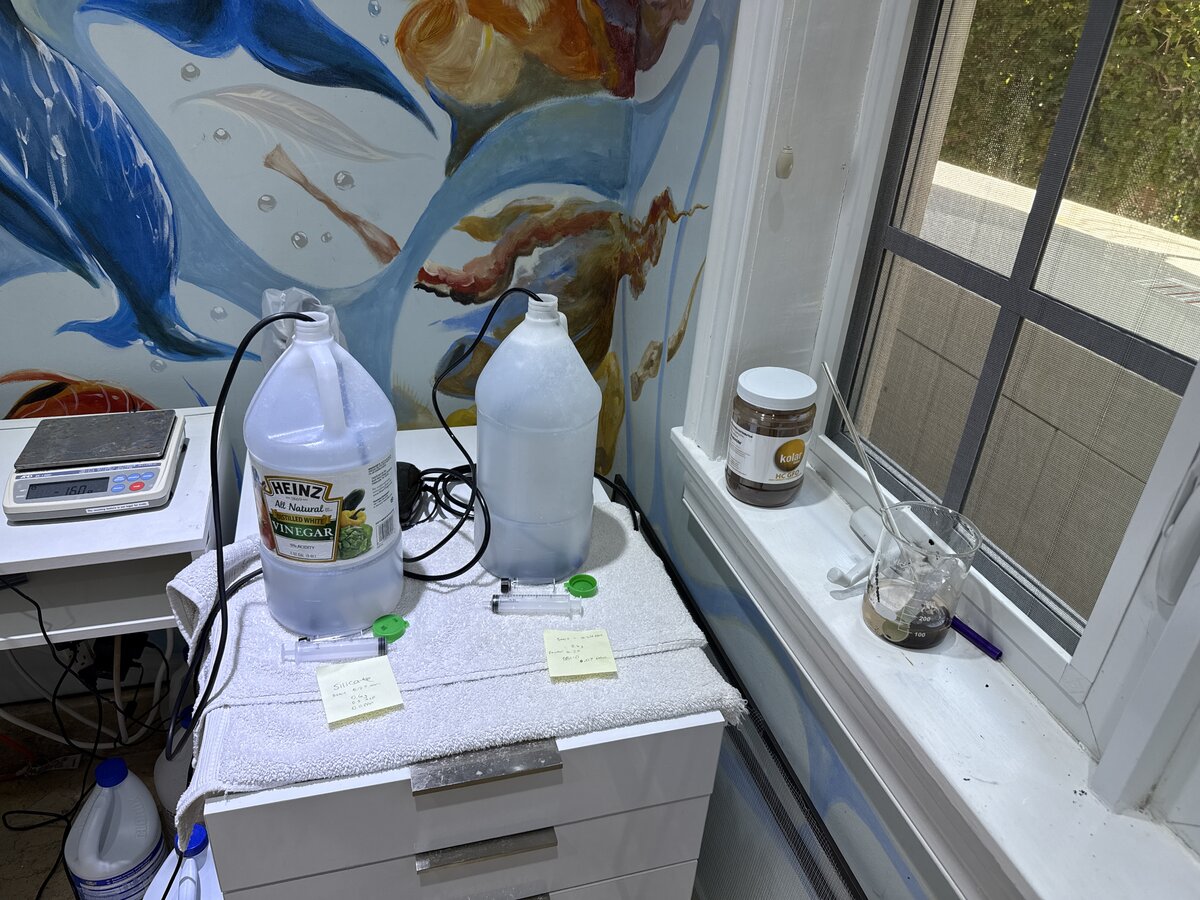
I did a small hobby-grade experiment: I made 2 vessels of fresh seawater and added 0.25 ppm phosphate per each. Then, I spiked one with 2 ppm silicate.

Over the course of a few days I slowly added GFO, tracking how much phosphate decreased over time. I learned GFO has a higher affinity for phosphate. It ended up decreasing both vessels to 0.01 ppm at a very similar depletion rate.

For the people using GFO to remove silicate from the water…maybe all you’re doing is removing phosphate. 🙂

What do you think?

IMG_4471.jpeg
 
It’s possible for the results to be different in the real world with organics and stuff. At least in my test, I didn’t see a significant silicate preference that decreased the efficacy of phosphate adsorption.
 
It’s a paradox: I like using GFO to remove phosphate from my aquarium, but I also like dosing silicate for sponges and diatoms. GFO is known to bind silicate, and I’ve always wondered if I’m wasting my money binding silicate instead of phosphate when adding both.

I did a small hobby-grade experiment: I made 2 vessels of fresh seawater and added 0.25 ppm phosphate per each. Then, I spiked one with 2 ppm silicate.

Over the course of a few days I slowly added GFO, tracking how much phosphate decreased over time. I learned GFO has a higher affinity for phosphate. It ended up decreasing both vessels to 0.01 ppm at a very similar depletion rate.

For the people using GFO to remove silicate from the water…maybe all you’re doing is removing phosphate. 🙂

What do you think?

IMG_4471.jpeg
Nice experiment.

How much did the silicate level drop?
 
Hi, my silicate and silicon levels are very high. I’m not dosing anything, and I’m using a phosphate remover, but the levels are not dropping. There’s also a lot of sponge growth, but no dino. What could be the reason?
 
Hi, my silicate and silicon levels are very high. I’m not dosing anything, and I’m using a phosphate remover, but the levels are not dropping. There’s also a lot of sponge growth, but no dino. What could be the reason?

When you say levels are not dropping, does that mean phosphate or silicate is not dropping?

What is your phosphate level?
 
Phosphate is dropping but slikat and silicones not.
 
Phosphate is around 0.02-0.05 also I dose phos feed
 
Phosphate is dropping but slikat and silicones not.

It is somewhat unclear what the chemicals are that folks get when Si is very high by icp, and GFO won’t bind uncharged Si molecules. They also are unlikely to be used by diatoms or sponges, and may be relatively inert in reef aquaria. I’d ignore them if you do not have a problematic level of diatoms.
 
Thank you so much I will follow your recommendation 🙏🏼
 

TOP 10 Trending Threads

HOW MUCH DOES A FISH’S FEEDING REQUIREMENTS AFFECT YOUR STOCKING DECISIONS?

  • A lot! - I avoid fish that require frequent or specialized feeding

    Votes: 22 32.4%
  • Quite a bit, but an automatic feeder can change my answer

    Votes: 10 14.7%
  • It depends on whether my nutrient export can handle it

    Votes: 9 13.2%
  • It depends on how badly I want the fish

    Votes: 14 20.6%
  • Not much. I’m willing to adjust my routine

    Votes: 12 17.6%
  • Not at all. Feeding demands don’t limit my stocking choices

    Votes: 12 17.6%
  • I usually learn about the demanding feeding schedule after buying the fish!

    Votes: 2 2.9%
  • I haven’t really considered this before

    Votes: 4 5.9%
  • Something else (see my comments in the thread)

    Votes: 2 2.9%
Back
Top
Home
Post thread…
Market
What's new