


Miami Reef
Reef Chem Enthusiast
View BadgesPartner Member 2026
Excellence Award
R2R App User
Expert Contributor
Article Contributor
Rest In Peace
Hospitality Award
305 Reef Club
R2R Research
ThreadAward
My Tank Thread
- Joined
- Sep 8, 2017
- Messages
- 17,255
- Reaction score
- 29,666
- Location
- Miami
- What state or country do you live in
- Florida
Introduction:
Many reef tanks have an incredible nitrate demand, and despite the additional fish and coral food, still struggle to make an impact on the nitrate level. This can subject corals, anemones, coralline, macro/microalgae, and clams to nutrient starvation. Any photosynthetic organism requires an external nitrogen source because they cannot synthesize it on their own. While using a DIY nitrate dosing recipe is a fine plan to increase nitrate, corals and photosynthetic organisms prefer and will readily assimilate ammonia. In order for an organism to utilize nitrate, they must first internally convert it into ammonia; this takes more work and is less bioavailable. When given the choice, these organisms will choose ammonia over nitrate.
Why dose ammonia and what does it do?
Dosing ammonia can accomplish two goals: it increases nitrogen availability, and it can also be used as an indirect nitrate additive. Photosynthetic creatures can still use and benefit from nitrate, and having detectable levels is important to ensure nitrogen is constantly available. Nitrifying bacteria will convert excess ammonia into nitrate. While there is little risk of proper ammonia dosing to accumulate in cycled reef tanks, it also means ammonia will always be in short supply. For this reason, a detectable level of nitrate is recommended.
Ammonium chloride or ammonia bicarbonate?
Ammonium chloride and ammonium bicarbonate are the two common ammonium compounds used in reefkeeping. I prefer ammonium bicarbonate because it has no effect on the alkalinity of the aquarium, whereas ammonium chloride steadily depletes it: every 50 ppm of nitrate equivalents added through ammonium chloride will decrease the alkalinity by 2.3 dKH. It has an acidifying effect. Both are readily available online. It's highly recommended and inexpensive to source food-grade and high purity sources.
Ammonia Recipes:
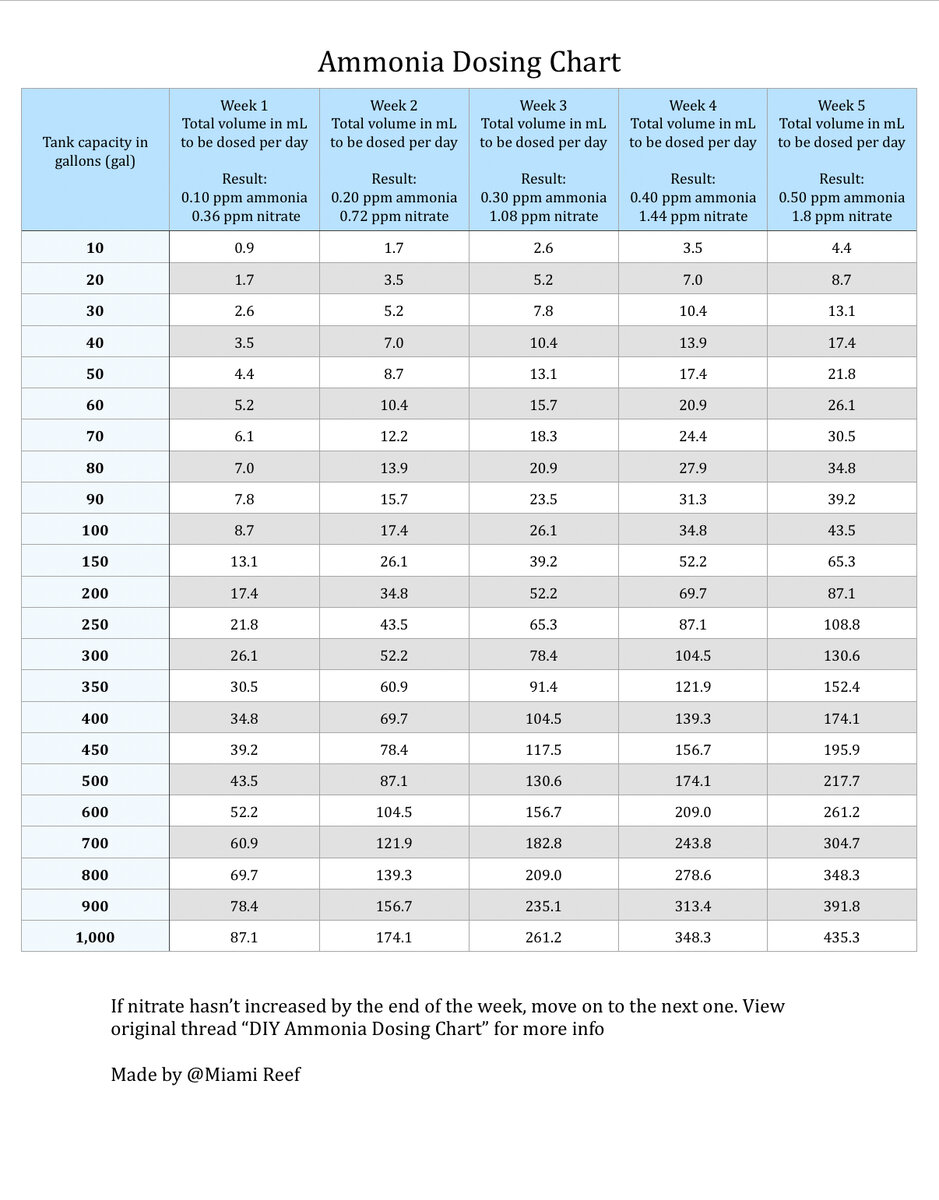
The original recipes were taken from the DIY ammonia dosing for low nitrate systems thread by @Randy Holmes-Farley. I've only conveniently organized the chart and dosing regimen.
Ammonium bicarbonate: most ideal for alkalinity stability. However, it is prone to evaporation and losing potency from air exposure. Keep the solution as tightly sealed as possible, away from chronic air exposure.
Recipe:
20 g ammonium bicarbonate in 1 L of freshwater.
-------------------------------------
Ammonium chloride: While the solution is more shelf stable, it will steadily decrease the alkalinity over time, so additional alkalinity compensation may be warranted in tanks receiving substantial ammonium chloride dosing.
Recipe:
13.5 g ammonium chloride in 1 L of freshwater
Both of these solutions have the same concentration: 4300 mg/L (4.3 mg/mL) ammonia, equivalent to 15,700 mg/l nitrate. 2.3 mL of this solution added to 100 L raises ammonia by 0.10 ppm (nitrate equivalent to 0.36 ppm).
Use nitrate tests to guide the dose
It's recommended to use nitrate levels as a proxy for targeting ammonia dosing, as directly testing ammonia isn't very accurate for the low and safe levels we aim for.
1. If nitrate is decreasing below your ideal target, nitrogen is in short supply (deficit) and warrants more ammonium dosing.
2. If nitrate is held stable around your ideal target, the dose is maintaining the nitrogen demand, which is the ultimate goal.
3. If nitrate is increasing beyond your goal, there is a surplus, and the dose should either be reduced or stopped.
Knowing how to progress with the chart:
Start the chart from week one and determine whether a dose increase is warranted by the end of the week. If nitrate is undetectable and hasn't increased within 3-4 days of dosing, skip to the following week.
Pro tip:
Ammonium can be mixed with nitrate and even phosphate in the same solution. There are no interactions between them.
Why are we dosing ammonium instead of actual ammonia?
We cannot readily dose actual ammonia; it is a vapor at normal room temperature and pressure. Ammonium is a suitable substitute because some naturally converts into ammonia in seawater depending on pH, similar to how bicarbonate and carbonate alkalinity sources shift among each other despite only dosing one form.
Many reef tanks have an incredible nitrate demand, and despite the additional fish and coral food, still struggle to make an impact on the nitrate level. This can subject corals, anemones, coralline, macro/microalgae, and clams to nutrient starvation. Any photosynthetic organism requires an external nitrogen source because they cannot synthesize it on their own. While using a DIY nitrate dosing recipe is a fine plan to increase nitrate, corals and photosynthetic organisms prefer and will readily assimilate ammonia. In order for an organism to utilize nitrate, they must first internally convert it into ammonia; this takes more work and is less bioavailable. When given the choice, these organisms will choose ammonia over nitrate.
Why dose ammonia and what does it do?
Dosing ammonia can accomplish two goals: it increases nitrogen availability, and it can also be used as an indirect nitrate additive. Photosynthetic creatures can still use and benefit from nitrate, and having detectable levels is important to ensure nitrogen is constantly available. Nitrifying bacteria will convert excess ammonia into nitrate. While there is little risk of proper ammonia dosing to accumulate in cycled reef tanks, it also means ammonia will always be in short supply. For this reason, a detectable level of nitrate is recommended.
Ammonium chloride or ammonia bicarbonate?
Ammonium chloride and ammonium bicarbonate are the two common ammonium compounds used in reefkeeping. I prefer ammonium bicarbonate because it has no effect on the alkalinity of the aquarium, whereas ammonium chloride steadily depletes it: every 50 ppm of nitrate equivalents added through ammonium chloride will decrease the alkalinity by 2.3 dKH. It has an acidifying effect. Both are readily available online. It's highly recommended and inexpensive to source food-grade and high purity sources.
Ammonia Recipes:
The original recipes were taken from the DIY ammonia dosing for low nitrate systems thread by @Randy Holmes-Farley. I've only conveniently organized the chart and dosing regimen.
Ammonium bicarbonate: most ideal for alkalinity stability. However, it is prone to evaporation and losing potency from air exposure. Keep the solution as tightly sealed as possible, away from chronic air exposure.
Recipe:
20 g ammonium bicarbonate in 1 L of freshwater.
-------------------------------------
Ammonium chloride: While the solution is more shelf stable, it will steadily decrease the alkalinity over time, so additional alkalinity compensation may be warranted in tanks receiving substantial ammonium chloride dosing.
Recipe:
13.5 g ammonium chloride in 1 L of freshwater
Both of these solutions have the same concentration: 4300 mg/L (4.3 mg/mL) ammonia, equivalent to 15,700 mg/l nitrate. 2.3 mL of this solution added to 100 L raises ammonia by 0.10 ppm (nitrate equivalent to 0.36 ppm).
Use nitrate tests to guide the dose
It's recommended to use nitrate levels as a proxy for targeting ammonia dosing, as directly testing ammonia isn't very accurate for the low and safe levels we aim for.
1. If nitrate is decreasing below your ideal target, nitrogen is in short supply (deficit) and warrants more ammonium dosing.
2. If nitrate is held stable around your ideal target, the dose is maintaining the nitrogen demand, which is the ultimate goal.
3. If nitrate is increasing beyond your goal, there is a surplus, and the dose should either be reduced or stopped.
Knowing how to progress with the chart:
Start the chart from week one and determine whether a dose increase is warranted by the end of the week. If nitrate is undetectable and hasn't increased within 3-4 days of dosing, skip to the following week.
Pro tip:
Ammonium can be mixed with nitrate and even phosphate in the same solution. There are no interactions between them.
Why are we dosing ammonium instead of actual ammonia?
We cannot readily dose actual ammonia; it is a vapor at normal room temperature and pressure. Ammonium is a suitable substitute because some naturally converts into ammonia in seawater depending on pH, similar to how bicarbonate and carbonate alkalinity sources shift among each other despite only dosing one form.
Last edited:





 Nice article thanks for this














