

light rail Project still in motion!!!

Battlecorals

Vivat imitator!
View Badges
Joined
Oct 15, 2009
Messages
8,717
Reaction score
20,622
Location
Wisconsin
Rating - 100%
2   0   0
So I dug a little bit and I couldn't find anything quite like this other than the standard light rail that moves back-and-forth on a flat track. I use those in the past and they were great. It's not what I'd like for this application, but we're basically going to expand.

I think I have a guy who can fabricate it if we can design it, but what I'm proposing to build, is essentially an arced light rail that spans 4 foot wide that would move back-and-forth throughout the day maybe once or twice.

Why do I like the idea? Couple reasons.

First, I could cut my light fixtures and usage in half. So rather than running four lights over my raceways each I could run two. Which would be considered a significant in my case.

Second, I like the idea of hitting the corals at just about every angle throughout the course of the day. This would be different than typical flat light rail that just moves back-and-forth because the light itself would be angled inward at the far end of the arc. so as it progressed throughout the cycle, it would almost simulate the sun in that regard as a point source hitting a lot more areas of the Coral than a regular mounted light.


Now the overall cost of designing and making something like this I'm sure exceeds the cost of the additional fixtures I'm running on each raceway, and I would need at least five rigs to cover all of the tanks I'm running a LEDs one, so it could be a pretty hefty price tag at the end of the day, but I can see a lot of benefits to lighting propagation raceways this way. And if it could be pulled off feasibly, I would absolutely try it.

Essentially, it's an arced light rail mover that I would have to be able to mount two LED fixtures on somehow.


Now, forgive this drawing, it does not get any cruder than this, but I'd like to think it'llgive you an idea at least a visual of what I'm trying to say here.

so if any ambitious go-getters, would like to help me actually design something like this let me know.
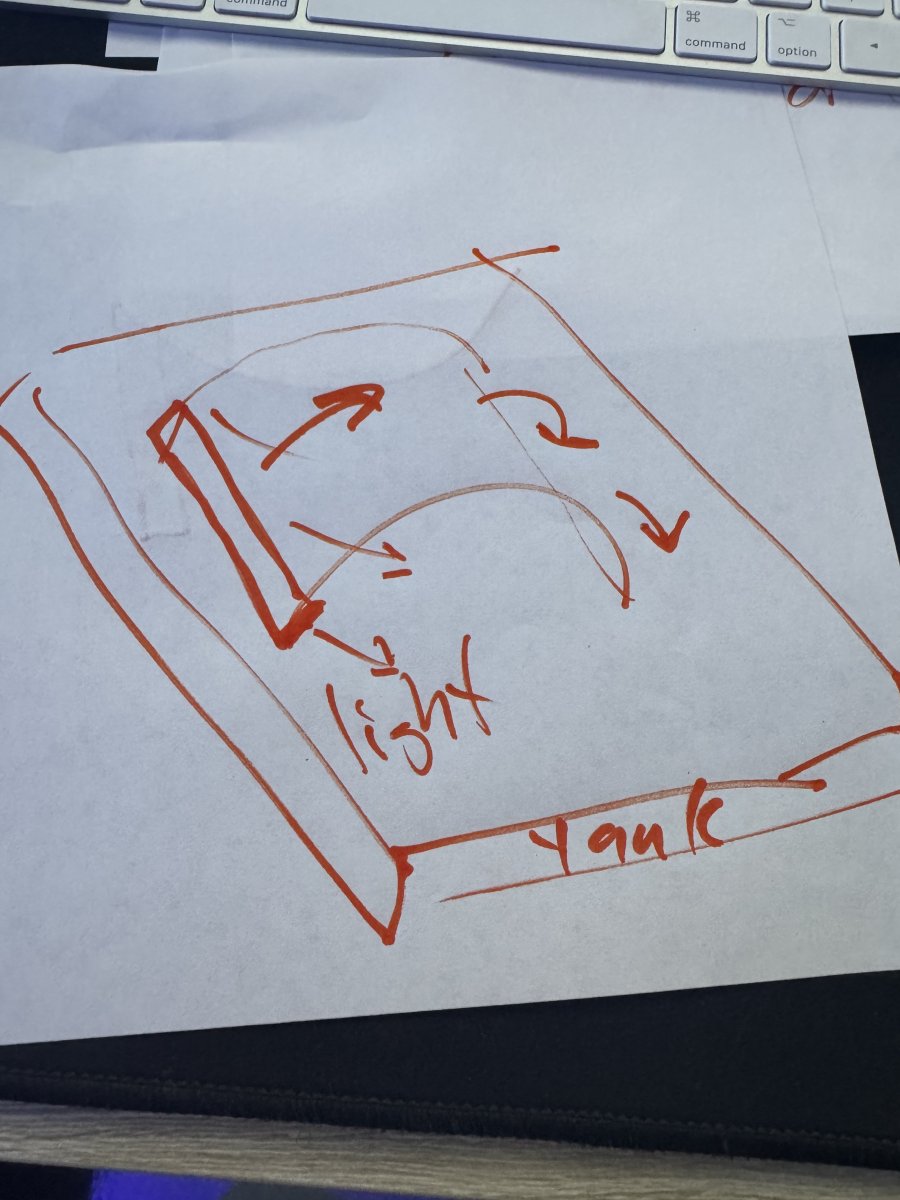
IMG_8410.jpeg
 

JTP424

2500 Club Member
View Badges
Joined
Jan 10, 2022
Messages
2,762
Reaction score
3,195
Location
US
Rating - 0%
0   0   0
This is awesome.
I'm no engineer... but if you could bend conduit, this might be a start.
Basically stepper motors running on tracks... not sure how to curve the rubber tracks though....
You'd technically need one axis...
OR build two verticals... so it rises and lowers.... hmmmm
 
OP
OP
Battlecorals

Battlecorals

Vivat imitator!
View Badges
Joined
Oct 15, 2009
Messages
8,717
Reaction score
20,622
Location
Wisconsin
Rating - 100%
2   0   0
This is awesome.
I'm no engineer... but if you could bend conduit, this might be a start.
Basically stepper motors running on tracks... not sure how to curve the rubber tracks though....
You'd technically need one axis...
OR build two verticals... so it rises and lowers.... hmmmm
Yes, right my man! something like that. Definitely on the right track. That's kind of how the traditional light rail movers work they just have a little motor that propels itself on the actual rail. I was envisioning some weird gear system, or some thing or like a chain even almost like a garage door opener. and some like this makes way more sense
 

Jasonak

7500 Club Member
View Badges
Joined
Feb 11, 2018
Messages
7,609
Reaction score
11,903
Location
Anchorage
Rating - 0%
0   0   0
Cool idea, well if no engineers figure it out a cool way to do this, you could hang three lights, that would save you one. Two down low at angles like your drawing and one up high dead center and have the lot track back and fourth instead of left to right if that makes sense.
 
OP
OP
Battlecorals

Battlecorals

Vivat imitator!
View Badges
Joined
Oct 15, 2009
Messages
8,717
Reaction score
20,622
Location
Wisconsin
Rating - 100%
2   0   0
Cool idea, well if no engineers figure it out a cool way to do this, you could hang three lights, that would save you one. Two down low at angles like your drawing and one up high dead center and have the lot track back and fourth instead of left to right if that makes sense.
Yeah, that does make sense! that would be a fantastic Plan B for this that would work on a conventional light rail and just move parallel to the tank.

Not a bad idea my friend. I think I can get away with two lights slightly angled inward and we would just need essentially a rounded mount for the lights or a triangle whatever that would be pretty simple. Actually, I'm our friend lee could do it.
 

Mschmidt

Average Maybe
View Badges
Joined
Feb 9, 2022
Messages
18,574
Reaction score
39,605
Location
Bellingham
Rating - 0%
0   0   0
It might be easier to have a flat rail and angle the light as it moves along it. That would take one motor to move the light and one to rotate it.
I think the programming would be harder than the building though. At least in my head.
 
OP
OP
Battlecorals

Battlecorals

Vivat imitator!
View Badges
Joined
Oct 15, 2009
Messages
8,717
Reaction score
20,622
Location
Wisconsin
Rating - 100%
2   0   0
It might be easier to have a flat rail and angle the light as it moves along it. That would take one motor to move the light and one to rotate it.
I think the programming would be harder than the building though. At least in my head.
Actually, the more I think about it, Jason‘s idea of just running three stationary lights. The outside ones on an angle inward, parallel on a simple light rail really makes sense to me and would definitely be the path of these resistance to essentially achieve just about the same effect.

Maybe not as cool from a gizmo perspective, but function over form here I think would be very effective

And the best news of allI think I still have three or four of them out in the shed, light rails I mean.

However, I like your idea too, and that would be a heck of a lot easier than having to create a round rail. Mechanically would be pretty simple. I agree the programming would be way out of my wheelhouse by about a gazillion. lol
 

Mschmidt

Average Maybe
View Badges
Joined
Feb 9, 2022
Messages
18,574
Reaction score
39,605
Location
Bellingham
Rating - 0%
0   0   0
Actually, the more I think about it, Jason‘s idea of just running three stationary lights. The outside ones on an angle inward, parallel on a simple light rail really makes sense to me and would definitely be the path of these resistance to essentially achieve just about the same effect.

Maybe not as cool from a gizmo perspective, but function over form here I think would be very effective

And the best news of allI think I still have three or four of them out in the shed, light rails I mean.

However, I like your idea too, and that would be a heck of a lot easier than having to create a round rail. Mechanically would be pretty simple. I agree the programming would be way out of my wheelhouse by about a gazillion. lol
And running Jason's idea means more lights. But your side lights don't really need to be trn same meridian since they are effectively a secondary light.

I'm sure there is someone out there that could code it easily enough. Just an angle of x at position y and change at z rate. Kinda how a 3d printer adjusts the feed rate.
 

BeanAnimal

7500 Club Member
View Badges
Joined
Jul 16, 2009
Messages
9,275
Reaction score
15,568
Rating - 0%
0   0   0
I am not an engineering student, but I posted a few designs for this back at RC years ago. The idea was to move a metal halide in an arc. The idea was abandoned for several reasons.

The basic are easy:
A single continuous loop cable with limit reversing switches on each side is the easiest approach. Trying to sync two opposite motors for pull and braking is a bit of a mess. The rails, bearings and trolly are fairly simple.

The pitfalls are significant:
The biggest issue is the coverage. If the light moves in an arc, then the arc must extend well beyond the sides of the tank, otherwise the ends will not get light. Even then, the rim of the tank will shadow the coral. This means at the extreme ends (extended or not), the light needs to point down, not toward a single focal point or perpendicular to the tangent of the arc.

While this is "doable" it requires the trolly to also have a means to aim the light in a non linear fashion based on the rail position. This could be another stepper and logic or a two lobed cam that rides the rail. etc. The point is that it adds a fair bit of complication to an otherwise simple setup.

The arc also means that the middle of the tank will overall see less light energy than the sides, due to the law of inverse squares and the hight of the fixture rising as it travels to "midday". Now this is "fixable" to an extent if the light is always somewhat aimed toward the center. In the end, it just means a good bit of math to get the angle and speed correct.

You read that correctly... speed. The only way to figure out overall light energy is to take the radious of the arc, the beam angle and the light angle into consideration. This may mean ideally a non linear speed as the fixture approaches or leaves the apex of the arch.

Anyway - it all felt like far more trouble than it was worth compared to a linear light mover.
 

tripdad

Valuable Member
View Badges
Joined
Feb 9, 2014
Messages
2,293
Reaction score
4,876
Location
Chicago suburbs
Rating - 0%
0   0   0
The arc also means that the middle of the tank will overall see less light energy than the sides, due to the law of inverse squares and the hight of the fixture rising as it travels to "midday". Now this is "fixable" to an extent if the light is always somewhat aimed toward the center. In the end, it just means a good bit of math to get the angle and speed correct.
This could be solved by programming a ramp up and down cycle to coincide with the distance from the coral. And a simple "cam follower" on a patterned third rail can change fixture angle fairly easily.
 

BeanAnimal

7500 Club Member
View Badges
Joined
Jul 16, 2009
Messages
9,275
Reaction score
15,568
Rating - 0%
0   0   0
This could be solved by programming a ramp up and down cycle to coincide with the distance from the coral. And a simple "cam follower" on a patterned third rail can change fixture angle fairly easily.

Yes to both. That profiled rail was basically what we came up with when discussing the design on RC. We didn't have dimming halides though 🙃

I don't have a design for the profiled rail, but I do (somewhere) have a set of AutoCad drawings for the trolly. It was designed around 3/4" EMT, 608 bearings and small urethane tires. The pulleys and cable were stainless and driven by a stepper. It may be easier to start from scratch in Fusion360 though and much easier to model the profile rail.

I bent a few pieces of conduit on a wooden form. It was tough to get them even and smooth. I think a ring roller would be needed to do this right.

I still think it is far more trouble than it is worth, but interesting. I don't mind helping with the design if needed.
 

Sisterlimonpot

Effortless Perfection
View Badges
Joined
Jul 15, 2009
Messages
4,891
Reaction score
8,621
Location
Litchfield Park
Rating - 100%
2   0   0
I did something similar a few years back with the effort to get more light coverage from the single source LEDs.

A time lapse of it in motion:


A motion study of the basic mechanics:


Actual mechanism in motion:


I also dabbled a little bit in simply rotating the frags themselves, but I never perfected it. It would've been cool to see how a frag grew while rotating in the flow as well as how the light effected growth of the normally shaded parts.


Anyway... these are some ideas to mull over.
 

BeanAnimal

7500 Club Member
View Badges
Joined
Jul 16, 2009
Messages
9,275
Reaction score
15,568
Rating - 0%
0   0   0
I did something similar a few years back with the effort to get more light coverage from the single source LEDs.

A time lapse of it in motion:


A motion study of the basic mechanics:


Actual mechanism in motion:


I also dabbled a little bit in simply rotating the frags themselves, but I never perfected it. It would've been cool to see how a frag grew while rotating in the flow as well as how the light effected growth of the normally shaded parts.


Anyway... these are some ideas to mull over.

LoL - I forgot about that.

I can't find the RC arc mover thread, do you remember participating? It was a good one, along with the reversing piston and trolling motor closed loop thread...
 

Jasonak

7500 Club Member
View Badges
Joined
Feb 11, 2018
Messages
7,609
Reaction score
11,903
Location
Anchorage
Rating - 0%
0   0   0
I did something similar a few years back with the effort to get more light coverage from the single source LEDs.

A time lapse of it in motion:


A motion study of the basic mechanics:


Actual mechanism in motion:


I also dabbled a little bit in simply rotating the frags themselves, but I never perfected it. It would've been cool to see how a frag grew while rotating in the flow as well as how the light effected growth of the normally shaded parts.


Anyway... these are some ideas to mull over.

That rotating frag rack is fricken awesome! Ive joked around about doing something like that many times over the years but you did, well done sir!
 

Sisterlimonpot

Effortless Perfection
View Badges
Joined
Jul 15, 2009
Messages
4,891
Reaction score
8,621
Location
Litchfield Park
Rating - 100%
2   0   0
LoL - I forgot about that.

I can't find the RC arc mover thread, do you remember participating? It was a good one, along with the reversing piston and trolling motor closed loop thread...
Vaguely, and perhaps that's why that mechanical reversing action was what came to mind if I were to design this... hehe. Keep it simple.

However there's a good case in simply using an encoder to track movement and that way you can program it to do whatever you wanted on the arch and the software knows where it is at any given point. For example: move 20 degrees (or distance, or pulses etc) from an end point, stop for an hour, move to high noon, stop for an hours, maybe even reverse backwards before moving forward before it simulates sunset...

I'd probably use a esp32 so that you can create a simple app for it and make the UI as user friendly as time and patience allows.

As for the way it travels, I'd probably try to source an arch that already exists and then utilize a 3 point roller bearing to maintain contact.

Driving it would be a challenge, I'd probably go with a rack and pinion setup to where the rack follows the arch. To save money, I'd design and print the rack gear out of nylon because a custom one out of aluminum or something better would cost a mint.

The motor drive would be designed so that it attaches to the moving light rail and forego any beauty in design so that it can be made out of aluminum stock on a 3 axis cnc. Basically form following function.

Probably a fun project.
 

BeanAnimal

7500 Club Member
View Badges
Joined
Jul 16, 2009
Messages
9,275
Reaction score
15,568
Rating - 0%
0   0   0
However there's a good case in simply using an encoder to track movement and that way you can program it to do whatever you wanted on the arch and the software knows where it is at any given point.
Assuming that we don't skip steps, we could do without an encoder i think. But the encoder would make it much more reliable with arguably less effort and worry. You always tend to come up with the more elegant solution...

I am not sure about the rack and pinion in implementation. Would you by or print flexible gear track? The pulley concept is simple enough but has its own challenges depending on trolly design.

A bit swamped with work, so won't get to F360 for a few days to try and render both.
 

tripdad

Valuable Member
View Badges
Joined
Feb 9, 2014
Messages
2,293
Reaction score
4,876
Location
Chicago suburbs
Rating - 0%
0   0   0
Maybe we are overthinking this. What if we simply mad a single carrier that held two lights. And pivoted it at a point near tank base hieght? Like two arms up to the light carrier and then extend one down beyond the pivot. You could simply use a low speed gearmotor with a monkey motion link to drive it? Kind of like a swinging umbrella. Thoughts?
 

BeanAnimal

7500 Club Member
View Badges
Joined
Jul 16, 2009
Messages
9,275
Reaction score
15,568
Rating - 0%
0   0   0
Maybe we are overthinking this. What if we simply mad a single carrier that held two lights. And pivoted it at a point near tank base hieght? Like two arms up to the light carrier and then extend one down beyond the pivot. You could simply use a low speed gearmotor with a monkey motion link to drive it? Kind of like a swinging umbrella. Thoughts?
Very interesting approach, other than the obtrusive arms. But does that matter for a grow out tank?

Swing limiters could also prevent the light from hanging vertical at both ends of the swing, or even kick in someplace on either side of "noon" as needed.
 

BeanAnimal

7500 Club Member
View Badges
Joined
Jul 16, 2009
Messages
9,275
Reaction score
15,568
Rating - 0%
0   0   0
Also instead of a traditional rotary to linear drive or linkage, a linear actuator would pride much more torque, or a worm and gear that the arm is attached to. I guess it all depends on the moment arm which would be dictated by height and weight at the extent of the arc.

given the ~12 hour cycle, I don't think noise would be an issue.
 
OP
OP
Battlecorals

Battlecorals

Vivat imitator!
View Badges
Joined
Oct 15, 2009
Messages
8,717
Reaction score
20,622
Location
Wisconsin
Rating - 100%
2   0   0
Man I was hoping for some decent info and you guys are delivering like mad! Wow lots of good stuff here.

I will come right out and say the minutiae of the actual light coverage and such is not a concern.

Here’s why,

I think we need a shallow radius, definitely not talking about a half circle here. Far from it I think. 3-4 inch rise at most at 24” maybe less even. Just enough to aim the light inwards only slightly at the far ends.

I’m certain over the course of the cycle they would get everything they need.

In my experience the corals will adapt either way. Some will get more light somewill get less. I’d just play around moving pieces if it looked like they needed it. That’s where my nerdiness comes in. Again we can safely scrub that as a general concern. At least in this application. In fact I am always moving stuff around. lol. So nothing new.

Most will actually get light in areas they normally wouldn’t, so there’s a trade off there too.


Anyway I think we are in the right track. And the pivoting arm is also a great concept.

Thanks a ton for all the input. You guys are way smarter than me and I really appreciate it.
 

TOP 10 Trending Threads

WHAT AMOUNT OF LIVE ROCK AND SAND SHOULD BE PRIORITIZED FOR OPTIMAL BIODIVERSITY/FILTRATION?

  • 100% live rock + bagged sand

    Votes: 34 26.4%
  • 100% dry rock + 100% live sand

    Votes: 45 34.9%
  • 50/50 live/dry rock, 50/50 live/bagged sand

    Votes: 29 22.5%
  • 75% live rock, 25% live sand

    Votes: 11 8.5%
  • 25% live rock, 75% live sand

    Votes: 10 7.8%
Back
Top



