My sps tank is crashing

Troylee

all about the diy!!!!!
View Badges

Joined
Jan 15, 2010
Messages
22,206
Reaction score
23,366
Location
Vegas baby!!!!
Rating - 0%
0   0   0
Like I also said, many ways to success…however, Ime and backed by research, are that corals do better with available nutrients but at levels near ocean reefs or slightly higher.

Examples: my tank from 2000, nice and I was proud of it….however years later I realized stonies didn’t grow too fast if barely, po4 was ~>.5.
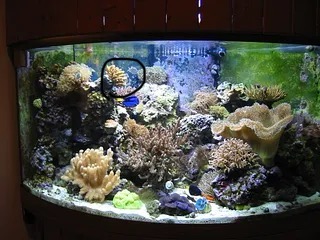
IMG_0690.jpeg


My recent tank which is smaller but very similar in terms of filters and management, however one key difference is po4 is ~ .00-.05. Stonies growth is lighting fast as compared to above. Approximately 10 months:
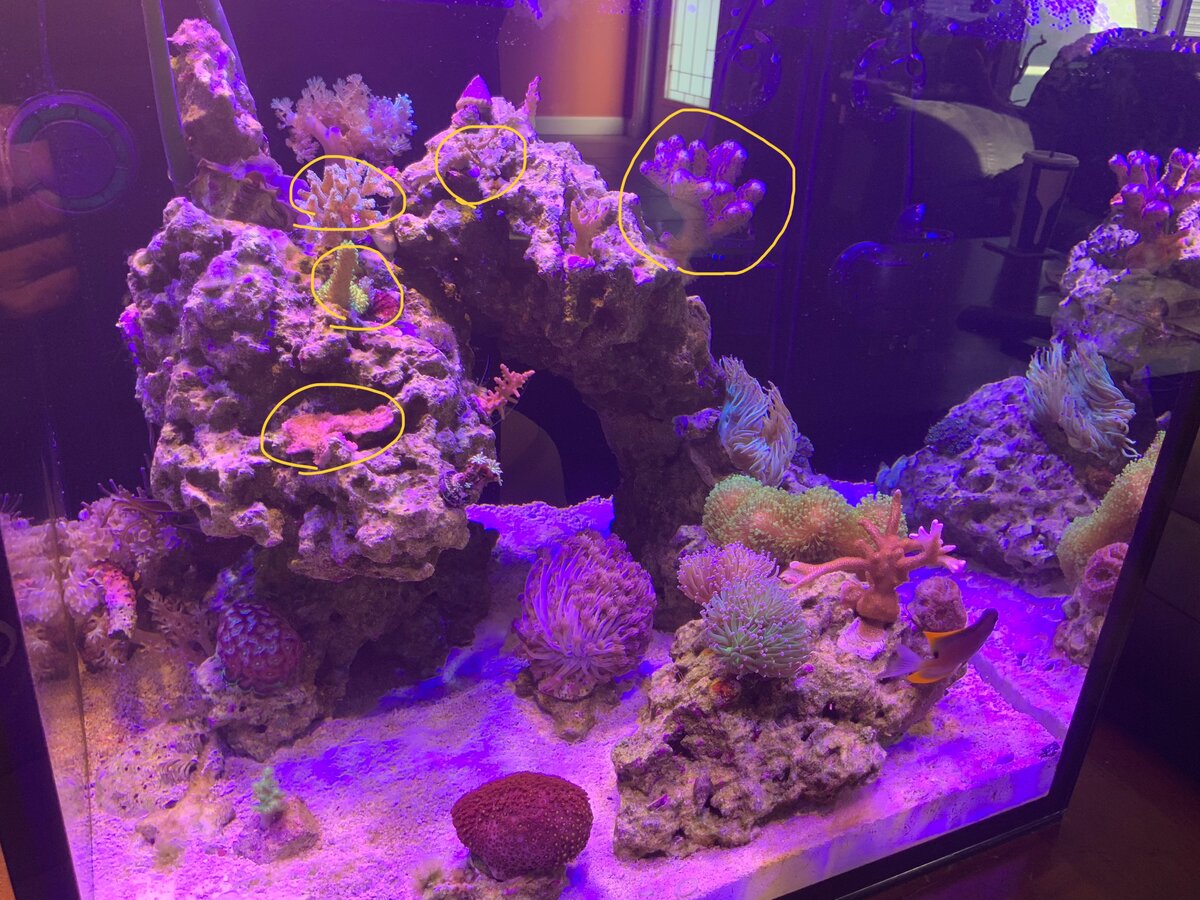
IMG_0815.jpeg

IMG_1105.jpeg

Finally my tank in the middle years from ~2009 to 2017 used all methods including carbon dosing, sulfur denitrification, refuge, giant powerful skimmer, daily AWC was more difficult than the other two with less success. I believe because I pushed nutrients, specifically po4, too low and corals suffered. However no algae problems including dinoflagellate. This tank, imo, is an example of a system with near ocean levels of inorganic nutrients that lacked particular nutrients that the ocean has in abundance because of over filtration.
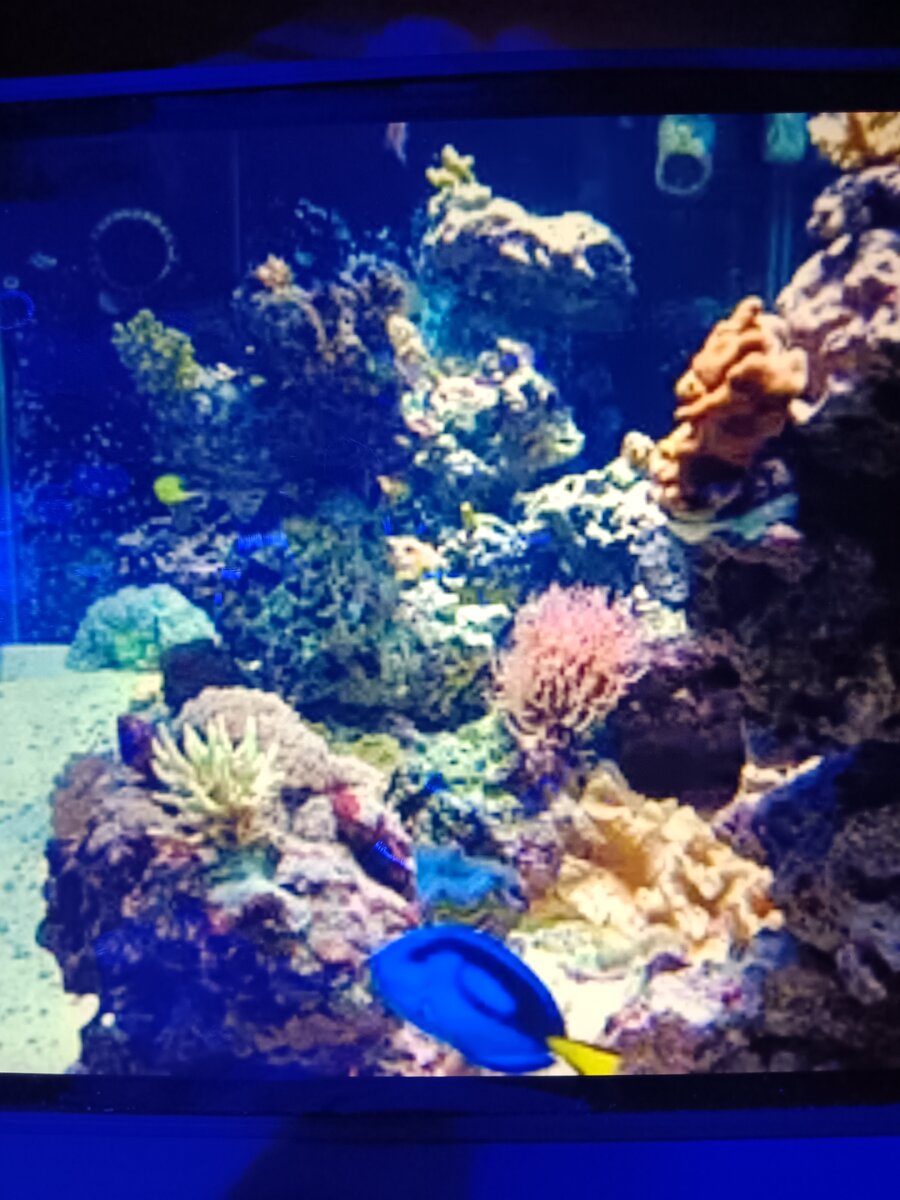
20250409_201659.jpeg

Important note is that hobby testing could not distinguish different levels of no3 because all three examples where below hobby testing resolution with Salifert. As I have never had a reef aquarium with hobby test kit measurable no3.

Looks good! Both work! I’ll see how this current grow out works out cause I’m running high on purpose and it’s going well thus far.. my corals could care less they adapt very well to anything I throw at them!
2EF0B203-6946-420C-B264-2B685C913A4C.jpeg
IMG_8169.jpeg
 

dwest

2500 Club Member
View Badges
Joined
Feb 27, 2018
Messages
4,951
Reaction score
9,537
Location
Cincinnati
Rating - 0%
0   0   0
Over the years, I’ve had all of my STN/RTN events in the summer just after many relatives stayed over for a couple of weeks. Last summer we had 5 guests over and had biggest bad event thus far. Almost certainly this is attributed to low pH caused by CO2. I am wondering if you had lots of extra people over because of the newborn. Anyway, I was going to try a new outside air system the next time I got a bunch of relatives over for a long visit.

I have been able to save most, but not all acro colonies by fragging. Once the bacteria takes over, it’s tough…

I personally would not be concerned about your nitrates, phosphates, or alkalinity.

Good luck.
 
OP
OP
BriansBrain

BriansBrain

Well-Known Member
View Badges
Joined
Jul 31, 2014
Messages
684
Reaction score
778
Location
Ohio
Rating - 0%
0   0   0
I run about the same and my acros are also going gangbuster.

I'm by far not an expert, but I like to equate running high nutrients to if you supercharge an engine without upgrading other components like valves, cam, cylinders, intake, etc. Going to end up blowing something up pretty quickly and end up destroying the engine.
My tank looked great as well with no algae. I was doing moonshiners last year and beginning of this year. I had weaned off it (for the time being) because it’s tedious and expensive. It’s apparent that you need to keep up with the lifestyle per se to keep high nutrients which I have not done.

I was walking a tightrope then the rope caught on fire lol

IMG_4037.jpeg
IMG_3615.jpeg
IMG_3618.jpeg
IMG_3321.jpeg
IMG_3225.jpeg
 

Reginald Reefer III

Coral Connoisseur
View Badges
Joined
Dec 15, 2020
Messages
2,354
Reaction score
4,153
Location
Boise, ID
Rating - 0%
0   0   0
My tank looked great as well with no algae. I was doing moonshiners last year and beginning of this year. I had weaned off it (for the time being) because it’s tedious and expensive. It’s apparent that you need to keep up with the lifestyle per se to keep high nutrients which I have not done.

I was walking a tightrope then the rope caught on fire lol

IMG_4037.jpeg
IMG_3615.jpeg
IMG_3618.jpeg
IMG_3321.jpeg
IMG_3225.jpeg
Yep gotta keep up with it! Beautiful acros! :(
 

mcarroll

10K Club member
View Badges
Joined
Jan 8, 2012
Messages
15,213
Reaction score
8,968
Location
Virginia
Rating - 0%
0   0   0
NO3 and PO4
What was going on from....maybe October thru maybe May or June? Erratic. Outside of that period, the increasing trend lines seem normal/natural...perhaps indicating your bio-load (and/or feeding regime) being slight in excess of the current system capacity (or less-likely water change rate could be higher)....depends a little on your other goals and a little bit on where the numbers would have plateaued had you not started interfering. Corals and their allies consume/recycle an ever-increasing share of dissolved nutrients the more mature they get, assuming system stability. I think your system has been more dependent on water changes than you suspected. I'm also curious to see a finer-grained set of N&P charts for the June-July time frame where you started seeing RTN....but that is when the weirdness in the charts stop and the trends from pre-October/November seems to re-establish themselves. Your numbers are not "too high" per se...and more importantly, they seem balanced, at least when you aren't messing with them. ;)

Alkalinity
The numbers seems a little all over the place if you're running a doser (can't remember if you mentioned this)....including one "bottom out" around January down to around 7 dKH. I don't remember if you mentioned the reason for this dip? Doesn't seem to mesh with adding the fish in March. Was it the GFO addition and/or the water changes you'd started? Maybe something else? Even if we ignore the little spike in January, lots of "higher end" corals get irritated with alk that varies like this – 7.0-9.2 dKH from ~Oct to ~Jan. (Even an el-cheapo doser should be able to lock in alkalinity to a very close range.) This set of swings could be your culprit, but it would help to know the story of what caused these numbers.

pH
Looks fine....pretty normal diurnal cycle...indicating strong photosynthesis action reducing dissolved-CO2 levels during the day, and buildup of CO2 from respiration during the night...though with a slight overall downward trend in avg pH. I wonder if aeration and circulation in the tank could be better? (If this is the same cirulation system the tank had when the corals were nubs, then it could be time for an overhaul.) A theoretical improvement in aeration and/or circulation would close the gap between min and max pH levels at least a bit. Better circulation and aeration are never a bad thing. :) (I'm curious to see the pH chart of the longer time frame depicted in the other charts.) I also wonder if the long term downward trend in pH indicates increasing bio-mass and maturity of the reef...and maybe a slight too-high bio-load and/or feeding rate for what the system can process? What is algae growth like in the system?

How old is this system? Any changes/additions/removals to the system in the timeframe of those charts? ...especially around/before March? (I don't want to make assumptions, but just going from the pics the tank looks too mature to be having "mystery issues" like this...almost like a new tank.)

Because it keeps coming up... "Burnt tips" is an inaccurate, subjective observation of something reefers see in their tanks but don't understand...it's not something that will ever be studied per se. Coral nutritional and biology are studied extensively though, and often explain what's happening IF you can see enough clues. In a nutshell, Low-PO4 is the coral's achilles heal....with adequate availability of PO4 (considering all sources), most other numbers are much less significant or insignificant, especially in a well-fed reef tank. Unless some of those PO4 dips in your chart are more severe than they appear (could be possible), I don't think you're experiencing this.

Check out this article (great photos!) where they look at the effect of different N and P levels on coral:
Phosphate deficiency promotes coral bleaching and is reflected by the ultrastructure of symbiotic dinoflagellates

In the low-P scenarios, you can see at all three macro/micro levels shown what the damage is that leads to necrosis......aka "burnt tips" "RTN" etc. Unless some of those PO4 dips in your chart are more severe than they appear (could be possible), I don't think you're experiencing this. (I bet you're already on-board with this, but...use livestock levels and feeding rates to control PO4 levels in the future vs using chemistry.)

At least from the thread so far, I don't feel like we've come much closer to resolving the mystery of what started this in the first place. The charts you posted were great, but raised more questions than answers. Maybe the answers to some of my questions will shed more light on things? Also, does it seem like I misssed anything?
 

mcarroll

10K Club member
View Badges
Joined
Jan 8, 2012
Messages
15,213
Reaction score
8,968
Location
Virginia
Rating - 0%
0   0   0
I was doing moonshiners last year and beginning of this year.
...that seems to overlay with the crazy numbers on the charts.....I think you put your finger on the problem. So what is "moonshiners"? (...I already know from asking the question that it's something to be avoided....but we can use the details just the same!)
 

Miami Reef

Reef Chem Enthusiast
View Badges
Joined
Sep 8, 2017
Messages
17,255
Reaction score
29,618
Location
Miami
Rating - 0%
0   0   0
...that seems to overlay with the crazy numbers on the charts.....I think you put your finger on the problem. So what is "moonshiners"? (...I already know from asking the question that it's something to be avoided....but we can use the details just the same!)
Wow. I never thought I’d see you active. Nice to meet you. 🙂
 
OP
OP
BriansBrain

BriansBrain

Well-Known Member
View Badges
Joined
Jul 31, 2014
Messages
684
Reaction score
778
Location
Ohio
Rating - 0%
0   0   0
What was going on from....maybe October thru maybe May or June? Erratic.
All of my notes:
  • October/November noticed white bugs.
  • December Interceptor treatment.
  • Mid January changed to Aquaforest salt.
  • March medium/larger sized yellow tang added.
  • Early May dosed PNS Probio to help with high N and P.
  • May-mid July I basically did nothing maintenance testing wise. Life and summer was very busy.
The numbers seems a little all over the place if you're running a doser (can't remember if you mentioned this)....including one "bottom out" around January down to around 7 dKH
These number are from me randomly manual testing. I do have a trident too. Higher alk, is from stressed coral from dealing with white bugs. The 7 is when my doser broke and I had to hand dose.
I’d have to disagree with “all over the place” numbers. Of course they can be tighter, but I feel I do a decent job keeping within 1 dkh for a year of logging.

This tank was the best running/growing I had ever had from October 2023-end of May 2025. Of course hiccups and what not happened.

improvement in aeration and/or circulation would close the gap between min and max pH levels at least a bit.
I do have 5 powerheads in a 60”x20”x20”

How old is this system? Any changes/additions/removals to the system in the timeframe of those charts?
I rebooted this tank 2 years ago. Though I had moved most of these corals in as small frags from the past setup. They all grew in.

Hopefully that answered the questions you had.
 

Troylee

all about the diy!!!!!
View Badges
Joined
Jan 15, 2010
Messages
22,206
Reaction score
23,366
Location
Vegas baby!!!!
Rating - 0%
0   0   0
...that seems to overlay with the crazy numbers on the charts.....I think you put your finger on the problem. So what is "moonshiners"? (...I already know from asking the question that it's something to be avoided....but we can use the details just the same!)
Long time no see! Welcome back.
 

kingranch2003

10K Club member
View Badges
Joined
May 4, 2024
Messages
18,515
Reaction score
131,173
Location
Mississippi Gulf Coast
Rating - 100%
1   0   0
I’ve been dealing with this rtn/stn event for over a month now. It’s so dang disappointing to watch years of hard work and passion get thrown in the garbage. Seems like every couple of days that I come home from work, another colony is pealing that had looked to be struggling.

I just don’t know if I should cut my losses and throw out the struggling colonies to maybe stop the spread if it’s bacterial or something?

All stn started from mostly burnt tips, but some have just rtn pealed away.

My culprits I can put a finger on:
  • Very low pH lows for several weeks. Lows of 7.6 to 7.55. Normally 8.3-8.1.
  • High phosphate 0.60 (Hanna ULR phosphate). My system always seemed to run high though at 0.3-0.4.
Things to note:
  1. I’ve ran an ICP and nothing negative of importance
  2. I have not noticed any rusting deteriorating equipment
  3. Alkalinity normally sits around 8-8.5 and the highest I’ve seen it spike to was 9.4 over a few days because I adjusted dosing daily down
  4. I ordered (waiting to receive) a phosphate checker standard to cross check the accuracy of the checker itself. Maybe my phosphate aren’t actually that high. I’m running GFO thinking it’s high, but it’s actually very low. Just a thought.

  5. I have no algae for being such high phosphates.
  6. Only sps affected
I have a new system currently being built and was looking forward to filling it with these corals.

IMG_4431.jpeg
IMG_4432.jpeg
IMG_4433.jpeg
IMG_4326.jpeg
IMG_4323.jpeg


The last nice picture I have of this tank 5/26/25.

IMG_3900.jpeg
This is heartbreaking to me my friend. Im not a reefer with a long history of sps experience. So I just want to remind you to stay as positive as possible and remember why you started all this. There's obviously a love in your heart for reefing. Figure this out and dont lose the fire.
 

SeaDweller

2500 Club Member
View Badges
Joined
Jul 11, 2016
Messages
3,595
Reaction score
4,908
Location
.
Rating - 0%
0   0   0
Over the years, I’ve had all of my STN/RTN events in the summer just after many relatives stayed over for a couple of weeks. Last summer we had 5 guests over and had biggest bad event thus far. Almost certainly this is attributed to low pH caused by CO2. I am wondering if you had lots of extra people over because of the newborn. Anyway, I was going to try a new outside air system the next time I got a bunch of relatives over for a long visit.

I have been able to save most, but not all acro colonies by fragging. Once the bacteria takes over, it’s tough…

I personally would not be concerned about your nitrates, phosphates, or alkalinity.

Good luck.
Any time I've had issues, it was during summer as well; I think the water municipalities are pumping in more chloramines. Because of that (what I feel) I bought and use the large chloramines filters for this reason. Sure enough... no more problems in summer for me.
 

dwest

2500 Club Member
View Badges
Joined
Feb 27, 2018
Messages
4,951
Reaction score
9,537
Location
Cincinnati
Rating - 0%
0   0   0
Any time I've had issues, it was during summer as well; I think the water municipalities are pumping in more chloramines. Because of that (what I feel) I bought and use the large chloramines filters for this reason. Sure enough... no more problems in summer for me.
Interesting. Thank you.
 

Troylee

all about the diy!!!!!
View Badges
Joined
Jan 15, 2010
Messages
22,206
Reaction score
23,366
Location
Vegas baby!!!!
Rating - 0%
0   0   0
Any time I've had issues, it was during summer as well; I think the water municipalities are pumping in more chloramines. Because of that (what I feel) I bought and use the large chloramines filters for this reason. Sure enough... no more problems in summer for me.
Interesting..
 

dwest

2500 Club Member
View Badges
Joined
Feb 27, 2018
Messages
4,951
Reaction score
9,537
Location
Cincinnati
Rating - 0%
0   0   0
Any time I've had issues, it was during summer as well; I think the water municipalities are pumping in more chloramines. Because of that (what I feel) I bought and use the large chloramines filters for this reason. Sure enough... no more problems in summer for me.
What do you use and where do you put them in your system? Also, do you use them full time now? (Sorry to derail OP)
 

SeaDweller

2500 Club Member
View Badges
Joined
Jul 11, 2016
Messages
3,595
Reaction score
4,908
Location
.
Rating - 0%
0   0   0
What do you use and where do you put them in your system? Also, do you use them full time now? (Sorry to derail OP)
i use a big blue filter with this:

it's inline right after my RODI's last carbon block. so this is sandwiched between the last carbon block and the RO membranes. I change it out annually. My first real bad crash was a few years ago when I was losing colonies, and then fall/winter things bounced back. come next year approx. same time, same thing. I read my water report and i distinctly remember reading more chloramines where being used.
 
OP
OP
BriansBrain

BriansBrain

Well-Known Member
View Badges
Joined
Jul 31, 2014
Messages
684
Reaction score
778
Location
Ohio
Rating - 0%
0   0   0
Any time I've had issues, it was during summer as well; I think the water municipalities are pumping in more chloramines. Because of that (what I feel) I bought and use the large chloramines filters for this reason. Sure enough... no more problems in summer for me.
so my very first inclination was this. I posted on a local reefing Facebook group if anyone else was seeing issues in July. I tried to inquire about chloromines usage from my local municipality but I’d have a better luck getting an answer from a brick wall lol

I changed out ro filters and di because I was blowing through di resin but probably because my filters needed changed anyway.

totally a great idea to use more robust chloromine carbon blocks during the late spring through early fall. At least change the current blocks beginning and during summer.
 
OP
OP
BriansBrain

BriansBrain

Well-Known Member
View Badges
Joined
Jul 31, 2014
Messages
684
Reaction score
778
Location
Ohio
Rating - 0%
0   0   0
I do know municipalities that use chloromines for regular line disinfection do conduct periodic flushes with free chlorine.

I did have and use chlorine test strips from my pool and did not get a reading.
 

mcarroll

10K Club member
View Badges
Joined
Jan 8, 2012
Messages
15,213
Reaction score
8,968
Location
Virginia
Rating - 0%
0   0   0
Wow. I never thought I’d see you active. Nice to meet you. 🙂
Greetings!

All of my notes:
  • October/November noticed white bugs.
  • December Interceptor treatment.
  • Mid January changed to Aquaforest salt.
  • March medium/larger sized yellow tang added.
  • Early May dosed PNS Probio to help with high N and P.
  • May-mid July I basically did nothing maintenance testing wise. Life and summer was very busy.
Well, that explains the charts going a little crazy through that period....wow. Just a confluence of things that added up to too much stress.

These number are from me randomly manual testing. I do have a trident too. Higher alk, is from stressed coral from dealing with white bugs. The 7 is when my doser broke and I had to hand dose.
That's tough....probably very little you could have done differently.

I’d have to disagree with “all over the place” numbers. Of course they can be tighter, but I feel I do a decent job keeping within 1 dkh for a year of logging.
You obviously had been doing a killer job on that tank – no question there! :)

But through that one period of time I singled out (or at least meant to) that was a lot of up and down for the corals in question. For a tank full of super-hardy corals, no biggie. But "higher end" corals are pretty sensitive to shifts like that. (Your overall trend for alk is nice and sable though – I don't disagree with you on that!)

This tank was the best running/growing I had ever had from October 2023-end of May 2025. Of course hiccups and what not happened.
It's just the odds of things....eventually "something" is going to happen. The price we pay for having a successful reef with a long life. ;) But seriously....it's part of the experience....we just hope it's not too bad when it happens....whatever "it" is.

I do have 5 powerheads in a 60”x20”x20”
Well, "good flow" is entirely subjective to the corals. So number of pumps and even GPH are not necessarily good indicators of what they are experiencing. YOU would definitely know better than I though...I'm just giving all the likelihood's I can think of. (Corlas *do* outgrow their flow...pumps wear and slow. Yours may/may not have done so.)

I rebooted this tank 2 years ago. Though I had moved most of these corals in as small frags from the past setup. They all grew in.

Hopefully that answered the questions you had.
So it was still recovering from the transplant when all this "fun" started.

Do you know where the "bugs" came from? (From pre-reboot?) Whatever the source, I might be inclined to point to that as "the root problem".

I do know municipalities that use chloromines for regular line disinfection do conduct periodic flushes with free chlorine.

I did have and use chlorine test strips from my pool and did not get a reading.
For what it's worth, unless you're pretty close to the treatment plant (where the Cl is added), this should never be an issue. (If you are close, it should be a *regular* issue.)
 

TOP 10 Trending Threads

WHAT AMOUNT OF LIVE ROCK AND SAND SHOULD BE PRIORITIZED FOR OPTIMAL BIODIVERSITY/FILTRATION?

  • 100% live rock + bagged sand

    Votes: 38 27.0%
  • 100% dry rock + 100% live sand

    Votes: 47 33.3%
  • 50/50 live/dry rock, 50/50 live/bagged sand

    Votes: 32 22.7%
  • 75% live rock, 25% live sand

    Votes: 14 9.9%
  • 25% live rock, 75% live sand

    Votes: 10 7.1%
Back
Top